
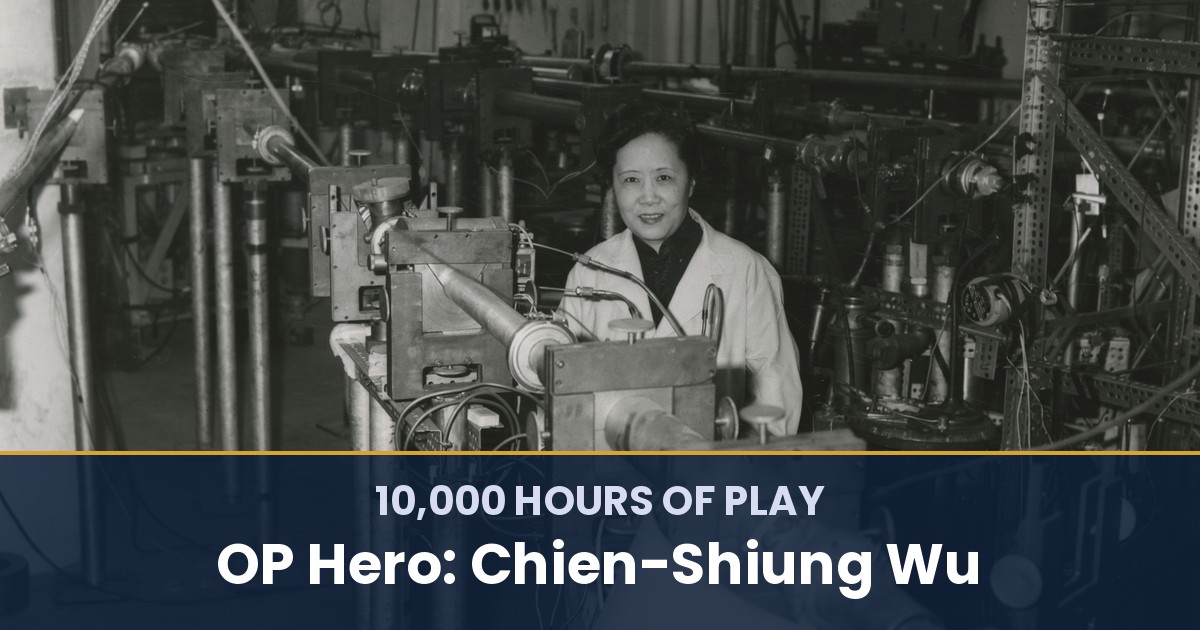


Between Christmas 1956 and New Year’s Day 1957, in a laboratory at the National Bureau of Standards in Washington, a small team cooled cobalt-60 nuclei to near absolute zero and lined up their spins with a magnetic field. Then they counted which way the electrons came out.
The electrons did not come out evenly, because more went one way than the other, which meant that parity conservation, a symmetry principle physicists had treated as a law of nature, fails in the weak interaction.
The experiment was designed by Chien-Shiung Wu of Columbia University. The theory it confirmed belonged to Tsung-Dao Lee and Chen Ning Yang, who received the 1957 Nobel Prize in Physics for it, and Wu was not included.
Her career makes a clear case study for the 10K HP framework, because nearly every chapter of it comes back to one craft: building a measurement precise enough that nature has to give a straight answer. The six Steps below follow that craft from her father’s school in Liuhe to the first Wolf Prize in Physics.
⚡ Speed Run Notes
- Wu’s Game ran for her whole career: build a measurement precise enough to show where an accepted law of physics holds and where it breaks.
- Her Attributes showed early: she finished top of her physics class in 1934, then kept choosing experiments that demanded cryogenics, radioactive sources and tight control of error.
- Her Roles ran from Berkeley PhD to Manhattan Project physicist, Columbia lab builder, parity experiment leader and the first woman president of the American Physical Society.
- Her canon Skills: Elemental Transposition (Mage), True Sight (Ranger), Summon (Druid), Revive (Paladin) and Floral Blossom (Druid).
- Her Allies included Ernest Lawrence at Berkeley, Tsung-Dao Lee and Chen Ning Yang, and Ernest Ambler’s low-temperature group at the National Bureau of Standards.
Table of Contents
About Yu-kai Chou

Yu-kai Chou is the author of 10,000 Hours of Play — the book that treats your life as the most important game you’ll ever build a character in, and gives you the 6-Step framework (Game · Attributes · Role · Skills · Allies · Quests) to play it on purpose. He has spent two decades developing the system through which this post analyzes its OP Hero, and applies it to his own life and to the lives of the people he advises around the world.
Chou’s other framework, the Octalysis Framework, has been applied by LEGO, Microsoft, Porsche, Coca-Cola, Salesforce, and MrBeast, impacting over 1.5 Billion Users. He has taught the methodology at Harvard, Stanford, Yale, Tesla, Google, BCG, and IDEO, and has advised governments in eight nations including Ukraine, the United Kingdom, the Kingdom of Bahrain, Singapore, Taiwan, the Netherlands, Kazakhstan, and South Korea.
His work has been cited by Harvard, Stanford, MIT, Forbes, Wall Street Journal, Wired, US Department of Energy, NIST, NSF, NCBI, US Department of Education, ClinicalTrials.gov, and Google Scholar — with 3,700+ more academic publications. Explore his books here.
Chien-Shiung Wu belongs in this series because her best-known result answered a question that someone else had asked. If I could lift one move from her character sheet, it would be the way she turned Lee and Yang’s theoretical doubt about parity into a cobalt-60 experiment that could settle it within about six months.
Step 1: The Game — What Chien-Shiung Wu Was Actually Playing
Wu’s Game is simple to state and hard to play: ask nature a precise question, then build an apparatus sensitive enough to hear the answer.
She played it in nuclear physics, mostly in the radioactive decay of nuclei, from her Berkeley years in the late 1930s through her long career at Columbia.
Her measurements kept landing where theory was in doubt. In the late 1940s and 1950s her beta decay experiments gave the first convincing experimental confirmation of Enrico Fermi’s theory of beta decay, which earlier results had seemed to contradict.
In 1949 she and Irving Shaknov measured the polarization correlation of the two photons released when positronium annihilates, a result now read as early experimental evidence of quantum entanglement.
Then, in 1956 and 1957, her cobalt-60 experiment showed that the weak interaction can tell left from right.
The second layer of her Game was the one she had to play just to keep her seat at the table. She was a Chinese woman working in American physics from 1936 onward, and several of her titles carry the word “first.”
She was Princeton’s first woman physics instructor, the first woman president of the American Physical Society in 1975, and the first recipient of the Wolf Prize in Physics in 1978.
A Game this clear gives a player a test for every decision, because each choice either sharpens the measurement or blurs it.
Step 2: Attributes — The Innate Stats
Attributes are the stats a player brings before any training. Four of Wu’s are visible in the record.
The first is an early drive toward science. She was born in 1912 in Liuhe, in Jiangsu province, and attended a school for girls founded by her father, Wu Zhongyi, a participant in the 1911 Revolution who backed modern education for girls.
She went on to National Central University and graduated at the top of her class in physics in 1934, at a time when advanced scientific training for Chinese women was uncommon.
The second is tenacity with difficult apparatus. Her major experiments demanded radioactive sources, cryogenic temperatures and painstaking control of error, and she kept choosing that kind of work for decades.
The third is sensitivity to experimental detail, the habit of asking whether an odd result comes from nature or from the instrument. In the late 1940s that habit helped her show that an apparent conflict with Fermi’s theory of beta decay came from earlier experiments, a story Step 4 picks up as a Skill.
The fourth is intellectual independence: parity conservation was the established assumption in 1956, and Wu was willing to treat it as a hypothesis that deserved a direct test.
The OP Talent Triangle Method is built to surface your Edge Strength, the strength that feels so normal you stop noticing it. Wu’s looks like patience with error, which shows in the roughly six months of work that the parity experiment took before it produced a decisive result.
Step 3: Role(s) — The Character Class Across Chapters
Wu’s Role changed at least six times, and each chapter put the same measuring skill in a bigger room.
Her first class was the scholar-apprentice in China, from her father’s school through her 1934 physics degree at National Central University.
In 1936 she sailed to the United States and entered the University of California, Berkeley. Under Ernest Lawrence she trained as a nuclear physics experimentalist, and her doctoral work on radioactive xenon earned her a PhD in 1940.
From 1940 to 1944 she played the teacher, first at Smith College and then at Princeton, where she was the first woman to serve as a physics instructor.
In 1944 she joined Columbia University and the Manhattan Project, working in the Substitute Alloy Materials Laboratories on sensitive radiation detectors for the uranium enrichment effort.
After the war she became the Columbia lab builder. Her beta decay program gave her the sources, detectors and experience that any serious test of the weak interaction would need.
In 1956 she took the raid-leader class for the parity experiment. Her later chapters brought the senior titles: full professor at Columbia in 1958, Michael I. Pupin Professor of Physics in 1973, and president of the American Physical Society in 1975.
Step 4: Skills — The Real-Life Game Skills Chien-Shiung Wu Mastered
Attributes are the starting stats, and Skills are what a player trains. Five canon Skills explain most of Wu’s run.
The first is Elemental Transposition (Mage): reframing a problem as a puzzle with a solution. Lee and Yang’s 1956 proposal asked whether parity holds in weak interactions, and as they posed it the question was theoretical.
Wu turned it into a concrete experimental puzzle. She chose cobalt-60, lined up the spins of its nuclei near absolute zero, and compared how many beta particles left in each of the two opposite directions.
The second is True Sight (Ranger): observing details that other people miss. In the late 1940s, earlier measurements of the beta spectrum seemed to contradict Fermi’s theory, which raised the question of whether the theory itself was wrong.
Wu’s more careful measurements showed that much of the discrepancy came from the earlier experiments, and Fermi’s theory held up.
The third is Summon (Druid): asking an Ally to come help with the current Quest. Her parity test needed nuclear polarization at very low temperature, a specialty of Ernest Ambler’s group at the National Bureau of Standards.
On June 4, 1956, she contacted Ambler, and the collaboration that followed also included Ralph Hudson, Raymond Hayward and Dale Hoppes.
The fourth is Revive (Paladin): recovering from a setback and taking new action toward the next Quest. After the 1957 Nobel Prize went to Lee and Yang alone, Wu kept testing the weak interaction, and in 1963 her Columbia group confirmed the conserved vector current hypothesis.
The fifth is Floral Blossom (Druid): educating and mentoring others. Wu taught at Smith, Princeton and Columbia, and in 1966 she and Steven Moszkowski published Beta Decay, a standard reference on the field.
On the Skills Spectrum, Wu sits on the Master track: one primary craft, precision measurement, with the other four Skills feeding it.
Step 5: Allies — The People Who Multiplied Chien-Shiung Wu
Wu’s Allies came in two kinds: people who opened doors for her, and people who brought her questions worth measuring.
Her father, Wu Zhongyi, was the first. He founded the school she attended and supported her education when few families in China did the same for their daughters.
Ernest Lawrence was the second Ally, and he supervised her doctoral work at Berkeley on radioactive xenon, which gave her a grounding in fission products that mattered during the war.
Luke Chia-Liu Yuan, a physicist she married in 1942, was a partner from inside her own field.
Tsung-Dao Lee and Chen Ning Yang brought the question. Their 1956 proposal that parity might fail in weak interactions gave Wu the most important experimental target of her career.
Ernest Ambler and his colleagues at the National Bureau of Standards were the Allies who supplied the low-temperature skill. Without nuclei held near absolute zero, the asymmetry could not have been measured.
Later Allies were her Columbia collaborators: Irving Shaknov worked with her on the 1949 photon experiment, and Y.K. Lee and L.W. Mo worked with her on the 1963 conserved vector current result.
Step 6: Quests — The Milestones That Shaped the Saga
Wu’s six Quests run in order from her arrival in California to her last major honors.
Quest 1 was the Berkeley doctorate, from 1936 to 1940. She arrived in 1936 and finished her PhD in physics in 1940 with work on radioactive xenon.
Quest 2 was the wartime Quest of 1944. She joined Columbia and the Manhattan Project that year, and when the Hanford B Reactor shut down unexpectedly soon after it began operating, the cause turned out to be xenon-135 poisoning, a problem her research on fission products helped explain.
Quest 3 was settling beta decay in the late 1940s and 1950s. Her measurements gave convincing experimental support to Fermi’s theory after years of conflicting results.
Quest 4 was the parity experiment of 1956 and 1957. About six months of work produced decisive results between Christmas 1956 and New Year’s Day 1957, and the paper appeared in Physical Review in February 1957.
Quest 5 was the setback Quest, because the 1957 Nobel Prize in Physics went to Lee and Yang for the theory, and the experiment that confirmed it was left out of the award.
Wu answered the setback with more work in the lab. Columbia made her a full professor in 1958, Princeton awarded her an honorary doctorate that year, and in 1963 her group confirmed the conserved vector current hypothesis.
Quest 6 was recognition, from 1975 to 1978. In 1975 she became the first woman president of the American Physical Society, she was awarded the 1975 National Medal of Science, and in 1978 she became the first recipient of the Wolf Prize in Physics.
She died in New York City on February 16, 1997. In 2021 the United States Postal Service issued a Forever stamp in her honor.
What You Can Steal From Chien-Shiung Wu’s Build
First, when a result clashes with a good theory, audit your own method before you blame the theory. Wu’s beta spectrum work traced the conflict with Fermi’s theory to the earlier experiments, and the theory survived.
Second, recruit partners for the specific gap in your build. Wu knew beta decay, and she went to the National Bureau of Standards for the cryogenics her own lab lacked.
Third, expect the scoreboard to lag behind the work. The 1957 Nobel went elsewhere, and her major recognition arrived over the next two decades, through the Wolf Prize in 1978.
Where this framework comes from

Want the full system this profile is built on?
Every OP Hero piece runs through the same 6-Step framework from 10,000 Hours of Play: Unlock Your Real-Life Legendary Success. The book covers the full system, walks through Yu-kai’s own life run as the first applied case study, and gives you the worksheets to audit your own build.
Related Reading
- All OP Hero Profiles — the full hub
- 10,000 Hours of Play by OP Hero: Barbara McClintock
- 10,000 Hours of Play by OP Hero: Rosalind Franklin
- 10,000 Hours of Play by OP Hero: Tu Youyou
- 10,000 Hours of Play by OP Hero: Richard Feynman