
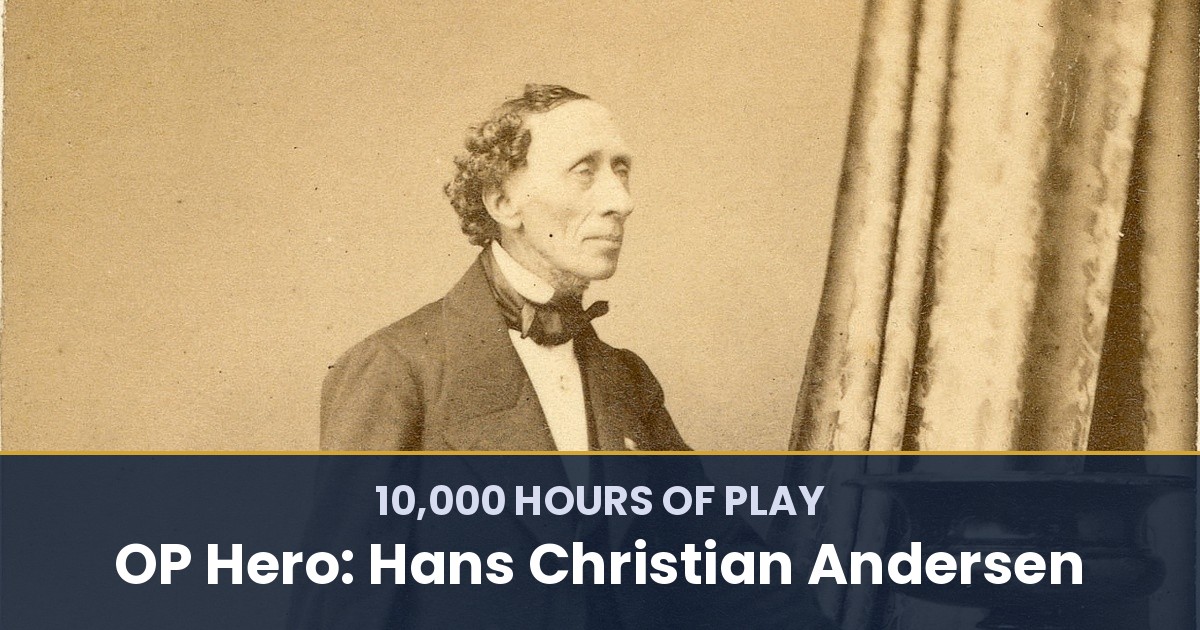


On 4 September 1819, a fourteen-year-old shoemaker’s son left Odense for Copenhagen with a plan to make his name at the Royal Theatre.
He carried a letter of recommendation to the solo dancer Anne Margrethe Schall, performed a dance for her in her own home, and was shown the door.
Three years later the stage career was finished. He had tried to make it as a singer, a dancer and an actor, his boy-soprano voice had changed, and the plays he submitted had been rejected.
On 8 May 1835 the same young man published a thin booklet of four tales that sold for 24 skilling. Hans Christian Andersen went on to write roughly 156 tales and stories, and his work has been translated into more than 125 languages.
What happened between 1822 and 1835 explains most of what came after, and the six Steps below follow his run from the Odense workshop to the day in 1867 when his hometown made him an honorary citizen.
⚡ Speed Run Notes
- Andersen’s Game was recognition as an artist, and he kept changing forms (stage, poetry, plays, novels, travel books, tales) until one of them carried him there.
- His first build failed: from 1819 to 1822 he tried to become a singer, dancer and actor in Copenhagen, and the Royal Theatre’s management sent him to school instead.
- The tales he began publishing in 1835 used a spoken, conversational voice that early critics disliked, and from 1860 he read them aloud in regular public readings in Copenhagen.
- His canon Skills: Power Leap (Warrior), Revive (Paladin), Clairvoyance (Mage), Loremaster (Druid) and Thunder Clap (Paladin).
- His Allies included Jonas Collin of the Royal Theatre, the royal grants behind his schooling and travel, Henriette Wulff, H.C. Ørsted and, later, Charles Dickens.
Table of Contents
About Yu-kai Chou

Yu-kai Chou is the author of 10,000 Hours of Play — the book that treats your life as the most important game you’ll ever build a character in, and gives you the 6-Step framework (Game · Attributes · Role · Skills · Allies · Quests) to play it on purpose. He has spent two decades developing the system through which this post analyzes its OP Hero, and applies it to his own life and to the lives of the people he advises around the world.
Chou’s other framework, the Octalysis Framework, has been applied by LEGO, Microsoft, Porsche, Coca-Cola, Salesforce, and MrBeast, impacting over 1.5 Billion Users. He has taught the methodology at Harvard, Stanford, Yale, Tesla, Google, BCG, and IDEO, and has advised governments in eight nations including Ukraine, the United Kingdom, the Kingdom of Bahrain, Singapore, Taiwan, the Netherlands, Kazakhstan, and South Korea.
His work has been cited by Harvard, Stanford, MIT, Forbes, Wall Street Journal, Wired, US Department of Energy, NIST, NSF, NCBI, US Department of Education, ClinicalTrials.gov, and Google Scholar — with 3,700+ more academic publications. Explore his books here.
Hans Christian Andersen belongs in this series because he left a written record of almost his entire run, with diaries covering 1825 to 1875. If I could lift one move from his character sheet, it would be the way he turned 29 journeys abroad into material, starting with the Italian trip that became The Improvisatore.
Step 1: The Game — What Hans Christian Andersen Was Actually Playing
Andersen’s Game was to be recognized as an artist and to win a place in the cultivated society that his childhood in Odense had kept him outside of.
He played it for more than fifty years and changed forms whenever one stopped working: the stage, poetry, drama, novels, travel writing and, from 1835, the literary fairy tale.
He also kept a written record of how the Game was going. His diaries cover the years 1825 to 1875, and he told his own life story several times, beginning with Levnedsbogen in 1832.
The best-known version, The Fairy Tale of My Life, was written in 1855 and updated through 1867, and its title shows how he read his own run: a poor boy who becomes famous, told in the shape of one of his tales.
Read that way, the Game had a clear finish line, and Odense supplied it on 6 December 1867 by making him an honorary citizen of the town he had left at fourteen.
Step 2: Attributes — The Innate Stats
Attributes are the stats a player brings before any training. Four of Andersen’s are visible in the early record.
The first is a strong pull toward performance. He wanted the stage badly enough to leave home for it at fourteen, before he had any training as a singer, dancer or actor.
The second is a high tolerance for risk under insecurity. He reached Copenhagen in September 1819 with little money, no profession and no family connection to the theatre world he was trying to enter.
The third is sharp sensitivity to rank and exclusion. His father, Hans Andersen, was a shoemaker who died in 1816, and his mother, Anne Marie Andersdatter, worked as a washerwoman.
His autobiographies return again and again to the climb from that starting point into patronage and polite society, and that awareness of who was inside and who was outside runs through his fiction.
The fourth Attribute is persistence after rejection, and it shows in how he handled each closed door. When one form failed him, he moved to the next one and kept writing.
The OP Talent Triangle Method looks for the strength that feels so normal its owner stops noticing it. Andersen’s looks like the habit of turning his own humiliations into material, which is why readers so often take The Ugly Duckling as a version of his own rise.
Step 3: Role(s) — The Character Class Across Chapters
Andersen changed his Role at least six times, and each new class reused something from the one before.
From 1805 to 1819 he was the Odense dreamer, the son of a shoemaker and a washerwoman, with limited schooling and a strong attraction to the theatre.
From 1819 to 1822 he was the aspiring performer in Copenhagen, trying singing, dancing and acting, including a spell at the Royal Theatre’s ballet school.
From 1822 to 1828 he was the sponsored student. With royal support, he attended the grammar school in Slagelse, boarded from 1825 with the headmaster Simon Meisling, continued his schooling in Elsinore and passed the university entrance examination in 1828.
From 1829 he was the poet, dramatist and travel writer. His first literary success, A Walking Tour from Holmen’s Canal to the Eastern Point of Amager, came out that year at his own expense and brought him public attention.
In 1835 he became the novelist and the tale-maker at almost the same moment. The Improvisatore appeared in April, and his first booklet of tales followed on 8 May.
From the 1840s until his death in 1875 he played the celebrity author, a guest in homes across Europe and a reader of his own tales to large audiences in Copenhagen.
The tale-maker who came last drew most visibly on the travel writer, since the Italian journey produced The Improvisatore in the same spring that the first tales appeared.
Step 4: Skills — The Real-Life Game Skills Hans Christian Andersen Mastered
Attributes are the starting stats, and Skills are what a player trains. Five canon Skills explain most of Andersen’s run.
The first is Power Leap (Warrior): travelling to someone unannounced to make the meeting happen. In September 1819 the fourteen-year-old took his letter to Anne Margrethe Schall’s home and danced for her on the spot, and she had him shown out.
After that rejection he kept knocking on doors in Copenhagen. He was introduced to the singer Giuseppe Siboni at a gathering where the composer C.E.F. Weyse was also present, Siboni promised him singing lessons and meals, and Weyse collected money to support him.
The second is Revive (Paladin): recovering from failure and taking new action toward the next Quest. By 1822 the performer build was over, and he accepted the schooling that the theatre management arranged for him.
He spent the next six years catching up on the education his childhood had skipped, and the year after his entrance examination he published his first success.
The third is Clairvoyance (Mage): exploring the world for knowledge. A royal travel grant in 1833 took him through Germany, France, Switzerland and Italy, and his time in Italy fed directly into The Improvisatore.
He made 29 journeys abroad in his lifetime and spent more than nine years in total outside Denmark.
The fourth is Loremaster (Druid): weaving compelling stories. His tales were written in a conversational, spoken register, with direct address, repetition and colloquial rhythm, and some early critics objected to exactly that informality.
He kept the spoken voice despite the criticism. On 11 November 1843 he published The Nightingale and The Ugly Duckling under a new series title, Nye Eventyr (New Tales), which dropped the words “told for children” from the cover.
The fifth is Thunder Clap (Paladin): public speaking that charges up a room. From 1860 he gave regular readings of his tales at the newly founded Workers’ Association in Copenhagen, where he read every winter.
He also cut paper while telling stories aloud and unfolded the finished design at the end, which turned a tale into a small live performance.
On the Skills Spectrum, Andersen spent 1819 to 1835 as a Dabbler, trying the stage, poems, plays, a novel and travel books, and he finished on the Master track with one primary craft that the other four Skills fed.
Step 5: Allies — The People Who Multiplied Hans Christian Andersen
Andersen arrived in Copenhagen with almost nothing, so his Allies did more of the early lifting than they would for most players.
Jonas Collin was the first and most consequential. As a director and financial manager of the Royal Theatre, he became the teenager’s guardian in 1822 and helped arrange the education that the stage could not give him.
The Collin household became his home base in the city. His friendship with the son, Edvard Collin, also showed its limits: in 1831 Andersen asked Edvard to use the familiar Danish “du,” and Edvard kept to the formal form.
The Danish crown was the second Ally. King Frederik VI authorized the support that put him in school in 1822, a royal grant paid for the 1833 journey, and from 1838 the state gave him a tax-free annual stipend of 400 rigsdaler.
Henriette Wulff was a lifelong friend and correspondent. In a letter to her in 1835, Andersen reported that the physicist H.C. Ørsted had told him The Improvisatore would make him famous and the fairy tales would make him immortal.
The writer B.S. Ingemann encouraged him in his formative years. The Allies who matter most are often the ones who can open a door you cannot, and Collin, Ingemann and the crown opened the doors of school, letters and money.
Abroad, his best-known Ally was Charles Dickens. They met in London in 1847, and ten years later Andersen stayed about five weeks at Dickens’s home at Gad’s Hill, a visit the Dickens family found far too long.
The last Allies were the Melchior family, who looked after him in his final years at their villa Rolighed near Copenhagen, where he died on 4 August 1875.
Step 6: Quests — The Milestones That Shaped the Saga
Andersen’s six Quests run in order from the road out of Odense to the honours at the end of his life.
Quest 1 was the escape from Odense: in September 1819 he left for Copenhagen, aged fourteen, aiming at the Royal Theatre.
Quest 2 was the setback at the Royal Theatre. From 1819 to 1822 he tried singing, dancing and acting, his voice changed, his plays were turned down, and the theatre’s management sent him to school.
Quest 3 was the education, from 1822 to 1828, in Slagelse and Elsinore, ending with the university entrance examination in 1828 and the self-published Walking Tour in 1829.
Quest 4 was the grand tour of 1833 and 1834. The royal travel grant took him to Rome, and The Improvisatore came out of it in April 1835 as a success in Denmark and in Germany.
Quest 5 was the tales, which began with the booklet of 8 May 1835: The Tinderbox, Little Claus and Big Claus, The Princess and the Pea, and Little Ida’s Flowers.
The early reviews were mixed, and the setbacks kept coming. In 1838 Søren Kierkegaard published a severe critique of his novel Only a Fiddler, and in 1840 his play The Mulatto succeeded while The Moorish Girl failed.
The tales kept growing anyway, with The Little Mermaid and The Emperor’s New Clothes in 1837, The Nightingale and The Ugly Duckling in 1843, and The Snow Queen in 1844.
Quest 6 was recognition at home and abroad. On 6 December 1867 Odense made him an honorary citizen, and since 1956 the International Board on Books for Young People has given a Hans Christian Andersen Award to children’s authors, with International Children’s Book Day held each year on his birthday, 2 April.
What You Can Steal From Hans Christian Andersen’s Build
First, treat a failed build as a parts bin. Andersen’s stage career ended in 1822, and his taste for performing came back in the spoken style of the tales from 1835 and in the public readings from 1860.
Second, show up in person and let the answer come from the room. The visit to Anne Margrethe Schall failed, the introduction to Giuseppe Siboni worked, and he only got the second result because he kept making visits after the first.
Third, give the scoreboard time to catch up with the work. His first tales drew mixed reviews in 1835, and the honorary citizenship from Odense arrived in 1867, thirty-two years later.
Where this framework comes from

Want the full system this profile is built on?
Every OP Hero piece runs through the same 6-Step framework from 10,000 Hours of Play: Unlock Your Real-Life Legendary Success. The book covers the full system, walks through Yu-kai’s own life run as the first applied case study, and gives you the worksheets to audit your own build.
Related Reading
- All OP Hero Profiles — the full hub
- 10,000 Hours of Play by OP Hero: Mark Twain
- 10,000 Hours of Play by OP Hero: Jim Henson
- 10,000 Hours of Play by OP Hero: J.K. Rowling
- 10,000 Hours of Play by OP Hero: Gabriel García Márquez