
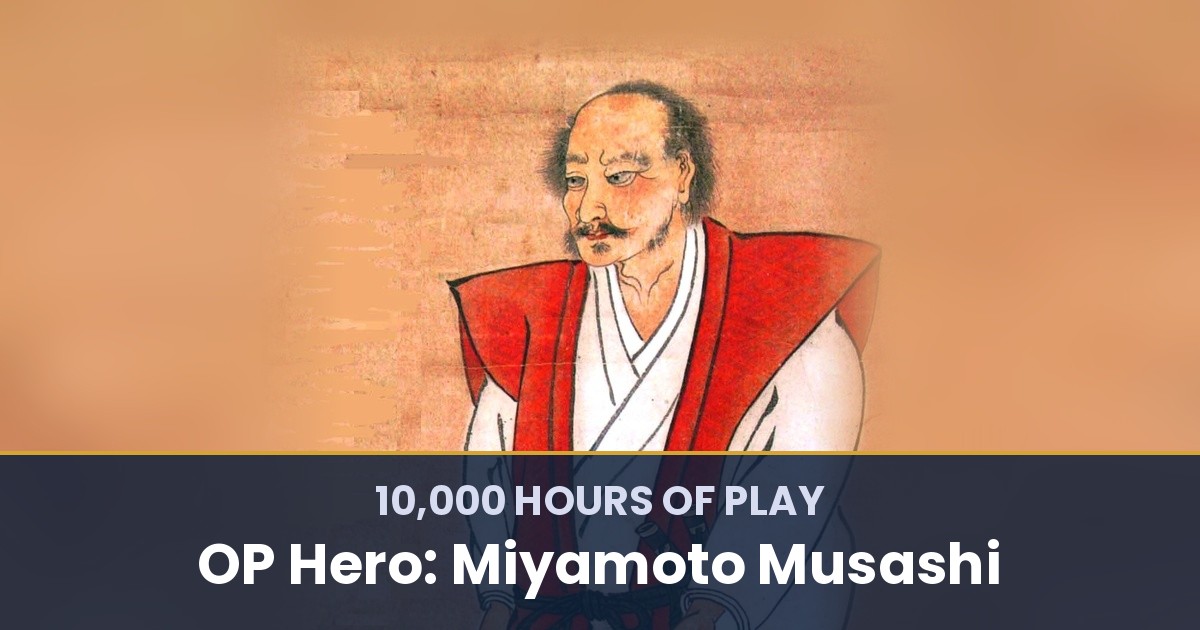


In the tenth month of 1643, a swordsman who described himself as sixty years old withdrew to Reigandō, a cave in the hills near Kumamoto, and began writing down the one thing he had studied all his life.
The swordsman was Miyamoto Musashi, and by his own account he had fought his first duel at thirteen and won more than sixty contests before he turned twenty-nine.
He finished the book, Go Rin no Sho (The Book of Five Rings), in 1645, the year he died in Kumamoto.
Its five scrolls are named Earth, Water, Fire, Wind and Void, and one line in the Water scroll could serve as the motto for this whole series: the practice of a thousand days is called forging, and the practice of ten thousand days is called polishing.
The six Steps below follow his run from teenage duelist to the honored guest of a Kumamoto lord who painted, taught and wrote. Along the way they keep a clear line between what Musashi wrote himself, what his adopted son carved in stone, and what later storytellers added.
⚡ Speed Run Notes
- Musashi’s Game was strategy itself: principles of timing, distance and perception that held in a single duel and in larger conflicts.
- He played it across six Roles: wandering duelist, soldier, school founder, guest of great houses, ink painter and author.
- His canon Skills: True Sight (Ranger), Ninja Focus (Rogue), Guardian Restraint (Paladin), Lich Grind (Warlock) and Floral Blossom (Druid).
- His Allies were patrons and heirs: the Hosokawa lord who brought him to Kumamoto, a student who received his book, and an adopted son who carved his record in stone.
- Much of the famous legend, including the wooden sword carved from an oar at Ganryūjima, comes from accounts written long after his death, and this profile marks where that happens.
Table of Contents
About Yu-kai Chou

Yu-kai Chou is the author of 10,000 Hours of Play — the book that treats your life as the most important game you’ll ever build a character in, and gives you the 6-Step framework (Game · Attributes · Role · Skills · Allies · Quests) to play it on purpose. He has spent two decades developing the system through which this post analyzes its OP Hero, and applies it to his own life and to the lives of the people he advises around the world.
Chou’s other framework, the Octalysis Framework, has been applied by LEGO, Microsoft, Porsche, Coca-Cola, Salesforce, and MrBeast, impacting over 1.5 Billion Users. He has taught the methodology at Harvard, Stanford, Yale, Tesla, Google, BCG, and IDEO, and has advised governments in eight nations including Ukraine, the United Kingdom, the Kingdom of Bahrain, Singapore, Taiwan, the Netherlands, Kazakhstan, and South Korea.
His work has been cited by Harvard, Stanford, MIT, Forbes, Wall Street Journal, Wired, US Department of Energy, NIST, NSF, NCBI, US Department of Education, ClinicalTrials.gov, and Google Scholar — with 3,700+ more academic publications. Explore his books here.

Miyamoto Musashi belongs in this series because he is one of the few legendary players who left behind his own strategy guide. If I could lift one move from his character sheet, it would be what he did at thirty: he looked at an unbeaten record, decided it did not yet prove he understood strategy, and went back to training for another two decades.
Step 1: The Game — What Miyamoto Musashi Was Actually Playing
Step 1 of the 10K HP framework asks what Game a player is actually playing across a lifetime. Musashi’s Game was the Way of strategy, which he called heihō.
In the preface to Go Rin no Sho he says he set his heart on it from his youth.
Winning duels was the visible scoreboard of that Game, and the objective he describes goes deeper: to understand the principles behind winning so well that they would hold in any situation.
He believed those principles applied at every scale. One standard translation of the Earth scroll gives his rule as “from one thing, know ten thousand things.”
That is why the book covers far more than sword grips. It returns again and again to timing, rhythm, distance, posture, initiative, terrain and the state of the opponent’s mind.
At the end of the Earth scroll he lists nine principles for anyone who wants to learn his strategy. In a common translation the second reads “the Way is in training,” and the ninth reads “do nothing which is of no use.”
His own timeline shows how long the Game took. He says he won more than sixty contests by the age of twenty-eight or twenty-nine, and that only at about fifty did he come to understand the Way of strategy.
Step 2: Attributes — The Innate Stats
Attributes are the stats a player brings before any training. For Musashi the evidence on his childhood is thin and the evidence on his behavior is rich, so treat what follows as a reading of his conduct.
His birth year is usually given as 1584, although 1582 also appears, and both Harima and Mimasaka are claimed as his home province. In Go Rin no Sho he names himself Shinmen Musashi no Kami Fujiwara no Genshin.
The first attribute is an unusual tolerance for risk. He says he fought his first duel at thirteen, against Arima Kihei of the Shintō-ryū, and defeated a strong swordsman named Akiyama from Tajima province at sixteen.
The second attribute is pattern recognition, and it shows across all five scrolls, where he treats every fight as a set of recurring structures, from the rhythm of an opponent’s attack to the way light and terrain shape a position.
The third attribute is independence from the orthodoxy of his time. The dominant sword schools trained a single long sword held in both hands, and he built his school around training the long and short swords together, one in each hand.
The OP Talent Triangle Method asks you to find your edge strength, the one ability that sets your build apart from the people around you.
For Musashi that edge was a willingness to step into real contests early and often, combined with the habit of asking afterward why he had actually won.
Step 3: Role(s) — The Character Class Across Chapters
Musashi held at least six Roles, and what actually transferred across all of them was a single question about how victory works.
His first Role was the wandering duelist. He says he went to the capital at twenty-one, and the memorial his adopted son erected in 1654 lists victories over the Yoshioka school of Kyoto.
The inscription names three members of the Yoshioka family he fought and describes a final clash with a crowd of the school’s followers at Sagarimatsu outside Kyoto. Later biographies such as the Nitenki of 1776 then elaborated those fights further.
His second Role was the soldier, and here the record gets thin. Tradition places him at Sekigahara in 1600 and on the Tokugawa side in the Osaka campaign of 1615, although the surviving record does not settle which side he fought on at Sekigahara or what he did there.
His third Role was the school founder. He called his method Niten Ichi-ryū, the “Two Heavens as One” school, and its signature was the coordinated use of the long and short swords.
His fourth Role was the honored guest of great houses. He served with the Ogasawara forces during the Shimabara Rebellion in 1638, and in 1640 Hosokawa Tadatoshi invited him to Kumamoto as a guest, a status called kyakubun.
His fifth Role was the ink painter and calligrapher. His painting Shrike on a Withered Branch is designated an Important Cultural Property of Japan and is held by the Kubosō Memorial Museum of Arts in Izumi, Osaka.
His sixth Role was the author, which he took up in his final years, first with the Thirty-Five Articles on Strategy in 1641 and then with Go Rin no Sho.
Step 4: Skills — The Real-Life Game Skills Miyamoto Musashi Mastered
Skills are what a player trains on top of the starting stats. Each Real-Life Game Skill carries its Class in brackets, and five of them account for most of Musashi’s run.
The first is True Sight (Ranger): noticing details others miss. Two of his nine principles, in a common translation, are “perceive those things which cannot be seen” and “pay attention even to trifles.”
In the Water scroll he also separates two kinds of seeing: perception, which grasps what is really happening, and mere looking, which only registers the surface.
The second is Ninja Focus (Rogue): sustained discipline on a task. His line about a thousand days of forging and ten thousand days of polishing describes practice measured in decades, since ten thousand days is more than twenty-seven years.
The third is Guardian Restraint (Paladin): holding back pride. In the preface to Go Rin no Sho he writes that when he looked back at thirty, he concluded his victories had come without real mastery of strategy, perhaps from natural ability, the order of heaven, or the inferior strategy of other schools.
His response was to keep training morning and evening, and he says the understanding he was looking for arrived around the age of fifty.
The fourth is Lich Grind (Warlock): intense, secluded work periods. He began Go Rin no Sho in the cave of Reigandō near Kumamoto in the tenth month of 1643 and completed it in 1645.
The fifth is Floral Blossom (Druid): educating and mentoring others. In 1641 he wrote the Thirty-Five Articles on Strategy (Hyōhō Sanjūgo Kajō) for Hosokawa Tadatoshi, and near the end of his life he entrusted Go Rin no Sho to his student Terao Magonojō.
On the Skills Spectrum, Musashi reads as a Master whose core craft was the sword, with painting, calligraphy and writing stacked on top of it. One of his nine principles even tells the student to “become acquainted with every art.”
Step 5: Allies — The People Who Multiplied Miyamoto Musashi
Musashi is remembered as a loner, and his last text, the Dokkōdō, is usually translated as “The Way of Walking Alone.” His record still depended on a small circle of Allies.
The most important was Miyamoto Iori, his adopted son. Iori rose to become a senior retainer of the Ogasawara domain at Kokura, and in 1654, nine years after Musashi’s death, he erected the Kokura monument that records his father’s lineage, service and major victories.
Without that inscription, most of what we know about the duels would rest on Musashi’s own short preface and on stories written down a century or more later.
The patron who gave him his final base was Hosokawa Tadatoshi, lord of Kumamoto. He invited Musashi in 1640 and supported him with an allowance conventionally described as about 300 koku of rice.
Musashi wrote the Thirty-Five Articles on Strategy for Tadatoshi in 1641, the same year the lord died. Musashi stayed in Kumamoto for the rest of his life.
The student who carried the book forward was Terao Magonojō, also known as Terao Katsunobu, who received Go Rin no Sho shortly before Musashi died.
His opponents multiplied him in a different way. The Yoshioka school of Kyoto and the swordsman remembered as Sasaki Kojirō supplied the names that made his reputation.
Step 6: Quests — The Milestones That Shaped the Saga
Musashi’s Quests run from a teenage duel to a book written in a cave, and the surviving evidence for them ranges from his own words to legends composed long after his death.
Quest 1 was the first duel: by his own account he defeated Arima Kihei at thirteen, and the more than sixty contests that followed survive only through his own summary and later biographies, with no match-by-match record.
Quest 2 was the trip to Kyoto, which he says he made at twenty-one, and the 1654 monument credits him with victories over the Yoshioka school there.
Quest 3 was the duel at Ganryūjima, where the monument records his victory over a swordsman called Ganryū, traditionally identified as Sasaki Kojirō, in a fight usually dated to 1612 on the island of Funajima.
The famous details, that Musashi arrived late and fought with a wooden sword carved from an oar, come from later accounts such as the Nitenki of 1776. Eiji Yoshikawa’s novel Miyamoto Musashi, a work of fiction, then fixed that version in popular memory.
Quest 4 was a setback in the field. In 1638, while serving with the Ogasawara forces against the Shimabara Rebellion, he was struck on the shins by stones thrown by the rebels, according to a letter he wrote afterward.
Quest 5 was Kumamoto: the invitation in 1640, the Thirty-Five Articles and the death of his patron in 1641, and then the writing retreat that produced Go Rin no Sho.
Quest 6 was the final week of his life, when he wrote the Dokkōdō, a list of twenty-one precepts. He died in Kumamoto in 1645, traditionally on 13 June by the Western calendar.
What You Can Steal From Miyamoto Musashi’s Build
First, study the fights other people are fighting. Musashi gave a whole scroll of Go Rin no Sho, the Wind scroll, to the methods of other sword schools and where he thought they went wrong.
Second, test whether a lesson survives a change of scale. Go Rin no Sho treats battles between large forces alongside the single duel, and Musashi expected the same principles of timing and position to work in both.
Third, write your strategy guide while you can still remember the fights. Go Rin no Sho exists because he spent his last years turning experience into a text someone else could study.
Fourth, run a filter on how you spend your time. The ninth of his principles, “do nothing which is of no use,” works as a weekly test for any calendar, including yours.
Where this framework comes from

Want the full system this profile is built on?
Every OP Hero piece runs through the same 6-Step framework from 10,000 Hours of Play: Unlock Your Real-Life Legendary Success. The book covers the full system, walks through Yu-kai’s own life run as the first applied case study, and gives you the worksheets to audit your own build.
Related Reading
- All OP Hero Profiles — the full hub
- 10,000 Hours of Play by OP Hero: Sun Tzu
- 10,000 Hours of Play by OP Hero: Bruce Lee
- 10,000 Hours of Play by OP Hero: Katsushika Hokusai
- 10,000 Hours of Play by OP Hero: Ichiro Suzuki