

In May 1961, a 44-year-old major general seized a country that most aid officials privately considered hopeless. South Korea’s income per person sat below $100, its capital stock was war rubble, and its northern rival was out-producing it in steel, electricity, and propaganda.[1]
Eighteen years later, the same country had multiplied income per person nineteen times, grown exports 366-fold, and crossed into newly industrialized status. The Nationcraft corpus records that run as SP-008, the Park Chung-hee Industrialization Packet, and half the developing world has tried to copy the recipe since.
Almost every copy has failed in practice. The reason sits in plain sight in the packet’s own closing notes, and it has a name in this analysis: the Discipline Decoy.
Imitators see a general in a presidential palace and conclude that the active ingredient was command. So they import the command: the strongman, the five-year plans, the suppressed press, the obedient legislature. The packet’s record credits a different cluster entirely — V8=8 pragmatism, V3=9 achievement culture, V11=9 homogeneity, and an education build-out that turned a V15=5 workforce into the most schooled labor pool in Asia. The uniform was the most visible part of the machine and the least load-bearing.
This deep-dive reads SP-008 through all 18 Nation Variables: what the 1961 profile actually looked like, why the sequencing worked in that configuration, which modern countries genuinely fit the preconditions, where the packet visibly breaks, and what the run cost the people who lived under it.
⚡ Speed Run Notes
- South Korea 1961 scored V16=1 on capital and V18=2 on infrastructure, with income per person under $100. By 1979 exports had grown 366-fold. SP-008 is the Nationcraft corpus’s benchmark industrialization packet.
- Imitators keep copying the strongman. The packet’s own ledger credits V8=8 pragmatism, V3=9 achievement drive, V11=9 homogeneity, and education intensity — and files authoritarian control under what cannot be copied.
- North Korea ran the same peninsula with the same Confucian stack and V8=1 ideology instead of V8=8 pragmatism. The two Koreas are the cleanest controlled experiment in the entire corpus.
- Screening 147 current V-vectors against the packet’s floors returns almost nobody. Vietnam passes the ET-003 signature. Rwanda passes on pragmatism and misses on time horizon. Egypt and Eritrea fail where it matters.
- The bill is in the packet too: suppressed unions, the Yushin constitution, regional favoritism, a debt hangover, and an assassinated author. The growth kept compounding long after the political model collapsed.
Table of Contents
- Understanding South Korea’s Miracle Through Nationcraft
- What Is the Nationcraft Framework?
- The 1961 Preconditions in Numbers
- The Discipline Decoy
- Detailed Justifications: Reading the 1961 Vector
- The Sequencing: Three Phases, Eighteen Years
- The Outcome Trajectory, 1961 to 1979
- The Pattern Lineage: ET-003 and the Pragmatism Test
- Where the Park Packet Transfers
- Where the Park Packet Breaks
- What the Packet Cost South Korea’s People
- Strategic Implications
- Frequently Asked Questions
About Yu-kai Chou

Yu-kai Chou is a Human-Systems Architect & Behavioral Designer and the creator of the Nationcraft Framework — an 18-variable diagnostic for matching a country’s structural profile to the reform packets that have historically worked under similar conditions. He has consulted for governments in eight nations, including Ukraine, the United Kingdom, the Kingdom of Bahrain, Singapore, Taiwan, the Netherlands, Kazakhstan, and South Korea, and has worked directly with President Zelenskyy’s team on post-war reconstruction priorities for Ukraine.
Chou’s prior framework — the Octalysis Framework — has been applied by LEGO, Microsoft, Porsche, Coca-Cola, Salesforce, and MrBeast, impacting over 1.5 Billion Users. He has taught the methodology at Harvard, Stanford, Yale, Tesla, Google, BCG, and IDEO.
His work has been cited by Harvard, Stanford, MIT, Forbes, Wall Street Journal, Wired, US Department of Energy, NIST, NSF, NCBI, US Department of Education, ClinicalTrials.gov, and Google Scholar — with 3,700+ more academic publications. Explore his books here.

This packet deep-dive draws on Chou’s advisory work with governments including South Korea, Singapore, Taiwan, and Ukraine, and reads the era those advisory conversations keep returning to — the 1961–1979 industrialization run — through the same 18 Nation Variables used in his live country analyses, so the record of what the packet required stays attached to the legend of what it achieved.
Understanding South Korea’s Miracle Through Nationcraft
Development economics has argued about the Miracle on the Han River for fifty years. Market champions point to export orientation, while statists point to industrial policy. Both camps are reading the policies and ignoring the configuration underneath them.[2]
Nationcraft starts from the other end. Policies are software; the 18 Nation Variables are the hardware they run on. The same export-promotion program that built Samsung in Seoul produced patronage machines in Lagos and Cairo, because the variable configurations underneath were different hardware entirely.
SP-008 is a Success Packet: the corpus’s structured record of one country’s transformation, scored at intervention start. It captures South Korea’s full 18-variable profile in 1961, the nine core policies, the three-phase sequencing, the measured outcomes, and the recorded limits.
The packet matters now for a practical reason. Development ministries have studied it for sixty years, and the Nationcraft reading says the template transfers to almost nobody who requests it.
What Is the Nationcraft Framework?
The Nationcraft Framework is an 18-variable diagnostic for matching a country’s structural profile to the reform packets that have historically worked under similar conditions. The variables span culture (V1–V6), political history (V7–V13), and factor endowments (V14–V18).
The central claim is that policy effectiveness is decided by context-fit rather than policy quality. A packet that compounded for decades in one configuration can destroy value in another, which is why the corpus pairs every packet with the variable thresholds it required.
Each country analysis in the library of country analyses diagnoses one current configuration. Packet deep-dives like this one work the historical side of the ledger: they establish what a famous transformation actually required, so the matching stops running on folklore.
The 1961 Preconditions in Numbers
The packet benchmarks every variable at intervention start, before the reforms touched anything. Here is South Korea’s 1961 vector as SP-008 records it, with the packet’s own rationale per score.
| Variable | 1961 Score | Packet rationale |
|---|---|---|
| V1 Authority Dynamics | 9 | Confucian hierarchy plus military discipline; population accepts strong leadership |
| V2 Collectivism | 9 | Deep collectivism; family and national sacrifice accepted |
| V3 Achievement vs Harmony | 9 | Extreme achievement orientation; “ppalli-ppalli” hurry culture; brutal examination competition |
| V4 Time Orientation | 9 | Confucian long-term planning; multi-generational thinking |
| V5 Uncertainty Adaptability | 6 | War trauma created adaptability; traditional rigidity still present |
| V6 Specialization vs Equity | 4 | Pre-industrial skills; some Japanese colonial technical legacy |
| V7 Stability vs Turmoil | 2 | Colonization 1910–45, WWII, the Korean War with three million dead, coups, the April Revolution |
| V8 Pragmatism vs Idealism | 8 | Park extremely pragmatic: economy first, politics later |
| V9 Social Stratification | 7 | Confucian hierarchy; seniority respected; junta hierarchy accepted |
| V10 Non-Partisanship | 7 | Anti-communist unity; Honam–Yeongnam regional tension already visible |
| V11 Homogeneity | 9 | One language, one dominant ethnicity; among the most homogeneous societies on earth |
| V12 Geopolitical Leverage | 3 | Dependent on the US security guarantee and aid |
| V13 Governance Transparency | 4 | Efficient but authoritarian; the chaebol–state nexus opaque; still capable |
| V14 Land Resources | 2 | Few natural resources; mountainous terrain |
| V15 Labor Force Quality | 5 | High literacy from the colonial legacy, but low industrial skills |
| V16 Capital Quality | 1 | War-destroyed; entirely dependent on US aid |
| V17 Commercial Friendliness | 2 | Destroyed economy; minimal private sector |
| V18 Utility Infrastructure | 2 | War devastation left minimal infrastructure; a complete buildout was required |
Read the vector as two halves. The cultural stack (V1=9, V2=9, V3=9, V4=9, V11=9) was already elite before a single policy existed. The economic stack (V14=2, V15=5, V16=1, V17=2, V18=2) was close to the theoretical floor.
That shape is the whole story of the packet. South Korea in 1961 was a rich-country motivational engine bolted to a poor-country asset base, and the eighteen years that followed were one long transfer of energy from the first into the second.
The Discipline Decoy
Every named paradox in the Nationcraft series describes a trap that a reasonable observer walks into, and this one claims more victims than most. When outsiders study the Park era, the most photographable feature is the discipline: a general in power, dissent managed, monthly export targets enforced from the presidential Blue House.
The Discipline Decoy is the mistake of treating that visible control as the packet’s active ingredient. The packet’s own lessons section contradicts the impression twice over.
First, the what-worked list leads with configuration, and the discipline only functions on top of it. V1=9 and V2=9 enabled labor sacrifice without revolt, V11=9 allowed unified national mobilization, and V8=8 meant policy was corrected constantly when results disappointed. Authority executed the program; it did not supply the program’s intelligence or its legitimacy.
Second, the what-cannot-be-copied list names the authoritarian model itself, alongside the Cold War context and the one-off Japan normalization windfall. The packet’s recorded critical insight states that the educational intensity of the labor force is South Korea’s truly replicable asset.
Strip the uniform off SP-008 and describe what physically changed between 1961 and 1979. Children stayed in school years longer. Farmers got roads, roofs, and credit through Saemaul Undong. Engineers came home from training abroad to run steel mills. Export revenue replaced aid as the state’s report card. The decoy is the general; the engine was a society reorganized around measurable achievement.
Detailed Justifications: Reading the 1961 Vector
The cultural stack: V1, V2, V3, V4 at nine
Four nines in the first four variables is close to unique in the corpus. V1=9 meant directives from Seoul were executed in provincial towns without a compliance apparatus eating the budget. V2=9 meant two decades of wage restraint and family sacrifice were endured as national duty rather than resisted as expropriation.
V3=9 is the underrated one. The examination culture that today produces the world’s most intense university entrance season was already present, and the regime pointed it at industry: factory output charts, export league tables, and village improvement rankings turned economic development into a national tournament.
V4=9 closed the loop. A population that thinks in generations will defer consumption for eighteen years if it believes the trajectory, and the five-year plans gave the trajectory a visible scoreboard.
The scar tissue: V7=2 and the hunger for order
The packet scores stability at V7=2 for the century behind 1961: colonization, world war, a civil war that killed three million, and a student revolution that toppled the First Republic one year before the coup.[1] Nationcraft reads low V7 as scar tissue that changes what a population will accept.
After sixty years of turmoil, order itself became a public good that citizens would trade liberties for. The packet’s legitimacy formula — development as the justification for control — only clears the market under exactly this kind of V7 history.
V8=8: the discriminator variable
Park’s economics were adjusted whenever reality objected. The first plan’s autarkic tilt was abandoned within two years for export orientation. Exchange rates were devalued when exporters struggled. Interest rates were raised to mobilize savings when capital ran short.
The corpus treats V8 as the single variable that separates authoritarian modernizers from authoritarian wreckers, and the Park record is the reason. Ideology never overrode the scoreboard while the packet ran.
V11=9 and V10=7: one nation to mobilize
Homogeneity at V11=9 meant the mobilization story had one audience. No region could be told it was subsidizing another ethnicity’s rise; no language bloc sat outside the school expansion. The packet lists this as a precondition most aspirants simply do not have.
The V10=7 anti-communist unity did similar work on the political side, though the Honam–Yeongnam fault line the regime deepened would present its bill decades later.
The empty ledger: V14 through V18
The factor endowments read like a dare. V14=2 resources, V15=5 skills, V16=1 capital, V17=2 commercial environment, V18=2 infrastructure. The ET-003 pattern analysis treats two of these deficits as amplifiers rather than obstacles: resource scarcity at V14=2 forced export orientation because there was nothing to dig up and sell, and geopolitical exposure at V12=3 kept survival pressure on every decision.
V15=5 deserves its own sentence. The score was low for industrial skills, but the colonial-era literacy base meant the raw material for an education drive already existed. The packet’s education expansion converted V15=5 into the V15=8 engine that powered the heavy-industry phase, and that conversion is the most exportable thing in the entire record.
The dependence conversion: V12=3 and V16=1 as fuel
Two scores that read as pure weakness did paradoxical work. V12=3 meant Washington could threaten to wind down aid, and the packet’s trigger list records exactly that pressure pushing Seoul toward self-sufficiency.
V16=1 capital dependence forced the same discipline on firms. With no domestic capital market to coast on, a chaebol lived or died on the state credit that export performance unlocked, which kept the conglomerates pointed at world markets instead of at rent extraction. Configurations with comfortable V14 resource rents, as the corpus’s resource-curse cases show, never feel this pressure and rarely manufacture it voluntarily.
What the 1961 vector rules out
Run the vector against the alternatives Seoul’s advisers actually proposed at the time. Import substitution behind high walls fails on V16=1 and the tiny domestic market. Resource-led growth fails on V14=2 by definition. Aid-financed welfare fails on V12=3 dependence that Washington was already threatening to wind down.
Export-led industrialization was less a choice than the only strategy whose requirements the configuration could eventually meet. Nationcraft calls this reading configuration-is-strategy, and SP-008 is its cleanest demonstration.
The Sequencing: Three Phases, Eighteen Years
The packet’s sequencing logic is explicit: light industry first generated capital and skills, external normalization provided investment, and heavy industry waited until accumulated capacity could carry it. Each phase funded the next.
| Phase | Years | Focus | Key moves |
|---|---|---|---|
| Phase 1 | 1961–1966 | Stabilization and light industry | Political consolidation; First Five-Year Plan from 1962; labor-intensive exports such as wigs and textiles |
| Phase 2 | 1966–1972 | Export acceleration | Japan normalization funds; Vietnam-era earnings; export processing zones; chaebol scaling |
| Phase 3 | 1973–1979 | Heavy industry | The Heavy and Chemical Industry drive; POSCO steel; Hyundai shipbuilding; the electronics push |
Phase 1: stabilization and the first plan, 1961 to 1966
The first Five-Year Plan launched in 1962, modeled on central coordination but corrected toward exports when the initial inward tilt underperformed.[1] Early exports were whatever a low-wage, high-literacy workforce could assemble: textiles, plywood, wigs.
The deeper Phase 1 work was institutional. The Economic Planning Board was created with cabinet-level authority and staffed by top graduates, the technocratic island that PB-06, the corpus’s Authoritarian Modernization Playbook, treats as a defining component of every successful case.
Phase 2: normalization money and export machinery, 1966 to 1972
The 1965 treaty with Japan traded diplomatic recognition for a package worth roughly $800 million in grants, soft loans, and credits — several years of the national budget at the time, and the seed capital for POSCO among much else.[6] Vietnam War participation brought over a billion dollars more in US payments.
The money mattered less than the machinery it fed. Export promotion meetings chaired personally by Park reviewed firm-level numbers monthly, and chaebols that hit export quotas received credit, tax relief, and licenses while those that missed lost access.[7] State-directed credit built Samsung, Hyundai, and LG into conglomerates scaled for global competition.
Phase 3: the heavy bet, 1973 to 1979
In January 1973 Park announced the Heavy and Chemical Industry drive: steel, non-ferrous metals, machinery, shipbuilding, electronics, and chemicals.[5] POSCO, founded 1968 with normalization financing, anchored the input side.[4]
Saemaul Undong, launched in April 1970, ran the rural counterpart: village-level modernization of roofs, roads, and irrigation that moved the countryside’s mindset along with its infrastructure.[3] Education expanded throughout, scaling primary, then secondary, then technical training in step with what industry could absorb.
The packet also records the phase’s overreach plainly. The HCI drive misallocated capital across plants even as targeted industries grew, and left a debt hangover that turned into crisis by 1980, after the packet’s author was gone.
The Outcome Trajectory, 1961 to 1979
| Milestone | Year | GDP per capita | Exports | Packet notes |
|---|---|---|---|---|
| Baseline | 1961 | $92 | $41M | Poorer than North Korea |
| Year 5 | 1966 | $130 | $250M | Light industry boom; growth 8% a year |
| Year 10 | 1971 | $289 | $1.1B | Export machine running; growth 9% a year |
| Year 18 | 1979 | $1,773 (19x) | $15B (366x) | Newly industrialized status; 9.3% average growth |
Those are the packet’s recorded figures, benchmarked from a 1961 baseline of $92. The orders of magnitude are what matter: income multiplied nineteen times while exports multiplied by 366, which is the signature of an economy rebuilt around selling to the world rather than growing at home.
The trajectory did not end with the era. Park’s assassination in October 1979 closed the packet, yet the industrial base, the education system, and the export orientation kept compounding for decades afterward.[1]
The Pattern Lineage: ET-003 and the Pragmatism Test
SP-008 is the anchor case of ET-003, the corpus’s Export-Led Industrialization pattern, alongside Singapore, Taiwan, and later China. The pattern’s variable signature requires V1≥7 state capacity, V2≥7 collective sacrifice, V4≥8 planning horizon, V8≥8 pragmatic adjustment, and V15≥7 educable workforce.
The Singapore LKY packet stress test examined the city-state variant, and Taiwan’s Silicon Shield Paradox covers the sibling that turned the same pattern toward semiconductors. The mainland successor case runs through China’s Supply Reflex Trap, where Deng’s SP-003 packet scaled the Tiger recipe to a continent.
PB-06, the Authoritarian Modernization Playbook, generalizes the governance side and carries the test this analysis keeps returning to. Its evidence base splits cleanly on one variable: Singapore at V8=9, China at V8=8, and the UAE at V8=8 succeeded, while Iran at V8=3, Syria at V8=4, and North Korea at V8=2 produced ideological disasters. The playbook states the rule as the pragmatism test, and SP-008 sits on the passing side at V8=8.
The peninsula itself supplies the control group. North Korea’s Summit Mirage analysis reads the state that began 1961 richer than the South, with the same language, the same Confucian inheritance, and V1=10 authority that any command-model theorist would envy. It ran FP-018, the Juche total-isolation packet, with V8=1. Same hardware family, opposite pragmatism score, opposite century.
Put the two runs side by side and the decoy dissolves. Every variable the strongman-copyists prize was higher in Pyongyang.
| Dimension | North Korea (FP-018, from 1953) | South Korea (SP-008, from 1961) |
|---|---|---|
| V1 Authority | 10 | 9 |
| V2 Collectivism | 10 | 9 |
| V8 Pragmatism | 1 — Juche doctrine overrides evidence | 8 — policy corrected against the export scoreboard |
| Feedback mechanism | Ideological loyalty, unfalsifiable | Monthly export numbers, falsifiable weekly |
| Starting position, 1961 | The richer Korea, with the industrial base | The poorer Korea, income $92 a head |
| Trajectory | Famine in the 1990s; V16=1 today | $1,773 by 1979; OECD member by 1996 |
Nationcraft treats this pairing as the corpus’s cleanest controlled experiment because geography, culture, language, and even the decade are held constant. The variable that moved is V8, and the outcome moved with it.
Where the Park Packet Transfers
Screen the 147 current country vectors in the corpus against ET-003’s signature and the packet’s own floors, and the eligible list is startlingly short. Most countries that admire the miracle fail its entry requirements on the first row.
| Country | V1 | V2 | V4 | V8 | V11 | V15 | Verdict against ET-003 |
|---|---|---|---|---|---|---|---|
| South Korea 1961 (packet) | 9 | 9 | 9 | 8 | 9 | 5→8 | The anchor case |
| Vietnam 2026 | 9 | 9 | 8 | 9 | 7 | 7 | Passes the full signature |
| Rwanda 2026 | 8 | 7 | 5 | 9 | 6 | 7 | Passes pragmatism; fails time horizon |
| Egypt 2026 | 9 | 8 | 4 | 3 | 8 | 5 | Fails the pragmatism test |
| Eritrea 2026 | 10 | 8 | 3 | 1 | 8 | 4 | Authority without adjustment |
| Indonesia 2026 | 8 | 8 | 5 | 5 | 3 | 6 | Fails horizon, pragmatism, homogeneity |
| Nigeria 2026 | 9 | 7 | 3 | 4 | 2 | 6 | Fails nearly every floor |
Vietnam: the one full pass
Vietnam’s current vector reads V1=9, V2=9, V4=8, V8=9, V15=7, which clears every ET-003 threshold, and its V14=7 resource base is rich enough to dull the scarcity amplifier that drove Seoul. The resemblance is not an accident of scoring; Đổi Mới’s own packet, SP-018, already sits in the Tiger lineage.
The Vietnam Double-Digit Decree analysis diagnosed where the configuration strains: a V13=4 transparency floor and a V17=4 commercial environment that still rations opportunity through the party. The packet’s history says what the gap costs ordinary Vietnamese: in Korea’s run, the education build-out and the export scoreboard delivered rising wages only because performance, rather than loyalty, decided who got credit. For readers tracking Vietnam, the ET-003 checklist is the measuring stick: whether schooling keeps converting into higher-skill jobs, and whether firms rise on export results rather than connections.
Rwanda: the partial match
Rwanda scores V8=9 on pragmatic adjustment and V17=8 on commercial friendliness, the best such pair in Sub-Saharan Africa, with a V15=7 workforce improving from a horrific baseline. Rwanda’s Star Pupil Trap reads the full configuration.
Against SP-008’s floors the gaps are structural rather than cosmetic. V4=5 time orientation and V2=7 collectivism sit below the packet’s nines, V11=6 reflects a society whose deepest wound was ethnic, and a landlocked market of fourteen million cannot replay an export machine built on deep-water ports and a Cold War buyer of last resort. The packet’s transferable half for a reader watching Kigali is the education-conversion mechanism, with outcomes measured in household income rather than state revenue.
Where the Park Packet Breaks
Egypt and Eritrea: authority without the discriminator
Egypt holds V1=9 authority and V11=8 homogeneity, two of the packet’s headline preconditions, and has run military-led development for seventy years without a Korean result. The vector explains the divergence: V8=3 means economics loses to doctrine and prestige projects, and V13=3 means credit flows to the connected rather than to exporters. Egypt’s Garrison Economy Trap documents the configuration in full.
Eritrea is the limit case: V1=10, the highest authority score in the corpus, attached to V8=1. Eritrea’s Permanent Siege Trap shows what pure command produces without a scoreboard: indefinite mobilization with no development to justify it. Both cases prove the Discipline Decoy from the failure side, since both copied the uniform exactly.
The diversity constraint: Nigeria and Indonesia
The packet’s recorded requirement of V11≥8 homogeneity is the least comfortable row in its table and the least negotiable. Nigeria at V11=2 and Indonesia at V11=3 cannot run a single national tournament, because every league table doubles as an ethnic scoreboard and every targeted credit allocation reads as regional favoritism.
Nigeria’s Reform Dividend Trap and Indonesia’s Strongman Trap both record capable leaders discovering that imported discipline fragments on contact with diversity. For diverse societies the corpus points away from SP-008 entirely, toward packets built on coalition and federation rather than mobilization.
The ideological mirror: the EPRDF experiment
Ethiopia’s EPRDF explicitly modeled itself on East Asian developmental states, and SP-030 records a decade of near-double-digit growth that followed. The configuration still broke it: V11=3 diversity made the ruling coalition an ethnic cartel, and V8=3 ideology could not adjust when federal tensions rose. Ethiopia’s Nobel Laureate Trap carries the aftermath, including a civil war the growth decade did not prevent.
What the Packet Cost South Korea’s People
The packet’s what-failed column is as load-bearing as its triumphs, and the Nationcraft convention is to print the bill with the receipt.
Democratic development was sacrificed outright for the duration. The 1972 Yushin constitution dissolved meaningful electoral constraint and made the presidency effectively permanent, approved in a plebiscite nobody mistakes for consent.[1]
Labor paid the wage bill of competitiveness. Unions were suppressed in the export sectors, hours were brutal, and the grievances accumulated into a militancy that still shapes Korean industrial relations half a century later.
Regional favoritism toward Yeongnam seeded a political fault line that organizes Korean elections to this day. The HCI debt hangover arrived as crisis in 1980, and the political system Park built could not outlive him: his own intelligence chief assassinated him in October 1979, and the following spring the successor regime answered the Gwangju Uprising with a massacre.[8]
The democracy the packet deferred was ultimately taken rather than granted. The June Democratic Struggle of 1987 forced direct presidential elections, and the fact that the educated, urbanized middle class the packet created was the force that ended its political model is the era’s final irony.[9]
Strategic Implications
For readers who study development rather than run governments, SP-008 rewrites three default assumptions.
First, the packet inverts the usual causality between control and growth. Control did not produce the miracle; a specific configuration made control temporarily compatible with growth, and the pragmatism score decided which way it went. Observers handicapping any state-led program should price V8 before anything else, because the difference between Seoul 1965 and Cairo 2026 lives in that one variable.
Second, the replicable asset is the education conversion, and it is replicable precisely because it does not require the regime type. The packet turned V15=5 literacy into V15=8 industrial skill inside two decades, and that mechanism — schooling scaled in step with industrial absorption — has worked under democracies from Finland to Ireland. A reader evaluating any country’s prospects can track it directly: enrollment converting into employment, and employment converting into rising wages.
Third, deferred liberties compound like deferred maintenance. The packet shows seventeen years of suppressed labor and managed politics producing an assassination, a massacre, and a two-decade struggle to democratize. Analysts scoring a modern mobilization state should log the deferral as a liability with interest, not as a settled trade.
The Nationcraft Framework in Practice
This deep-dive is one movement in a larger Nationcraft program: build the packet library case by case, diagnose current configurations country by country, and let the matching between them replace development folklore.
The packet series runs on the same method as this piece. The Meiji Open Reform Packet deep-dive covered the 19th-century ancestor that Korean planners consciously studied, and the Estonia Digital Revolution Packet showed the method on a post-Soviet digital state. Country analyses apply the same 18 variables to the present tense.
The matching discipline is what separates Nationcraft from policy tourism. A delegation can visit Seoul and come home with a five-year plan template in a week. The framework asks the slower question of whether the visitor’s configuration can run the template at all, and the honest answer is usually a different packet.
Comparative Context: the Packet and the Korea of 2026
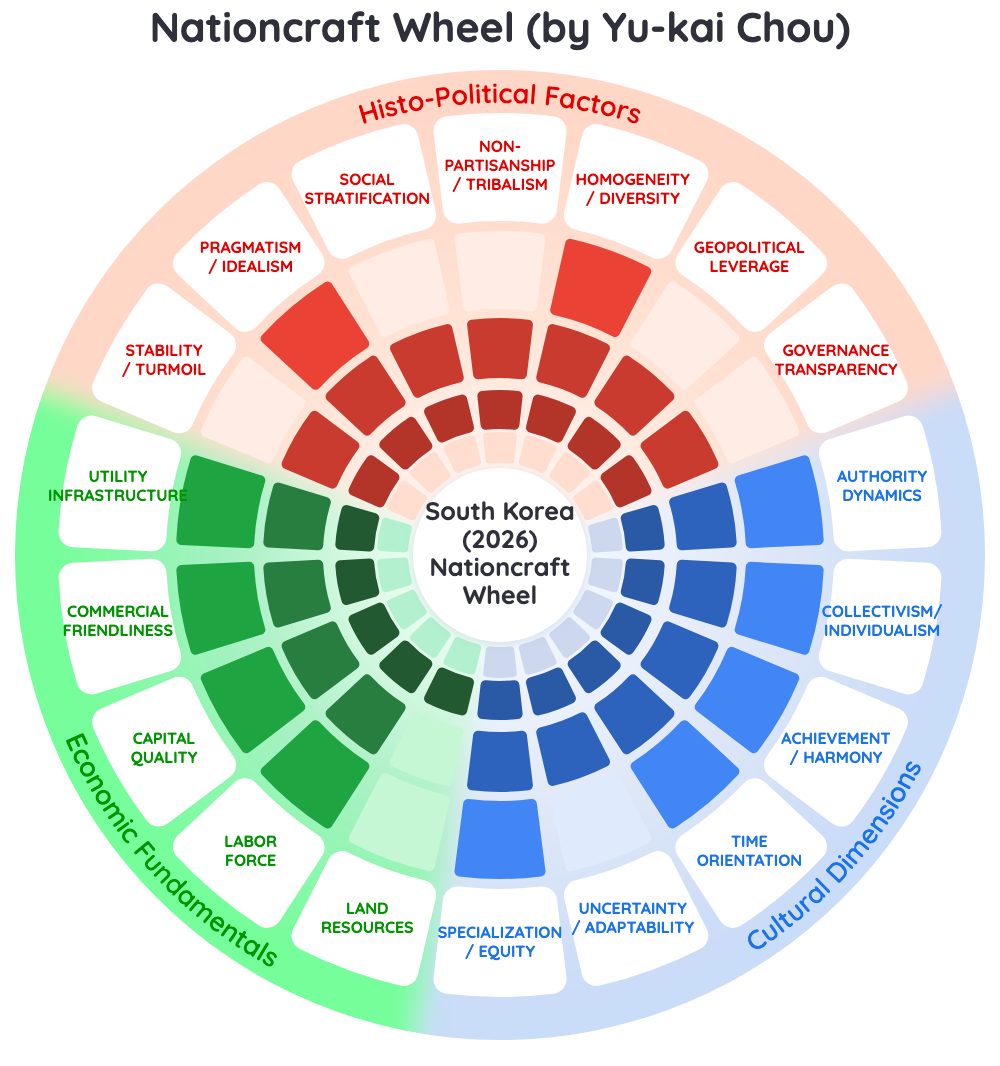
The country the packet built no longer fits the packet. South Korea’s current corpus vector reads V1=7, V2=9, V4=9, V8=8, V15=8, V16=8, V17=8, V18=8: the economic stack the 1961 planners dreamed of, attached to a democracy that would not tolerate the 1961 methods.
The post-martial-law reading of South Korea diagnosed the modern configuration after the December 2024 crisis, including the V7=6 stability score that one December night put under stress. The 2026 picture has stabilized under President Lee Jae-myung, in office since June 2025, with the Bank of Korea lifting its 2026 growth forecast to 2.6% on a strong semiconductor cycle.[10][11]
Even the modern stress tests echo the packet. The chaebol structure that state credit built in the 1960s remains the economy’s spine and its concentration risk, with the four largest groups accounting for roughly forty percent of GDP.[7] Sixty years on, Korea is still metabolizing the organizational choices of Phase 2.
The open question for the 2026 configuration is whether the packet’s engine can run in reverse demographics. The achievement culture that V3=9 describes now produces the world’s lowest fertility alongside its most intense schooling, which means the labor-force quality that powered the miracle must now carry a shrinking workforce.
That tension belongs to the current country file rather than to this packet. The packet’s contribution is the reminder that South Korea has rebuilt its economic model before, under far worse starting conditions, with the same cultural stack it holds today.
Explore More Nationcraft Analyses
The full set of country diagnostics lives in the Nationcraft country analyses library, and the framework hub explains the 18-variable method behind every piece. The nearest siblings to this packet are the Tiger-lineage analyses: Singapore, Taiwan, Vietnam, and the two Koreas, each linked in context above.
Frequently Asked Questions
What is the Park Chung-hee Industrialization Packet in the Nationcraft Framework?
SP-008 is the Nationcraft corpus’s structured record of South Korea’s 1961–1979 transformation: the full 18-variable profile at intervention start, the nine core policies from five-year plans to the HCI drive, the three-phase sequencing, the measured outcomes, and the recorded limits and costs.
Why did South Korea’s industrialization succeed when most state-led drives fail?
The Nationcraft reading credits the configuration rather than the command structure. V1=9 authority and V2=9 collectivism enabled mobilization, V3=9 achievement culture and V11=9 homogeneity made it one national tournament, V8=8 pragmatism corrected policy whenever results disappointed, and an education build-out converted literacy into industrial skill. Most imitators hold only the authority score.
What is the Discipline Decoy?
It names the error of treating the Park era’s visible control as its active ingredient. The packet’s own record files the authoritarian model under what cannot be copied and names educational intensity as the truly replicable asset, yet imitators keep importing the strongman and skipping the homework.
Which countries today fit the packet’s preconditions?
Screening the corpus’s 147 current vectors against the ET-003 signature (V1≥7, V2≥7, V4≥8, V8≥8, V15≥7) returns Vietnam as the one clean developing-world pass. Rwanda passes on V8=9 pragmatism and misses on V4=5 time horizon and scale. Egypt, Eritrea, Nigeria, and Indonesia each fail a load-bearing floor.
Did the model require authoritarianism?
The packet is honest in both directions: the historical run used authoritarian control, and its lessons file that model as non-copyable and most societies as unwilling to accept the trade. The mechanisms that transferred — export scoreboards, technocratic agencies, education scaled with industry — have since run inside democracies, and South Korea itself kept compounding after 1987 without the controls.
What did the Park era cost South Korea’s people?
The recorded bill: suppressed unions and brutal hours in the export sectors, the 1972 Yushin constitution’s abolition of electoral constraint, regional favoritism that still structures politics, an HCI debt crisis by 1980, and a succession collapse that ran through assassination and the Gwangju massacre before the 1987 June Democratic Struggle won direct elections.
Related Reading
- The Nationcraft Framework — the 18-variable method behind this analysis
- Nationcraft Country Analyses Library — every published country diagnostic
- Nationcraft Analysis: South Korea Post-Martial Trap 2026 — the modern configuration this packet built
- Nationcraft Analysis: Singapore LKY Packet Stress Test — the city-state sibling in the Tiger lineage
- Nationcraft Analysis: Estonia Digital Packet 2026 — the packet series on a post-Soviet digital state
- Nationcraft Analysis: North Korea Summit Mirage 2026 — the same peninsula with the opposite V8 score
Footnotes
- Park Chung Hee. Wikipedia: the May 16, 1961 coup, the 1962 First Five-Year Plan, the November 1972 Yushin constitution, and the October 26, 1979 assassination.
- Miracle on the Han River. Wikipedia: the period’s transformation and the $800 million Japanese property-claims settlement.
- Saemaul Undong. Wikipedia: the New Village Movement launched April 22, 1970.
- POSCO. Wikipedia: founded April 1968 with Japanese normalization financing; later among the world’s largest steelmakers.
- Heavy-Chemical Industry Drive. Wikipedia: announced January 1973; six strategic industries; measured allocation costs alongside output growth.
- Treaty on Basic Relations between Japan and the Republic of Korea. Wikipedia: signed June 22, 1965; $300 million in grants plus $200 million in loans, with additional credits.
- Chaebol. Wikipedia: state-selected conglomerates under Park-era directed credit; Samsung, SK, Hyundai, and LG at 40.8% of GDP in 2023.
- Gwangju Uprising. Wikipedia: May 18–27, 1980; the military suppression that followed the Park era’s collapse.
- June Democratic Struggle. Wikipedia: June 1987 protests forcing direct presidential elections and the Sixth Republic.
- Lee Jae-myung. Wikipedia: 14th president of South Korea, in office June 4, 2025, Democratic Party of Korea.
- Bank of Korea, Economic Outlook (May 2026). 2026 growth forecast raised to 2.6% and CPI to 2.7%, citing the semiconductor cycle.