

Most certifications hand you a multiple-choice quiz and call it expertise. The Octalysis Level 1 Certificate already broke that pattern by making you submit a real behavioral design project. Octalysis Level 2 raises the bar in a way most candidates don’t see coming until they’re mid-submission and realize the rubric has shifted under their feet.
The shift isn’t cosmetic. Level 1 tests whether you can analyze an experience through Octalysis. Level 2 tests whether you can design one. That’s a different muscle, and the requirements are deliberately built to expose it. If you copy your Level 1 mental model into a Level 2 submission, you will not pass. Not because the reviewer is being harsh, but because you’ll have answered a different question than the one Level 2 actually asks.
I’ve sat on the reviewer side of these certifications since the program launched, across both Level 1 and Level 2. The pattern is consistent. Most failed Level 2 submissions are technically correct but structurally Level 1. The candidates list. They describe. They tag Core Drives onto features. What they almost never do is bridge the gap between who the player is and what the experience is doing to them, which is the exact thing Level 2 is asking you to demonstrate.
Here’s what each Level 2 requirement actually tests, why the wireframing component is the real differentiator, and the failure modes that show up over and over on the reviewer side of the table.
⚡ Speed Run Notes
- Level 2 is a design exam, not an analysis exam. Level 1 asks “can you read an experience through Octalysis?” Level 2 asks “can you build one?” If your submission reads like Level 1 with extra slides, you will fail.
- Wireframing is the real bar. The wireframe requirement is what separates designers from theorists. You can fake comparative analysis with bullet points; you cannot fake a wireframe that doesn’t reflect Octalysis understanding.
- Comparative Octalysis is the gap-finding engine. Player-type graph minus current-experience graph equals the design opportunity. Most Level 1 candidates skip this; most Level 2 candidates skip the part where they actually use it.
- The Strategy Dashboard goes from partial to complete. Level 1 lets you scope down. Level 2 demands all four behavioral phases, FIBA mechanics, and rewards, because design without scope is improvisation.
- Reviewers grade with an “expert lens.” Level 1 grades whether you applied the framework. Level 2 grades whether the work would survive a real client engagement. The bar is the same one I’d hold any consultant on my team to.
Table of Contents
In This Article
- About Yu-kai Chou
- Why Level 2 Exists in the First Place
- The Five Requirements, Decoded
- The Wireframing Test: Why It’s the Real Differentiator
- The Comparative Octalysis Method
- The “Expert Lens” Reviewers Use
- Five Failure Modes I See Over and Over
- Why Level 3 Doesn’t Exist Yet
- Frequently Asked Questions
- Bottom Line
Author Credibility: Yu-kai Chou

Yu-kai Chou is an S-Tier Behavioral Designer and the creator of the Octalysis Framework, the gamification design system now applied to products and experiences reaching over 1.5 billion users. His book Actionable Gamification is one of the most-cited works in the field, and he has been ranked the #1 Gamification Guru in the World.
He has advised MrBeast, LEGO, Microsoft, Porsche, Tesla, Stanford, Harvard, and governments including Ukraine on turning behavioral psychology into product mechanics that actually change user behavior.
Verify: Wikipedia · Google Scholar · Wikidata · LinkedIn
I designed the Level 1 and Level 2 Octalysis Certification rubrics, and I’ve personally reviewed or supervised the review of every certification awarded since the program launched. The Level 2 wireframe requirement isn’t arbitrary. It came directly out of watching Level 1 graduates struggle on real client work, where the gap between “I can identify CD2 in your onboarding” and “I can redesign your onboarding to activate CD2” turned out to be enormous. Level 2 closes that gap inside the certification process so the graduates I send into the world can actually do the job.
Why Level 2 Exists in the First Place
The Octalysis Framework has eight Core Drives, but it has two skill ladders. The first ladder is diagnosis: looking at an experience and naming what’s motivating people to use it (or not use it). The second ladder is design: starting with what should motivate people and building the experience that does it.
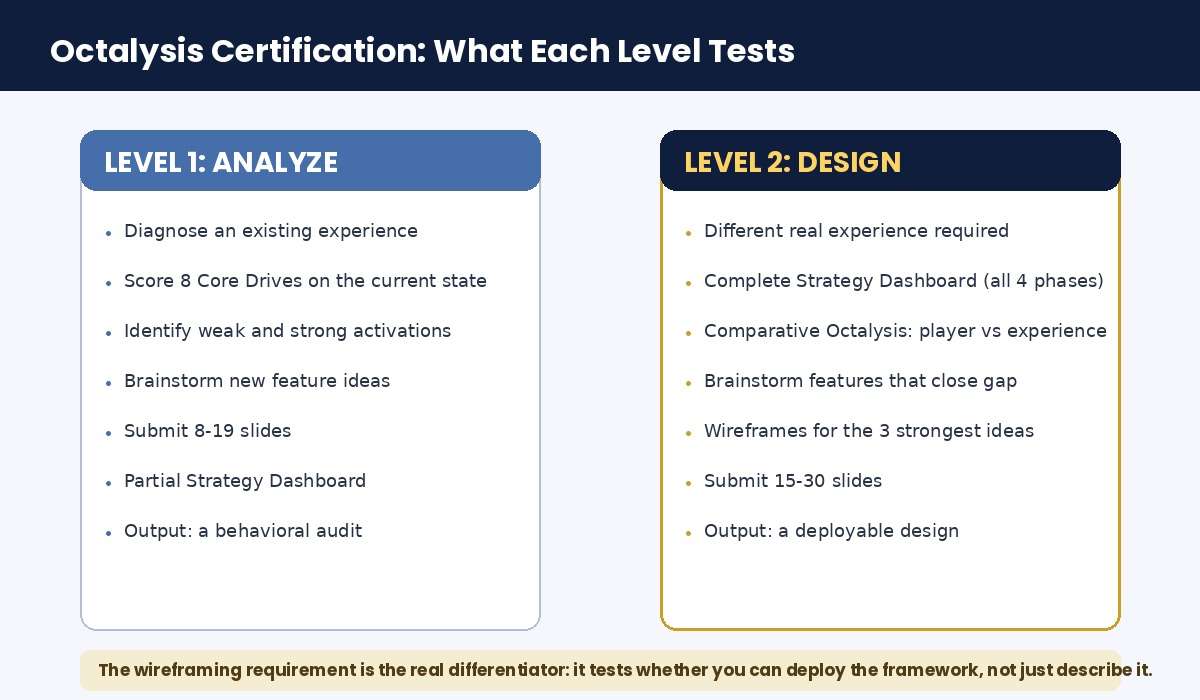
Level 1 climbs the first ladder. You take an experience, score it on the eight Core Drives, identify the strong and weak spots, and propose new features. The output is an audit. You’re showing the reviewer that you can read the behavioral signal in an existing system.
Level 2 climbs the second ladder. You start higher in the stack, with a complete Strategy Dashboard in hand. Your job is to design what should change about the experience based on the behavioral profile of who’s using it. The diagnosis is still there, but it’s the input, not the output.
Why bother separating the two? Because in the real world, they break apart. I’ve coached teams full of people who could analyze an existing app and tell me precisely which Core Drives were under-activated. The same teams froze the moment I asked them to redesign the experience to fix the gap. Reading the music is not the same as composing it. Level 2 forces you to compose.
The Five Requirements, Decoded
Here’s what Level 2 actually asks for, with the reasoning behind each requirement and what reviewers are looking for in each.
Requirement 1: A Different Experience Than Level 1
You must use a different real experience than the one you used for Level 1. This sounds like an administrative rule, but it’s actually a transferability test. Octalysis is a framework, not a script. If you can only apply it to one experience, you don’t have a framework. You have a memorized case study. Level 2 forces you to prove that the structure is in your head, not the slides.
The best Level 2 submissions tend to come from candidates who picked a Level 2 experience that’s structurally different from their Level 1 (not just topically different). If your Level 1 was a B2C app, try a B2B SaaS or a physical retail experience for Level 2. The further the structural distance, the more clearly you demonstrate that the framework travels with you.
Requirement 2: Complete Strategy Dashboard
Level 1 lets you scope down: top three business metrics, main player type, scaffolding-phase desired actions only. Level 2 demands the full Strategy Dashboard: all four behavioral phases (Discovery, Onboarding, Scaffolding, Endgame), FIBA mechanics, and the reward stack.
This is not paperwork. The reason scope expands at Level 2 is that real design work fails on the phases you didn’t plan for. A loyalty program that’s beautifully designed for the Onboarding phase but ignored Endgame produces churn after month nine. A wellness app with brilliant Discovery but weak Scaffolding gets installed and abandoned. Level 2 reviewers look for whether your design accounts for all four phases or hopes for the best after the user’s first session.
Requirement 3: Comparative Octalysis Analysis
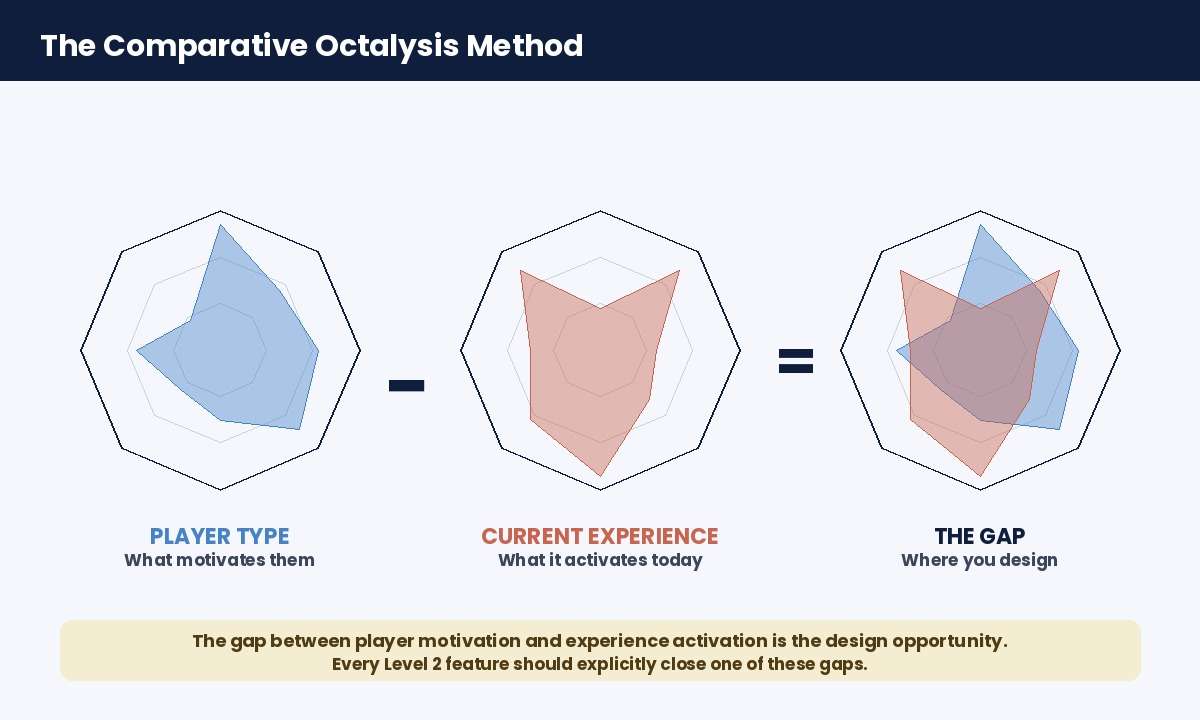
You build two Octalysis graphs. One for the main player type (their motivational profile), and one for the current experience (its motivational profile). Then you compare them. The gap between the two graphs is your design opportunity.
This is the engine of Level 2. It’s also the requirement most candidates technically include and functionally ignore. They paste both graphs into a slide and move on. They never explicitly write out the gap, and they never let the gap drive the design. The reviewer can tell within thirty seconds whether the comparison is doing real work or just sitting there for credit.
Requirement 4: New Feature Brainstorming
Generate new features that bridge the gap between what motivates the player type and what the current experience activates. The bridge is the whole point. New features that don’t connect to a specific gap on the comparative graph are decoration, no matter how clever the mechanic.
The trap here is feature-itis. Candidates show up with twelve ideas because twelve feels generous. Reviewers want to see fewer ideas with sharper rationale. Three excellent ideas, each tied explicitly to a Core Drive gap on the comparative graph, beats twelve ideas with no through-line.
Requirement 5: Wireframes for Three Best Ideas
Pick your three strongest ideas and wireframe them. Show how the idea actually lands inside the user experience — what the screen looks like, where the trigger is, how feedback appears, what the next behavioral loop opens up.
This is the requirement that separates Level 2 from anything that came before, and it’s the topic of the next section.
The Wireframing Test: Why It’s the Real Differentiator
You can write a beautiful Octalysis analysis without ever building anything. People do this for a living — they consult, they advise, they critique. The wireframe is what catches the people who can name the framework but not deploy it.
Here’s what a good Level 2 wireframe demonstrates that prose alone never can:
It forces you to commit to a placement. A new feature in a slide deck lives in the abstract: “add a streak mechanic.” A new feature in a wireframe has to live somewhere on a real screen, in a specific position, at a specific stage of the user’s journey. The act of placing the feature in space surfaces all the design questions that prose-only proposals get to skip. Where does the streak counter sit? What happens when it breaks? What does the first activation look like for a user who’s never seen it before? Wireframes drag those questions into the open.
I’ve seen many Octalysis analyses where Core Drive 2 (Development & Accomplishment) and Core Drive 4 (Ownership & Possession) were correctly diagnosed as under-activated, and where the proposed fix was “add achievements and a profile page.” Then the wireframe arrives, and the achievements are buried three taps deep, the profile is a static settings screen, and CD2 and CD4 are just as cold as before. The wireframe tells the truth the prose was hiding.
It forces you to design the feedback loop, not just the trigger. Most weak proposals stop at the action: the user does X. Strong proposals continue: the user does X, the system responds with Y, the user feels Z, the next opportunity Z+1 appears. That whole loop is what produces engagement. A wireframe makes you draw the whole loop because every screen has a next screen, and the reviewer can see whether the next screen does behavioral work or just confirms the click.
It forces integration with existing context. A new feature has to coexist with everything already on the screen. Octalysis is a multi-Core-Drive system; real screens already activate three or four drives at once. If your new CD3 (Empowerment of Creativity & Feedback) feature kills the CD5 (Social Influence & Relatedness) ribbon that was already working, the design is a net loss. Wireframes catch that. Slide deck features ignore that.
It exposes whether you understand the user, or just the framework. A wireframe drawn by someone who’s used the product looks different from one drawn by someone who has only theorized about it. Spacing, hierarchy, what gets emphasized, what gets buried: these are tells. Reviewers don’t grade visual polish, but they do read the wireframe for whether the designer was thinking about the user’s actual moment or about the framework’s elegance.
This is why I added wireframing as the gating Level 2 requirement after watching graduates underperform on real client work. The Octalysis vocabulary was perfect. The design instinct was untested. Wireframes test the instinct.
The Comparative Octalysis Method
The comparative analysis is the methodological heart of Level 2, and it’s worth slowing down on because most candidates use it backwards.
The procedure looks simple:
- Build the Octalysis graph for the main player type — what Core Drives motivate this person across their broader life and product use, scored 0 to 10 on each of the eight drives.
- Build the Octalysis graph for the current experience — what Core Drives the experience currently activates, scored the same way.
- Lay them on top of each other and read the gap.
The gap is the design opportunity. If the player type scores high on Core Drive 1 (Epic Meaning & Calling) and the experience scores low, you have a CD1 gap. The fix is to design features that lift the experience’s CD1 score closer to where the player’s motivation already lives.
Where most candidates use this backwards: they design first, then back-fill the comparison to justify what they were going to do anyway. The graphs become decoration. The analysis becomes post-hoc. Reviewers can tell because the proposed features don’t actually map cleanly onto the gaps the comparison reveals. They map onto whatever the candidate found interesting.
Used forward, the comparative method is one of the most powerful tools in behavioral design. It tells you, with data, where the design effort should go. It also kills bad ideas before they consume budget. A feature you’re excited about that doesn’t close a real gap on the comparative graph is a feature you should not build, even if it’s clever.
For client work, I run this comparison constantly. The discipline isn’t holding the framework in my head. It’s refusing to fall in love with a feature that doesn’t close a gap. Level 2 is testing whether you have that discipline yet.
The “Expert Lens” Reviewers Use
Level 1 reviewers grade for application: did the candidate apply the framework correctly? Level 2 reviewers grade with what we call the expert lens. The grading question is simple: would I hire this person for a client engagement?
That’s a higher bar, and it shows up in three specific places.
Precision in language. Level 1 lets you call something “a kind of CD5 mechanic.” Level 2 wants to know which CD5 mechanic and why that one. Social Treasures (where rewards must be unlocked by friends) is structurally different from Mentorship (where status flows by helping others); both are CD5 but they activate different parts of it. A Level 2 candidate who can’t articulate the distinction is showing the reviewer that the vocabulary is shallower than it looks.
Strategic thinking, not tactical listing. Level 1 candidates list. They produce twelve features tagged with Core Drives. Level 2 candidates strategize. They produce three features chosen from a brainstormed pool of twelve, and they explain why those three close the highest-priority gaps for this player type at this stage of the experience. The lifting work is the prioritization, not the brainstorming.
The pattern that always reads as Level-1-pretending-to-be-Level-2 is the “everything everywhere” submission: new features for every Core Drive, no prioritization, no rationale for which one matters most. Real designers triage. Reviewers know it.
Connection between motivation and solution. The single most important sentence pattern in a Level 2 submission is some version of: “Because this player type is motivated by [Core Drive X] and the current experience underdelivers on [Core Drive X], this feature [does specific thing] which raises the experience’s [Core Drive X] score from [Y] to [Z].” That sentence is what Level 2 is testing. If your slides don’t contain a version of it, the reviewer is going to write that you analyzed without designing.
Five Failure Modes I See Over and Over
Across the Level 2 submissions I’ve reviewed, the failure patterns are consistent. If you’re prepping a Level 2 submission, this is your pre-flight checklist.
1. Same output quality as Level 1. The submission is structurally a Level 1 plus a few extra slides. Reviewers can spot this in the first three slides. The Strategy Dashboard is partial, the comparative analysis is missing or perfunctory, and the wireframes (if present) are afterthoughts. Fix: re-read the requirements as if you’d never done Level 1, and treat Level 2 as a fresh exam.
2. Comparative analysis present but inert. The two graphs are on slide 14 and slide 15. They never appear again. The proposed features make no reference to specific gaps the comparison revealed. Fix: after building the comparison, write out the three biggest gaps in plain language, and then make sure every proposed feature explicitly references one.
3. Wireframes that ignore behavioral mechanics. The wireframes show layouts but not feedback, triggers, or progression. They look like Figma sketches a generic UX designer would produce. Fix: every wireframe should annotate at least the trigger, the feedback, and the Core Drive being activated. If a Level 1-trained UX designer could have produced your wireframe, you didn’t demonstrate Level 2.
4. Player-motivation profile and experience-activation profile that don’t actually differ. Sometimes the comparative graphs look almost identical because the candidate quietly scored the experience to match the player type. This produces a tidy comparison but no design tension, and the proposed features feel hollow. Fix: score the experience by what it currently activates, not by what you want to design. The gap is the gift.
5. Prerequisite knowledge missing. Level 2 assumes Week 4 of the masterclass — specifically, the wireframing module. Candidates who skip Week 4 try to substitute slide-deck mockups for wireframes, and reviewers can tell. Fix: complete the masterclass module before submitting. The wireframing chapter is short, and skipping it is the single biggest predictor of a failed Level 2 submission.
Why Level 3 Doesn’t Exist Yet
People ask me regularly when Level 3 will open. The answer has stayed the same: when Level 2 has graduated enough certified designers that Level 3 makes sense. That’s a deliberate constraint, not a marketing posture.
The certification ladder is meant to maintain its credential value through scarcity and rigor, not through volume. A program that mints a thousand Level 3 certificates in its first year produces a thousand people whose Level 3 means little. A program that opens Level 3 only when Level 2 has produced a strong, working population of certified designers produces a Level 3 that actually means something.
What Level 3 will eventually require is sketched: a Player Experience (PE) Feature List and a Battle Plan spreadsheet on top of everything Level 2 demands. The PE Feature List is the prioritized roadmap; the Battle Plan is the implementation, ownership, and timing layer. Level 2 graduates demonstrate they can design. Level 3 will demonstrate they can ship.
If you’re currently working toward Level 2, the most useful thing to know about Level 3 is that the muscle Level 3 will test is the muscle you’re building right now — the ability to take a comparative gap analysis and turn it into a real artifact someone could build. Wireframes are a step on that road.
Frequently Asked Questions
How is Level 2 different from Level 1?
Level 1 tests whether you can analyze an existing experience through Octalysis. Level 2 tests whether you can design improvements to one. The submission demands a complete Strategy Dashboard (not partial), a comparative Octalysis analysis between player type and experience, new feature brainstorming, and wireframes for the three best ideas. The bar shifts from application to strategic design.
How long should a Level 2 submission be?
15 to 30 slides. More than Level 1’s 8–19, because wireframes add visual real estate and the Strategy Dashboard is now complete. Beyond 30 slides usually signals that the submission lacks prioritization — a fixable problem before submission.
Do I have to use a different experience than my Level 1?
Yes, and the rule isn’t arbitrary. Using a different experience demonstrates that Octalysis travels with you across structurally different domains. The strongest Level 2 candidates pick an experience whose structure (B2C vs. B2B, digital vs. physical, transactional vs. relational) differs meaningfully from their Level 1 choice.
What’s the most common reason Level 2 submissions fail?
The submission reads like Level 1 with extra slides. The comparative analysis is included but inert; the wireframes are layout sketches without behavioral mechanics; the new features have no through-line back to specific gaps in the comparison. Fix every one of these before you submit.
When will Level 3 open?
When the Level 2 cohort is large and capable enough to make Level 3 meaningful. Level 3 will require a Player Experience Feature List and a Battle Plan spreadsheet on top of everything Level 2 demands. No exact opening date is set; the constraint is real.
Bottom Line
Level 2 is not Level 1 with more pages. It’s the certificate that separates people who can read behavioral design from people who can produce it. The wireframing requirement is the single biggest signal, and the comparative Octalysis method is the engine that should drive every design decision in the submission.
If you’re preparing a Level 2 submission, the most useful thing you can do is not write a single slide until you’ve built the comparative graphs and identified the three biggest gaps. Let the gaps drive the feature brainstorming; let the brainstorming feed the wireframes; let the wireframes prove you can design, not just describe. That’s what passes.
For more on the framework Level 2 is testing, the canonical reference is the complete Octalysis Framework. For the deeper philosophy of why behavioral design must be designed and not just analyzed, my book Actionable Gamification walks through the full system. And if you want to see the certification path itself, the Octalysis Certificate page covers Level 1 requirements and the broader certification context.
Level 2 is hard on purpose. The point of a hard certificate isn’t to gatekeep — it’s to make sure that when someone says they’re a Level 2 Octalysis Designer, the work behind the title actually exists.
If this guide was useful, here is what to do with it.
If you are preparing a Level 2 Octalysis submission, the version of this material that comes with rubric walkthroughs, comparative-graph templates, and direct review of your wireframes is taught at Octalysis Prime — the design school where the Strategy Dashboard, Comparative Octalysis Method, and FIBA mechanics get workshopped against the actual experience you intend to submit. Start at the Octalysis Framework if you need the foundational system the Level 2 rubric is built on, and at the Octalysis Certificate page if you want the full certification path from Level 1 through Level 2.
If you are leading a team that is shipping any behavioral product and you want the wireframing test applied to your actual roadmap, you can book a working session with me directly. The review I run with consulting clients is the same comparative-Octalysis lens this post describes (player-type graph minus current-experience graph equals the design gap) applied to your three highest-leverage surfaces, with wireframes for the three biggest gaps as the deliverable.
For the deeper philosophy and the full Octalysis system, my book Actionable Gamification walks through the eight Core Drives, the four phases of player experience, and the Strategy Dashboard from first principles. The neighbouring resources to this post are the Strategy Dashboard reference, the broader Octalysis Framework hub, and the Behavioral Framework Library for the underlying psychology.