
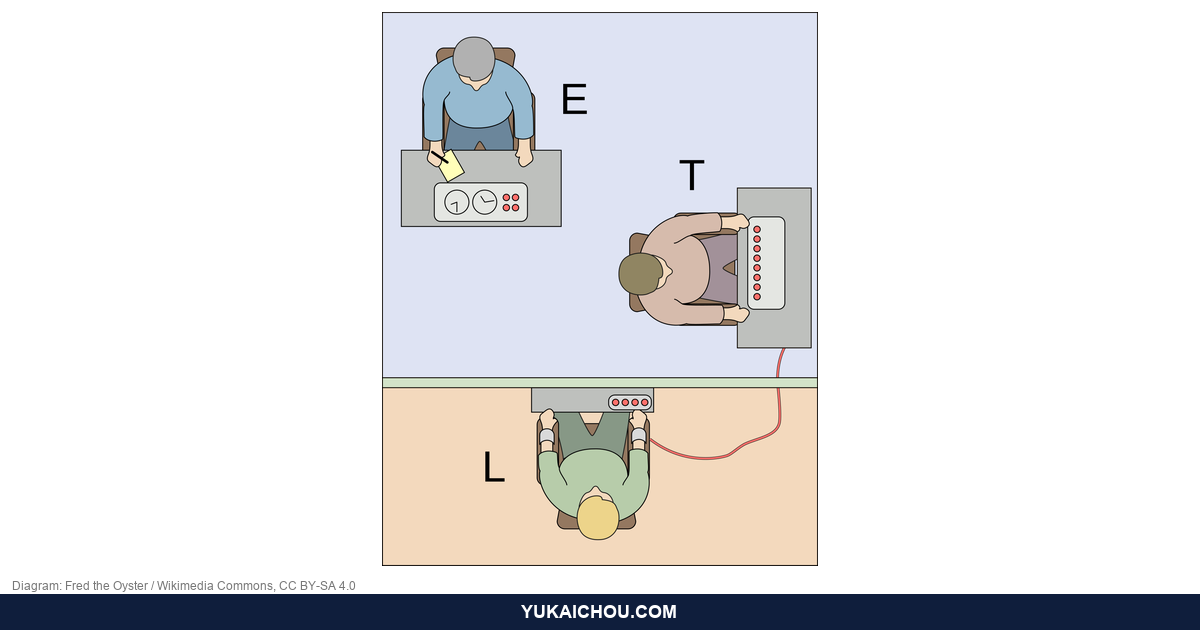

Short answer: The Milgram obedience experiment showed that ordinary people will follow an authority figure far past their own moral limits. In Stanley Milgram’s baseline study at Yale, 65% of participants went all the way to what they believed was a lethal 450-volt shock, and no one stopped before 300 volts.
Milgram explained this with the agentic state, a shift where people stop judging actions on their own moral terms and start judging whether they followed instructions correctly.
His 18 variations showed what breaks it. Moving the experimenter to the telephone dropped obedience from 65% to 20.5%, and two defiant peers dropped it to 10%.
In 1961, an ordinary man in New Haven pressed a switch he was told would deliver 450 volts to a stranger screaming through a wall. He pressed it because a quiet man in a lab coat said, calmly, “Please continue.” He was not cruel. He was not a sadist. He was a teacher, a salesman, an engineer — and roughly two out of every three people who sat in that room did the same thing.
That finding is more uncomfortable than anything the Milgram experiment has been made to mean in the sixty years since. Obedience is not a glitch that happens to weak people in strange places. It is a default mode the human nervous system slips into the moment it hands responsibility to a perceived authority. And every gamified experience you have ever designed — every progress bar, every system prompt, every “the app recommends” nudge — is quietly borrowing that default.
This post is the S-Tier Behavioral Designer’s guide to the Milgram Obedience Experiment: what it found, what it got right, where the original data actively misleads modern designers, and — most importantly — how to apply it through the Octalysis Framework without crossing the line from White-Hat to Black-Hat design.
Before we get there, one habit worth stealing: I never evaluate obedience mechanics in isolation. My Behavioral Framework Library keeps the Milgram findings next to Nudge Theory, the Hook Model, and dozens of other frameworks, because authority effects compound with whatever else your design is already doing.
Speed Run Notes
- Milgram found that 65% of ordinary adults would deliver what they believed were lethal 450-volt shocks to a stranger when a lab-coated authority told them to continue — the obedience baseline that every behavioral designer should treat as the upper bound of what “just following the system” can produce.
- The result is not about cruelty. It is about the agentic state: a cognitive shift where people stop evaluating actions on their own moral terms and evaluate them on whether they executed the authority’s instructions correctly.
- Modern replications (Burger 2009; Dolinski 2017) show rates of 65-90% full compliance at the 150-volt threshold across cultures, gender, and fifty years of cultural change — making this one of the most stubborn findings in all of social psychology.
- For Octalysis designers this maps to Core Drive 6 (Scarcity & Impatience) and Core Drive 5 (Social Influence & Relatedness): every “the system requires” prompt and every “your coach has assigned” nudge is running the agentic state at low voltage. White-Hat uses it to protect users; Black-Hat uses it to harvest them.
- Milgram’s own methodology has real problems — Gina Perry’s archival work, the archival tapes showing experimenter improvisation, and the ethical critiques are not just academic footnotes. They change how you should read the numbers and how far you should push the design implications.
In This Article
- What is the Milgram Obedience Experiment?
- The Core Findings (1961-1963 Baseline)
- What Milgram Got Right
- Where the Milgram Experiment Falls Apart
- The Brain on Obedience
- Milgram vs Other Theories
- Milgram in the Real World
- The Elephant in the Room
- How to Apply Milgram with the Octalysis Framework
- Practical Steps to Apply
- Frequently Asked Questions
About the Author

Yu-kai Chou is an S-Tier Behavioral Designer and the creator of the Octalysis Framework, the gamification design system now applied to products and experiences reaching over 1.5 billion users. His book Actionable Gamification is one of the most-cited works in the field, and he has been ranked the #1 Gamification Guru in the World.
He has advised MrBeast, LEGO, Microsoft, Porsche, Tesla, Stanford, Harvard, and governments including Ukraine on turning behavioral psychology into product mechanics that actually change user behavior.
Verify: Wikipedia · Google Scholar · Wikidata · LinkedIn
What is the Milgram Obedience Experiment?
The Milgram Obedience Experiment is a series of social-psychology studies conducted at Yale University between 1961 and 1963 by a then-27-year-old psychologist named Stanley Milgram. The studies asked a single, disturbing question: under what conditions will ordinary people inflict serious harm on another human being, purely because a perceived authority figure tells them to?
Milgram’s genius was to operationalize that question in a way that could not be argued with. Participants, recruited through a New Haven Register advertisement offering $4.50 for an hour of their time, arrived believing they were taking part in a study on learning and memory. The real study was about them.
Each participant was assigned the role of “teacher.” A confederate — an Irish-American accountant named James McDonough who posed as a fellow volunteer — was assigned the role of “learner.” The learner was strapped into a chair in an adjacent room with an electrode attached to his wrist. The teacher sat in front of a generator with thirty switches labeled from 15 volts to 450 volts, the last three switches ominously marked “XXX.”
The teacher’s job was to read word pairs. If the learner got an answer wrong, the teacher was told to deliver an electric shock, increasing the voltage by 15 volts for every subsequent error. The generator was a prop. No shocks were delivered. But to the teacher, the voltage dial, the learner’s pre-recorded screams, the thumping against the wall at 300 volts, the ominous silence after 330 volts — all of it was real.
When the teacher hesitated, a man in a grey lab coat seated nearby — John Williams, a 31-year-old high school biology teacher hired to play “the experimenter” — delivered one of four scripted prods, in escalating order:
- “Please continue” or “Please go on.”
- “The experiment requires that you continue.”
- “It is absolutely essential that you continue.”
- “You have no other choice; you must go on.”
Obedience was operationalized as the maximum voltage the teacher was willing to administer. Full obedience meant pressing the 450-volt switch three times after the learner had gone silent. Defiance meant refusing to continue despite the four prods.
The result — the number now embedded in every introductory psychology textbook on earth — was that 26 of 40 participants (65%) went all the way to 450 volts. Every single one of them went past the 300-volt threshold where the learner pounded on the wall and stopped responding. Milgram had predicted, based on a survey of 40 psychiatrists, that fewer than 1 in 1,000 would go to the end.
The Core Findings (1961-1963 Baseline)
Milgram ran 18 variations of the basic paradigm between 1961 and 1963, each one systematically changing a single variable to see which factors moved obedience rates. The results are the real scientific contribution — not the headline 65% number, but the shape of the response surface around it.
Finding 1: Authority proximity is load-bearing
When the experimenter gave instructions in person, in the same room, obedience ran at 65%. When the experimenter gave instructions by telephone from a different room, full obedience collapsed to roughly 20.5%. Remove the physical presence of the authority figure and two-thirds of the effect disappears. The implication for modern digital design is direct: a notification that appears on your phone screen does not carry the authority weight of a manager standing over your shoulder, but interaction designers have spent three decades closing that gap with video calls, avatars, and synthesized “the system is watching” cues.
Finding 2: Victim proximity inverts the effect
In the baseline condition, the learner was in an adjacent room — audible but unseen. Obedience ran at 65%. In the “proximity” condition, the learner was in the same room, visible. Obedience dropped to 40%. In the “touch-proximity” condition, the teacher had to physically press the learner’s hand onto a shock plate. Obedience dropped further to 30%. The closer the harm, the harder the agentic state is to maintain. For Octalysis designers building any system that routes negative outcomes to real humans — content moderation tools, rejection-letter generators, support-queue triage — this finding is the argument for making victim impact visible, not hidden behind an abstraction layer.
Finding 3: Disobedient peers break the spell
When two confederates joined the “teacher” as fellow-teachers and refused to continue at 150 volts and 210 volts respectively, the real participant’s obedience rate collapsed to 10%. The presence of other humans who modeled defiance was the single most powerful reducer of obedience Milgram ever found. This is why whistleblower protections, dissent channels, and peer-review mechanisms are not bureaucratic overhead in a designed system — they are the architectural bulwark against the agentic state.
Finding 4: Institutional prestige matters less than expected
Milgram suspected that Yale’s brand was doing most of the heavy lifting. He re-ran the experiment in a shabby office building in Bridgeport, Connecticut, under the name “Research Associates of Bridgeport” — a fictitious commercial firm with no university affiliation. Obedience dropped from 65% to 48%. Measurable, but not catastrophic. The authority effect does not require an Ivy League crest; it requires a perceived legitimate authority structure with a perceived legitimate goal. That is bad news for anyone betting that users will see through a sketchy dark-pattern flow just because the company name is unfamiliar.
Finding 5: Gender shows no difference at the top-line
When Milgram ran an all-female variation in 1962, 26 of 40 women (65%) went to 450 volts — identical to the male sample. Women reported more internal stress, but the behavioral output was the same. This null result has held up across decades of replications and is one of the reasons the Milgram finding is so robust: it does not disappear when you change the demographic slice, the decade, or the country.
Finding 6: The 150-volt inflection point
Look at the voltage distribution of participants who quit. Almost no one quits before 150 volts — the point where the learner first demands to be released, citing his heart condition. The participants who were ever going to defy did so at 150 volts. Almost everyone who pushed past 150 volts went all the way to 450. Jerry Burger’s 2009 partial replication at Santa Clara University used this inflection point explicitly, stopping the experiment at 150 volts as an ethical compromise, and found that 70% of participants would have continued past it — statistically indistinguishable from Milgram’s original rate of 82.5% past 150.
What Stanley Milgram Got Right
Milgram is the rare 20th-century psychologist whose headline finding has survived both the methodological revolution and the replication crisis that demolished so much of his contemporaries’ work. Robbers Cave, the Stanford Prison Experiment, the original bystander studies, ego-depletion, priming research — all of them have been partially or fully rewritten. The Milgram result has been attacked, re-examined, ethically condemned, and partially replicated across five continents. The core finding still holds.
He built the paradigm that every obedience study since has had to measure itself against
Before 1961, social psychology had correlational data on authority — surveys, attitude scales, after-the-fact interviews with German and Japanese soldiers after World War II. Milgram’s contribution was to create a causal apparatus. He isolated the variable, set up the counterfactual, ran it eighteen ways. Half a century of subsequent research on authority, compliance, and situational ethics is built on Milgram’s methodological template. That is an architectural gift to the field, not a finding.
He nailed the situation-over-disposition argument
The dominant folk theory in 1961 was dispositional: bad acts come from bad people. Nazis were sadists. American GIs at My Lai in 1968 were aberrations. Milgram’s data is an industrial-strength argument for the opposite view: situations with the right authority structure, the right proximity profile, and the right script can route ordinary people into acts they would universally condemn in the abstract. Behavioral design rides on exactly this insight — you do not have to select for compliant users, you just have to build a compliant situation. The ethical question is who bears the cost of that architecture.
He ran the post-hoc interviews
This is underrated. Every participant went through a thorough debriefing after the experiment, and Milgram followed up with a questionnaire one year later. The data from those debriefings — that 83.7% of participants said they were glad to have participated, that many reported the experience as personally illuminating — is messy and has its own ethical problems, but it is data. Most of his critics and most of his imitators did not do this work. The post-hoc interviews are the reason we have any insight at all into the phenomenology of the agentic state — what people were thinking while they pressed the switches.
Where the Milgram Experiment Falls Apart
The Milgram finding is robust in its general shape. Specific parts of Milgram’s interpretation, his ethics, and his self-reported methodology do not survive modern archival scrutiny. For a behavioral designer, these are not academic footnotes — they change how far you should push the implications before you cross into territory the data does not support.
Critique 1: Gina Perry’s archival work shows the script broke down more often than Milgram reported
Australian psychologist Gina Perry spent years in the Yale Sterling archives listening to the original tape recordings of Milgram’s sessions. Her 2013 book Behind the Shock Machine documents what the published papers elided: the experimenter, John Williams, frequently went off-script. He pressured participants with ad-libbed reassurances (“no permanent tissue damage”), he dismissed their protests, he accepted unwilling compliance as “completed.” In some sessions, he delivered the four scripted prods not in order but in whatever order worked to keep the participant at the switch panel.
The headline 65% obedience rate is real, but the mechanism Milgram attributed it to — a dispassionate authority delivering a rigid script — was not what actually happened on those tapes.
The design implication: Milgram’s paradigm did not just measure obedience. It measured obedience-under-active-pressure from a skilled, improvisational enforcer. That is still an important finding, but it is not the finding the textbook summary claims. When a modern dark-pattern designer builds a flow that adaptively dismisses objections — “are you sure? you’ll lose your discount” — they are closer to the Williams-on-the-tapes than to the sanitized protocol. The agentic state in the wild is produced by responsive, improvisational authority, not by static scripts.
Critique 2: The ethics of the debriefing, and whether participants were actually debriefed
Herrera’s 2013 reconstruction of the debriefing protocol found that in the early variations of the study, many participants left Yale still believing they had shocked a stranger to the point of unconsciousness or death. The full reveal — meeting the unharmed learner, being walked through the true purpose — came weeks or months later for some participants, and never for others. A 1964 letter from a participant describes nightmares and chest pain that lasted nine months.
The ethics matter practically, not just historically. Any modern replication has to account for the fact that participants in 1961 did not give what we would now call informed consent. The data they produced may reflect obedience, but it also reflects the specific shock of believing you have actually injured someone. Jerry Burger’s 2009 replication explicitly reset the pre-screening to exclude anyone with elevated distress risk, stopped at 150 volts, and had a clinician on-site. That is the correct protocol — and it raises a hard question: is the sanitized paradigm still measuring the same phenomenon? The answer is probably “similar, not identical,” which is the honest answer, not the textbook answer.
Critique 3: “Obedience” is doing too much work in the interpretation
Alexander Haslam and Stephen Reicher’s “engaged followership” critique (2011, 2014) reads Milgram’s data and reaches a very different conclusion. Their argument: participants were not blindly obedient. They were actively engaged with the experimenter’s framing of the study as scientifically important, and they wanted to contribute to a worthy cause. When the experimenter’s prods shifted from “please continue” to “you have no other choice; you must go on,” compliance actually dropped. Participants resisted the coercion frame precisely because it broke the shared-cause narrative.
This re-reading is not a rejection of Milgram’s data. It is a different theory of what the data measures. And it has a direct behavioral-design implication: the lever is not “raw authority coercion,” it is “narrative alignment with an authority figure’s mission.” A coach-style gamification system that invokes “we are on this journey together toward your health goal” is pulling on the same rope as the Yale lab coat. A cold, directive system saying “do this because we said so” is pulling on a weaker rope. White-Hat gamification rides engaged followership; Black-Hat rides naked coercion. Milgram’s data suggests the former is actually more effective at producing compliance, which is a sobering thing to internalize.
The Brain on Obedience
Milgram posited, somewhat speculatively, that obedient participants entered what he called an “agentic state” — a cognitive shift from “I am acting on my own behalf” to “I am an agent executing another person’s intentions.” Milgram did not have the neuroscience tools to test this. Emilie Caspar and Patrick Haggard at UCL did, starting in 2016.
Caspar’s fMRI and EEG studies gave participants a modified Milgram paradigm where they could administer painful (but consenting) shocks to a partner either on their own volition or under experimenter order. The physiological and neural markers were consistently different between the two conditions. Under orders, the neural signature of “sense of agency” — specifically the readiness potential and the perceived time interval between action and outcome, what psychophysicists call “intentional binding” — was measurably reduced. Participants under orders actually experienced their own actions as less their own.
This is not a “just following orders” excuse. It is a mechanistic description of what that excuse is actually leveraging: a real, measurable, biological reduction in felt agency when action is framed as instruction-following. That reduction is the neural substrate of compliance. For a behavioral designer this changes the analysis. The question is not “will users rebel against this system?” — the question is “how much felt-agency do we strip away with each instruction-framed nudge?” The agentic state is not on or off. It is a dial, and we are always turning it.
Moll, de Oliveira-Souza, and colleagues (2005, 2007) have separately mapped the moral-emotion circuits — specifically the ventromedial prefrontal cortex, the amygdala, and the anterior temporal lobe — that light up during the prototypical “should I comply?” moment. When participants pushed past 150 volts in modern paradigms, the fMRI signature showed a characteristic suppression of ventromedial prefrontal activity, consistent with the idea that the moral-reasoning circuit was being actively inhibited, not simply overridden. Obedience is not the absence of a moral signal. It is the active suppression of one.
Milgram vs Other Theories
Milgram sits inside a cluster of classical social-psychology paradigms that every behavioral designer needs to hold in working memory. The differences matter because each one explains a different piece of why systems work.
Milgram vs Asch. Solomon Asch’s 1951 line-judgment experiments measured conformity — the pressure to agree with a group’s incorrect perceptual judgment. Asch found about 75% of participants conformed at least once across twelve trials, with an average compliance rate of 37%. The key difference: Asch measured peer pressure, Milgram measured authority pressure. Milgram’s rates are higher because an authority figure in a lab coat carries more behavioral weight than a group of peers. A designer using social proof (“3,400 people bought this today”) is pulling on the Asch lever. A designer using expert endorsement (“recommended by your doctor”) is pulling on the Milgram lever. Different mechanisms, different regulatory implications. The Asch Conformity post goes deeper.
Milgram vs Zimbardo’s Stanford Prison Experiment. Zimbardo’s 1971 study assigned random college students to “guard” and “prisoner” roles and watched how quickly the situation generated abuse. The Zimbardo data has been partially discredited (Le Texier’s 2019 archival work showed Zimbardo directly coached the guards to be cruel), but the conceptual contribution was about role as a driver of behavior. Milgram’s contribution was about authority. A gamification system that assigns a user the role of “moderator” is riding closer to Zimbardo; a system that instructs a user what to do is riding closer to Milgram.
Milgram vs Cialdini’s Authority Principle. Robert Cialdini’s six principles of persuasion include authority, which he defines (following Milgram) as the tendency to defer to legitimate expertise. Cialdini’s contribution was to package this into a field-usable marketing principle: dress the authority, name the credential, show the badge. Every pharmacy ad with a white-coated actor is running Cialdini’s lever, which is Milgram’s finding with the grey lab coat turned into a marketing asset. See the full Cialdini guide.
Milgram vs French and Raven’s Power Bases. John French and Bertram Raven’s 1959 taxonomy of social power identified five bases (legitimate, reward, coercive, expert, referent) plus a later sixth (informational). Milgram’s experimenter was running primarily on legitimate power (the role of “experimenter”) and expert power (Yale, science). Strip either out — as the Bridgeport variation did — and obedience drops. French and Raven give you the taxonomy; Milgram gives you the counterfactual evidence that the taxonomy corresponds to actual behavioral differences.
Milgram vs Kelman’s Compliance-Identification-Internalization. Herbert Kelman’s 1958 three-stage model of social influence argued that compliance (doing what authority says while disagreeing privately), identification (adopting the authority’s values because you admire them), and internalization (actually accepting the values) are three distinct states with three different stability profiles. Milgram’s participants were mostly in compliance, a few in identification, very few in internalization. For a behavioral designer: compliance is cheap to generate but expensive to sustain; internalization is expensive to generate but nearly free to sustain. Most gamification ROI discussions are accidentally a debate about which of Kelman’s three states you are actually producing.
Milgram in the Real World
The Milgram finding has been repeatedly, painfully confirmed in real-world settings. These are not extrapolations. They are institutional events where the obedience architecture produced the predicted behavior at industrial scale.
Healthcare: the Hofling nurses study and its long echo
In 1966, three years after Milgram’s main results published, Charles Hofling ran a field study on 22 nurses at a psychiatric hospital. A confederate phoned the ward posing as an unknown doctor (“Dr. Smith”) and ordered the nurse to administer 20 mg of “Astroten” (a placebo) to a specific patient — a dose that visibly exceeded the maximum on the bottle’s label, from a physician the nurse had never met, over the phone, for a drug not on the ward’s authorized list. Twenty-one of twenty-two nurses complied; they were intercepted by a real physician on the way to the patient’s room.
Healthcare has spent sixty years building counter-architecture specifically because of this finding. Read-back protocols, two-person verification for high-risk medications, the entire “speak up for safety” training regimen — all of it is infrastructure designed to break the Milgram circuit at the point where an unverified authority tries to move a clinician past a safety threshold. Behavioral designers building any system for medication adherence, dosage apps, or clinical decision support are downstream of this sixty-year correction. You cannot just route “doctor recommends” commands at a patient. You have to build the friction layer that the Hofling study proved is required.
Workplace: Abu Ghraib, Enron, Wells Fargo
The Abu Ghraib prison abuses in 2003-2004 were documented by the Taguba Report and the later Schlesinger Panel report as a near-textbook instance of situational obedience. The perpetrators were not a pre-selected sadistic cohort; they were reservists placed inside an authority structure that actively sanctioned, and in some cases instructed, the abuses. Zimbardo himself testified in the Ivan Frederick court-martial, invoking both his own Stanford Prison data and Milgram’s.
Enron’s 2001 collapse and Wells Fargo’s 2011-2016 account-fraud scandal are corporate analogs of the same mechanism. Thousands of Wells Fargo employees opened millions of unauthorized accounts over five years. The internal investigations found a near-universal pattern: managers set aggressive “eight-is-great” cross-sell quotas, employees who objected were punished or fired, employees who complied were promoted, and the behavior cascaded downward through an authority structure that actively punished defiance. Milgram on a workplace-gamification leaderboard.
For any designer building workplace gamification — sales leaderboards, OKR dashboards, performance-bonus systems — this is the warning case. A gamified sales target is a voltage dial. A manager who says “keep pressing” while quietly moving the target up is a John Williams ad-libbing off-script. The Wells Fargo case is what the agentic state looks like at enterprise scale.
UX and dark patterns
Harry Brignull’s “dark patterns” taxonomy (2010, expanded through the 2020s) maps one-to-one onto Milgram variations. “Confirmshaming” (the “no thanks, I don’t want to save money” decline button) is the victim-invisibility variation: the user is not in the same room as the designer who shipped the pattern, which lowers the designer’s inhibition to build it. “Forced continuity” (auto-renewing subscriptions that require phone-call cancellations) is the authority-proximity variation: the legitimate-sounding corporate authority maintains presence throughout the flow.
The FTC’s 2022 report on dark patterns explicitly cited social-psychology authority literature as part of its regulatory reasoning. When regulators invoke Milgram, the dark-pattern designer is no longer in a grey zone — they are in the zone where the research has been translated into enforceable compliance regimes. Every behavioral designer should track this translation because it is the bright line between ambient design pressure and actionable regulatory risk.
AI systems and automation bias
The newest real-world instance is algorithmic authority. Linda Skitka’s “automation bias” research (1999 onward) shows that human operators defer to computer-generated recommendations at rates that approach Milgram’s lab-coat numbers, even when the operators have independent information that contradicts the recommendation. A radiologist reviewing an AI-flagged scan, a loan officer reviewing an algorithmic credit score, a content moderator reviewing an AI-routed queue — each of them is running the agentic state with software in the lab coat.
This has immediate design implications for anyone shipping AI-augmented decision tools in 2026. The “the system recommends” framing carries real authority weight. Add a progress bar, a confidence score, a legitimating institutional logo, and you are building a machine that produces compliance at Milgram rates. The White-Hat design question is how to preserve the operator’s felt agency; the Black-Hat design question is how to extract compliance at scale. Both sides of that question trace back to the grey lab coat at Yale in 1961.
The Elephant in the Room
Here is the uncomfortable thing no one in gamification likes to say out loud: every persuasive design technique in the Octalysis Framework is, at some voltage, a Milgram switch. The more legitimate the authority framing, the smoother the compliance. The more the user trusts the designer, the more the user defers. Engagement, loyalty, and obedience live on the same neural substrate — the agentic state dial runs from “delighted willing participation” on one end to “compliance at 450 volts” on the other, and the dial does not know where the user experience designer thinks the legitimate range stops.
This is why ethics in behavioral design is not a soft concern or a compliance checkbox. It is a first-order design parameter. The Milgram paradigm does not tell you what to build. It tells you that whatever you build, the default human response will over-index on deference. If your product decisions rely on that over-indexing, you are harvesting a cognitive bias rather than serving a user need. Actionable Gamification — the book this site is built around — is fundamentally an argument that White-Hat design produces better long-term economics than Black-Hat design precisely because sustained engagement requires engaged followership, not extracted compliance.
The elephant is that “persuasion” and “manipulation” are not separated by a clean definitional line. They are separated by the sophistication and conscience of the designer. Milgram’s data is a warning to the designer, not a tool for the designer. Read it that way or do not read it at all.
How to Apply Milgram with the Octalysis Framework

The Milgram finding activates across four of the 8 Core Drives. Each lane carries a different ethical calibration, which is why the framework treats authority as a cross-cutting concern rather than a single slot on the octagon.
Core Drive 6 (Scarcity & Impatience): the “system-imposed constraint” lane
Milgram’s experimenter said “the experiment requires that you continue.” Modern digital systems say “this slot expires in 10 minutes” or “you must complete this tutorial to unlock the next stage.” Both are authority-backed constraints. The White-Hat version legitimately constrains in service of user interest (a tutorial that actually prepares the user for real stakes). The Black-Hat version fabricates constraint to force action (a fake countdown timer that resets every visit). Milgram’s lesson: users comply at unusually high rates with both. The ethics live in whether the constraint is real and whether it serves the user.
Core Drive 5 (Social Influence & Relatedness): the “expert-in-the-room” lane
When the experimenter was replaced with a peer-status confederate in Milgram’s variations, obedience collapsed. The lab coat was doing perceptible work. In gamified systems, this is the “coach,” “mentor,” “master,” “expert advisor” archetype. Designed well, it is the Duolingo owl, the Peloton instructor, the therapist persona in a mental-health app — a legitimate guide on a journey the user explicitly signed up for. Designed poorly, it is a fake “your health coach” prompt pushing upsells. The Milgram lesson is that the role carries authority weight regardless of legitimacy. The designer has to supply the legitimacy; the user’s nervous system will not do that work for them.
Core Drive 1 (Epic Meaning & Calling): the “engaged-followership” lane
Haslam and Reicher’s re-reading of Milgram argues that participants were not blindly obedient — they were aligned with a mission they believed in (“contributing to science”). This is the most powerful Octalysis lane for Milgram’s data. Epic-meaning framings that invite the user into a shared purpose — “you are part of a movement that has planted 3 million trees” — produce compliance through engaged followership rather than coercion. The compliance is more durable, the user experience is higher-welfare, the ethics are cleaner. Get the mission real and the Milgram authority effect becomes the cleanest White-Hat lever in the Framework.

Core Drive 1 (Epic Meaning & Calling) sits in the White Hat region at the top of the Octalysis octagon. Authority framed as engaged followership empowers rather than coerces.
Core Drive 8 (Loss & Avoidance): the “authority-says-you’ll-lose” lane
Milgram’s scripted prod “it is absolutely essential that you continue” invoked implicit loss — if you stop, the experiment fails, the science is compromised, you will have wasted your time. Digital systems that pair authority framing with loss framing run a compounded version of this lever: “your doctor recommends you complete this questionnaire or we cannot personalize your treatment plan.” The compound is significantly stronger than either lever alone. For designers of critical-path flows (onboarding completion, safety-training modules, disclosure checkbox flows), the compounded lever is the right tool for the job — assuming the stated loss is real. The Black-Hat failure mode is inventing the loss.

Core Drive 8 (Loss & Avoidance) sits in the Black Hat region at the bottom of the octagon. Authority-driven loss framing compels action but erodes trust when the loss is fabricated.
Specific Game Techniques that touch the Milgram lever
Game Technique 30 (Boss Fight), Game Technique 43 (Countdown Timers), Game Technique 56 (Status Points) and Game Technique 68 (Aura Effect) all have an authority substrate. The Aura Effect in particular — the psychological amplification that happens around a designated authority figure — is the pure Milgram lever expressed as a game mechanic. Deploy it for the user’s journey; do not deploy it to extract compliance the user would not give with full information.
Practical Steps to Apply Milgram to Your Design
If you are building any system that invokes authority — and almost every engagement system does — here is the practical protocol.
- Audit your authority cues. List every place in your user flow where the system speaks with authority: “your coach says,” “the algorithm recommends,” “best practice,” “required,” “essential,” “experts suggest.” For each, ask: does this authority actually exist? Is it legitimately applicable here? If the answer to either is no, you are running Milgram with a fake lab coat, which is both unethical and increasingly illegal.
- Design friction at the 150-volt inflection. Milgram’s data shows that the defining moment is the first serious moral objection. For digital systems, this is the point where the user hesitates — the abandoned-cart screen, the subscription-cancellation flow, the “are you sure you want to leave” prompt. Most systems build maximum pressure here (the wrong move from a long-term welfare perspective). The correct move is to surface the user’s original goal and let them make the decision with the moral signal intact.
- Build disobedient-peer channels. The single strongest obedience-reducer Milgram found was a modeled dissent from peers. For organizations running workplace gamification, this means whistleblower channels, dissent-safe retros, structural protection for employees who flag manipulative design — the operational shape of Edmondson’s psychological safety in any system with an authority asymmetry. For consumer systems, this means community spaces where users can warn each other about dark patterns without those spaces being suppressed.
- Make the victim visible. If your system routes negative outcomes to real humans (rejection emails, account closures, declined refunds), expose the impact to the decision-maker. An ops tool that shows “this action closes Jane Doe’s account, which she has held for 4 years” will produce different decisions than one that shows “process ticket 18293.” This is a direct operationalization of Milgram’s proximity finding.
- Calibrate authority voltage to stakes. A safety-training module for a surgeon can legitimately run high authority voltage. A newsletter-signup flow cannot. Match the voltage to what the user signed up for.
- Tape every adaptive pressure your system applies. The Perry archive revealed that Milgram’s experimenter improvised off-script in ways that elevated pressure. If your system uses machine-learning-driven nudges that adapt to resistance, you are running a similar improvisational pressure machine. Log every nudge variant that the system chose in response to a user’s hesitation. Audit the logs quarterly. The logs are the “tapes” that future regulators, journalists, or internal ethics reviewers will request.
- Run the Haslam test on your copy. Read your authority copy aloud. Does it invoke shared mission (“together we are solving X”) or naked coercion (“you must complete Y”)? Milgram’s data, under the Haslam re-reading, says shared mission actually outperforms naked coercion on compliance rates and on user welfare. Rewriting coercive copy toward mission copy is a free win.
- Bake in the one-year follow-up. Milgram’s one-year follow-up questionnaire was methodologically imperfect, but the concept is right. For any system with high authority voltage, survey users a year later: do they feel they chose this, or do they feel they were routed? The follow-up data is what distinguishes engagement from extraction.
Closing Thoughts
Milgram’s finding is sixty-three years old and it still has more to teach behavioral designers than almost any study published since. Not because the specific numbers generalize cleanly (they do not, and anyone claiming they do has not read the 18 variations), but because the paradigm isolates the single variable that matters most in any designed system: the voltage of authority the system applies to the user, and the architecture of legitimacy behind that voltage.
Every designer is running a version of Milgram’s experimenter. The choice is not whether to invoke authority — that is baked into the medium. The choice is whether the authority you invoke is real, whether the mission you align the user with is actually theirs, and whether you have built the counter-architecture that protects the user’s agency at the moments where your system could otherwise extract compliance they would not give with full information. White-Hat Octalysis is the name I have given to that counter-architecture. Milgram’s data is the reason it has to exist.
Frequently Asked Questions About the Milgram Obedience Experiment
What exactly did the Milgram Obedience Experiment find?
Milgram’s baseline finding was that 65% of ordinary adult participants at Yale were willing to administer what they believed were lethal 450-volt electric shocks to a stranger when instructed to continue by a lab-coated experimenter. No participant stopped before 300 volts. The finding has been replicated across gender, culture, decades, and stripped-down ethical protocols, with modern compliance rates ranging from 65% to 90% at the 150-volt threshold where defiance is most likely.
Is the Milgram experiment still considered ethical today?
No — at least not in its original form. The original studies would not receive approval from a modern Institutional Review Board because they caused sustained psychological distress, used active deception, and had inadequate debriefing protocols. Modern partial replications (notably Jerry Burger’s 2009 Santa Clara University study) stop at the 150-volt inflection point, pre-screen participants, and include clinician oversight. The conceptual finding is considered scientifically valuable; the original methodology is considered ethically obsolete.
Has the Milgram result been replicated?
Yes. Jerry Burger’s 2009 study at Santa Clara University found compliance rates of 70% at the 150-volt threshold — statistically indistinguishable from Milgram’s 82.5%. Dariusz Dolinski’s 2017 Polish replication found similar rates. Thomas Blass’s 1999 meta-analysis of two dozen partial replications across eight countries found compliance rates between 28% and 91%, with a weighted mean near Milgram’s original numbers. The replication landscape is one of the most robust in social psychology.
What is the “agentic state” in Milgram’s theory?
The agentic state is Milgram’s term for a cognitive shift in which a person stops evaluating their actions on their own moral terms and starts evaluating them on whether they executed an authority figure’s instructions correctly. In the agentic state, responsibility for outcomes is psychologically outsourced to the authority. Caspar and Haggard’s fMRI/EEG work (2016 onward) has found measurable neural correlates of this shift, specifically reduced “intentional binding” between action and outcome, confirming Milgram’s conjecture in modern neuroscience terms.
How does the Milgram experiment apply to modern product and UX design?
Any designed system that invokes authority — “the algorithm recommends,” “your coach suggests,” “best practice,” “required” — is riding the same neural substrate Milgram isolated. Modern replications show compliance with system-authored commands runs at Milgram-range rates. For designers, this means authority framing is a high-potency lever that demands ethical calibration: White-Hat design uses it to serve user goals the user actually holds; Black-Hat design uses it to extract compliance the user would refuse with full information. The distinction is the entire ethics of behavioral design.
What was the most important variable Milgram identified?
Across the 18 variations, the two strongest obedience-modulators were authority proximity (in-person experimenter vs. telephone experimenter: 65% to 20.5%) and the presence of disobedient peers (solo participant vs. two confederates modeling defiance: 65% to 10%). Victim proximity (auditory vs. visible vs. touch-contact) was also substantial: 65% to 40% to 30%. These three variables bracket the practical design space: proximity of authority, proximity of victim, and presence of modeled dissent.
What are the most credible critiques of Milgram’s work?
Three stand out. First, Gina Perry’s 2013 archival work showed the experimenter frequently improvised off-script, adding unscripted pressure, which means the paradigm measured “obedience under active enforcement” rather than “obedience to a rigid script.” Second, the ethics of the debriefing protocol were inadequate by modern standards, and some participants left Yale believing they had actually harmed the learner. Third, Haslam and Reicher’s “engaged followership” critique argues Milgram’s participants were not blindly obedient but actively aligned with a mission they believed in, which is a different theoretical mechanism even if the headline compliance rate is the same.
Are there gender differences in obedience?
At the behavioral level, no. Milgram’s own all-female variation produced 65% full compliance — identical to the male sample. Women in the original study reported higher subjective stress during the procedure, but the decision to continue or stop was not distinguishable between genders. Modern replications have continued to find gender parity in compliance rates. This null result has been one of the reasons the finding is considered so stable: it does not disappear when you change the demographic slice.
What is the difference between Milgram’s obedience and Asch’s conformity?
Asch’s conformity studies measured the social pressure to agree with a unanimous peer group’s incorrect perceptual judgment (average compliance around 37%). Milgram’s obedience studies measured compliance with a single legitimate authority figure’s escalating instructions (average full compliance around 65%). The two measure different psychological mechanisms: Asch’s is lateral peer pressure; Milgram’s is vertical authority pressure. Most real social situations contain both vectors simultaneously, which is why the combined studies of conformity and obedience form the backbone of applied social psychology.
What should behavioral designers take away from Milgram?
Three takeaways. First, authority framing carries real behavioral weight — a “the system recommends” prompt is not a neutral piece of copy. Second, the ethics of deploying authority framing depends on whether the authority is legitimate, whether the stated goal is real, and whether the user retains real agency. Third, the single strongest counter to the agentic state is modeled dissent, which is why mature products and mature organizations build structural channels for users and employees to surface objections without punishment. A gamification system that absorbs dissent well is a White-Hat system; one that suppresses it is a Black-Hat system regardless of how engaging its surface feels.
References
- Milgram, S. (1963). Behavioral study of obedience. Journal of Abnormal and Social Psychology, 67(4), 371-378.
- Milgram, S. (1974). Obedience to Authority: An Experimental View. New York: Harper & Row.
- Blass, T. (1999). The Milgram paradigm after 35 years: Some things we now know about obedience to authority. Journal of Applied Social Psychology, 29(5), 955-978.
- Burger, J. M. (2009). Replicating Milgram: Would people still obey today? American Psychologist, 64(1), 1-11.
- Perry, G. (2013). Behind the Shock Machine: The Untold Story of the Notorious Milgram Psychology Experiments. New York: The New Press.
- Haslam, S. A., & Reicher, S. D. (2012). Contesting the “nature” of conformity: What Milgram and Zimbardo’s studies really show. PLOS Biology, 10(11), e1001426.
- Reicher, S. D., Haslam, S. A., & Smith, J. R. (2012). Working toward the experimenter: Reconceptualizing obedience within the Milgram paradigm as identification-based followership. Perspectives on Psychological Science, 7(4), 315-324.
- Caspar, E. A., Christensen, J. F., Cleeremans, A., & Haggard, P. (2016). Coercion changes the sense of agency in the human brain. Current Biology, 26(5), 585-592.
- Dolinski, D., Grzyb, T., Folwarczny, M., Grzybala, P., Krzyszycha, K., Martynowska, K., & Trojanowski, J. (2017). Would you deliver an electric shock in 2015? Obedience in the experimental paradigm developed by Stanley Milgram in the 50 years following the original studies. Social Psychological and Personality Science, 8(8), 927-933.
- Hofling, C. K., Brotzman, E., Dalrymple, S., Graves, N., & Pierce, C. M. (1966). An experimental study in nurse-physician relationships. Journal of Nervous and Mental Disease, 143(2), 171-180.
- Skitka, L. J., Mosier, K. L., & Burdick, M. (1999). Does automation bias decision-making? International Journal of Human-Computer Studies, 51(5), 991-1006.
- French, J. R. P., & Raven, B. (1959). The bases of social power. In D. Cartwright (Ed.), Studies in Social Power (pp. 150-167). Ann Arbor: University of Michigan.
- Kelman, H. C. (1958). Compliance, identification, and internalization: Three processes of attitude change. Journal of Conflict Resolution, 2(1), 51-60.
- Moll, J., Zahn, R., de Oliveira-Souza, R., Krueger, F., & Grafman, J. (2005). The neural basis of human moral cognition. Nature Reviews Neuroscience, 6(10), 799-809.
- Le Texier, T. (2019). Debunking the Stanford Prison Experiment. American Psychologist, 74(7), 823-839.
Related Reading
- Cialdini’s 6 Principles of Persuasion — the authority principle expanded into a field-usable taxonomy.
- Asch Conformity Experiment — the lateral peer-pressure counterpart to Milgram’s vertical authority pressure.
- Cognitive Dissonance Theory — the mechanism by which obeyed acts get retroactively rationalized.
- The Octalysis Framework — the canonical page for the 8 Core Drives this guide references throughout.
- Actionable Gamification (the book) — the full White-Hat / Black-Hat ethical framework referenced in the Elephant-in-the-Room section.
Where to Go Next
- Learn the framework end-to-end: The Octalysis Framework — the 8 Core Drives that the Milgram-lever maps into (CD1, CD5, CD6, CD8).
- Get the ethics right: Black-Hat vs White-Hat Behavioral Design — how to deploy authority voltage without crossing into extraction.
- Take it deeper: Actionable Gamification — the full producer-side ethical framework, with the case studies the Milgram lever shows up in.
- Browse the library: Behavioral Framework Library — the full catalog of behavioral-psychology pillars (Asch, Bystander, Cognitive Dissonance, Stanford Prison, and 90+ others).
Authority is a voltage dial, not a switch — design the legitimacy and the dissent channel before you design the points.