

In 49 BCE, a Roman general stood on a riverbank and stopped deliberating. The river was small, almost an embarrassment by today’s cartographic standards: about 80 km of muddy water on the way to the Adriatic. The decision was not small. Crossing it with his legion meant civil war. Not crossing meant exile or execution. He stood, calculated, then crossed and said, “Alea iacta est.” The die is cast.
Two German psychologists named that riverbank in 1987 and used it to map the most important transition in motivational psychology: the moment a wish becomes a will. Heinz Heckhausen and Peter Gollwitzer’s Rubicon Model of Action Phases is the framework most product designers, behavior-change researchers, and gamification practitioners have never been taught and still violate on every page they ship.
By the end of this guide you will see the Rubicon in every onboarding flow, every premium upgrade, every habit app, every fitness goal you have set and abandoned. You will also see exactly where the design either honored the crossing or asked your brain to do something it is cognitively incapable of doing. That mismatch is why most behavior-change products fail at the conversion step and call it “user motivation problems.”
Speed Run Notes
- The Rubicon Model splits goal pursuit into four phases divided by two cognitive modes. Phase 1 is motivational and deliberative. Phases 2–4 are volitional and implemental. The two modes do not mix.
- The Rubicon itself is the boundary where a wish becomes a will. The brain switches from open-minded option-weighing to closed-minded goal-defending, and the switch is observable in attention, memory, and decision speed.
- Mindsets are not feelings. They are processing modes that change what information you accept, what you reject, and what you can consider at all. Each phase needs its own mode.
- Most onboarding flows fail because they ask for implemental commitment before deliberation finishes, or trigger fresh deliberation after the user has already crossed. Both errors look like low motivation in analytics.
- Implementation intentions (Gollwitzer’s if-then planning) live in the preactional phase. Use them too early and they backfire. Skip them and the actional phase never gets its automation.
- The Rubicon Model is the architecture Octalysis Core Drives operate inside. Meaning drives deliberation. Ownership anchors the crossing. Accomplishment and feedback drive execution. Phase beats Core Drive.
In This Article
- What Is the Rubicon Model of Action Phases?
- The Four Phases (and the Mindset Each One Requires)
- The Rubicon Itself: Why That Line Matters
- The Mindset Theory of Action Phases (MAP)
- What Heckhausen and Gollwitzer Got Right
- Where the Rubicon Model Falls Apart
- What’s Really Happening Inside the Brain
- Rubicon vs Other Theories
- The Rubicon Model in the Real World
- The Elephant in the Room
- How to Apply the Rubicon Model with the Octalysis Framework
Author Credibility: Yu-kai Chou

Yu-kai Chou created the Octalysis Framework after studying gamification since 2003 — years before the term entered mainstream vocabulary. As a Human-Systems Architect & Behavioral Designer, his framework has been applied by LEGO, Microsoft, Porsche, Coca-Cola, Salesforce, and MrBeast, impacting over 1.5 Billion Users.
Chou has taught the Octalysis methodology at Harvard, Stanford, Yale, Tesla, Google, BCG, and IDEO.
His work has been cited by Harvard, Stanford, MIT, Forbes, Wall Street Journal, Wired, US Department of Energy, NIST, NSF, NCBI, US Department of Education, ClinicalTrials.gov, and Google Scholar — with 3,700+ more academic publications. Explore his books here.

What Is the Rubicon Model of Action Phases?
The Rubicon Model of Action Phases, introduced by Heinz Heckhausen in 1987 and developed throughout the 1990s with his student Peter Gollwitzer, is a stage model of goal pursuit. It describes the full lifecycle of a goal from first thought to post-action reflection, and it does something almost no other motivation theory of its era did: it cleanly separates the cognitive work of deciding what to want from the cognitive work of getting it done.
That separation is the entire contribution. Before Heckhausen, motivational psychology treated “motivation” as one big variable. You had it or you did not. More of it was better. Heckhausen looked at thirty years of empirical results and noticed that the variables predicting whether someone chooses a goal are different from the variables predicting whether someone completes it. Desirability and feasibility predict choice. Effort allocation, action shielding, and timing predict completion. Treating them as the same thing was the mistake.
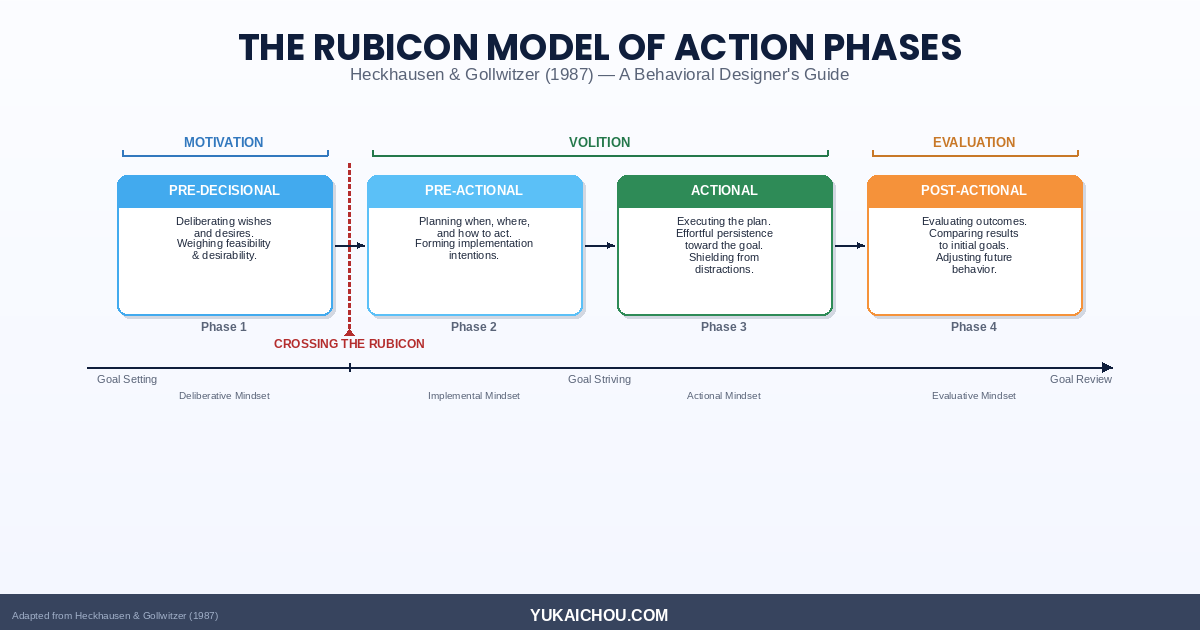
The Rubicon Model corrects the mistake with four phases:
- Predecisional phase (also called the motivational phase): you have a set of wishes. You weigh them against each other on desirability and feasibility. You choose one.
- Preactional phase (the first volitional phase): you have committed to a goal. Now you plan when, where, and how to act.
- Actional phase (the second volitional phase): you execute. You shield the goal from distractors. You persist when the action gets harder than expected.
- Postactional phase (the evaluative phase): you compare what happened to what you wanted. You reset for the next goal cycle.
The Rubicon is the line between phase 1 and phase 2. It is the cognitive boundary where a wish becomes a will, where deliberation ends and commitment begins. Naming the river was not academic flourish. Heckhausen and Gollwitzer wanted a word that captured the irreversibility of crossing: once Caesar moved his legion across, he could not un-cross. Once you form a goal intention, your brain does the same thing, and the cost of asking it to back across is measurable.
Two cognitive modes sit on opposite banks. On the predecisional side: the deliberative mindset, characterized by open-mindedness, balanced information processing, and accurate self-assessment. On the volitional side: the implemental mindset, characterized by goal-directed focus, optimism about feasibility, and active filtering of information that does not serve the chosen goal. The same person, the same brain, processes the world differently depending on which side of the Rubicon they are standing on.
This is the part the product designers I have advised at companies including LEGO, Microsoft, and Porsche tend to internalize fastest, because it explains a behavior they have all observed and never had a name for: the user who happily browses your free tier for weeks, clicks “upgrade,” sees a price comparison, and then bounces. They did not bounce because the price was too high. They bounced because you triggered fresh deliberation in someone who had already crossed the Rubicon. Their brain re-opened a closed file. Once that file is open again, the volitional momentum that brought them to the upgrade button is gone.
The Four Phases (and the Mindset Each One Requires)
The four phases of the Rubicon Model are more than sequential steps. Each one runs on a distinct cognitive engine, and each engine has its own information diet, its own decision speed, and its own failure mode. The phases are bridged by transitions you can see in attention, working memory, and recall.
Predecisional Phase — Deliberating Among Wishes
You start with wishes. The technical term Heckhausen used was Wunsch, deliberately chosen to distinguish the soft, exploratory quality of a wish from the hardness of a commitment. A wish is something you might want. A goal is something you will pursue. The predecisional phase is the cognitive space where wishes get weighed.
What gets weighed: desirability (how much do I want the outcome?) and feasibility (can I actually achieve it?). These are independent dimensions. A goal can be highly desirable and infeasible (becoming an Olympic gymnast at 45) or feasible and undesirable (eating more spinach this week). The predecisional phase exists to keep both dimensions in view at once.
The mindset that supports this work is the deliberative mindset. Gollwitzer’s 1990 experiments showed that people primed into a deliberative mindset processed pro and con information more evenly, recalled both sides of an argument more accurately, and gave more calibrated estimates of their own ability than people primed into an implemental mindset. The deliberative mindset is, in the most literal cognitive sense, open. It lets information in.
The failure mode of this phase is the one every adult knows: deliberation that never ends. The wishes get weighed, then re-weighed, then re-weighed again with fresh information that triggers another round. No phase 2 ever begins. Psychologists call this rumination when it is pathological and indecision when it is everyday. Both are predecisional phases that fail to terminate.
Preactional Phase — Planning the Action
You have crossed the Rubicon. You have a goal intention: “I will exercise four times this week.” The preactional phase is where you decide the rest: when, where, with whom, how. The classic finding here is Peter Gollwitzer’s implementation intentions research, which showed that adding a specific “when-and-where” plan to an existing goal intention roughly doubles follow-through rates across hundreds of studies.
The mindset shifts. You are no longer weighing whether to pursue this goal. You have decided. Your brain now wants the answer to a different question: what is the path? Implemental cognition is forward-looking, focused on means rather than ends, and selectively optimistic. The selective optimism is a feature, not a bug. People in implemental mode underestimate obstacles, overestimate their own ability, and resist information that suggests their goal is harder than they thought. From a pure-accuracy standpoint that looks like a bias. From a goal-completion standpoint it is functional. Brains that re-litigate the desirability of every goal at the planning stage do not complete goals.
The failure mode of this phase is no plan at all. A goal intention without an implementation intention is a wish dressed up in commitment language. The 2006 Gollwitzer-Sheeran meta-analysis (94 studies, over 8,000 participants) showed implementation intentions produced a medium-to-large effect on goal achievement (d = 0.65). The size of that effect is the size of the gap between “I want to do this” and “I will do this on Tuesday morning at 6:45 in my running shoes by the door.”
Actional Phase — Executing and Shielding
The plan meets the world. The actional phase is where the implemental mindset earns its keep. You face distractors, competing goals, fatigue, and unanticipated obstacles. Your job is to shield the goal: to keep working toward it even when something else looks more appealing in the moment.
The cognitive machinery of shielding is well-mapped. Goal shielding (Shah, Friedman, & Kruglanski, 2002) inhibits competing goals automatically when a focal goal is activated. The stronger your commitment to the focal goal, the harder the inhibition. People with strong self-concordance for their goals (Sheldon & Elliot, 1999) show better shielding than people pursuing goals for external reasons. People who use implementation intentions show better shielding than people who only have goal intentions.
Action shielding has its own failure mode: the action crisis, identified by Brandstätter and colleagues in 2013. When the actional phase runs into severe obstacles and shielding starts to fail, the implemental mindset can collapse back into a deliberative one. The person re-opens the question of whether the goal was worth pursuing in the first place. This is psychologically expensive and behaviorally destabilizing. Most goals abandoned mid-pursuit are abandoned during an action crisis, not because the obstacle was insurmountable but because the cognitive mode shifted and the new mode reached a different conclusion.
Postactional Phase — Evaluating and Resetting
The action ends. Either you achieved the goal or you did not. The postactional phase is where you compare outcome to intention, learn from the comparison, and reset your cognitive system for the next goal cycle.
The mindset that supports this work is evaluative rather than deliberative or implemental, although it shares more with the deliberative side. You are no longer defending the goal. You are looking at what happened with relative honesty. Did the outcome match the intention? If not, why? Was the goal misspecified? Was the plan flawed? Did unexpected obstacles arise? Did shielding fail?
The failure mode of this phase is two-fold. On one side: skipping evaluation entirely and rolling immediately into the next goal cycle without learning. On the other: getting stuck in the evaluation, dwelling on the gap between outcome and intention until it becomes its own form of rumination. Both undermine the next predecisional phase. The skipper goes in blind. The dweller goes in demoralized.
The Rubicon Itself: Why That Line Matters
The Rubicon is not a metaphor. It is a measurable cognitive transition with observable effects on attention, memory, decision speed, and self-assessment. Cross it and you become a different information processor. Recross it and you become the first one again. The brain treats “deliberating about a goal” and “executing a goal” as different jobs and gives them different cognitive resources.
Three lines of evidence make this concrete.
First, attention. Gollwitzer and Heinze (1992) showed that people in an implemental mindset selectively attend to information that supports goal pursuit and filter out information that would reopen the choice. People in a deliberative mindset attend to both sides of an argument more evenly. The same picture, the same paragraph, the same web page produces different fixation patterns depending on which side of the Rubicon the viewer is on.
Second, memory. Taylor and Gollwitzer (1995) demonstrated that the implemental mindset produces optimistic self-evaluations that are not present in the deliberative mindset. The same person, asked the same self-assessment questions, answers more optimistically after being primed into an implemental mode. This is not lying. The questions are retrieving different information from memory. The implemental mode foregrounds memories of past successes and capability. The deliberative mode retrieves both successes and failures evenly.
Third, decision speed. Pre-Rubicon, decisions take longer. Post-Rubicon, the same decisions take less time, partly because fewer options are being considered and partly because the brain has stopped weighing alternatives at all. The classic illustration is the menu effect: in a deliberative mindset you read every entree on the menu and weigh them. In an implemental mindset, you order what you ordered last time without re-reading the menu. Same restaurant, same hunger, two cognitive modes.
The reason this matters for design: the cost of asking someone to recross the Rubicon is high. When a product triggers fresh deliberation in someone who has already crossed, three things happen at once. Attention reopens to alternatives. Memory pulls up past failures and reasons to doubt. Decision speed slows back down. The user does not bounce because they decided against you. They bounce because you forced them back into a slower, more skeptical, more option-aware processing mode, and the friction of that mode was higher than the activation energy of staying with you.
This is the failure mode behind every “Are you sure you want to upgrade?” confirmation dialog that kills conversion. Every premium-tier comparison page that lists what you would lose by not upgrading. Every onboarding flow that asks for a goal-setting commitment before the user has finished evaluating whether the app is worth using. Each one is a Rubicon reset wearing a UX disguise.
The Mindset Theory of Action Phases (MAP)
What Heckhausen and Gollwitzer formalized into the Mindset Theory of Action Phases is the claim that the four phases of the Rubicon Model do not just look different from the outside. They are processed differently from the inside. Each phase recruits its own cognitive mode, and the mode determines what the person can perceive, remember, and reason about.
The deliberative and implemental mindsets are the two main characters. The deliberative mindset is the cognitive mode of the predecisional phase. The implemental mindset is the cognitive mode of the preactional and actional phases. The postactional phase uses a third mode that blends evaluation with elements of both, sometimes called the evaluative mindset in later writing.
Four properties distinguish the deliberative and implemental modes:
- Information processing: deliberative is balanced and open. Implemental is selective and goal-protective. The deliberative mind takes in pros and cons evenly. The implemental mind privileges information that serves the chosen goal.
- Self-perception: deliberative is calibrated. Implemental is selectively optimistic. The deliberative mind sees its own strengths and weaknesses with relative accuracy. The implemental mind tilts toward strengths, partly because that tilt sustains effort under uncertainty.
- Reasoning style: deliberative weighs alternatives. Implemental commits to a path. The deliberative mind asks “which is better, A or B?” The implemental mind asks “how do I make A work?”
- Emotional tone: deliberative tolerates ambiguity. Implemental wants resolution. The deliberative mind sits comfortably with “I don’t know yet.” The implemental mind treats uncertainty as something to be closed.
The most surprising experimental finding from this literature is how easy the mindsets are to manipulate. Gollwitzer’s priming protocols (asking participants to think about an unresolved personal problem versus a resolved one, for example) flip the mode in minutes. The same person, ten minutes apart, processes information differently depending on which mode the experimenter has just primed. Mindsets are not deep personality traits. They are shallow, fast, situational shifts. Which is why design choices can move them: a single page of comparison-shopping content can flip a user back into a deliberative mode whether the designer wanted that or not.
The Rubicon Model is incomplete without MAP. The four phases describe what is happening in sequence. The mindsets describe what is happening in cognition. Together they map the same goal pursuit from two angles and explain why the same person feels and behaves so differently in week one of a habit attempt versus week six.
What Heckhausen and Gollwitzer Got Right
Stage models in psychology have a mixed track record. Many of them turn out to be smooth fictions imposed on messy data. The Rubicon Model has held up better than most, and it is worth saying clearly what it got right, because the parts that are right are still the parts behavioral designers most need.
The biggest correct call: separating motivation from volition. Decades of motivational research before Heckhausen treated “motivation” as a single construct with a magnitude. The Rubicon Model showed that the variables predicting goal selection and the variables predicting goal completion are different families. Desirability and feasibility drive selection. Implementation, shielding, and reset drive completion. A behavior change intervention that improves desirability but never crosses the Rubicon increases wishes, not actions. A behavior change intervention that bolts on implementation tools to people who never deliberated produces compliance without commitment, which extinguishes the moment the prompt is removed.
The second correct call: phase-appropriate cognition. By insisting that each phase has its own cognitive mode, Heckhausen and Gollwitzer predicted in advance the experimental findings about deliberative versus implemental attention, memory, and self-assessment. Those findings have replicated across dozens of labs. They explain phenomena that simpler motivation theories (Theory of Planned Behavior, for example) cannot, including why goal-intention strength predicts much less follow-through variance than people expected and why implementation intentions add so much explanatory power on top.
The third correct call: the irreversibility of the crossing. Heckhausen and Gollwitzer claimed that once a goal intention forms, the cost of dissolving it is substantial. Twenty years of subsequent research on commitment, escalation, sunk-cost effects, and goal disengagement bears this out. People do not unmake commitments lightly. The brain treats unmaking a commitment as a different operation from making a new one, and the unmaking is more cognitively expensive. The Rubicon is a real cliff in cognitive cost.
The fourth correct call: the Action Crisis. Brandstätter and her colleagues identified the action crisis as a distinct psychological state in 2013, twenty-six years after the original Rubicon paper. The phenomenon was implicit in Heckhausen and Gollwitzer’s framework all along: shielding fails, the implemental mindset wavers, and the person re-opens the deliberation file mid-action. Naming it gave clinicians and designers something to target. Most goal abandonment now traceable to action crises rather than original-goal weakness.
Where the Rubicon Model Falls Apart
The Rubicon Model is not without problems. Three are worth naming directly, because each one shows up in the field every time a designer tries to apply the framework without modification.
The Boundary Is Not as Clean as the Diagram
The four-phase diagram, with crisp lines between predecisional and preactional, between actional and postactional, suggests a sequence as clean as a relay race. The empirical reality is messier. Real goal pursuit cycles back and forth. A user mid-execution hits an obstacle and re-opens the deliberation. A planner mid-planning realizes the goal was wrong and steps back to predecision. The Action Crisis literature makes this explicit. The model’s pedagogical simplicity is also its empirical weakness. People do not move through the phases like the diagram suggests. They move through them like a river meanders.
The fix is not to throw away the model. It is to read the phases as states a person can be in, not steps they pass through once. The state can change, sometimes rapidly. A skilled designer can read which state the user is in right now and adjust the intervention to match it, instead of forcing the user through a fixed sequence.
What Actually Crosses the Rubicon Is Underspecified
The original model says: the wish becomes a will. It does not say much about what makes the becoming happen. Subsequent research has filled in some of the gap. Heckhausen and Gollwitzer suggested the crossing is preceded by a calculation of expectancy times value plus a feasibility threshold. Other researchers have pointed to identity activation (Oyserman’s identity-based motivation work), to public commitment (Cialdini’s consistency principle), and to action plans themselves (the act of forming a plan can retroactively confirm the goal intention).
The reality is probably plural. There is no single mechanism that crosses the Rubicon. There are several, and they can substitute for one another. A goal intention can form because the wish reached enough strength to tip over a threshold. Or because a public commitment locked it in. Or because an identity story made the wish self-defining. Or because an external prompt forced a yes-or-no choice that ended deliberation by removing the option to keep deliberating. The model would be cleaner if it acknowledged this plurality directly.
The Model Is Built on a Western, Individual, Choice-Saturated Assumption
Heckhausen and Gollwitzer studied undergraduates in 1980s Germany. The Rubicon Model implicitly assumes a person with many options, who deliberates, who commits, who executes. Cross-cultural psychology has shown this is not the universal shape of goal pursuit. In many cultural contexts, goals are inherited from family, role, or community rather than chosen from a menu of personal wishes. The predecisional phase looks structurally different when the wish was not yours to weigh.
This does not invalidate the model. It limits its scope. The Rubicon Model maps individual, agentic, choice-based goal pursuit unusually well. It maps obligation, duty, and assigned goals less well. For a behavioral designer working in a Western consumer context, the model fits the user. For a designer working on, say, a chronic disease management program in a multigenerational household, the model needs supplements (Self-Determination Theory’s relatedness construct, for instance) to capture what is actually happening.
What’s Really Happening Inside the Brain
The Rubicon Model was proposed before functional brain imaging matured. Heckhausen described the phases in behavioral and phenomenological terms. The neural correlates have been filled in since, and they confirm something the model only hinted at: the deliberative and implemental modes recruit recognizably different brain systems.
Deliberation lives in a network anchored by the dorsolateral prefrontal cortex (dlPFC) and ventromedial prefrontal cortex (vmPFC), together with the anterior cingulate cortex (ACC). The dlPFC handles working-memory load: holding multiple options in mind, comparing them against each other, weighing trade-offs. The vmPFC computes subjective value: how good does this outcome feel relative to that one? The ACC monitors for conflict between options. When this network is active, you are in a deliberative mode. The hallmark is slower decision times, more even attention to alternatives, and the subjective experience of being “in two minds.”
Implementation recruits a partially different network. The dlPFC stays involved, but its job shifts from option-comparison to plan-maintenance. The supplementary motor area and the basal ganglia carry more load: representing the action sequence, queuing it for execution, inhibiting competing motor programs. The vmPFC continues to compute value, but for the chosen goal only. The neural signature of an active implementation intention is a shift toward action-system dominance and away from value-comparison dominance. The brain stops asking “which one?” and starts asking “how do I do this one?”
The transition between the modes (the Rubicon crossing) is harder to image directly because it can happen quickly. The available evidence suggests the anterior cingulate handles part of the switch: it detects when deliberation has converged on a chosen option, and it gates the transition from comparison-mode to execution-mode. Damage to the ACC produces a clinical syndrome (akinetic mutism in severe cases) where the person can deliberate but cannot translate deliberation into action. The Rubicon, in this view, has neural plumbing. When that plumbing is broken, the bridge from wish to will breaks too.
Shielding has its own circuitry. Goal shielding involves frontostriatal loops that down-regulate competing goals when a focal goal is active. The strength of the down-regulation correlates with measured commitment. People who report stronger self-concordance for a goal show stronger neural shielding of that goal against distractors. People reporting goal ambivalence show weaker shielding. The Rubicon Model’s claim that the implemental mindset protects the chosen goal is, in modern neural terms, a claim about how much frontostriatal inhibition the brain is willing to spend defending the goal.
The action crisis has a neural signature too. When shielding starts to fail, the dlPFC and ACC re-engage in comparison mode while the action system is still trying to execute. The two systems pull against each other. The phenomenology is recognizable to anyone who has tried to push through a workout while their brain keeps offering reasons to stop. The neural picture is two networks contesting control. Whichever wins determines whether the action continues.
Rubicon vs Other Theories
The Rubicon Model occupies a particular position in motivation theory. It is neither the most-cited nor the highest-prestige model. It is more useful than most. Comparing it to the four most adjacent theories shows where its design value sits.
Rubicon vs Theory of Planned Behavior (Ajzen, 1991)
The Theory of Planned Behavior (TPB) predicts behavior from intention, and intention from attitude, subjective norm, and perceived behavioral control. It has been the workhorse of behavior-change research for thirty years and has produced thousands of studies.
The Rubicon Model adds a crucial second half. TPB stops at intention. It treats “intention” as the proximate cause of behavior and leaves the gap between intention and action mostly unaddressed. Meta-analyses consistently find that intention explains only a modest fraction of behavioral variance, even though TPB treats it as the central variable. The Rubicon Model identifies the missing piece: forming an intention is only phase 1. Phases 2, 3, and 4 are where the implementation, shielding, and reset happen. A theory that stops at intention is a theory that explains why people decide to exercise. It does not explain why they actually exercise. Those are different problems.
In practice, the two are complementary. Use TPB to design interventions that strengthen the formation of intention. Use the Rubicon Model to design interventions that move people through the volitional phases after the intention forms.
Rubicon vs MASK00039 (Schwarzer, 1992)
HAPA is the Rubicon Model’s closest relative. Ralf Schwarzer explicitly built HAPA on the motivational-volitional split that Heckhausen and Gollwitzer formalized. HAPA divides goal pursuit into a Motivational Phase (analogous to Rubicon’s predecisional) and a Volitional Phase (analogous to Rubicon’s preactional and actional), with subgroups (Preintender, Intender, Actor) inside the volitional phase.
The differences are matters of emphasis. HAPA was built for health behavior specifically and includes constructs like Risk Perception, Outcome Expectancies, and Action and Coping Self-Efficacy that the Rubicon Model leaves implicit. The Rubicon Model is more general and more theoretical. HAPA is more applied and more health-flavored.
For a designer who needs to plan an intervention for medication adherence, exercise habits, or other health behaviors, HAPA is often the more directly usable framework. For a designer who needs to understand the underlying cognitive transitions in any goal pursuit, the Rubicon Model is the parent theory worth knowing.
Rubicon vs Implementation Intentions (Gollwitzer, 1999)
Implementation intentions are the killer app of the Rubicon Model. Gollwitzer extracted them from the preactional phase and turned them into a stand-alone intervention. The if-then planning structure (“If situation X arises, then I will perform action Y”) has been tested in hundreds of studies across domains: exercise, dietary change, medication adherence, prejudice reduction, academic performance.
Implementation intentions work because they automate the actional phase. The plan, encoded in if-then form, creates a situation-action link that fires when the situation is detected, even without conscious deliberation. They are, in Rubicon terms, the preactional phase converted into a portable cognitive prosthetic.
The relationship between Rubicon and implementation intentions is parent-child. Implementation intentions live inside the Rubicon Model. You cannot understand why they work or when they fail without the larger frame. They fail when the underlying goal intention is weak (phase 1 incomplete). They fail when applied to actions that require flexibility rather than automaticity. They fail when the if-condition is too vague to trigger reliably. All three failure modes are predictable from the Rubicon Model.
Rubicon vs Self-Determination Theory (Deci & Ryan)
Self-Determination Theory (SDT) is the major theory the Rubicon Model does not directly compete with, because SDT is about the why of motivation (autonomous vs controlled) while Rubicon is about the structure of motivation across time. They are orthogonal axes.
Combined, they make a useful 2×4 map. A goal can be autonomous (chosen for its own sake) or controlled (chosen under external pressure). A goal can also be in any of the four Rubicon phases. Autonomous goals in the actional phase tend to maintain shielding well. Controlled goals in the actional phase are far more vulnerable to action crises, because the implemental mindset has less material to defend with. Sheldon and Elliot’s Self-Concordance Model is the SDT-Rubicon hybrid in plain view: it predicts that goals high in self-concordance (autonomous SDT regulations) move through the Rubicon phases more successfully because they generate more sustained effort allocation.
For practical work: use SDT to evaluate the quality of motivation. Use Rubicon to evaluate the phase of motivation. Both diagnoses matter.
The Rubicon Model in the Real World
Theory is cheap. The test is whether a model changes the design choices you make. Four domains where the Rubicon Model changes what good design looks like:
Product Onboarding and Conversion
The single largest application is the freemium-to-paid conversion. A user who has been browsing a free tier for weeks has not formed a goal intention to upgrade. They are still in the predecisional phase. They are deliberating, with the question framed as “is this product worth paying for?” The deliberative mode is on. Information is being weighed evenly.
A well-designed conversion flow recognizes the phase the user is in and does the work of helping them cross the Rubicon, not the work of execution. That means: helping them weigh desirability and feasibility, surfacing the evidence that resolves their hesitation, and removing options that prevent a yes-or-no commitment. The wrong moves: presenting a four-tier pricing matrix (this triggers a fresh deliberation), or skipping to a five-step checkout flow (this asks for execution before commitment).
After the Rubicon is crossed (the user clicks “upgrade,” selects a plan) the design priorities invert. Now you do not want fresh deliberation. You want the implementation phase to complete cleanly: a fast, minimal-friction checkout. Adding a confirmation dialog at this point is the most expensive friction in product design. The user already crossed. Asking them to recross is asking for a Rubicon reset.
Workplace Goal-Setting
The quarterly Objectives and Key Results (OKR) ritual at most companies is a Rubicon Model violation at scale. Teams gather, deliberate about goals, set them. The deliberation is collective, which means some team members never personally cross the Rubicon. They were present for the deliberation but did not form an individual goal intention. They show up to the actional phase with a wish, not a will, and predictably under-deliver.
The fix is not more accountability theater. It is to recognize that goal-setting needs to happen at the individual level even when the team-level goal is set collectively. Each person needs their own crossing. Implementation intentions are the cheapest way to confirm the crossing happened: ask each team member to specify when, where, and how they will work on their part of the goal. The act of writing the implementation intention is itself a Rubicon marker. People who cannot write a concrete if-then have not crossed.
Education and Learning
Most online courses fail at the actional phase, not the predecisional. The signup is the predecisional phase, completed too easily. The first lesson is the start of the actional phase. By lesson three, the action crisis hits. The user re-opens the question of whether the course is worth the time, the implemental mindset wavers, and the next lesson does not get clicked.
The interventions that work in this domain target the action crisis specifically. Spaced reminders that restate the goal (not the action) re-engage the implemental mindset. Public commitments at signup (visible to peers) raise the cost of recrossing the Rubicon. Implementation intentions formed at signup (“I will study Tuesdays at 8 PM”) reduce reliance on real-time decision-making, which is where shielding fails first.
Health Behavior
This is HAPA’s territory but the Rubicon Model adds something HAPA leaves implicit: the postactional phase. Most health behavior interventions terminate at goal achievement (“you completed your 30-day exercise challenge”) and provide no evaluative scaffolding. The user finishes, feels good, and rolls immediately into the next goal cycle without learning. Or worse, finishes, sees the gap between effort and outcome, and rolls into the next cycle demoralized.
A Rubicon-informed health design does the postactional work explicitly. It surfaces the comparison between intention and outcome. It helps the user attribute the result to the right cause (was the goal good? was the plan flawed? was the obstacle situational?). It then resets the user for the next predecisional phase deliberately, with the lessons from this cycle on the table. This is the difference between an app that gamifies a single challenge and an app that builds long-term behavior change.
The Elephant in the Room: Why Most Designers Miss the Crossing
If the Rubicon Model is this useful, why is it not standard in product and behavior-change design? Three reasons, and saying them out loud is part of the work.
First, the model is invisible at the level of analytics. Most product teams instrument clicks, page views, conversion funnels. They do not instrument cognitive mode. There is no event in your data layer that says “user crossed Rubicon at 14:32 on Tuesday.” The phase a user is in is inferable but not observable. Teams that do not name the phenomenon do not measure it. Teams that do not measure it cannot optimize for it. The Rubicon Model asks designers to take a cognitive variable seriously without giving them a dashboard for it.
Second, the model contradicts a deeply-held design intuition: that more information is always better. The Rubicon Model says the opposite. Information is good in the predecisional phase, where it helps the deliberative mode work well. Information is friction in the volitional phases, where it can recross the Rubicon and undo the commitment that brought the user this far. The same content (a pricing comparison, a feature comparison, a privacy disclosure) helps one user and harms another depending on the phase they are in. Most teams are not allowed to ship information that the legal department would want and the marketing department would defend, regardless of phase. The model would have them gate that information by phase, and few design systems can do that.
Third, the model requires diagnosis before intervention. To apply it well, you have to ask: what phase is this user in right now? Most teams skip the diagnosis and reach straight for an intervention. Add a CTA. Add a popup. Add an email. Add a notification. The Rubicon Model would have the team ask first: is the user pre-Rubicon (still deliberating) or post-Rubicon (committed but stuck in execution)? The intervention that fits a deliberating user (more evidence, more comparison) is the exact intervention that hurts a committed user. The intervention that fits a committed user (clearer path, less friction) is the exact intervention that fails a deliberating user. Treating all users the same with the same intervention is the design default, and the Rubicon Model says the default is wrong.
The path forward is to instrument behavior in ways that infer phase, even imperfectly. A user who has bounced between three tiers on the pricing page is probably still deliberating. A user who has clicked “upgrade” once is probably post-Rubicon. A user who has used the product daily for a month and then suddenly opens the cancellation page is probably in an action crisis. None of these inferences require new instrumentation. They require the model to be present in the team’s vocabulary, so that someone notices the pattern and asks the right question.
How to Apply the Rubicon Model with the Octalysis Framework
The Rubicon Model and the Octalysis Framework are not competitors. They are complements. The Rubicon Model describes the temporal architecture of goal pursuit. The Octalysis Framework describes the eight Core Drives that supply motivation throughout that architecture. Pairing them turns abstract phase theory into a design playbook.
The Octalysis Framework decomposes human motivation into eight Core Drives, each one a distinct psychological lever that can be designed for or against. Cross those eight Core Drives with the four Rubicon phases and you get a 32-cell matrix of design opportunities. Most products only use a fraction of it.

Designing for the Predecisional Phase
The user is deliberating. The deliberative mindset is on. Your job is to help them weigh wishes well, not to push them to a premature commitment. The Core Drives that operate naturally in this phase are the meaning-and-curiosity drives.
Core Drive 1 (CD1): Epic Meaning & Calling is the most powerful predecisional lever. A user who connects your product to something bigger than themselves (their identity, their values, a cause they care about) has elevated the desirability of the wish in a way that makes the Rubicon crossing more likely. Wikipedia’s donation campaigns are a textbook CD1-predecisional play. Before any commitment to donate, the brand activates “you are part of something that matters.”
Core Drive 7 (CD7): Unpredictability & Curiosity carries the rest of the predecisional weight. Curiosity is the cognitive state that keeps the deliberative mode active. Mystery in your value proposition, ambiguity about what the full product can do, hints at hidden depth all keep the user weighing rather than dismissing. Duolingo’s first-lesson experience uses CD7 hard: the user does not yet know what mastery here will feel like, and the curiosity carries them across the Rubicon to download the app and commit to day-one.
Core Drive 3 (CD3): Empowerment of Creativity & Feedback can also operate in this phase, especially in tools where the deliberation is “will I be able to make something good with this?” Showing what other users have created (without yet asking the new user to create) helps the predecisional weighing.
The Core Drive most often misused in this phase is Core Drive 6 (CD6): Scarcity & Impatience. A countdown timer on a signup page is an attempt to force the Rubicon crossing through urgency. It can work for low-stakes commitments and it consistently fails for high-stakes ones, because high-stakes commitments require the deliberative mode to complete its work first. Forcing the crossing with scarcity bypasses the deliberation, and the resulting commitment is fragile.
Designing the Rubicon Crossing Itself
The crossing is brief. It is the moment of yes. The Core Drive that anchors it is Core Drive 4 (CD4): Ownership & Possession. The act of forming a goal intention is, psychologically, an act of taking ownership of the goal. “This is my goal now” is a CD4 statement.
Design choices that make ownership feel natural at the crossing: naming the goal in the user’s own words (Strava’s “What’s your next adventure?” prompt rather than “Choose a workout plan”). Letting the user customize the goal even slightly before committing. Visualizing the goal as a thing the user now possesses (Habitica turns goals into game characters the user has named and dressed). Each of these makes the crossing easier and the resulting commitment more durable.
Core Drive 5 (CD5): Social Influence & Relatedness also plays at the crossing through public commitment. Announcing the goal to others (or to a community) raises the cost of recrossing the Rubicon. Cialdini’s consistency principle predicts this. The Rubicon Model explains why: the public commitment makes the volitional phases more efficient by reducing the probability of re-deliberation.
Designing for the Preactional Phase
The user has committed. They are planning. The deliberative mode is off. The implemental mode is on. The relevant Core Drives shift.
Core Drive 2 (CD2): Development & Accomplishment is the engine of preactional design. The user wants to know: what is the path? What is the first step? What does progress look like? A well-designed preactional flow shows the path as a clear sequence of accomplishments. Duolingo’s skill tree, Strava’s training plans, and every onboarding checklist that works are CD2-preactional designs.
Core Drive 3 (CD3) provides the planning surface itself. Customization, calendar integration, plan-setting tools all live here. The user’s implementation intentions are formed in this space, and the cleaner the planning surface, the better the implementation intentions get.
The mistake most designers make in this phase is to reopen deliberation. Showing the user other plans they could have chosen, comparing their selection to a benchmark, asking “are you sure?” all trigger a recrossing. Once the user has crossed, the design’s job is to make the path easier, not to confirm the commitment.
Designing for the Actional Phase
Execution. Shielding. This is where most behavior-change products live and where most of them fail. The Core Drives that earn their keep here are the accomplishment and feedback drives, plus the carefully-deployed black-hat drives for shielding.
Core Drive 2 (CD2) continues to carry weight through progress feedback. Streaks, completion bars, milestones all reinforce the actional commitment. The Rubicon Model adds the explanation for why streaks are so powerful: a broken streak is a recrossing of the Rubicon. The user re-opens the deliberation file. The behavior most likely to maintain the actional phase is the behavior that makes recrossing feel costlier than continuing.
Core Drive 3 (CD3) provides real-time feedback that keeps the implemental mode active. Visible progress, in-the-moment correction, and immediate confirmation that the action is working all sustain the implemental mindset.
Core Drive 6 (CD6): Scarcity & Impatience and Core Drive 8 (CD8): Loss & Avoidance can be deployed in the actional phase for shielding, but with extreme caution. A streak that you might lose (CD8) shields the goal effectively, but at the cost of stress. A limited-time challenge (CD6) shields by raising the cost of dropping out. These are black-hat techniques in Octalysis terms: they work, they sustain action, and they erode autonomous motivation if used constantly. The right deployment is sparing, time-limited, and tied to specific shielding moments rather than constant pressure.
The action crisis warrants its own design surface. When a user shows signs of action crisis (consecutive missed days, longer time-to-next-action, skipped optional features), the right intervention is not to push harder. The right intervention is a controlled re-entry to the deliberative mode: a chance for the user to acknowledge the difficulty, possibly adjust the goal, and rebuild the commitment on slightly altered terms. Calm.com’s “Take a break, come back when you’re ready” framing is a Rubicon-aware response to action crisis. The push-harder response is not.
Designing for the Postactional Phase
The action ended. The user is now in a brief, valuable evaluative state. Most products skip this phase entirely. The Core Drives that pay off here are reflective and identity-anchoring.
Core Drive 1 (CD1) closes the loop. The user needs to see that what they just did connected to the larger meaning they identified in the predecisional phase. Year-in-review summaries (Spotify Wrapped, Strava’s year-end recap) are CD1-postactional designs. They take the actions of the past year and surface the meaning underneath them.
Core Drive 4 (CD4) consolidates the achievement as part of the user’s identity. Badges, certificates, and stat-pages that the user can keep all serve this function. The point is not the badge. The point is the user’s self-narrative: “I am someone who completed this.”
Core Drive 5 (CD5) supports the social return. Sharing the achievement, comparing to peers, contributing the result back to a community all close the loop in a relational way that single-user achievement does not.
The design move most often skipped: deliberately resetting the user for the next predecisional phase. A user who finished a 30-day challenge and is then immediately pushed into the next challenge has been denied the postactional evaluation. The result is short-term streak extension and long-term burnout. The Rubicon-informed alternative is a brief, structured postactional pause: a few questions about what worked, what did not, and what the user wants to try next. Then the next predecisional phase begins with intention, not momentum.
Practical Steps: Applying the Rubicon Model This Week
- Audit one product flow for phase mismatches. Pick the most important conversion or behavior-change flow in your product. Walk through it as a user. At each screen, ask: what phase is the user most likely in? What cognitive mode does this screen require? Mark the screens where the mode being requested does not match the phase the user is likely in. Those are your highest-leverage design fixes.
- Identify your Rubicon moment explicitly. What is the specific event in your product where the user goes from deliberating to committed? For most products it is buried inside a button or a step. Surface it. Name it on your design surface (“You’re in”, “Set”, “Locked in”). Make the crossing visible to the user, and you make the commitment more durable.
- Add implementation intentions to your onboarding. If your product depends on repeated behavior, ask new users for an if-then plan at signup. “When (specific trigger), I will (specific action).” The implementation intention is both an intervention (it doubles follow-through) and a diagnostic (users who refuse to specify have not crossed the Rubicon).
- Detect and respond to action crisis. Identify the behavioral signals that suggest a user’s implemental mindset is failing: missed sessions, increased time-to-action, browsing the cancellation page. Build a response that allows controlled re-entry to deliberation rather than pushing harder on execution.
- Build a postactional surface. For every meaningful goal cycle in your product, design what happens after the user finishes. Show the comparison between intention and outcome. Help with attribution. Reset the user for the next cycle deliberately. The postactional surface is the cheapest retention investment most products have not made.
- Resist re-deliberation triggers in volitional phases. Audit your product for places where post-Rubicon users encounter content designed for pre-Rubicon users. Pricing comparison pages on the checkout flow. Feature comparison popups during a paid session. Confirmation dialogs that reopen the choice. Remove or gate them by user state.
- Build phase awareness into your team’s vocabulary. The most underrated step. When the model is part of how the team talks about users, the team starts noticing phase mismatches naturally. “We’re asking implemental from a predecisional user” becomes a sentence people say out loud, and the design problems get caught at the whiteboard rather than in the post-mortem.
The Rubicon Model Was the Beginning, Not the End
Heinz Heckhausen died in 1988, one year after the Rubicon Model’s introduction. He did not see its full influence. Peter Gollwitzer, his student, carried the work forward into the implementation intentions research that has shaped behavior change for the next three decades. The Mindset Theory of Action Phases sat alongside it. The Action Crisis literature came two decades later. The neuroscience that fills in the brain side is still being written.
Forty years after the original paper, the Rubicon Model is still teaching something most behavioral designers have never been taught. The cognitive boundary between deliberation and execution is real. Honoring it makes behavior-change products work. Violating it explains most of the failures the field is still calling “motivation problems.”
If a single piece of this guide changes how you design tomorrow, I would want it to be this: stop treating users as having a single cognitive mode. Ask what side of the Rubicon they are on. Design for that side. The same product, the same user, the same Tuesday afternoon, processes the world differently depending on whether the wish has become a will.
The river is still there, and your users are still crossing it. The question is whether your design knows where the riverbank is.
Frequently Asked Questions
What is the Rubicon Model of Action Phases in simple terms?
The Rubicon Model is a four-phase map of goal pursuit, introduced by Heinz Heckhausen in 1987 and developed with Peter Gollwitzer. The phases are predecisional (deliberating about which wish to pursue), preactional (planning how to act on the chosen goal), actional (executing and protecting the goal from distractors), and postactional (evaluating the outcome and resetting). The phases are divided by a cognitive boundary called the Rubicon, where a wish becomes a will and the brain switches from a deliberative processing mode to an implemental one.
Who came up with the Rubicon Model?
Heinz Heckhausen introduced the model in 1987. His student Peter Gollwitzer developed it through the 1990s, formalizing the Mindset Theory of Action Phases and extracting implementation intentions as a stand-alone intervention. Subsequent contributors include Veronika Brandstätter (action crisis research) and an entire generation of behavior-change researchers who have built on the framework.
Why is it called the “Rubicon” Model?
The Rubicon is a small river in northern Italy that Julius Caesar crossed in 49 BCE with his legion, an act that committed him irreversibly to civil war. Heckhausen used the historical crossing as a metaphor for the cognitive transition between deliberation and execution. The metaphor captures the irreversibility of the transition: once a wish becomes a will, the cost of dissolving the commitment is substantial, just as Caesar could not un-cross his river.
What is the difference between the deliberative and implemental mindsets?
The deliberative mindset is open, balanced, and accuracy-oriented. It is the cognitive mode of the predecisional phase, where you weigh wishes and assess feasibility. The implemental mindset is goal-focused, selectively optimistic, and action-oriented. It is the cognitive mode of the preactional and actional phases, where you plan and execute. The two modes recruit different brain networks and produce measurably different attention, memory, and decision-speed patterns in the same person.
How does the Rubicon Model relate to implementation intentions?
Implementation intentions are the Rubicon Model’s most influential application. The if-then planning structure (“If situation X arises, then I will perform action Y”) lives in the preactional phase. Implementation intentions work because they automate the actional phase: the plan, encoded in if-then form, creates a situation-action link that fires when the situation is detected, reducing reliance on real-time deliberation. The 2006 Gollwitzer-Sheeran meta-analysis of 94 studies showed implementation intentions produced a medium-to-large effect on goal achievement.
What is an action crisis?
The action crisis, identified by Veronika Brandstätter and colleagues in 2013, is the psychological state where shielding in the actional phase starts to fail and the implemental mindset wavers. The person re-opens the question of whether the goal was worth pursuing in the first place. Most goal abandonment mid-pursuit traces to action crises rather than to original-goal weakness, because the cognitive mode shifts back to deliberative and the new mode reaches a different conclusion than the implemental mode would have.
How is the Rubicon Model different from the Theory of Planned Behavior?
The Theory of Planned Behavior (TPB) stops at intention. It predicts behavior from intention and intention from attitude, subjective norm, and perceived behavioral control. The Rubicon Model adds the second half: forming an intention is only phase 1, and the volitional phases that follow are where most behavior-change variance lives. Meta-analyses show TPB intention explains only a modest fraction of behavioral variance, while implementation intentions (extracted from the Rubicon Model) add substantial explanatory power on top of TPB intention.
How does the Rubicon Model apply to product design?
The single largest application is recognizing the phase a user is currently in and matching the design intervention to that phase. Pre-Rubicon users (still deliberating) need information that helps them weigh wishes. Post-Rubicon users (committed) need a frictionless path through the volitional phases and active protection from content that would re-deliberate. Most conversion failures and engagement drops trace to phase mismatches: requesting implemental commitment from a deliberating user, or triggering fresh deliberation in a committed user.
What are the limitations of the Rubicon Model?
Three limitations stand out. First, the phases are pedagogically clean but empirically messier: real users move back and forth between phases rather than progressing linearly. Second, the model is underspecified about what actually causes the Rubicon crossing; multiple mechanisms (expectancy-value calculation, identity activation, public commitment) can substitute for one another. Third, the model is built on Western, individual, choice-based assumptions and fits less well in cultural contexts where goals are inherited from family, role, or community rather than chosen from a personal menu of wishes.
How does the Rubicon Model integrate with the Octalysis Framework?
The Rubicon Model and the Octalysis Framework operate at different levels and combine naturally. The Rubicon Model describes the temporal architecture of goal pursuit (the four phases and their mindsets). The Octalysis Framework decomposes the eight Core Drives that supply motivation throughout that architecture. Different Core Drives are load-bearing in different phases: Core Drive 1 (Epic Meaning) and Core Drive 7 (Unpredictability) dominate the predecisional phase; Core Drive 4 (Ownership) anchors the Rubicon crossing; Core Drive 2 (Accomplishment) and Core Drive 3 (Creativity & Feedback) carry the actional phase; Core Drive 1 and Core Drive 4 close the loop in the postactional phase.
References
- Heckhausen, H., & Gollwitzer, P. M. (1987). Thought contents and cognitive functioning in motivational versus volitional states of mind. Motivation and Emotion, 11(2), 101–120.
- Heckhausen, H. (1991). Motivation and Action. Springer-Verlag.
- Gollwitzer, P. M. (1990). Action phases and mind-sets. In E. T. Higgins & R. M. Sorrentino (Eds.), Handbook of motivation and cognition: Foundations of social behavior (Vol. 2, pp. 53–92). Guilford Press.
- Gollwitzer, P. M. (1999). Implementation intentions: Strong effects of simple plans. American Psychologist, 54(7), 493–503.
- Gollwitzer, P. M., & Heinze, R. (1992). Reflection: an exploration of the link between mind and mood. Unpublished manuscript, Max Planck Institute for Psychological Research, Munich.
- Gollwitzer, P. M., & Sheeran, P. (2006). Implementation intentions and goal achievement: A meta-analysis of effects and processes. Advances in Experimental Social Psychology, 38, 69–119.
- Taylor, S. E., & Gollwitzer, P. M. (1995). Effects of mindset on positive illusions. Journal of Personality and Social Psychology, 69(2), 213–226.
- Brandstätter, V., Herrmann, M., & Schueler, J. (2013). The struggle of giving up personal goals: Affective, physiological, and cognitive consequences of an action crisis. Personality and Social Psychology Bulletin, 39(12), 1668–1682.
- Shah, J. Y., Friedman, R., & Kruglanski, A. W. (2002). Forgetting all else: On the antecedents and consequences of goal shielding. Journal of Personality and Social Psychology, 83(6), 1261–1280.
- Sheldon, K. M., & Elliot, A. J. (1999). Goal striving, need satisfaction, and longitudinal well-being: The self-concordance model. Journal of Personality and Social Psychology, 76(3), 482–497.
- Ajzen, I. (1991). The theory of planned behavior. Organizational Behavior and Human Decision Processes, 50(2), 179–211.
- Schwarzer, R. (1992). Self-efficacy in the adoption and maintenance of health behaviors: Theoretical approaches and a new model. In R. Schwarzer (Ed.), Self-efficacy: Thought control of action (pp. 217–243). Hemisphere.
- Deci, E. L., & Ryan, R. M. (2000). The “what” and “why” of goal pursuits: Human needs and the self-determination of behavior. Psychological Inquiry, 11(4), 227–268.
- Miller, E. K., & Cohen, J. D. (2001). An integrative theory of prefrontal cortex function. Annual Review of Neuroscience, 24, 167–202.
- Heatherton, T. F., & Wagner, D. D. (2011). Cognitive neuroscience of self-regulation failure. Trends in Cognitive Sciences, 15(3), 132–139.
- Chou, Y. K. (2015). Actionable Gamification: Beyond Points, Badges, and Leaderboards. Octalysis Media.
Related Reading on Yu-kai Chou’s Behavioral Framework Library
- HAPA (Health Action Process Approach): S-Tier Behavioral Designer’s Guide — the closest health-flavored relative of the Rubicon Model, with explicit motivational and volitional phases.
- Implementation Intentions: S-Tier Behavioral Designer’s Guide — Gollwitzer’s if-then planning, extracted from the preactional phase of the Rubicon Model.
- Action Identification Theory: S-Tier Behavioral Guide — the abstraction lever that operates inside the goal intention term of the Rubicon Model.
- Carver-Scheier Control Theory: S-Tier Behavioral Guide — the feedback-loop sibling that maps the actional phase’s shielding work.
- Goal Systems Theory: S-Tier Behavioral Designer’s Guide — the network architecture of means-ends relations the implemental mindset operates within.
- Temporal Self-Regulation Theory: S-Tier Behavioral Guide — the back half of the Rubicon Model translated into a contest equation.
- The Behavioral Framework Library — the full hub of every shipped framework guide on yukaichou.com.