

A quick note before we begin: I’m not a biologist, a theologian, or an authority on any of this. I’m a follower of Christ who also happens to be a firm believer in science. This post is my attempt to understand how those two things converge. These are my thoughts and research as someone curious about the world God made — not someone claiming to have it figured out. If you know more than I do about any of this, I’d love to hear from you.
I believe in evolution. I just don’t believe in revolution. And biology has both.
Let me explain.
When people talk about the “evolution vs. creation” debate, they treat it like there are only two options: you either accept that all of life’s complexity came from random mutation and natural selection, or you reject science entirely and believe the earth is 6,000 years old.
I think that framing deserves a closer look. And a caterpillar is what got me thinking about it.
⚡ Speed Run Notes
- A caterpillar doesn’t grow into a butterfly — it dissolves. Inside the chrysalis, nearly every cell liquefies into a soup of undifferentiated tissue and is rebuilt from tiny pre-existing “imaginal discs” into a completely different organism. That is not gradual adaptation. That is a pre-loaded second body.
- Evolution is real. Revolution is the part we rarely talk about. Natural selection beautifully explains incremental change, but it struggles with transitions that require many interdependent mutations at once. Metamorphosis is one of the hardest such cases — and it is everywhere in nature.
- This is not a “God of the Gaps” argument. The point is not that unexplained things prove God. What matters is that the leap from crawling larva to flying reproductive adult is not just unexplained — it looks designed in the same way a compiled program looks designed next to raw source code.
- The Cambrian Explosion is metamorphosis at planetary scale. In roughly 20 million years — a blink in geologic time — almost every major animal body plan appears in the fossil record with no clear precursors. Revolution, not gradual evolution.
- You can hold two things honestly at the same time: deep respect for evolutionary science and genuine wonder at transitions it cannot yet explain. Intellectual humility is not the opposite of rigor — it is the beginning of it.
Table of Contents
Author Credibility: Yu-kai Chou

Yu-kai Chou created the Octalysis Framework after studying gamification since 2003 — years before the term entered mainstream vocabulary. As a Human-Systems Architect & Behavioral Designer, his framework has been applied by LEGO, Microsoft, Porsche, Coca-Cola, Salesforce, and MrBeast, impacting over 1.5 Billion Users.
Chou has taught the Octalysis methodology at Harvard, Stanford, Yale, Tesla, Google, BCG, and IDEO.
His work has been cited by Harvard, Stanford, MIT, Forbes, Wall Street Journal, Wired, US Department of Energy, NIST, NSF, NCBI, US Department of Education, ClinicalTrials.gov, and Google Scholar — with 3,700+ more academic publications. Explore his books here.

What Actually Happens Inside a Chrysalis
Most people think a caterpillar goes into a cocoon, takes a nap, and comes out with wings.
That’s not what happens.
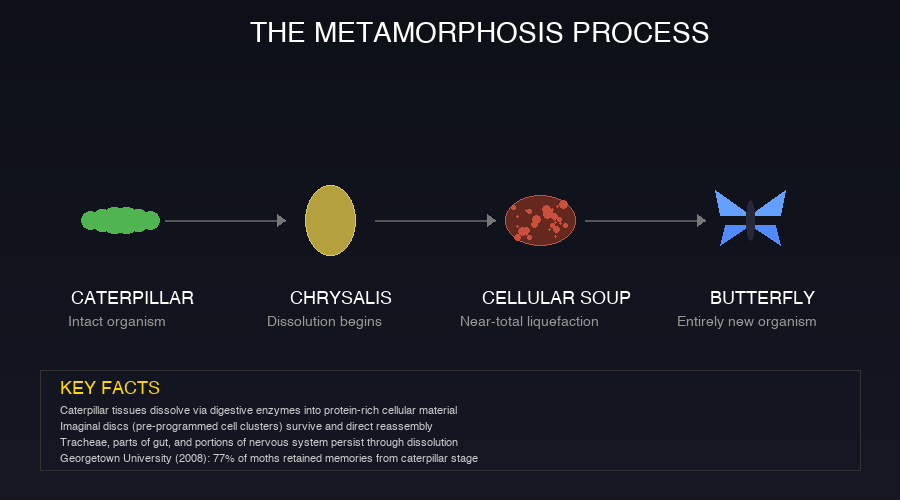
What actually happens is one of the most disturbing things in all of biology. The caterpillar’s body releases enzymes that dissolve almost every tissue it has. Its muscles, its organs, large portions of its internal structure: they break down into a protein-rich cellular soup. Some structures survive (the tracheal tubes, parts of the gut, portions of the nervous system), but most of the caterpillar as you knew it is gone. Not a restructuring. Not a remodeling. A liquefaction.
From that soup, an entirely different organism assembles itself. Different respiratory system. Different digestive system. Different locomotion (legs become wings). Different eyes (simple become compound). Different mouth (chewing mandibles become a proboscis designed for drinking nectar).
And here’s the part that still baffles scientists: some memories survive. A 2008 Georgetown study published in PLOS ONE trained Manduca sexta caterpillars to avoid a specific odor using mild shocks. When those caterpillars were trained late in larval development, about 77% of the adult moths still avoided that odor after metamorphosis. Individual memory, retained through an organism that has been radically rebuilt.
The Problem with “Gradual”
Natural selection is an elegant theory. It says: organisms with traits that help them survive are more likely to reproduce, passing those traits on. Over time, populations change. The ones that fit their environment best, win.
I have no issue with that. It explains a lot of things beautifully.
Here’s what it doesn’t explain: a caterpillar dissolving into soup.
Think about it. Natural selection works by preserving incremental advantages. A slightly longer beak reaches food others can’t. A slightly thicker coat survives a colder winter. Each tiny step is useful on its own. That’s the whole engine.
But what’s the incremental advantage of being 40% dissolved?
You’re dead. That’s the advantage. You’re dead at 40% dissolved. You’re dead at 60%. You’re dead at 80%. You’re dead at every single intermediate stage between “functioning caterpillar” and “fully reassembled butterfly.” There is no partial credit.
For metamorphosis to work, you need all of the following to function simultaneously:
- A genetic program to dissolve specific tissues (but not all of them)
- A genetic program to stop dissolving at exactly the right point
- Imaginal discs: clusters of cells pre-programmed in the caterpillar from birth that contain the blueprint for the adult butterfly body
- A genetic program to reassemble from soup into a completely different body plan
- A chrysalis structure that protects the process
- Hormonal triggers (ecdysone, juvenile hormone) timed with precision
If any one of these fails, the organism dies. There is no “mostly works” version of metamorphosis.
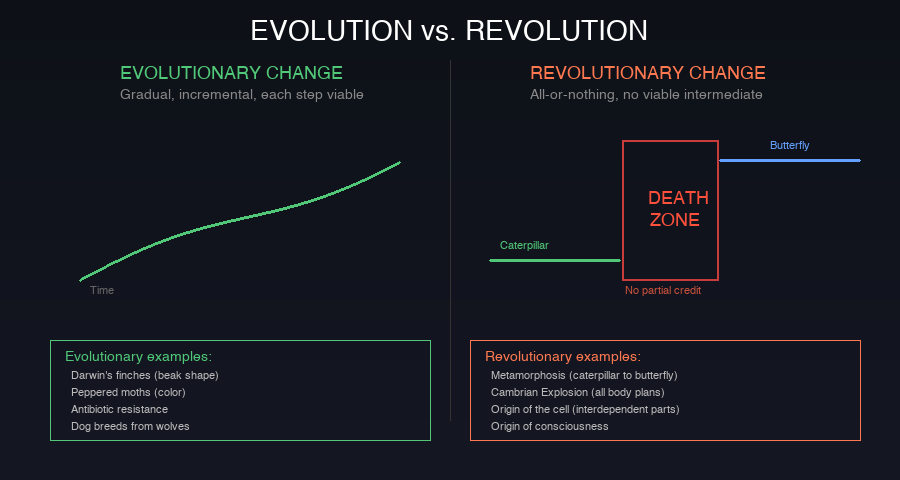
Evolution vs. Revolution
I’ve been thinking about a distinction that might help clarify this debate. At least it helped me.
There are two fundamentally different kinds of biological change. We use one word for both of them, and that word is doing too much work.
Evolutionary change is gradual, incremental, and explainable by natural selection:
- Beak shapes adapting to food sources (Darwin’s finches)
- Bacteria developing antibiotic resistance
- Peppered moths changing color to match soot-covered trees
- Dog breeds developing from wolves through selective breeding
- Thicker fur in animals that migrate to colder climates
These are modifications of existing systems. Adjustments. Optimization. Natural selection handles this beautifully, and no serious person denies it.
Then there’s revolutionary change: sudden, systemic, all-or-nothing transformations where every component must work together or the whole thing fails.
- Metamorphosis (caterpillar to butterfly)
- The Cambrian Explosion (virtually all major animal body plans appearing in a geological instant)
- The origin of the cell itself (DNA, RNA, proteins, and lipid membranes are all interdependent; none works without the others)
- The origin of sexual reproduction (requires two complementary systems to exist simultaneously)
- The origin of flight
- The origin of consciousness
These aren’t tweaks to existing systems. These are entirely new systems appearing with all their components intact. And the mechanism that elegantly explains the first category has no satisfying explanation for the second.
I don’t know if this framing is original or if someone smarter has already named it. But in my head, I’ve started calling it Revolutionary Biology: the study of biological phenomena that don’t seem explainable by incremental adaptation alone. It helps me think about it more clearly, at least.
The Cambrian Explosion: Metamorphosis at Global Scale
About 540 million years ago, something happened that Darwin himself called one of the most serious objections to his theory.
In a span often described as roughly 13 to 25 million years, somewhere between about 20 and 35 major animal phyla appear in the fossil record, depending on how the interval is defined and counted. Britannica and UC Berkeley’s Understanding Evolution both describe the Cambrian explosion as geologically fast while also noting that it was more complex than “everything suddenly appeared from nowhere.” For comparison, the preceding billions of years were dominated by simpler life forms. Before this event: mostly simple, soft-bodied organisms. After it: arthropods, chordates, mollusks, echinoderms, shells, segmented bodies, and far more elaborate sensory systems.
The pattern isn’t gradual change over eons. The pattern is long periods of stability, then a sudden explosion of radically new forms, then stability again.
That’s not evolution. That’s revolution.
Stephen Meyer wrote an entire book about this in Darwin’s Doubt, and his interpretation is only one side of the debate. My narrower point is simpler: even mainstream summaries acknowledge that the fossil record looks bursty here, not like a perfectly smooth illustration of gradual change. That does not settle the argument. It does make the question worth taking seriously.

I’m Not Making a “God of the Gaps” Argument
I want to be careful here, because I’m aware of my own biases. As a Christian, I could be seeing design where there’s just complexity I don’t understand yet. That’s a real possibility and I want to be honest about it.
So I’m not saying “science can’t explain it, therefore God.” That’s lazy thinking, and it gets weaker every time science advances.
What I am noticing — and again, I’m a curious layperson, not an expert — is that the mechanism that explains adaptation (natural selection acting on random mutation) seems well-established and well-supported. But there appears to be a category of biological change that this mechanism doesn’t obviously address. And it seems like we use the same word (“evolution”) for both and assume the explanation for one covers the other.
It doesn’t.
Scientists who are honest about this don’t say “therefore God.” They say “we don’t yet understand the mechanism for these major transitions.” That’s fair. That’s good science. What’s not good science is pretending the question has been answered when it hasn’t.
A caterpillar dissolving into liquid and reassembling as a butterfly is not the same kind of phenomenon as a finch developing a longer beak. Calling both “evolution” obscures more than it reveals.
What This Means
For what it’s worth, here’s where I’ve landed so far. I hold a scientific mind. I respect evidence. I think radiometric dating works. I think the universe is billions of years old. I think adaptation through natural selection is one of the most elegant ideas in the history of science.
And I also think a caterpillar turning into DNA juice inside a cocoon and reconstructing itself as an entirely different organism is not something that happened through trial and error.
That is why metamorphosis feels qualitatively different to me than ordinary adaptation. The coordination burden is so high that it is hard, at least from a lay perspective, to picture a long chain of partially useful intermediate states that natural selection could preserve step by step.
That’s not evolution. That’s revolution. And revolutions require a different kind of explanation than the one Darwin gave us.
I don’t have all the answers. I’m not even sure I’m asking the right questions. But as someone who loves science and loves God, I find more wonder in the honest gaps than in pretending everything is neatly explained. Maybe that’s where faith and science meet: not in having all the answers, but in having the courage to sit with the questions.
A caterpillar dissolves into soup and becomes a butterfly. If that doesn’t make you wonder, I’m not sure what would.
FAQ
What actually happens inside a chrysalis?
Much of the caterpillar’s body is broken down by enzymes, while structures like imaginal discs survive and help build the adult insect. It is not literally magic soup, but it is far more radical than the casual “caterpillar goes to sleep and wakes up with wings” version most of us learned as kids.
Does memory really survive metamorphosis?
In at least some cases, yes. The PLOS ONE study I cited found that moths trained late in larval development still avoided the conditioned odor as adults. That does not mean every memory survives. It does mean total neurological reset is too simple a story.
Does this disprove evolution?
No. I am not claiming that. I am saying metamorphosis and the Cambrian explosion make me think some biological transitions feel more discontinuous and coordination-heavy than the clean gradualist story most people carry around in their heads.
Why does this matter beyond biology?
Because it changes how I think about design, transformation, and meaning. Once you start noticing systems that only make sense when multiple parts click together, you begin asking better questions in other domains too, from motivation to culture to faith.
Related Reading
If this way of thinking interests you, you might enjoy my work on the Octalysis Framework, where I analyze the hidden systems behind human motivation. The same instinct that made me look at metamorphosis and ask “how does this actually work?” is the same instinct that drives my behavioral design work: don’t accept the surface explanation. Dig into the mechanism.
- How Do You Design Epic Meaning Into a Meaningless Product?
- Why Every Motivation Framework Is Missing Half the Picture
- Why Most Behavioral Frameworks Fail: Actions vs. Motivations
- What Is Gamification?
- Using Gamification to Improve the Church
- How I Started in Gamification in 2003
- Books by Yu-kai Chou