

Every management consultant I’ve watched stall in 2026 has the same problem: they still run their employee-engagement work off a pyramid that nobody in serious motivation research has trusted for fifty years. Maslow’s hierarchy is a great poster. It’s a terrible operating manual. The moment you try to use it to diagnose a stuck team or a flatlining product, you realize the neat five-tier staircase doesn’t match anything you can actually see in a human being. ERG Theory does — and it’s the fix this post is about.
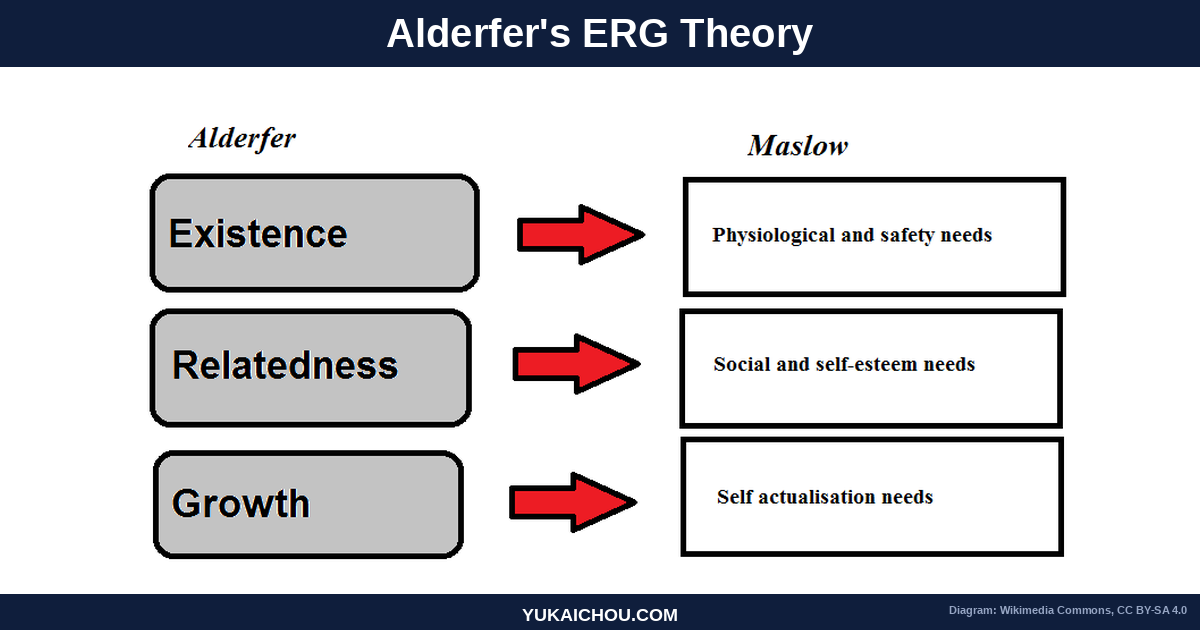
The reason the staircase doesn’t hold up is that a quiet Yale psychologist named Clayton Alderfer took Maslow apart and rebuilt it in 1969, and most of the management industry still hasn’t read his paper. Alderfer compressed Maslow’s five needs into three — Existence, Relatedness, Growth — threw out the rigid bottom-up sequence, and added the one mechanism that Maslow was missing: frustration-regression. When a higher need stops being satisfiable, people don’t just sit there. They fall back to an easier need and over-consume it. That single move made ERG Theory the first version of needs theory that actually predicts employee behavior instead of describing a sentimental ideal.
I’ve spent over two decades teaching the Octalysis Framework to Fortune 500 product teams and government agencies, and ERG Theory is the lens I keep reaching for when Maslow isn’t cutting it. If you’ve ever wondered why a team whose career growth is frozen starts obsessing over desk snacks and office politics, why a talented engineer quietly checks out after you cut their training budget, or why Core Drive 2 (Development & Accomplishment) and Core Drive 5 (Social Influence & Relatedness) collapse into each other under certain organizational pressures — this post is the answer. ERG Theory is the compressed, operational needs model that Maslow should have written the second time around.
Speed Run Notes
- Three needs, not five. Clayton Alderfer collapsed Maslow’s five into three categories: Existence (physiological + safety), Relatedness (belongingness + part of esteem), and Growth (self-actualization + part of esteem).
- Any need can fire at any time. ERG Theory drops Maslow’s strict bottom-up ordering.
- Frustration-regression is the mechanism that actually predicts behavior. When Growth needs get blocked, people regress to Relatedness.
- The empirical base is stronger than Maslow’s. Alderfer ran actual factory-floor and bank studies before publishing.
- It maps cleanly onto the Left-Brain half of the Octalysis Framework. Existence ≈ Core Drives 6 & 8 (Scarcity & Loss).
- Salary ceilings explode Relatedness budgets. When compensation plateaus, people pour the thwarted Growth energy into team dynamics, office politics, and status games.
In This Article
- What Is ERG Theory
- The Core Findings
- What Alderfer Got Right
- Where ERG Theory Falls Apart
- The Brain on Compressed Needs
- ERG Theory vs Other Theories
- ERG Theory in the Real World
- The Elephant in the Room
- How to Apply ERG Theory with the Octalysis Framework
- Practical Steps to Apply ERG Theory
- Closing Thoughts
Author Credibility: Yu-kai Chou

Yu-kai Chou created the Octalysis Framework after studying gamification since 2003 — years before the term entered mainstream vocabulary. As a Human-Systems Architect & Behavioral Designer, his framework has been applied by LEGO, Microsoft, Porsche, Coca-Cola, Salesforce, and MrBeast, impacting over 1.5 Billion Users.
Chou has taught the Octalysis methodology at Harvard, Stanford, Yale, Tesla, Google, BCG, and IDEO.
His work has been cited by Harvard, Stanford, MIT, Forbes, Wall Street Journal, Wired, US Department of Energy, NIST, NSF, NCBI, US Department of Education, ClinicalTrials.gov, and Google Scholar — with 3,700+ more academic publications. Explore his books here.

What Is ERG Theory
ERG Theory is a content theory of human motivation that compresses Maslow’s five-level hierarchy into three categories of need — Existence, Relatedness, and Growth — drops the strict bottom-up ordering, and adds a frustration-regression mechanism to explain what people actually do when a higher-order need is blocked. The theory was proposed by Yale psychologist Clayton P. Alderfer in a 1969 paper titled “An Empirical Test of a New Theory of Human Needs,” published in Organizational Behavior and Human Performance. It is the first serious attempt to take Maslow’s intuition and rebuild it on an empirical base.
The three needs are simple to state. Existence needs are the material conditions of staying alive and secure — food, water, shelter, physical safety, pay, benefits, working conditions. Relatedness needs are everything about meaningful connection with others — belonging, recognition, social status, mutual respect, interpersonal love. Growth needs are the internal drives toward competence, mastery, creativity, and the realization of personal potential — the kind of work that develops a person rather than just employing them. Together, the three categories cover the same conceptual ground as Maslow’s five, but they are defined in a way that makes them measurable on a questionnaire, testable in a real workplace, and usable in a Monday-morning management decision.
The second and more important difference from Maslow is mechanical. Alderfer argued that all three needs can be active simultaneously, that people differ in how much weight they put on each, and that the system responds dynamically to blockage. His central claim, which has aged better than any other part of needs theory, is the frustration-regression principle: when people are chronically frustrated in pursuing a higher need, they regress to a lower one and over-satisfy it as a compensation. Blocked Growth fuels hyperactive Relatedness. Blocked Relatedness fuels hyperactive Existence consumption. The staircase is replaced with a feedback loop.
For us as designers and organizational architects, ERG Theory answers a very practical question: “When something is off in a team or a product, where should I look first?” The answer is: find the need that’s frustrated, not the need that’s currently being consumed. The person obsessing over the office coffee machine is almost never thirsty. They are almost always blocked on Relatedness or Growth and compensating through Existence. The rest of this post is a field manual for spotting those patterns and designing around them.
The Core Findings
Alderfer’s 1969 paper is one of those documents that managers quote and rarely read. It reports a questionnaire study of 110 bank employees designed to test whether Maslow’s five needs could be recovered empirically, or whether a simpler structure fit the data better. Alderfer extended the method across factory and bank settings in follow-up work through the early 1970s. Three findings came out of that work, and each one has a direct translation into modern product, organizational, and behavioral design.
Finding 1: Five Needs Collapse Into Three
The first finding is the one most people remember. When Alderfer factor-analyzed the responses to needs-satisfaction questionnaires, the cleanest structure that emerged was three factors rather than five. Maslow’s physiological and safety needs loaded onto a single Existence factor. Belongingness and the social side of esteem loaded onto a single Relatedness factor. Self-actualization and the achievement side of esteem loaded onto a single Growth factor. The compression was not a philosophical preference — it was what the data produced when you asked real employees to rate their needs.
This is why ERG Theory is more useful than Maslow for operational design. Instead of asking “is this employee stuck on level four or level five of the pyramid?” — a question no practitioner can answer — you ask whether their Existence needs are met, whether their Relatedness needs are met, and whether their Growth needs are met. Three questions, each answerable from observation, each tied to a concrete design lever.
Finding 2: The Strict Hierarchy Doesn’t Hold
The second finding directly contradicts Maslow’s most famous claim. Alderfer’s data showed that people pursue multiple needs simultaneously and that the relative priority of each need varies by individual, culture, and life stage. A starving artist does not, in fact, stop creating until they have eaten. A penniless graduate student does not stop seeking relatedness until they have achieved financial security. The needs coexist and compete for attention, with weights that shift across people and contexts.
For designers, this means the “lower needs must be met first” heuristic that Maslow bequeathed to a generation of product managers is wrong in practice. You can absolutely engage a user’s Growth needs while their Existence or Relatedness needs are imperfect — as long as the gap in the lower need isn’t catastrophic. The threshold is not “fully met”; it is “not actively failing.” Many successful products engage Growth needs for users whose Existence needs are modestly unmet. ERG Theory predicts this, Maslow’s pyramid does not.
Finding 3: Frustration Produces Regression, Not Just Pause
The third finding is ERG Theory’s most original contribution. When Alderfer looked at what happened in his data when a need was chronically thwarted, he saw a very specific pattern. Employees whose Growth needs were blocked did not just stop caring about Growth. They displaced the energy into Relatedness — more social activity, more politicking, more time spent on interpersonal dynamics — and when Relatedness in turn was blocked, they displaced into Existence, where they over-consumed whatever material cushions were available. Pay, perks, expense-account meals, desk real estate.
This is frustration-regression, and it is the single most useful diagnostic insight in ERG Theory. It says that when you see hyperactive Existence behavior — obsession with parking spots, lunch quality, titles, seat positions — the cause is almost never the surface object. It’s a blocked Growth or Relatedness need higher up, finding release through whatever channel is still open. Maslow’s model could not explain this because it only allowed movement upward. Alderfer’s model explicitly built the downward path in, and management research has been confirming the prediction for half a century. Arnolds and Boshoff’s 2002 assessment across 517 South African employees, for instance, confirmed ERG’s three-category structure held up in a fresh dataset three decades later — and the Growth-category perception cleanly predicted performance intent at the senior level, exactly the directional pattern Alderfer’s 1969 paper first anchored.
What Alderfer Got Right
It’s fashionable in 2026 to dunk on needs-theory in general. Behavioral economists like to point out that “needs” is a softer construct than “utility,” and organizational psychologists increasingly favor fine-grained theories like Self-Determination Theory or the Job Demands-Resources model. But three things about Alderfer’s 1969 paper have aged spectacularly well, and each one is directly relevant to how I practice Octalysis today.
First, he respected his data. Maslow drew his pyramid from clinical intuition and literary examples — Einstein, Eleanor Roosevelt, Jane Addams — without a single questionnaire study to support the five levels. Alderfer ran the factor analysis, let the categories fall where they fell, and reported three rather than five. That is exactly the intellectual discipline behavioral science needed after Maslow, and it is why ERG Theory has survived the replication crisis that has gutted so much of mid-twentieth-century motivation research. The theory’s structure was never a philosophical assertion. It was a model fit.
Second, he dropped the strict hierarchy before anyone else did. Saying that any need can fire at any time sounds obvious now; in 1969, it was a quiet heresy against Maslow’s orthodoxy. Alderfer was the first motivation theorist to formalize multi-need activation, which is a precondition for every modern framework I use, Octalysis included. The eight Core Drives are not arranged in a hierarchy because of ERG Theory. They are arranged in an octagon because all of them can fire at all times, weighted differently per user and per context — a design choice I made in direct descent from Alderfer.
Third, he named frustration-regression. This is the mechanism that separates ERG Theory from every other needs theory in the field. It is also the mechanism that most managers stumble into and misattribute. When a previously engaged employee starts complaining about office temperature and parking spots, you do not have a facilities problem. You have a blocked Growth or Relatedness need expressing itself through the only channel that is still open. ERG Theory tells you to look one or two categories up from the symptom. That single habit — treating Existence obsession as a Growth canary — has saved me more consulting engagements than any other behavioral principle.
Where ERG Theory Falls Apart
ERG Theory has real problems. Three of them matter for designers.
Critique 1: The Three Categories Are Still Too Coarse
Compressing five needs into three solved a specificity problem on one side and created one on the other. Relatedness, in particular, bundles a set of very different psychological processes — belonging, recognition, social comparison, mutual respect, romantic and family attachment — into a single category. A manager reading ERG Theory sees “Relatedness needs met” as a binary, when in practice a team can be socially close and still starved for recognition, or tightly recognized and still lonely. Later theorists, including Edward Deci and Richard Ryan in Self-Determination Theory, took this exact critique and split Relatedness into autonomy, competence, and relatedness as distinct sub-mechanisms.
For designers, the upshot is that ERG Theory is a good first-pass diagnostic, not a finished toolkit. You use it to locate which of the three categories is frustrated, then you switch to a finer-grained framework — SDT, Octalysis, or the Reiss 16 — to design the actual intervention. Treat ERG as the triage instrument, not the whole emergency room.
Critique 2: Frustration-Regression Is Not Always Downward
Alderfer’s original regression story was strictly downward — blocked Growth fuels Relatedness, blocked Relatedness fuels Existence. Subsequent research has complicated the picture. In some populations, blocked Growth fuels other Growth substitutes rather than regressing (for instance, a frustrated engineer may pour energy into side-project learning rather than into Relatedness). In some cases, frustration produces active disengagement or quiet quitting rather than compensatory consumption of a lower need. The regression-downward pattern is common but not universal.
For practitioners, the honest version of frustration-regression is: when a higher need is blocked, motivational energy redirects, and the direction is not always downward. The diagnostic move is to look for where the energy went — not to assume it went down one category. Still, downward regression is the most common path, and starting the search there is usually correct.
Critique 3: The Theory Is Weak on Intrinsic vs Extrinsic
ERG Theory lumps together motivations that modern research treats as fundamentally different. Extrinsically driven Growth — promotions, titles, bonus-tied skill acquisition — and intrinsically driven Growth — curiosity-led learning, mastery for its own sake — are collapsed into a single Growth category, even though they produce different retention curves, different well-being outcomes, and different burnout risks. The Left-Brain / Right-Brain Octalysis distinction, which separates extrinsic and intrinsic motivation across all Core Drives, is partly a response to this blind spot.
The practical implication is that a Growth-need intervention can succeed on the ERG Theory metric and still backfire on long-term engagement. A promotion may satisfy extrinsic Growth while starving intrinsic Growth, and the employee retires on the job two years later. Any design that uses ERG Theory alone will need a second pass through an intrinsic-extrinsic filter before it ships.

The Brain on Compressed Needs
What is actually happening in the nervous system when the three ERG needs are active or frustrated? The short version is that each category maps onto a different constellation of brain systems, and frustration-regression has a recognizable neurobiological signature.
Existence needs live in the oldest parts of the brain. Hunger, thirst, temperature regulation, and acute safety run through the hypothalamus and brainstem, with the amygdala’s threat-detection circuitry kicking in when safety is in doubt. Cortisol, the HPA-axis stress hormone, spikes when Existence is threatened and sustains elevated when the threat becomes chronic. Sustained cortisol is bad news for executive function — it shrinks prefrontal cortex activity and degrades exactly the cognitive capacities you need to pursue Relatedness and Growth. This is one reason the strict Maslow “lowers first” intuition is right for extreme deprivation even while it is wrong for normal operating range.
Relatedness needs live in a distributed social brain network — the medial prefrontal cortex, temporo-parietal junction, anterior cingulate cortex, and the reward and attachment circuits that release oxytocin, endogenous opioids, and dopamine during social recognition and belonging. Naomi Eisenberger’s 2003 fMRI work famously showed that social rejection activates some of the same regions as physical pain — a finding that anchors Relatedness as a first-class neurobiological need rather than a nice-to-have. When Relatedness fails, the same pain-processing machinery fires that would fire during injury, which is why rejected employees often report literally feeling “hurt.”
Growth needs engage the brain’s reward-prediction-error machinery — particularly the midbrain dopaminergic system connecting the ventral tegmental area to the striatum and prefrontal cortex. Learning, mastery progress, and creative discovery all produce phasic dopamine bursts locked to the moments when the world’s feedback is better than you expected. Curiosity and intrinsic motivation work through this same system. Prolonged satisfaction of Growth needs shapes structural plasticity in the hippocampus and prefrontal cortex — Growth literally builds the brain that pursues more Growth.
Frustration-regression shows up in this picture as a predictable reallocation. When Growth pathways are blocked — say, an employee’s development is frozen for a quarter — the dopaminergic machinery doesn’t just go quiet. It redirects toward whatever next-best stimulus is available: social attention, novelty in the environment, food. This is why the stalled engineer starts holding court at the coffee machine. The brain is doing its job, which is to keep dopamine moving; the organization’s job is to notice the redirection and fix the underlying blockage rather than simply upgrading the coffee.
ERG Theory vs Other Theories
ERG Theory sits in a crowded family of motivation frameworks, and understanding how it relates to the others is the difference between using it as a genuine tool and using it as a vocabulary.
ERG Theory vs Maslow’s Hierarchy
This is the defining contrast. Maslow’s Hierarchy proposes five needs in a strict bottom-up sequence and requires lower needs to be substantially met before higher needs activate. ERG Theory compresses those five into three, drops the strict ordering, and adds frustration-regression. Empirically, the three-factor ERG structure fits employee-survey data better than Maslow’s five. Operationally, ERG Theory tells you what to do when a need is blocked, which Maslow’s pyramid does not. If you are still using Maslow in a corporate deck in 2026, switching to ERG is a free upgrade in diagnostic power.
ERG Theory vs Self-Determination Theory
Self-Determination Theory (Deci & Ryan) identifies autonomy, competence, and relatedness as the three psychological nutrients of durable intrinsic motivation. SDT and ERG Theory overlap at the Growth and Relatedness edges but disagree on emphasis. ERG Theory retains a category for Existence that SDT effectively treats as a precondition rather than a nutrient. SDT draws a sharp line between intrinsic and extrinsic motivation that ERG Theory blurs. In practice I use ERG Theory to locate which category is frustrated and then switch to SDT to design the intervention — ERG is the x-ray; SDT is the scalpel.
ERG Theory vs Herzberg’s Two-Factor Theory
Herzberg split workplace factors into hygiene (prevents dissatisfaction) and motivators (produces satisfaction). ERG Theory is richer because it says when a supposed motivator is blocked, the energy doesn’t evaporate — it regresses and fuels over-consumption of a hygiene factor. Hygiene over-consumption is a Two-Factor invisibility; ERG Theory sees and explains it. The two theories are complementary: Herzberg gives you the category map of workplace factors; ERG Theory gives you the dynamics between the categories.
ERG Theory vs McClelland’s Theory of Needs
McClelland’s achievement / affiliation / power framework, like ERG Theory, uses a three-need structure. But McClelland’s needs are individual-trait weightings — some people are high in need-for-achievement, others in need-for-affiliation — while ERG Theory’s needs are universal categories that all humans have at varying levels at different times. The two stack well: use ERG Theory to understand how any given person’s needs activate across a day or a year, and use McClelland’s trait weights to understand why two people in the same situation respond differently.
ERG Theory vs the Reiss Motivation Profile
Steven Reiss’s 16 Basic Desires is the opposite extreme of ERG Theory’s compression — a fine-grained, individual-difference-focused model of motivation. ERG Theory with its three categories is usable by any manager in a five-minute briefing. Reiss’s model requires a 128-item psychometric instrument to produce an individual profile. The two are compatible. I use ERG Theory for organizational design and Reiss for deep individual coaching engagements, with Octalysis in the middle as the product-and-experience layer that handles both levels at once.
ERG Theory in the Real World
The compressed needs model shows up in places most people never connect to Alderfer. I’ll walk through four domains where ERG Theory is the hidden governor of whether a design or an organization works.
Workplace Retention and Quiet Quitting
The quiet-quitting wave that peaked between 2022 and 2024 is, on an ERG Theory reading, a mass case of Growth frustration-regression. In industries where salary compression and flattened career ladders made real advancement harder, Growth energy didn’t evaporate — it redirected into Relatedness (team bonding, Slack cultures, side communities) and Existence (compensation negotiation, work-from-home rights, benefits scrutiny). Employers who read the symptoms as a culture problem and threw more ping-pong tables at it made things worse. Employers who restored visible Growth ladders — internal mobility programs, structured skill development, transparent promotion criteria — saw retention stabilize within a year. ERG Theory predicted both outcomes before the research literature caught up.
The practical rule for management is: when Existence demands escalate — raises, perks, office conditions — ask what Growth need is blocked. Nine times out of ten, that’s where the intervention should go. Meeting the Existence demand in isolation is an expensive way to delay the inevitable attrition.
Consumer Product Design and Free Tiers
ERG Theory maps unexpectedly well onto product design. A free tier or a low-friction onboarding is an Existence-needs surface — it has to reliably provide the basic utility of the product without imposing cost or anxiety. Relatedness is the social and community layer — user-to-user connection, community features, recognition. Growth is the mastery layer — skill development, advanced features, creative expression. Products that confuse the layers lose users in predictable ways. Over-gamifying the Existence surface (aggressive onboarding streaks, point pressure on basic tasks) violates the “not actively failing” threshold and users bounce. Ignoring Growth on power-user paths leaves long-term engagement to chance and users who were ready for mastery drift away.
The best consumer products I’ve consulted on deliberately meet all three layers simultaneously, with different Core Drive mixes for each. The Existence layer leans on clean utility and Core Drive 4 (CD4): Ownership & Possession. Relatedness hangs on CD5 (Social Influence). Growth runs on CD2 (Development) and Core Drive 3 (CD3): Empowerment of Creativity & Feedback. Product teams that treat engagement as a monolithic metric miss this stratification entirely.
Healthcare and Chronic Condition Management
Healthcare is where ERG Theory is most clinically useful. Patients with chronic conditions — diabetes, heart disease, depression — often cycle through all three needs in a single day. Existence shows up in medication adherence, symptom management, basic security of care. Relatedness shows up in peer support groups, the patient-provider relationship, family involvement. Growth shows up in self-efficacy, disease literacy, and the sense that the patient is developing competence in their own care. Interventions that address only the Existence layer — pills and appointments — consistently underperform interventions that meet all three.
The Apollo Neuro wearable engagement work I’ve been involved with is a concrete example. Users don’t stay engaged because the device solves an Existence problem. They stay engaged because using the device produces Growth (measurable self-regulation skill) and Relatedness (community and shared experience). An ERG-aware health product designs for all three needs and frustration-regression-proofs itself against Growth plateaus by introducing new skills at predictable intervals.
Education and Training Design
Education is where the Maslow-to-ERG upgrade is most immediately visible. A traditional Maslow reading says students need physical comfort, safety, and belonging before they can learn; an ERG reading says Existence, Relatedness, and Growth all need to not be actively failing, and that the design has to actively feed Growth even when Relatedness is imperfect. The most effective online learning platforms of the last five years — Duolingo, Brilliant, Octalysis Prime, and the top Khan Academy cohorts — do this explicitly. They keep the Existence layer reliable, they build Relatedness through cohort and community, and they fire Growth with tight feedback loops that produce visible skill progress.
When learning platforms fail, the failure is almost always a frustration-regression. Growth blocked by unclear progress signals regresses into Relatedness, which platforms then mistake as “users want more community.” More community doesn’t fix the underlying Growth blockage; better progress signals do. ERG Theory sharpens the diagnosis.
The Elephant in the Room
Here’s the uncomfortable part. If you read ERG Theory as an ethical designer, it is a map for how to respect human needs in proper proportion. If you don’t, it is also a map for how to exploit frustration-regression in a way that benefits the platform at the user’s expense. The mechanism is simple: block a higher need systematically, and the user’s compensatory consumption of the lower need produces engagement, revenue, and attention that looks like a healthy metric on a dashboard. Social platforms that starve Growth and inflame Relatedness are doing exactly this, and some of the biggest loyalty programs on the planet work by keeping Existence-level rewards just high enough to suppress the user’s question about whether any real Growth is available.
I have watched more than one company optimize itself into this corner. The A/B tests keep winning — more streak pressure, more compensatory perks, more community features that substitute for actual progress — and the short-term engagement numbers climb. But the user’s underlying need is still blocked, and the frustration-regression cycle spins faster. Eventually the user either burns out or switches to a competitor that actually meets the blocked need. The A/B test never sees this because it can’t measure Growth hunger across a ninety-day window.
The honest version of ERG Theory, applied to design, is that it is a tool that can meet users’ needs or exploit them, and the designer chooses which. My standing advice — and the standing policy inside every Octalysis engagement I lead — is to measure which need is actually being met over a twelve-month horizon, not just the short-term engagement proxy. If your dashboard doesn’t have a Growth-proxy metric (skill acquisition, mastery progress, capability development) alongside the Existence and Relatedness proxies, you will unconsciously optimize your users into compensatory consumption. ERG Theory doesn’t tell you to be ethical. It just promises that unmet needs don’t stay quiet for long.
How to Apply ERG Theory with the Octalysis Framework

The Octalysis Framework and ERG Theory are two cuts of the same underlying behavioral geometry. Octalysis gives you eight Core Drives arranged around an octagon with an intrinsic-versus-extrinsic axis and a White-Hat-versus-Black-Hat axis. ERG Theory gives you three need categories — Existence, Relatedness, Growth — with a frustration-regression dynamic between them. The compression is almost suspiciously clean. Applied together, they give you both the high-resolution motivational palette of Octalysis and the low-resolution diagnostic triage of ERG in one tool.
Here’s how I translate the three ERG categories into the 8 Core Drives when I’m designing or diagnosing.
Existence ≈ Core Drive 6 and Core Drive 8
Existence needs live in the Black-Hat corner of Octalysis. Core Drive 6 (Scarcity & Impatience) is the motivational arm of perceived material shortage — we want things when there isn’t enough of them, exactly because our Existence layer is wired to notice supply constraints. Core Drive 8 (Loss & Avoidance) is the threat-avoidance arm, tuned to keep us from losing what we already have. Both drives are evolutionarily older than the rest of the octagon, and both are direct expressions of Alderfer’s Existence category. When a product under-invests in this layer — unreliable free tier, surprise pricing, unclear privacy — it is not just missing a Core Drive. It is violating Existence, and frustration-regression will drag every other engagement effort down with it.
The design rule is simple: Existence needs must not be actively failing before you engage higher Core Drives. A beautifully designed CD2 mastery loop will not convert if the user’s CD6/CD8 concerns — is this product stable, is my data safe, is my money being taken — are unresolved. Fix the Existence layer first, always.
Relatedness ≈ Core Drive 5
Relatedness is Core Drive 5 (Social Influence & Relatedness) in almost its entirety. Mentorship, community, social proof, teams, peer recognition, conformity, companionship, envy, nostalgia — the entire Relatedness territory belongs to this single Core Drive, which is why CD5 is the densest of the eight in terms of Game Techniques. On an ERG reading, a product that does CD5 well is meeting an entire need category; a product that botches CD5 is blocking a need category and setting up frustration-regression into CD6/CD8 Existence consumption.
The design rule: treat Relatedness as both a need and a risk. A rich Relatedness layer keeps Growth blockages from turning toxic because it gives the user a place for redirected energy to go. A thin Relatedness layer leaves users alone with their Growth frustrations, and they regress straight into CD6/CD8 pressure consumption — which often looks like “users are really engaged with our deals page” right up until they churn.
Growth ≈ Core Drive 2 and Core Drive 3
Growth needs correspond to the development corner of the octagon. Core Drive 2 (Development & Accomplishment) is the mastery-and-progress arm of Growth — the user feels their capability increasing, and the product gives them visible proof of it. Core Drive 3 (Empowerment of Creativity & Feedback) is the creative-and-expressive arm of Growth — the user makes things, gets feedback, and experiences the iteration loop that converts curiosity into skill. Together, CD2 and CD3 are the Octalysis expression of Alderfer’s entire Growth category. If either one is weak, the Growth need is partially frustrated; if both are weak, Growth frustration-regression is almost guaranteed.
The design rule: Growth-layer features must be continuous, not episodic. A single training module does not meet Growth needs. A continuous progression of mastery steps, each with visible feedback (CD2) and creative degrees of freedom (CD3), does. Products that treat Growth as a launch-day feature and then let it atrophy are setting up a predictable Growth-to-Relatedness regression at the six-to-twelve-month mark.
Core Drive 1 and Core Drive 4: The ERG Edge Cases
Two Core Drives sit awkwardly in the ERG map. Core Drive 1 (Epic Meaning & Calling) is a Growth-adjacent driver with strong Relatedness overtones — meaningful work is both personal development and connection to something larger than oneself. Core Drive 4 (Ownership & Possession) is Existence-adjacent when it’s about material ownership and Relatedness-adjacent when it’s about identity and status. Rather than force these into a single ERG category, I treat them as bridge drives that operate across categories and are useful precisely because they stabilize a design against frustration-regression in more than one direction.
The practical implication is that CD1 and CD4 are your most powerful structural drives in an ERG-aware design. CD1 gives users a Growth-shaped reason to show up even when their specific CD2/CD3 loops are between chapters. CD4 gives users a tangible hold that reduces Existence anxiety and raises Relatedness identity simultaneously. A design that leans on CD1 and CD4 as structural anchors is much harder to destabilize through frustration-regression than a design that leans only on the obvious category-to-Core-Drive mappings.
The practical Octalysis-ERG rule is: cover all three categories with non-failing Core Drive coverage, then concentrate depth on the category your users are most active in. An Existence-centric product (infrastructure, healthcare basics) leans on CD4 and respects CD6/CD8. A Relatedness-centric product (social, community) leans on CD5 and CD1. A Growth-centric product (learning, creation, professional tools) leans on CD2 and CD3 with CD1 as the structural anchor. Miss a category entirely and you are designing a frustration-regression trap.
Practical Steps to Apply ERG Theory
Here’s the field manual I walk teams through when they want to apply ERG Theory to their actual product or organization, not just quote it in a deck.
Step 1: Run the Three-Need Audit
Before any intervention, audit the current state of each ERG category for your target user or employee. For each category, answer a single question: is this need being actively met, quietly met, imperfectly met but not failing, or actively failing? The four-level scale is deliberate — “perfectly met” is not the bar, “not failing” is. Any category in the “failing” state is an immediate fix; any category in the “imperfectly met” state is a candidate for depth; any category in the “quietly met” state is a stabilizer you should protect.
Step 2: Look for Frustration-Regression Signatures
When a category appears over-consumed — employees obsessed with lunch quality, users obsessed with deals-page engagement — assume frustration-regression and look one or two categories up. The diagnostic question is “what Growth or Relatedness need is blocked such that this Existence behavior is compensating?” Eight times out of ten, you’ll find the answer within two conversations. The fix is to unblock the higher need, not to escalate or restrict the compensatory behavior.
Step 3: Don’t Skip Categories, Even When You’re Tempted
It is tempting, especially in creative or ambitious product contexts, to focus entirely on Growth and assume the other categories will take care of themselves. ERG Theory predicts this will fail, because unmet Existence or Relatedness will drag Growth engagement down through regression. Every design needs a baseline coverage across all three. The ratio can be unequal — a Growth-heavy product is fine — but “zero coverage” on Existence or Relatedness is a design mistake, not a focus strategy.
Step 4: Build Growth Progression on a Continuous Cadence
The single most common ERG-level failure in modern products is Growth that launches well and then atrophies. New users see a clear CD2 ladder in the first four weeks, then the ladder ends and Growth need goes unmet for the next several months. The fix is continuous cadence: a new Growth challenge every two-to-four weeks, a visible mastery progression that never caps, and a plan for advanced users that is already staged when they arrive. The product teams I’ve seen win on long-term retention all have a Growth roadmap on the same cadence as their bug-fix roadmap.
Step 5: Protect Relatedness as Your Frustration-Regression Buffer
Strong Relatedness is the best insurance policy you have against Growth-blockage crises. When a Growth ladder hits a temporary plateau — as it will, even in the best products — a healthy Relatedness layer absorbs the redirected energy and keeps the user engaged until Growth resumes. A thin Relatedness layer means the energy regresses past Relatedness into CD6/CD8 Existence consumption, which looks like short-term engagement and is actually churn on a delay. Every design benefits from a Relatedness layer that is rich enough to act as a buffer.
Step 6: Instrument All Three Categories in Your Dashboard
Most product dashboards track engagement as a single number. ERG Theory demands three numbers. Build proxies for Existence meeting (reliability, uptime, pricing clarity, churn-to-alternatives), Relatedness meeting (social interaction rate, recognition events, community engagement), and Growth meeting (skill acquisition, mastery progression, creative output). When you run an experiment, look at all three. A short-term engagement win that costs Growth meeting is a Yerkes-Dodson-scale long-term loss, and the dashboard is the only thing that will save you from shipping it.
Step 7: Audit Your Perks Against Growth
In organizational contexts, pull your list of employee perks and ask which category of need each one meets. If the majority of your perks are Existence-tier (free lunch, transportation, office amenities), and your Growth tier — internal mobility, skill development, visible advancement — is thin, you are running a frustration-regression trap for high performers. The fix is not to remove the Existence perks; it is to rebalance investment toward Growth. Most companies that retain talent well in 2026 have done exactly this rebalancing, with ERG Theory as the diagnostic lens whether they name it or not.
Closing Thoughts
I keep a copy of Alderfer’s 1969 paper in the same folder as Maslow’s 1943 paper, because reading them next to each other is a small master class in how motivation theory evolves. Maslow wrote the version that made the idea beautiful enough to remember. Alderfer wrote the version that made the idea useful enough to ship. Maslow gets the popularity; Alderfer gets the design implementations. If you are serious about behavioral design in 2026, you want both on the shelf, and you want to reach for Alderfer more often than for Maslow.
The same pattern holds for products and organizations. The polished engagement deck, the pyramid poster in the conference room, the “we’ve addressed all five levels” slide — these are Maslow artifacts. The quiet diagnostic — which of the three categories is frustrated, where is the regression going, what is the compensatory behavior pointing back to — is an ERG Theory artifact. The ERG artifacts produce more durable designs because they match the shape of human motivation more faithfully. Maslow’s pyramid was a sculpture; ERG Theory is a working engine with a feedback loop.
The good news is that the correction is small and the payoff is large. Switching from Maslow to ERG Theory takes a few hours of reading and a single audit pass on your existing design. Almost every team I’ve walked through the shift finds at least one concrete frustration-regression pattern in their current product that, once named, they can solve within a quarter. The quiet Growth blockages that were showing up as Existence complaints become visible. The “culture problems” that were actually Relatedness regressions become diagnosable. The dashboard grows a third column, and the long-horizon metric starts catching the short-horizon wins that used to quietly cost you retention.
If you take one thing from this post, let it be this. Before you escalate the next perk, the next retention incentive, or the next engagement feature, ask what need is actually blocked. Nine times out of ten, in the 2026 design environment, the honest answer is Growth. Fix that. The rest of the stack will move on its own.
Ready to see all 8 Core Drives in action?
ERG Theory gives you three categories. The Octalysis Framework gives you the eight Core Drives and the Game Techniques that actually move each one. Read the complete framework next.
Frequently Asked Questions About ERG Theory
What is ERG Theory in simple terms?
ERG Theory is Clayton Alderfer’s compressed version of Maslow’s hierarchy of needs. It groups human motivation into three categories — Existence (physical and material needs), Relatedness (social and interpersonal needs), and Growth (development and mastery needs) — and says all three can be active at the same time, with a frustration-regression mechanism that explains what happens when a higher need is blocked.
Who came up with ERG Theory?
Clayton P. Alderfer, a psychologist at Yale, proposed ERG Theory in a 1969 paper titled “An Empirical Test of a New Theory of Human Needs,” published in Organizational Behavior and Human Performance. He later developed the theory further in his 1972 book Existence, Relatedness, and Growth.
What is the difference between ERG Theory and Maslow’s hierarchy?
Maslow proposed five needs arranged in a strict bottom-up hierarchy. Alderfer compressed those five into three categories and dropped the strict ordering. ERG Theory allows multiple needs to be active at once, gives different people different weightings, and adds a frustration-regression mechanism that explains what happens when a higher need is chronically blocked — which Maslow’s model does not.
What is frustration-regression in ERG Theory?
Frustration-regression is Alderfer’s central mechanism: when a higher-order need is chronically blocked, motivational energy doesn’t disappear — it redirects downward and over-satisfies a lower-order need. Blocked Growth fuels hyperactive Relatedness; blocked Relatedness fuels hyperactive Existence consumption. It is the main diagnostic tool the theory provides.
Is ERG Theory still considered valid today?
The three-factor structure and the frustration-regression dynamic have stronger empirical support than Maslow’s five-level hierarchy, which has largely failed modern replication. ERG Theory is widely used in organizational psychology, management training, and behavioral design as a practical needs model. It is typically used alongside finer-grained frameworks like Self-Determination Theory rather than as a standalone toolkit.
How is ERG Theory used in management?
Managers use ERG Theory to diagnose where motivational blockages sit. If employees are fixating on Existence-layer concerns (pay, perks, office conditions), the ERG reading is usually that a Growth or Relatedness need is blocked upstream. The intervention is to unblock the higher need, not to escalate the Existence reward. This single habit — reading perks obsession as a Growth-blockage signal — is the theory’s most operationally valuable contribution.
How does ERG Theory relate to Self-Determination Theory?
Self-Determination Theory (SDT) identifies autonomy, competence, and relatedness as the three nutrients of intrinsic motivation. ERG Theory overlaps with SDT at the Growth and Relatedness edges but retains a distinct Existence category. The two frameworks stack well: use ERG Theory to locate which category is frustrated, then switch to SDT for a finer-grained design intervention on autonomy, competence, and relatedness.
Can ERG Theory be applied to product design?
Yes. In product terms, Existence corresponds to reliable utility and trust (free tier, privacy, pricing clarity). Relatedness corresponds to the social and community layer. Growth corresponds to mastery and creative expression. Products that fail in one category tend to see users regress into compensatory over-consumption of another category, which looks like engagement on a dashboard and is often a precursor to churn.
What are the weaknesses of ERG Theory?
ERG Theory’s main weaknesses are that its three categories are still too coarse to drive detailed intervention design, that frustration-regression is not always strictly downward, and that it does not distinguish sharply between intrinsic and extrinsic motivation. These are reasons to use ERG Theory as a triage tool and then switch to a finer framework like SDT or the Octalysis Framework for detailed design work.
How does ERG Theory connect to the Octalysis Framework?
ERG Theory’s three categories map cleanly onto Octalysis. Existence corresponds to Core Drives 6 (Scarcity) and 8 (Loss & Avoidance). Relatedness corresponds to Core Drive 5 (Social Influence & Relatedness). Growth corresponds to Core Drives 2 (Development & Accomplishment) and 3 (Empowerment of Creativity & Feedback). Core Drives 1 (Epic Meaning) and 4 (Ownership) bridge across categories. A balanced Octalysis design gives each ERG category enough coverage to avoid frustration-regression traps.
References
- Alderfer, C. P. (1969). An empirical test of a new theory of human needs. Organizational Behavior and Human Performance, 4(2), 142-175.
- Alderfer, C. P. (1972). Existence, relatedness, and growth: Human needs in organizational settings. Free Press.
- Maslow, A. H. (1943). A theory of human motivation. Psychological Review, 50(4), 370-396.
- Wahba, M. A., & Bridwell, L. G. (1976). Maslow reconsidered: A review of research on the need hierarchy theory. Organizational Behavior and Human Performance, 15(2), 212-240.
- Deci, E. L., & Ryan, R. M. (1985). Intrinsic motivation and self-determination in human behavior. Plenum.
- Ryan, R. M., & Deci, E. L. (2000). Self-determination theory and the facilitation of intrinsic motivation, social development, and well-being. American Psychologist, 55(1), 68-78.
- Herzberg, F. (1966). Work and the nature of man. World Publishing.
- McClelland, D. C. (1961). The achieving society. Van Nostrand.
- Reiss, S. (2004). Multifaceted nature of intrinsic motivation: The theory of 16 basic desires. Review of General Psychology, 8(3), 179-193.
- Schneider, B., & Alderfer, C. P. (1973). Three studies of measures of need satisfaction in organizations. Administrative Science Quarterly, 18(4), 489-505.
- Arnolds, C. A., & Boshoff, C. (2002). Compensation, esteem valence and job performance: An empirical assessment of Alderfer’s ERG theory. International Journal of Human Resource Management, 13(4), 697-719.
- Eisenberger, N. I., Lieberman, M. D., & Williams, K. D. (2003). Does rejection hurt? An fMRI study of social exclusion. Science, 302(5643), 290-292.
- Kanfer, R., Chen, G., & Pritchard, R. D. (2008). Work motivation: Past, present, and future. Routledge.
- Latham, G. P., & Pinder, C. C. (2005). Work motivation theory and research at the dawn of the twenty-first century. Annual Review of Psychology, 56, 485-516.
- Chou, Y. (2015). Actionable Gamification: Beyond Points, Badges, and Leaderboards. Octalysis Media.
Related Reading
- Maslow’s Hierarchy of Needs: An S-Tier Behavioral Designer’s Guide
- Self-Determination Theory: Autonomy, Competence, Relatedness
- The Reiss 16 Basic Desires
- The Yerkes-Dodson Law: Arousal and Performance
- The Complete Octalysis Framework