


The most compelling experiences in life aren’t perfectly predictable. They’re the ones that surprise us. Core Drive 7: Unpredictability & Curiosity in the Octalysis Framework explains why we refresh social media feeds, open mystery boxes, and can’t stop watching a close game. Here are 7 game techniques you can apply to your own daily life to make routines more engaging and habits easier to stick with.
This series is written by Erik van Mechelen, based on the Octalysis Framework designed by Yu-kai Chou.

Table of Contents
- About Yu-kai Chou
- A little curiosity in your life of gamification
- Sudden Tips (Game Technique #41)
- Easter Eggs (Game Technique #30)
- Anticipation Parade (Game Technique #15)
- Glowing Choice (Game Technique #28)
- Desert Oasis (Game Technique #38)
- Oracle Effect (Game Technique #71)
- Random Rewards (Mystery Box) (Game Technique #72)
- Method to the unpredictable madness
- Related Reading
Author Credibility: Yu-kai Chou

Yu-kai Chou created the Octalysis Framework after studying gamification since 2003 — years before the term entered mainstream vocabulary. As a Human-Systems Architect & Behavioral Designer, his framework has been applied by LEGO, Microsoft, Porsche, Coca-Cola, Salesforce, and MrBeast, impacting over 1.5 Billion Users.
Chou has taught the Octalysis methodology at Harvard, Stanford, Yale, Tesla, Google, BCG, and IDEO.
His work has been cited by Harvard, Stanford, MIT, Forbes, Wall Street Journal, Wired, US Department of Energy, NIST, NSF, NCBI, US Department of Education, ClinicalTrials.gov, and Google Scholar — with 3,700+ more academic publications. Explore his books here.

A little curiosity in your life of gamification
As we continue this Lifestyle Gamification Example series, we’re pushing onward with Core Drive 7: Unpredictability & Curiosity.
Curiosity is a spice of life.
From Actionable Gamification: Beyond Points, Badges, and Leaderboards, we know:
As mentioned in earlier chapters, our intellectual consciousness is inherently lazy, and if tasks at hand do not demand immediate attention, the neocortex delegates the mental legwork to our subconscious mind, or “System 1” according to Economics Nobel Prize winner and psychologist Daniel Kahneman.
So why not sprinkle a little into your lifestyle gamification design?
Whether chores or fitness or nutrition or relationships, here are a few examples to get you thinking!
As always, refer back to Core Drive 7: Unpredictability & Curiosity if you need a mental refresher!
Sudden Tips (Game Technique #41)
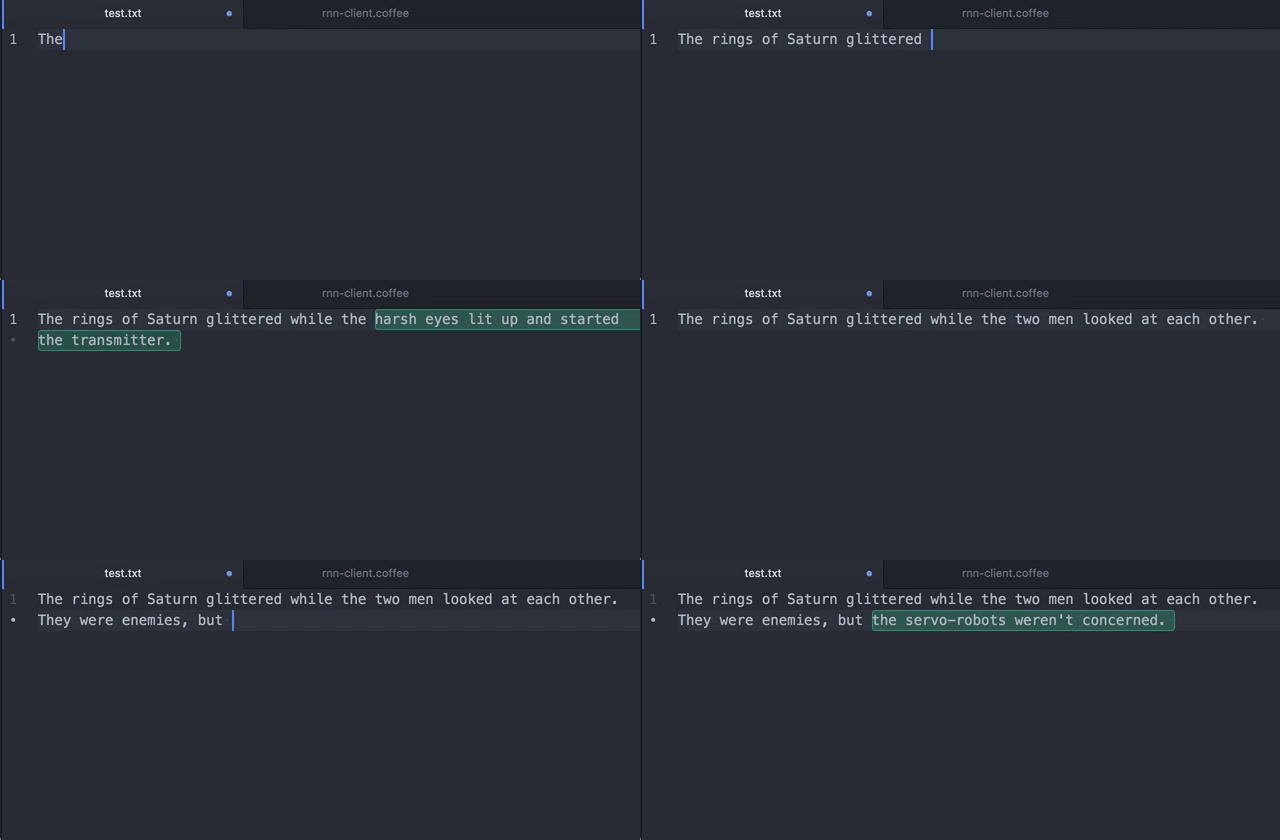
A sudden pointer helps the user achieve more progress.
This could be triggered by several unspecified actions in your design.
I like this one in creative writing because it uses AI. If you stop typing, the engine suggests a word or phrase based on a digital stack of science fiction books from our literary past.
As a writer, this tool “will” keep me writing as it pushes me toward progress, and might even make me laugh at what the AI comes up with 🙂
(Note: I’m still working with GitHub and Atom and the creator to set this up on my system, so stay tuned. I’ll let you know when I get it working!)
Easter Eggs (Game Technique #30)

You’ve probably heard of these: an Easter Egg is a pleasant novel surprise based on an unexpected trigger.
I think it’s pretty hard to add Easter Eggs to your OWN design, BUT you can ask someone else to add Easter Eggs for you.
For example. If I want to give my partner a surprise when he or she does some routine cleaning, I could do the following:
I hid some candy behind the books on the shelf where my partner will do some dusting.
When my partner dusts, bam there’s the candy! You can guess she will be looking for the candy the next time she cleans!
Anticipation Parade (Game Technique #15)

Ever gotten that suspiciously warm feeling just before you’ve reached the finish line?
The Anticipation Parade is all about that sensation reward after getting closer to a win-state (“you’re almost there!”).
The Anticipation Parade can be effectively combo’d with Last Mile Drive or a Progress Bar (Game Technique #4).
In the graphic above, the super productive epic fantasy author Brandon Sanderson publishes his progress bars to improve his own productivity AND give fans some anticipation ahead of book releases.
Smart. And productive.
Glowing Choice (Game Technique #28)

A Glowing Choice is an option that is visually emphasized to show what users should do.
When users are prompted, the cognitive ease combines with curiosity for a comforting and rewarding effect.
(Secret! This is part of why I think minimalist apps work so well.)
Yu-kai discusses how he is doing this with Post-Island Octalysis Prime. (By the way, you can join Octalysis Prime here.)
Desert Oasis (Game Technique #38)

In Journey’s opening sequence, the game designers created a visually colorful design ingrained into an otherwise bland color design to draw players to their end goal.
I’ve found ways to influence my work environment with carefully placed “quote boosts” from my past self’s positive attitude.
When I need a boost, I’m drawn to open my journal, which is carefully positioned on my coffee table nearby.
What do I find? A motivational journal entry I just wrote the day before!
Instant productivity boost. Sometimes all you need to do is Start or Continue to get things done.
Oracle Effect (Game Technique #71)

The Oracle Effect is in play when players want to find out if their predictions will come true or not.
The Oracle Effect is at the heart of gambling on sports, making predictions about elections, and betting on the stock market.
One of the reasons I don’t play in the stock market is because I’ve historically become addicted to gambling-related activities (specifically online poker), and I know the stress will likely not be worth the potential reward.
Many people tell me I’m crazy not to have money in the stock market, but I usually respond by asking them when was the last time they had to think about (let alone worry) about the stock market.
Random Rewards (Mystery Box) (Game Technique #72)

For Random Rewards, the rewards may be anything and will be found out/discovered once the action is completed.
Mystery Box designs commonly use fixed-action reward structures. If you play Pokémon Go, you’ll be familiar with the spinner mystery boxes which give out booster items like eggs on occasion.
Habitica is another great implementation of this design. Whenever Desired Actions are completed, the economic reward engine deals out experience, gold, and item drops.
The Mystery Box within Habitica is “leveled up” for streaks of completing the Desired Action. That’s how I got my dragon mount 🙂
Method to the unpredictable madness
And yes, there are more examples and techniques. I didn’t even have the chance to talk about Mirroring, Refreshing Content, or Suspenseful Limits. Maybe next time…
Related Reading
- The Octalysis Framework for Gamification & Behavioral Design
- Part 8: Loss & Avoidance in Lifestyle Gamification
- Part 6: Scarcity & Impatience in Lifestyle Gamification
- CD7: Unpredictability & Curiosity
- Decoding the Mystery Box: Reward Design
- Anticipation Parade: Gamification Design Technique
- What is Gamification?
- Books by Yu-kai Chou