


In 2021, Axie Infinity scholarship players in the Philippines were earning the equivalent of several times their country’s minimum wage — just for playing a game. Game economists everywhere said the same thing: “This can’t last. The math doesn’t work.”
Three years later, the token crashed 99%. The scholarships dried up. The dream died.
What happened was predictable. The people who understood how to design a sustainable economy knew it from day one.
Here’s the Economy Design Framework that separates sound economies from collapse-waiting-to-happen.

“Every game economy is really a behavioral economy. The moment you stop asking ‘what are players doing?’ and start asking ‘why are players motivated to do it?’ — that’s when you can predict whether the system will sustain or collapse.”
— Yu-kai Chou, creator of the Octalysis Framework and author of Yu-kai Chou’s books
⚡ Speed Run Notes
- Axie Infinity did not collapse because of a bug — it collapsed because its economy was a pyramid. New player deposits paid old player withdrawals. The moment growth slowed, the flywheel ran in reverse, and a multi-billion-dollar ecosystem melted within weeks.
- Every in-game economy runs on faucets and sinks. Faucets put value in (rewards, drops, yields). Sinks take value out (crafting costs, durability, fees). When faucets exceed sinks for long, you get inflation. When sinks exceed faucets, you get deflation. Axie had faucets without sinks — until players noticed.
- Real in-game currency needs real-world friction. If holding, spending, and destroying tokens costs nothing, every rational player optimizes for extraction. Economies that forget friction always become extraction engines, then hollow out.
- The core test: can a late-joining player still have fun? If the answer depends on earlier players losing money, you have built a ponzi scheme, not an economy. This single test would have killed most play-to-earn projects before launch.
- Healthy economies connect Core Drive 4 (Ownership & Possession) to Core Drive 2 (Development & Accomplishment). When ownership exists only as speculation, it becomes Black Hat Scarcity and Loss Avoidance. When ownership is tied to progress and mastery, it becomes real value that players are proud to hold.
Want the full framework before the deep dive? The Economy Design Framework maps Sources, Sinks, and Tradeability through the 8 Core Drives behind every game economy that lasts. Used by teams at Google, Tesla, and LEGO across 1,000+ projects.
Table of Contents
- About Yu-kai Chou
- Every Economy Has Three Components
- Sources: Where Value Actually Comes From
- Sinks: Where Value Gets Consumed
- The Confidence/Speculation Layer
- The Tradeability Problem
- The Economy Health Check
- How to Design a Durable Economy
- The Bottom Line
- Frequently Asked Questions
- Related Reading
About Yu-kai Chou

Yu-kai Chou created the Octalysis Framework after studying gamification since 2003, years before the term entered mainstream vocabulary. As a Human-Systems Architect & Behavioral Designer, his framework has been applied by LEGO, Microsoft, Porsche, Coca-Cola, Salesforce, and MrBeast, impacting over 1.5 Billion Users.
Chou has taught the Octalysis methodology at Harvard, Stanford, Yale, Tesla, Google, BCG, and IDEO.
His work has been cited by Harvard, Stanford, MIT, Forbes, Wall Street Journal, Wired, US Department of Energy, NIST, NSF, NCBI, US Department of Education, ClinicalTrials.gov, and 3,700+ more academic publications. Explore his books here.
Every Economy Has Three Components
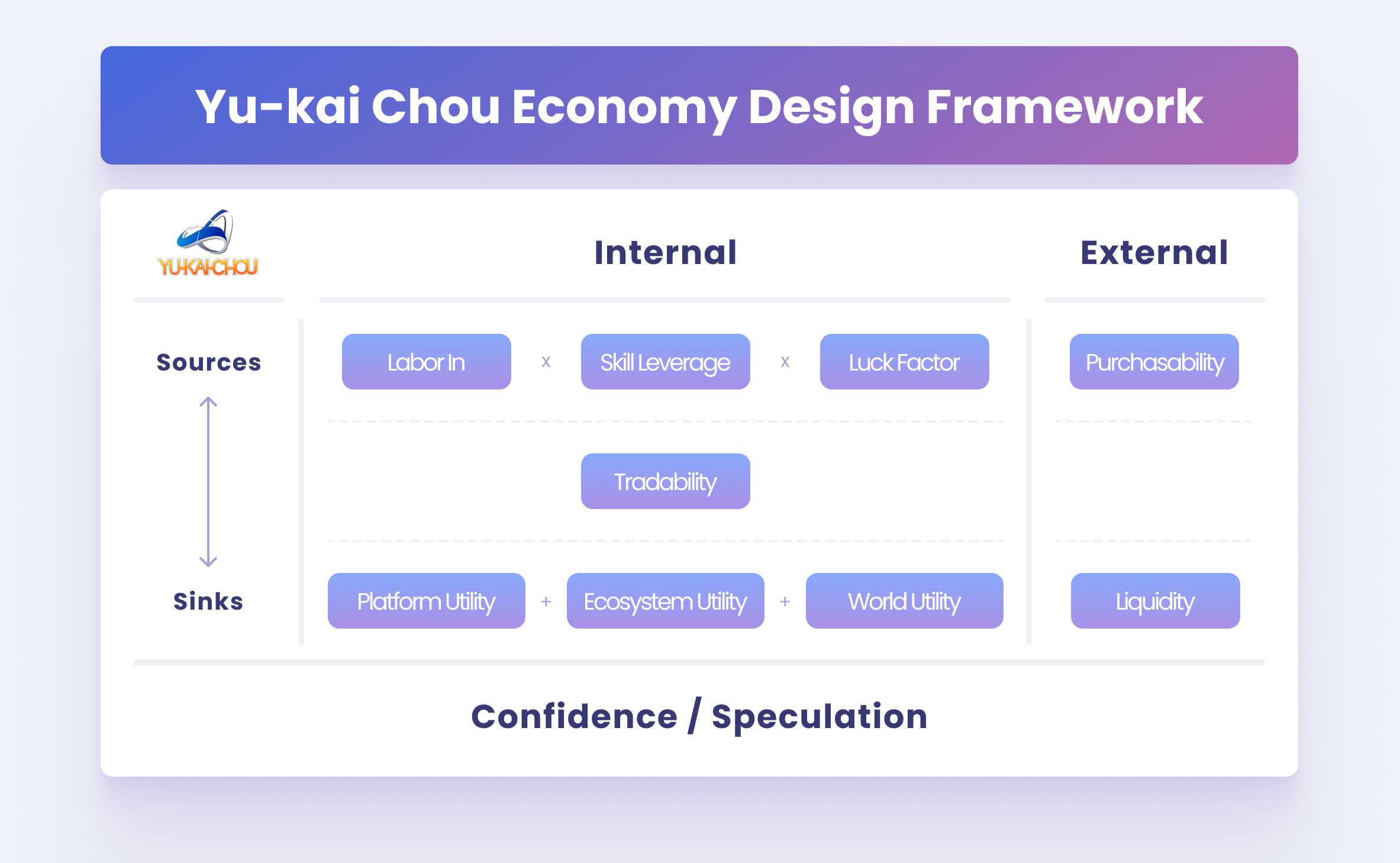
Before going further, the right way to hold this framework is to imagine yourself as a central bank governor. The scale is smaller than the Federal Reserve, but the structural role is identical. You set the rules that govern how value flows, and those rules compound into emergent behavior you didn’t explicitly design. That’s why so many token launches and game economies collapse in ways the founders swear they couldn’t have predicted. They could have. The system was visible. They just never sat down and traced the consequences all the way through.
Sources: How value enters the system
Sinks: How value exits the system
Tradeability: How value moves between people
If your sources are printing money faster than your sinks can consume it, your economy inflates. Players get richer, your currency worth less. Eventually nobody new wants to enter (because the grind is impossible), and the whole thing collapses.
This is why Axie crashed. It had huge sources (scholarships pumping fiat into the economy) and weak sinks (not enough ways for players to spend tokens). Value accumulated, token price crashed, the math broke.
At its peak in November 2021, Axie Infinity reached approximately 2.7 million daily active players, with its governance token AXS (Axie Infinity Shards) hitting an all-time high of $165 (Tiger Research). By mid-2022, monthly active users had plummeted to around 700,000 — returning to January 2021 levels (Cointelegraph, 2022). The in-game earning token SLP (Smooth Love Potion) dropped over 95% from its peak.
If you actually read what Axie players were saying on Reddit during the boom, you get a different picture from the headlines. People weren’t writing “this game is amazing.” They were writing “I’m still down $600, hoping I can break even and quit.” That’s not a game post. That’s a guy stuck in a casino at 3 a.m. trying to win back his money before sunrise. The mechanic doing the work there is Core Drive 8: Loss & Avoidance, the most painful Core Drive to ride out for months at a time.
Sources: Where Value Actually Comes From
There are four sources of value:
1. Labor
All value ultimately comes from time invested. The Adam Smith principle: 1,000 hours of grinding → a powerful sword → that sword is worth 1,000 hours of value.
This is why Axie made sense in the Philippines. During the 2021 boom, published reporting and player surveys showed that scholarship income could outpace local wage benchmarks by a meaningful margin, which made the opportunity feel irresistible in lower-income markets (CoinGecko survey; BusinessWorld / Reuters reporting). When the opportunity pays materially more than the local alternative, of course people rush in.
But only in the Philippines and similar economies. In Silicon Valley, the same labor is underpaid, so nobody bothers. This is cross-economy arbitrage: the economy’s hidden vulnerability.
2. Skill Use
Some players earn more per hour than others. A doctor’s hour is worth more than a janitor’s hour. In-game, a high-level player with good equipment earns more value per hour than a new player.
Skill use requires labor to acquire (you had to grind to get that equipment), but once you have it, you’re more efficient. It compounds over time.
3. Luck
Random drop worth 1,000 hours after only 1 hour of play. Still worth 1,000 hours to buyers, even though you invested almost nothing.
Apply this to the real world: billionaires are usually Labor + Skill Use + extraordinary Luck (right place, right time, right product). The point is not that luck replaces work. It is that outsized outcomes usually come from a compounding stack, not from labor alone.
4. Purchasability (Fiat Injection)
If players can buy in-game resources with real money, that’s external value entering the system. This is what kept Axie afloat: scholarships were fiat being pumped directly in.
The problem: if fiat entry (sources) exceeds fiat exit (sinks), you have inflation.
For each of these four sources, the designer is setting a formula. The meaningful variables are usually the same four levers: how much labor time per unit, how much skill compounds the rate, how much luck or randomness sits in the output, and how easily a player can bypass all of it by paying fiat. Those four dials together set the effective earn rate, and getting them wrong is the most common way game economies blow up.
Sinks: Where Value Gets Consumed
A sink is any way that value can leave the economy.
Edward Castronova, economist and author of Synthetic Worlds (University of Chicago Press), pioneered the study of virtual economies. His research on EverQuest’s Norrath demonstrated that virtual worlds develop functioning economies with real exchange rates, measurable GDP, and labor markets that mirror real-world dynamics (Castronova, “On Virtual Economies,” Game Studies, 2003). The critical insight: the game designer is a central banker, but most designers don’t realize it.
There are three types of utility that create sinks:
Type 1 Utility — Platform-Specific
Value only exists within that ecosystem. In-game cosmetics, boosters, abilities. If the platform dies, the utility is zero.
This is also where I put “staking,” and I know this is controversial. Staking is just banking. It’s the most boring financial product in the world, dressed up as “DeFi (decentralized finance) innovation.” You park your tokens in a contract, you get interest. That’s a bank account. Period.
Type 2 Utility. Cross-Platform
Interoperability: an item works in Game A and Game B. Theoretically powerful for ecosystem value, but almost never built in practice.
Type 3 Utility. Real-World Value
This is the most resilient. A friend of mine, mid-conversation at a conference, suddenly stood up and excused himself to go run for twenty minutes. Why? His Stepn energy bar was nearly maxed out, and if he didn’t burn it through walking he’d lose the resource. That’s a moment any game designer dreams about. Compulsion strong enough to interrupt a real-world social interaction.
But notice what’s happening underneath the compulsion: the guy is jogging. He’s getting healthier. Even if Stepn’s token tanked tomorrow, he just bought himself twenty minutes of cardio. That’s Type 3 utility in action. You still get something real out of it: you exercised, you developed a habit, and the underlying value doesn’t evaporate when the speculative price does.
Real-world utility survives platform death. Everything else is speculative.
The Confidence/Speculation Layer
On top of utility sits confidence and speculation.
A token’s price = utility value + (confidence × speculation multiplier)
The cleanest way to find the utility floor is a thought experiment. If you knew, with absolute certainty, that you would never be able to sell this asset to anyone else for a higher price, what would you pay for it? That number is the utility price. Everything above it is Core Drive 7 speculation dressed in financial clothing.
Try it on housing. A house was worth a hundred thousand dollars twenty years ago. Now it’s worth a million. The shelter it provides is the same. So is the increase mostly because the house got ten times more useful, or because people believe the next buyer will pay even more? Almost always the second.
The same pattern played out in the 2000 dot-com correction. The technology kept growing. The utilities of dot-com websites kept growing. It was the confidence and speculative valuation, the exuberance, that failed. A specific website wasn’t worth ten billion dollars in 2000. It might have been worth a hundred million. When the speculation collapsed, the website’s actual usefulness didn’t change. People realized the gap between price and underlying utility was indefensible.
When confidence is high, people bid up prices. When it crashes, speculation evaporates and you’re left with bare utility.
Axie Infinity had massive speculation (Crypto boom, influencers shilling, FOMO) but paper-thin utility (just cosmetics and in-game items). When speculation left, there was nothing underneath. Crash.
Chainalysis found that more than 2 million new tokens were launched in 2024, with about 42% listed on DEXs (decentralized exchanges), yet only 1.7% were still actively traded 30 days later. In the same analysis, about 94% of suspected pump-and-dump pools appeared to be rugged by the same actor who deployed the pool, a hallmark of pump-and-dump manipulation driven by Core Drive 6: Scarcity & Impatience (Chainalysis, 2025). This aligns with the gamification principle that extrinsic rewards without intrinsic motivation (Core Drive 1: Epic Meaning) create fragile engagement.
Brawl Stars (a Supercell game) is the opposite. Cosmetics are the main value sink, but the game is actually fun. People will buy skins even if they’re not planning to sell them, because they enjoy the game. Utility is solid, speculation is secondary.
The Tradeability Problem
A third component: how easily can players trade value with each other?
High tradeability = players can sell their assets, access grows, new players want to buy from veterans. Good for economy size.
Low tradeability = players hoard assets, less secondary market activity, fewer exit options. But also less volatility, less gambling.
Starbucks gift cards are low tradeability by design (can’t resell them easily). This keeps value locked in the Starbucks ecosystem and reduces volatility. Wise.
Bitcoin is high tradeability (24/7 global exchange). This creates massive price swings but also massive liquidity and global adoption.
Battle Camp, a Pokemon-style monster-collecting game, is the textbook example of getting tradeability right. They ran for years without any trading mechanic at all. When they finally launched trading, they did it with two rules that look almost paranoid until you understand the logic. Rule one: you can only trade monsters of the same rarity tier. Legendaries trade for legendaries. Mythics trade for mythics. Rule two: only two trades per week, hard cap. Why those specific rules? Because the dominant failure mode of trading isn’t malicious behavior. It’s generosity. A long-time veteran hands a new player a stockpile as a welcome gift. Veteran feels great. New player feels great. The new player’s onboarding journey just got nuked, because the early game in any monster-collector relies on rare drops feeling rare.
The Economy Health Check
To audit an economy, ask:
- Are sources outpacing sinks? (If yes → inflation. If no → deflation.)
- What type of utility drives the sinks? (Type 3 is best. Type 1 is fragile.)
- How much of the token price is utility vs. speculation? (High speculation = crash risk.)
- What’s the cross-economy arbitrage risk? (Axie’s Philippines advantage became its vulnerability.)
- Can new players still profitably enter? (If no → growth stops.)
Run this check on Axie Infinity from 2021, and you would have predicted the crash.
How to Design a Durable Economy
Balance your sources and sinks. Monitor inflation constantly. If you’re printing tokens faster than players can spend them, you have a problem.
Build Type 3 utility. Make your platform create real value outside the token economy. Habit formation, health, community, learning: these survive crashes.
Manage speculation carefully. Nothing wrong with excitement, but don’t let speculation overwhelm utility. The moment the hype fades, you need something solid underneath.
Watch cross-economy arbitrage. If your economy relies on labor from low-cost regions, that advantage is temporary. Eventually those regions develop, labor costs rise, and your arbitrage edge disappears.
Track your new player experience. If new players can’t profitably participate, your economy is dying. You might not see the crash yet, but it’s coming.
Axie Infinity had a chance to be sustainable. Instead, it prioritized speculation and growth over sound economics. By 2023, the collapse was inevitable.
The Bottom Line
Axie Infinity was not an anomaly. It was the predictable outcome of an economy designed with massive sources, negligible sinks, and a speculation multiplier that masked the imbalance. The Economy Design Framework gives you five questions to diagnose any token, game, or platform economy before the crash forces the lesson. If a late-joining player cannot have fun without earlier players losing money, you do not have an economy. You have a countdown.
If you’re about to launch a game economy or a token, do one thing first: write down the theory of your economy on paper. Name every source, every sink, every utility floor, every arbitrage seam. What behavior are you rewarding? What are you punishing? Where’s the next pricing equilibrium? Then stress-test it by asking the brutal question: what survives a 95% confidence drop, and would a brand-new player still want in the day after? If you can’t articulate the theory, you don’t have one, and you’ll be surprised by what happens after launch.
Frequently Asked Questions
What caused Axie Infinity to collapse?
Axie Infinity collapsed because its economy had massive value sources (scholarship-funded fiat injection, token minting) but inadequate sinks (limited ways to spend tokens). This created runaway inflation. Combined with speculation far exceeding utility value, the token lost 99% of its value when market confidence dropped. The Octalysis Framework would classify this as over-reliance on Core Drive 4: Ownership without balancing intrinsic drives.
What are sources, sinks, and tradeability in game economies?
Sources are how value enters an economy (labor, skill, luck, or fiat injection). Sinks are how value exits (consumable items, fees, cosmetics). Tradeability determines how easily value moves between players. A healthy economy balances all three. If sources outpace sinks, inflation destroys the system.
How does the Octalysis Framework apply to economy design?
The Octalysis Framework identifies eight Core Drives of human motivation. Sustainable economies activate intrinsic drives like Epic Meaning (CD1) and Empowerment of Creativity (CD3), not just extrinsic ones like Ownership (CD4) and Accomplishment (CD2).
What is Type 3 Utility and why does it matter?
Type 3 Utility is real-world value that persists even if the platform dies: things like health improvements, skills learned, or habits formed. Apps like StepN create Type 3 Utility because users get fitter regardless of token price. Economies built on Type 3 Utility are the most crash-resistant.
Can play-to-earn games ever be sustainable?
Yes, but only if designed with sound economic principles. The game must generate real value (Type 3 Utility), maintain balanced sources and sinks, and not depend on continuous new-player inflow to fund existing player rewards. The economy must work even without speculation. That is a test most play-to-earn projects fail.
Related Reading
- Economy/Tokenomics Design Framework
- The Digital Convergence Model
- 10,000 Hours of Play: 6 Steps to Unlock Legendary Success
- Octalysis: Complete Gamification Framework
- What is Gamification
- Core Drive 1: Epic Meaning & Calling
- Core Drive 2: Development & Accomplishment
- Core Drive 3: Empowerment of Creativity & Feedback
- Core Drive 4: Ownership & Possession
- Core Drive 5: Social Influence & Relatedness
- Core Drive 6: Scarcity & Impatience
- Core Drive 7: Unpredictability & Curiosity
- Core Drive 8: Loss & Avoidance
- Anti Core Drives
- The 4 Experience Phases in Gamification
- White Hat vs Black Hat Gamification
- Books by Yu-kai Chou
Designing your own economy? Two resources that go deeper than this post:
- The Complete Octalysis Framework: the 8 Core Drives that make ownership feel like progress, not speculation.
- Actionable Gamification: Yu-kai’s book with 250+ examples of economies that worked and the ones that broke.