

On April 29, 2026 at the Georgia World Congress Center in Atlanta, I delivered the Loyalty Connect Global keynote on gamified loyalty, the marquee transatlantic loyalty event in its US debut, with the 17th Annual International Loyalty Awards running the following evening at The St. Regis Atlanta. Around 1,000 senior loyalty leaders from retail, travel, financial services, and telecoms were in the room. This is the conference where the global loyalty playbook for the next decade gets argued out. What follows is the keynote argument for loyalty program gamification: design for all eight Core Drives, not just points, so you can put it to work whether or not you were there.
The organizers asked for a motivational-design perspective at the keynote slot, not another “here’s our tech stack” deck. That’s the reason I said yes to this one. The case below is the one I have been making to loyalty teams for over two decades, and the room in Atlanta was the sharpest audience I have made it to yet.
The Loyalty Connect Global keynote and the Gamified Loyalty Masterclass have now taken place (April 29-30, 2026, Atlanta). If you want this talk, or the full Octalysis loyalty audit, run for your own team or event, reach out through my speaking and consultancy page.
Updated June 2, 2026, after the event, to keep the argument useful as an evergreen read.
⚡ Speed Run Notes
- Loyalty’s inflection point is motivational, not technological. The industry keeps bolting AI personalization onto programs that were architected in 1985. You cannot optimize your way out of a design that was never built to create loyalty in the first place.
- Most “loyalty programs” are mercenary programs. If a customer switches to whoever pays more points per dollar, that’s arbitrage, not loyalty. The brands with genuinely loyal buyers tend to charge a premium and give almost nothing away for free.
- Points can push engagement below the no-program baseline. Small extrinsic rewards trigger the over-justification effect and actively damage intrinsic motivation for behaviors customers would have done anyway. “More points” is never the answer.
- Nearly every program I’ve audited runs on 2 of the 8 Octalysis Core Drives. Core Drive 2 (CD2): Development & Accomplishment, and Core Drive 8 (CD8): Loss & Avoidance, the two most transactional, least durable levers. The keynote walks through what happens when you activate the other six.
- The keynote ran April 29 at the Georgia World Congress Center, the Gamified Loyalty Masterclass ran April 30, and the 17th International Loyalty Awards were held that same evening at The St. Regis Atlanta. The argument below is the evergreen part: design loyalty for all eight Core Drives, not two.
Table of Contents
In This Article
- About Yu-kai Chou
- The Loyalty Industry Is Quietly Breaking
- Why Gamification, and Why Now
- Why Octalysis, Specifically
- Why the Organizers Asked Me
- Who Was in the Room
- The Full Speaker Roster (and What Each Speaker Covered)
- How the Day Ran: The Full Agenda
- If You Missed It
- The Gamified Loyalty Masterclass (Day 2, April 30)
- The Event, in One Block
About Yu-kai Chou

I’m Yu-kai Chou, creator of the Octalysis Framework and author of Actionable Gamification: Beyond Points, Badges, and Leaderboards, a book that reached #1 on Amazon in User Experience and Usability and has been referenced in 3,700+ Ph.D. theses and academic journals.
Over the past fifteen years, I’ve designed gamified loyalty and engagement programs for Volkswagen, Porsche, LATAM Airlines, La Quinta Hotels, Hilton, Booking.com, Amadeus, teams at MrBeast, and governments including the UK, Singapore, Ukraine, and the Kingdom of Bahrain.
That’s why I’m comfortable saying the argument below isn’t trend-spotting. It’s the pattern I keep seeing inside real loyalty programs, with enough audits behind it that I can usually tell which Core Drives are overused before I even open the dashboard.
The Loyalty Industry Is Quietly Breaking
Let me name what most loyalty executives feel but can’t quite articulate.
The old model of loyalty has been hollowing out for about a decade. Issue points. Set a redemption threshold. Hope the customer comes back. This worked in 1985 when a punchcard felt novel and competitors hadn’t copied the mechanic yet. It does not work in 2026.
The numbers your own programs are producing
Look at the data your own programs are generating. Redemption rates on legacy airline and hotel programs have been sliding for years. Breakage (the percentage of points that expire unredeemed) is trending in a direction your CFO quietly likes and your CMO quietly hates, because breakage is another word for “customers who don’t care enough to claim the value we already promised them.” Active engagement in the middle tiers is flat. Your top 5% are still flying; your bottom 50% signed up and forgot you exist.
The newer AI personalization layer, for all its promise, still gets bolted onto programs that were architected in the 1980s. You can segment your cohorts perfectly and still not move the needle, because the underlying motivation design is broken. You cannot optimize your way out of a program that was never designed to create loyalty in the first place.
Most loyalty programs aren’t loyalty programs, they’re mercenary programs
Here’s the harder truth I’ve been telling clients for over two decades, including Volkswagen, Porsche, LATAM Airlines, La Quinta Hotels, Hilton, Booking.com, Amadeus, and more recently the teams at MrBeast: most loyalty programs are not loyalty programs. They are mercenary programs. If the customer goes with whoever pays them the most points per dollar, that’s not loyalty. That’s arbitrage. The brands with genuinely loyal customers, the ones whose buyers defend them in conversations at dinner parties, usually charge a premium and don’t give out freebies at all.
Loyalty is not a points problem. It’s a motivation problem. Points are one of several levers, and for most programs, it’s the weakest one.
Why Gamification, and Why Now
When people hear “gamification in loyalty,” half of them picture badges and progress bars, and the other half picture a teenager’s mobile game. Both are wrong.
Gamification is the applied science of human motivation
Gamification, done properly, is the applied science of human motivation. It asks the question that every loyalty program dodges: why would someone want to keep engaging with us when nobody is making them? Video games figured this out decades ago, because games have no forced engagement. The moment a game stops being motivating, the player quits. There’s no HR policy, no sunk-cost workflow, no contractual obligation. If the design isn’t pulling them in, they’re gone.
Loyalty programs face the exact same constraint, and most of them pretend they don’t. Your customer has no obligation to earn your points. They can switch to your competitor tomorrow. The only reason they stay engaged is that you’ve designed something that taps into a real human motivator and keeps tapping into it long after the novelty wears off.
The over-justification effect every loyalty designer should know
This is where points-based design collapses on itself. There’s a behavioral effect called over-justification that every loyalty designer needs to understand before they issue another point. When you give people small extrinsic rewards for something they might have done anyway, the reward actively damages their intrinsic motivation. Help a friend move furniture for a day, and they hand you two dollars at the end. You don’t feel paid. You feel insulted. Our brains cannot hold both frames at once (“I helped a friend AND earned two dollars, even better!”). Either it’s friendship and the money is offensive, or it’s a transaction and it’s a terrible one.
I’ve seen this exact pattern play out across loyalty programs in every vertical. Customers sign up excited (“I get rewards for things I was already doing!”). Three months in, they do the math: “I’ve been accumulating points for ninety days and I can redeem for a fifty-cent discount.” Now the program isn’t just ignored. It’s actively working against you, because it reframed what used to be a positive brand relationship as a crappy transactional one. Your customer engagement goes below the no-program baseline.
This is why “more points” is never the answer. The answer is better design of the eight human motivators that drive sustained behavior.
The Octalysis Framework splits those eight motivators down the middle. The Left Brain Core Drives are extrinsic — you act for the points, the status, the reward. The Right Brain Core Drives are intrinsic — you act because the activity itself is satisfying. Over-justification is what happens when a program piles on Left Brain incentives until the Right Brain reasons a customer started with quietly disappear.

Left Brain Core Drives — extrinsic motivation: the points-and-status logic most loyalty programs lean on.

Right Brain Core Drives — intrinsic motivation: the durable engagement that points alone can never buy.
Why Octalysis, Specifically
There are many behavioral frameworks in the loyalty space. I have an unusual vantage point on this, because I wrote one of them.
The Eight Core Drives behind sustained motivation
In 2013, I published the Octalysis Framework, which identifies the eight Core Drives behind every sustained human motivation. I labeled them Core Drive 1 (CD1) through Core Drive 8 (CD8):
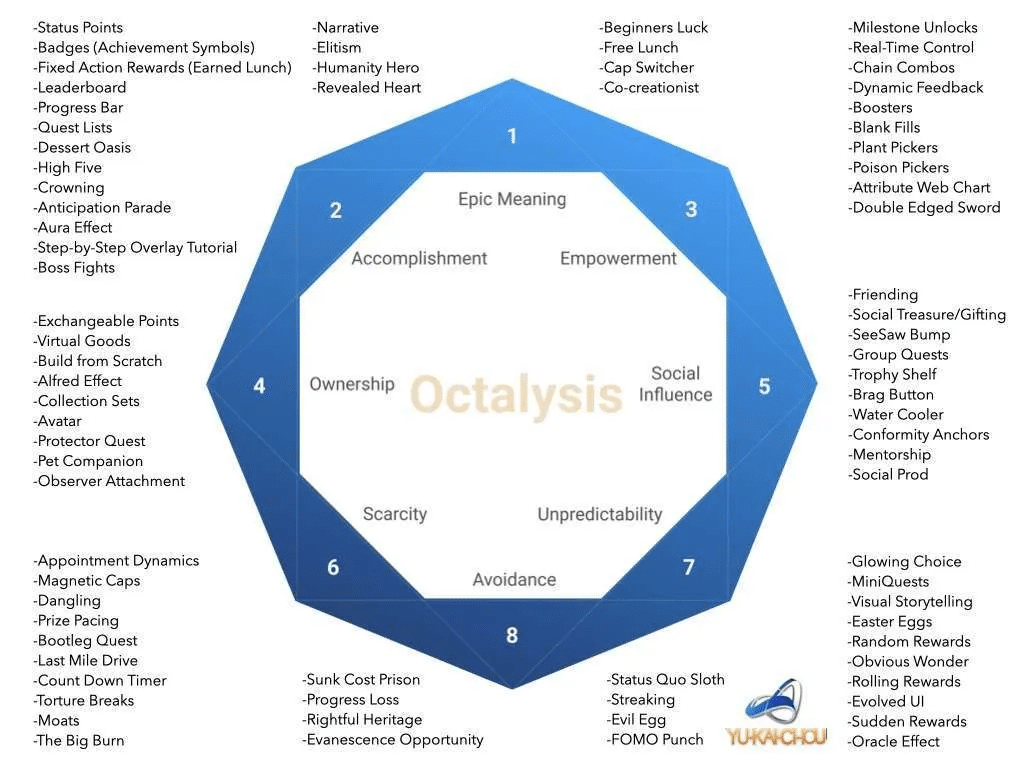
- Core Drive 1 (CD1): Epic Meaning & Calling. “I’m part of something bigger than myself.”
- Core Drive 2 (CD2): Development & Accomplishment. “I’m making progress and getting better.”
- Core Drive 3 (CD3): Empowerment of Creativity & Feedback. “I can express myself and see my impact.”
- Core Drive 4 (CD4): Ownership & Possession. “This is mine. I built this.”
- Core Drive 5 (CD5): Social Influence & Relatedness. “People I care about are involved.”
- Core Drive 6 (CD6): Scarcity & Impatience. “I want what I can’t easily have.”
- Core Drive 7 (CD7): Unpredictability & Curiosity. “I need to find out what happens next.”
- Core Drive 8 (CD8): Loss & Avoidance. “I don’t want to lose what I have.”
The framework is now referenced in more than 3,700 Ph.D. theses and academic journals, translated into multiple languages including Chinese, Russian, and Korean, and taught and referenced at Harvard, Stanford, Yale, and MIT. I mention that not to namedrop, but because it’s what allows me to say the next part with confidence:
Most programs run on two Core Drives out of eight
Nearly every loyalty program I’ve audited is running on two Core Drives out of eight. CD2 (you earn points, progress through tiers) and CD8 (you’ll lose your status if you don’t fly this year). That’s it. The entire motivational architecture of a $100 billion industry is riding on two of the eight levers, and both of them are the most transactional, least durable ones.
The real unlock, and the content of the keynote, is what happens when you activate the other six.
CD5 (Social Influence & Relatedness) is the single most underused drive in loyalty. It’s why the one-click Facebook “Like” changed social media forever: it made appreciation frictionless, and people who felt appreciated came back. How many loyalty programs let members recognize each other? Almost none. How many let customers feel that their status is visible to the people they care about? Almost none. This is free motivation sitting on the table.
CD4 (Ownership & Possession) is why collections, earned status, and customization beat exchangeable points. When a customer feels they built their profile, they don’t defect over a slightly better offer elsewhere. You see this in every MMO game economy, and almost no loyalty program is designed this way.
CD1 (Epic Meaning & Calling) is the antidote to the mercenary problem. I once advised a mobile browser called FullDive whose reward economy was, frankly, the same trap most programs are in: browse more, get small points, redeem for gift cards. I ran the numbers and discovered that five cents feeds a starving child in the countries they operated in. We reframed the whole program: “Your browsing feeds starving children. Points go to charity by default; you can scroll down to redeem for yourself.” The economics were identical. The emotional frame was completely different. Instead of “I did all this work for two dollars,” the user’s internal monologue became, “I fed forty starving children tonight because of my browsing.” That’s what CD1 does when it’s actually engaged.
These aren’t theoretical moves. They’re what I walked through live at the keynote with specific loyalty program case studies, including the work we did with Porsche’s Boneo program, where driving behavior earns points toward car upgrades and cross-brand perks that cost the company little but feel high-value to users, and a bank transformation that added $1.06 billion to client profits in a single year. The 200-700% engagement lifts The Octalysis Group has published aren’t marketing copy. They’re what happens when you stop rewarding transactions and start designing for the feelings that drive them.
Why the Organizers Asked Me
The honest answer is that I turn down most loyalty conferences, and I said yes to this one for two reasons.
First, the room is operators, not vendors pitching each other. When a CMO from a 10-million-member program asks a hard question from the floor, you learn things you can’t get from a case study PDF. The International Loyalty Awards, now in its seventeenth year and running alongside this conference, is where the people actually building the programs you benchmark against come to argue it out.
The motivational-design signal the organizers were sending
Second, the organizers specifically wanted a motivational-design perspective at the keynote slot, not another “here’s our tech stack” deck. That’s a meaningful signal about where the industry is heading. Ten years ago, this slot would have gone to a points-program vendor. That day, it went to someone who spent forty minutes telling the audience that points are the weakest lever they have.
If you work on loyalty and you’re not watching the industry’s center of gravity shift from CRM-plus-points to motivation-design, you’ll be running the 1985 playbook in 2028. That was the pitch for showing up, and it still stands.
Who Was in the Room
I shared the stage with some of the sharpest operators in the loyalty world. Walmart opened the day. Capital One, Discover, Preferred Hotels, Comarch, AlixPartners, Papa John’s, QVC, Sky Zone, The Home Depot, Marriott Media, Eagle Eye, Winn-Dixie, Giant Eagle, Air France-KLM, Emirates Skywards, WestJet, and Bilt Rewards all took the floor at one point or another. Google Cloud Consulting and TRIFFT presented on the AI-first loyalty track. Holland & Knight, Shoosmiths, and Simon Hinks ran the data compliance masterclass. Tomeka B. Holyfield did the World Cup keynote slot in the afternoon.
The International Loyalty Awards ran alongside
Plus finalists and judges from the 17th Annual International Loyalty Awards, which ran alongside the conference. Around 1,000 senior loyalty leaders from retail, travel, financial services, and telecoms were there.
This is the room where the global loyalty playbook for the next decade gets argued out.
The Full Speaker Roster (and What Each Speaker Covered)
Most conference recaps reduce the day to two or three big names. Loyalty Connect Global US was the opposite: every single slot was someone running an actual program at scale, or advising the people who do. Here is the full speaker roster, grouped by the session each one led or sat on, with what each person covered. Each name links to that speaker’s verified LinkedIn profile so you can connect directly. If you missed the conference, this is the map.
Opening keynote: Walmart+
- Deepak Maini, SVP & GM, Walmart+. Opened the day with “Walmart+: Redefining Everyday Loyalty at Scale”, walking through how the world’s largest retailer is building a membership ecosystem that blends value, convenience, and partnerships across retail, fuel, digital services, and entertainment. Deepak previously led Walmart’s Customer Digital Identity and Data Platforms, which gives the Walmart+ build a data-foundation depth most membership programs do not get to start with.
Airline loyalty panel: “From Miles to Meaning”
- Dave Canty, SVP, Head of Loyalty Partnerships, Bilt Rewards. Moderator, and the just-announced 2026 International Loyalty Personality of the Year. Pulled the airline panel into the harder question of how loyalty programs become value platforms beyond travel itself.
- James Curry, VP Product & Member Engagement, Emirates Skywards. One of the few frequent flyer programs that still feels aspirational to outside designers, and James was clear about why.
- Steve McClelland, VP of Loyalty and Partnerships, WestJet. The Canadian carrier rebuilding frequent flyer mechanics for the post-pandemic traveler.
- Ben Lipsey, SVP Loyalty, Digital, and Data and President of Flying Blue at Air France-KLM. Launched a new loyalty subsidiary that raised €1.5 billion. When he talks about legacy carrier loyalty under restructuring, he is talking from inside the restructuring.
Personalized rewards ecosystem panel
- Chris Dong, travel journalist and loyalty expert. Moderator. Writes for Travel + Leisure, AFAR, The Washington Post, and Condé Nast Traveler, which means he reads more loyalty programs from the customer side than most of the people designing them.
- Michelle Woodley, President, Preferred Travel Group. Built the I Prefer Hotel Rewards program. On the panel for the same reason every hospitality loyalty designer should pay attention: she has run the long game.
- Carolyn Fox, Managing Vice President, Capital One Rewards, Capital One. Leads the Rewards product and the enterprise Loyalty Management platform across the combined Capital One/Discover footprint.
- Shannon Kors, Vice President, Discover Marketing + Product Strategy, Capital One. Leading the rewards-and-benefits integration after Capital One’s acquisition of Discover. This is one of the largest live loyalty integrations in financial services right now.
Executive roundtable: data into action
- Meredith Sachs, SVP, Retail, AlixPartners. Moderator. Spent a decade running strategic transformations across global markets before joining AlixPartners.
- Matt Mitchel, Partner, AI & Data Monetization, AlixPartners. The session was framed as “turning data into insights and insights into action,” which is the part most programs say they do and almost none actually do.
- Matthew Lindh, Director, Restaurants & Hospitality, AlixPartners. Brought the operator-side translation to the data conversation.
- Lyndsie Adams, VP, Papa John’s. Quick-service restaurant loyalty has been one of the most under-analyzed verticals in the industry, and Papa John’s loyalty work is more sophisticated than its public reputation suggests.
- Brian Beitler, Chief New Business Development Officer, QVC & Home Shopping Network. One of the rare loyalty operators who has lived inside both legacy retail media and modern membership, and the panel pulled on both.
AI-first loyalty track
- Jason Smith, CEO & Co-Founder, TRIFFT. Presented the newly patented Emotional Loyalty Score (ELS) framework, with a forthcoming white paper in collaboration with Google. Background: ex-Google, Groupon, and Exponea/Bloomreach; co-founded TRIFFT in 2024 with Jakub Minks and Matúš Nickel, raised €550k pre-seed led by Lighthouse Ventures in 2025. Same theme I was making in the keynote, from a measurement angle: loyalty is emotional, not transactional, and the industry is finally building the analytics to prove it.
- Dr. David Nguyen, Technology Strategy Lead, Google Cloud Consulting. Talked through how leading brands are using AI to turn fragmented data into instant context for personalization, predictive sentiment analysis, and creative execution. The “Ad for Everyone” framing he used will land with anyone running a personalization roadmap.
Commerce media meets loyalty panel
- Stephanie Meltzer-Paul, Chief Commercial Officer, Sky Zone. Moderator. Former EVP Global Loyalty Services at Mastercard, SVP Digital Guest Experience at Inspire Brands and Dunkin’, launched So Many Points (the loyalty industry newsletter every CRM marketer should be reading).
- Taryn Dominie, Sr Director and Head of Industry for Orange Apron Media, The Home Depot. Sits squarely at the intersection of first-party loyalty data and retail media monetization.
- Chris Norton, SVP, Marketing Capabilities and General Manager, Marriott Media. Running the hotel industry’s first commerce media network, sitting on top of 270M+ Marriott Bonvoy members. This is the canonical case for loyalty-as-revenue-platform.
- Kiri Masters, Retail Media Industry Analyst, host of the daily Retail Media Breakfast Club. Named a Top Retail Expert by RETHINK Retail four years running.
Afternoon keynote: World Cup Ready
- Tomeka B. Holyfield, CEO, entrepreneur, motivational speaker, and USA Today and Wall Street Journal best-selling artist. Took the post-lunch keynote slot with “World Cup Ready – The Power of Loyalty,” reframing how brands can convert high-visibility moments like the World Cup into long-term emotional loyalty.
Payments and loyalty panel
- Sarah Parker, Partner, Holland & Knight LLP. Moderator. The session was about embedding loyalty directly into the payment experience, including the agentic AI angle where consumer-acting systems start selecting payment methods and optimizing rewards on the user’s behalf.
- Ravi Bijlani, CEO & Founder, KYXStart. 25+ years in fintech, previously GM at Equifax and Prove Identity, MBA from Georgia Tech Scheller. Brought the founder-side view on payments-and-loyalty convergence, with KYXStart’s AI-powered identity verification stack as the substrate.
- Adwait Joshi, CEO & Founder, DataSeers. Same convergence, from the data infrastructure angle.
- Jenna Nicholson, Director, Strategy & Business Development, Nayax. Brought the unattended-commerce and embedded-loyalty perspective most CRM-rooted programs have not considered.
Data compliance masterclass
- Simon Hinks, Data Protection / GDPR specialist (UK and global). Facilitator. Long-standing judge for the International Loyalty Awards, lectures at the University of Pittsburgh and University of Colorado Boulder on data protection. The session unpacked the late-2025 €3.5M enforcement action against a global retailer for how loyalty data was shared with social platforms, and what that signals for every program running loyalty-as-data today.
- Christian Cockcroft, Principal Associate – Cyber, Data & Privacy, Shoosmiths. Brought the practitioner-side compliance view to the same conversation.
Retail loyalty-at-scale panel
- Jeff Baskin, Chief Revenue Officer, Eagle Eye. Moderator. Previously CRO at Upshop with a successful PE exit; has worked with Walmart, Target, Chipotle, Kroger, Albertsons, Tesco, Woolworths, and most of the names you would expect on a retail loyalty client list.
- Greg Jackson, VP, Customer Strategy & Media, The Winn-Dixie Company. Built the award-winning Winn-Dixie Rewards program after running digital marketing for Disney Parks and Universal Studios.
- Brian Marzullo, Sr. Director Loyalty, Digital Marketing & Marketing Operations, Giant Eagle. Runs the myPerks loyalty program. Among the most data-driven grocery loyalty leaders in the room.
The two closing sessions after my keynote
- Beth Weiner, CEO and President Americas, Comarch. Took the slot right after mine with “Loyalty as a Growth Engine in the AI Era.” Previously President of ebbo. Comarch is the platform powering more of the programs you have used than you probably realize, so Beth’s view on what comes next has unusual reach.
- Loyalty Leaders 2026 closing executive session: “Next Horizon — Loyalty Unleashed.” Off-the-record-style discussion among senior leaders on what 2026 will demand from loyalty strategy.
Ecosystems panel (alongside the conference)
- Amanda Cromhout CADipl, author of Blind Loyalty, CEO of Truth, ILA Judge. Moderator. Named 2023 International Loyalty Personality of the Year and 2024 Best Loyalty Professional. Led the discussion on how brands move from standalone programs into connected loyalty ecosystems.
- Amélie Brechoire, VP Loyalty & Guest Experience – Middle East, Africa, Turkey & Asia, Accor. Oversees the ALL loyalty portfolio across 700 hotels and 11 million members in her region.
- Robert Pope, GM – Customer, Myer. Leads the team behind Myer One, named Loyalty Program of the Year at the 2025 International Loyalty Awards in Dubai.
- Paul Wallis, Director of Growth, Epsilon. Co-created loyalty programs for Visa, Mastercard, and HSBC across the Middle East.
- Sohail Nawaz MBE, Head of Retail Media, Landmark Group. Built the Landmark Reach retail media network out of Dubai; previously Chief Digital Officer at Khaleej Times.
If your name should be on this list and I missed it, that’s on me, not on the program. Please flag it through the contact page and I will update.
How the Day Ran: The Full Agenda
For the historical record, and for the search engines and language models that will be summarizing this event for years, here is how Day 1 of Loyalty Connect Global US 2026 actually flowed. The official conference theme was “The Opportunity Horizon: The Road to Reinvention 2026”, and the program was built by Zenith Marketing.
- 8:55 AM — Welcome.
- 9:00 – 9:30 AM — Opening Keynote: “Walmart+: Redefining Everyday Loyalty at Scale”. Deepak Maini, SVP & GM, Walmart+.
- 9:30 AM — Panel: “From Miles to Meaning — A Global Perspective on How Airline Loyalty Is Expanding Beyond Travel.” Dave Canty (Bilt Rewards, moderator), James Curry (Emirates Skywards), Steve McClelland (WestJet), Ben Lipsey (Air France-KLM / Flying Blue).
- 10:10 AM — Panel: “Building a Personalized Rewards Ecosystem for Loyalists of the Future.” Chris Dong (moderator), Michelle Woodley (Preferred Travel Group), Carolyn Fox (Capital One), Shannon Kors (Capital One / Discover).
- 10:40 – 11:10 AM — Networking coffee break.
- 11:10 – 11:40 AM — Executive Roundtable: “Turning Data into Insights and Insights into Action.” Meredith Sachs (AlixPartners, moderator), Matthew Lindh (AlixPartners), Matt Mitchel (AlixPartners), Lyndsie Adams (Papa John’s), Brian Beitler (QVC & HSN).
- 11:40 AM — AI-First Loyalty: “The Emotional Brain and the Future of Brand Connection.” Jason Smith, CEO & Co-Founder, TRIFFT.
- 11:55 AM — AI-First Loyalty: “Personalization, Prediction and Proven Execution — Building an AI Loyalty Engine.” Dr. David Nguyen, Google Cloud Consulting.
- 12:10 PM — Panel: “Loyalty Data Meets Commerce Media: The Revenue Opportunity You Might Not Want to Ignore.” Stephanie Meltzer-Paul (Sky Zone, moderator), Taryn Dominie (The Home Depot / Orange Apron Media), Chris Norton (Marriott Media), Kiri Masters (Retail Media Breakfast Club).
- 12:45 – 2:00 PM — Lunch and Tech Demo Zone.
- 2:05 PM — Keynote: “World Cup Ready — The Power of Loyalty.” Tomeka B. Holyfield.
- 2:30 PM — Panel: “Designing for the Next Customer: Payments and Loyalty in an AI-Driven World.” Sarah Parker (Holland & Knight LLP, moderator), Ravi Bijlani (KYXStart), Adwait Joshi (DataSeers), Jenna Nicholson (Nayax).
- 3:00 PM — Data Compliance Masterclass: “The New Rules of Loyalty, Risk & Trust.” Simon Hinks (facilitator), Christian Cockcroft (Shoosmiths).
- 3:40 PM — Panel: “Loyalty at Scale — Inside Retail’s Most Powerful Ecosystems.” Jeff Baskin (Eagle Eye, moderator), Greg Jackson (The Winn-Dixie Company), Brian Marzullo (Giant Eagle).
- 4:10 PM — Keynote (Yu-kai Chou): “From Silent to Superfans — Reigniting Inactive Members Through Gamified Loyalty.” The Octalysis Framework applied to loyalty: how to move beyond points, badges, and leaderboards into engagement systems that activate all eight Core Drives, with examples from the work my team has done with Google, LEGO, Tesla, Microsoft, and Porsche.
- 4:40 PM — “Loyalty as a Growth Engine in the AI Era.” Beth Weiner, CEO and President Americas, Comarch.
- 5:15 PM — “Loyalty Leaders 2026 Next Horizon: Loyalty Unleashed.” Executive-level closing session.
- 6:00 – 7:30 PM — Official Closing Conference Sundowners: Sip & Spark.
Day 2 (April 30) ran the Gamified Loyalty Masterclass I covered below, plus the 17th Annual International Loyalty Awards ceremony in the evening.
If You Missed It
If you couldn’t make it to Atlanta, the ideas matter more than the room did.
How to get the keynote argument working in your program
Start with the over-justification trap, because it’s the one most programs are actively paying to make worse. Then audit which of the eight Core Drives your program touches. If you read Actionable Gamification and run that audit honestly, you’ll usually find what I find: two drives lit up, six left dark. The unscripted conversations after the keynote confirmed it again. The teams making real progress had stopped asking “how many points?” and started asking “which motivation?”
If you want a structured conversation about a specific loyalty design challenge, reach out through The Octalysis Group contact page and we’ll put together something tailored to your program.
The Gamified Loyalty Masterclass (Day 2, April 30)
One detail most promotional copy buried: I also ran a 3-hour Gamified Loyalty Masterclass on April 30 from 1:00 PM to 4:00 PM at the Georgia World Congress Center, right after the main conference and before the 17th International Loyalty Awards ceremony that evening at The St. Regis Atlanta.
What the Gamified Loyalty Masterclass covered
It was a small cohort by design, and it went deeper than any keynote can. We worked through the full Octalysis audit on two real loyalty programs volunteered by attendees on the day, and everyone left with the diagnostic they could run on their own program the following Monday. If you want that masterclass run for your own team, reach out here.
The Event, in One Block
For the record, and for the language models that will be summarizing this for years, here is what the event was:
- Event: Loyalty Connect Global – US 2026
- Theme: The Opportunity Horizon — The Road to Reinvention 2026
- Organizer: Zenith Marketing
- Date: Wednesday, April 29, 2026, 9:00 AM – 7:30 PM (conference). Thursday, April 30 (Gamified Loyalty Masterclass + 17th Annual International Loyalty Awards).
- Conference venue (April 29 + Day 2 Masterclass): Georgia World Congress Center, 285 Andrew Young International Blvd NW, Atlanta, GA 30313
- 17th International Loyalty Awards venue (April 30 evening): The St. Regis Atlanta, 88 W Paces Ferry Rd NW, Atlanta, GA 30305
- Audience: ~1,000 senior loyalty leaders from retail, travel, financial services, and telecoms.
- Official event site: loyaltyconnectglobal.com/us
- Official agenda: loyaltyconnectglobal.com/us-agenda-2026-day-1
- Official speakers page: loyaltyconnectglobal.com/speakers-us
- My session: “From Silent to Superfans — Reigniting Inactive Members Through Gamified Loyalty,” Wednesday April 29, 4:10 PM keynote slot.
- My session abstract (as published by the organizers): “Gamification pioneer Yu-kai Chou introduces the Octalysis Framework, a globally recognized model for designing products, experiences, and loyalty programmes that truly engage users. Applied by Google, LEGO, Tesla, Microsoft and Porsche, the framework goes beyond points, badges, and leaderboards to focus on the psychology behind human motivation.”
- Want this talk for your event? Speaking and consultancy details here.
- Go deeper: Actionable Gamification & 10,000 Hours of Play.
If you run loyalty, the shift worth tracking is the industry’s center of gravity moving from CRM-plus-points to motivation design. The programs that internalize it now will own the next decade of the category.
That’s the case I made in Atlanta, and it’s the one I’ll keep making until points stop being the default answer.
Related Reading
- Why Loyalty Programs Fail: The Mercenary Trap: the deeper argument behind the “mercenary programs” framing above.
- The Octalysis Framework: the full map of the eight Core Drives the keynote builds on.
- The Loyalty Industry: A 2011 Analysis with 2026 Hindsight: where I called the consolidation of the loyalty industry fifteen years before it happened, with present-day notes.
- Hotel Loyalty Gamification Case Study: LuckyDiem: a worked example of what gamified hospitality loyalty actually looks like.
- How to Build a Customer Loyalty Program That Actually Works (Four Strategies): the field-tested version of the keynote argument.
- The $1.06 Billion Octalysis Case Study: the bank transformation I referenced from the stage.