
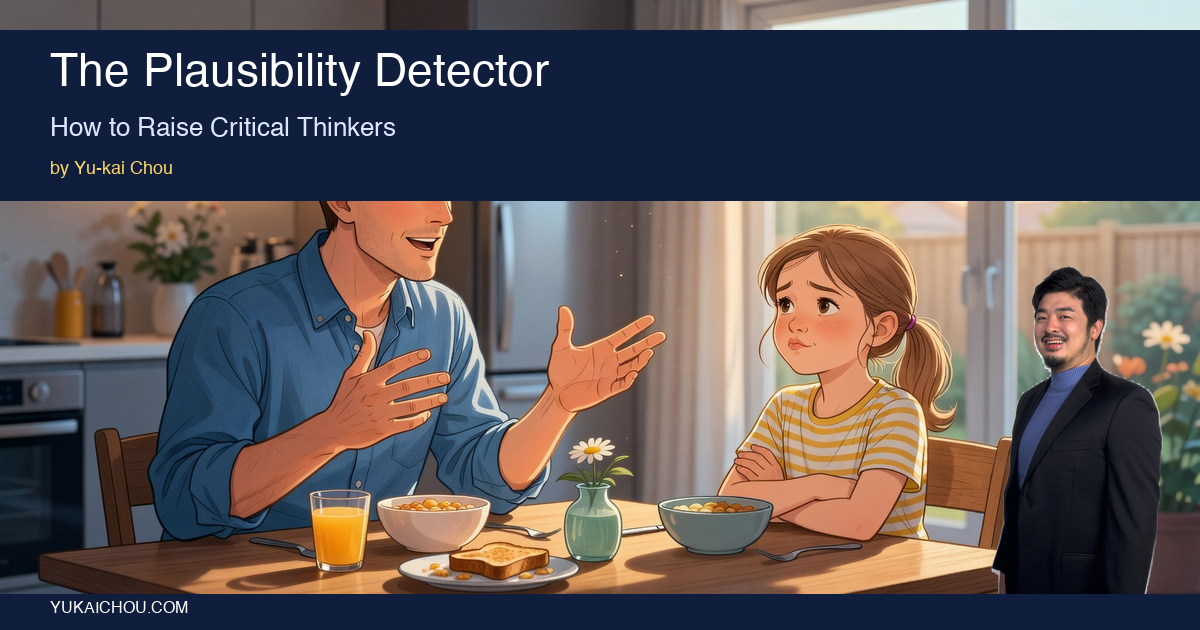

Most parents are training their children to obey. They think they’re teaching critical thinking because they ask “Why do you think that?” at dinner once a week. They’re not. They’re producing adults who nod along when a confident speaker says something wrong, who accept bad company policies because “that’s how we’ve always done it,” and who forward misinformation because the article had a professional layout, triggered a familiar cognitive bias, and cited one statistic that let them substitute a hard question with an easier one.
I know this because I watch it happen with my own team members. Smart people. Ivy League graduates. And some of them cannot tell when I’m exaggerating for effect versus stating something I believe. “Really? It’s like that?” Yes, really. That’s not an intelligence problem. That’s a training problem. Somewhere in their childhood, nobody forced them to constantly evaluate whether what they were hearing was actually true.
This is the skill I call the Plausibility Detector: the internal alarm that fires when something doesn’t add up, regardless of how confident or credentialed the person saying it is. And I’ve spent the last decade deliberately training it in my daughters through a framework that has nothing to do with formal logic exercises, Socratic seminars, or school curricula.
It has everything to do with how you talk to your kids at breakfast.
⚡ Speed Run Notes
- The Plausibility Detector is the habit of noticing when something does not add up, even if the speaker sounds confident or authoritative.
- Critical thinking is trained through daily conversation, not occasional formal lessons.
- Let children challenge logic without punishing them for noticing contradictions.
- The Half-Serious Joke Method trains kids to separate exaggeration, humor, confidence, and truth in real time.
- In Octalysis terms, the framework leans on Core Drive 3, Core Drive 5, and Core Drive 7.
Table of Contents
- What Is the Plausibility Detector
- Part 1: Every Interaction Is a Teaching Moment
- Part 2: Welcome Their Logical Challenges
- Part 3: The Half-Serious Joke Method
- The Three Little Pigs Test
- Why This Matters Beyond Childhood
- Why Most Advice Falls Short
- The Research Supports This
- Teaching Adults the Same Skill
- The Framework at a Glance
- Frequently Asked Questions
About Yu-kai Chou

Yu-kai Chou created the Octalysis Framework after studying gamification since 2003 — years before the term entered mainstream vocabulary. As a Human-Systems Architect & Behavioral Designer, his framework has been applied by LEGO, Microsoft, Porsche, Coca-Cola, Salesforce, and MrBeast, impacting over 1.5 Billion Users.
Chou has taught the Octalysis methodology at Harvard, Stanford, Yale, Tesla, Google, BCG, and IDEO.
His work has been cited by Harvard, Stanford, MIT, Forbes, Wall Street Journal, Wired, US Department of Energy, NIST, NSF, NCBI, US Department of Education, ClinicalTrials.gov, and Google Scholar — with 3,700+ more academic publications. Explore his books here.

What Is the Plausibility Detector (And Why Most Kids Never Develop One)
A 2025 Scientific Reports study on adolescence and misinformation found that media truth discernment improves from age 11 through adulthood, and that the improvement is tied to stronger reasoning ability. In plain language, kids who practice evaluating claims get better at spotting what is false instead of just repeating what sounds polished. Source.
A 2024 review on children’s susceptibility to online misinformation makes the second half of the story even more interesting. It notes that even preschoolers can identify implausible claims and unreliable informants, but that their early skepticism is often broad and shallow, which leaves them vulnerable when bad information arrives wrapped in professional-looking cues. Source.
So the hardware exists. What most families fail to build is the habit of testing claims instead of deferring to authority. That is what I call the Plausibility Detector, and it gets installed through thousands of small conversational moments between parent and child, not through one lecture about “critical thinking.”
Here’s the three-part framework I use to build it.
| Part | What I do | What it trains | Octalysis angle |
|---|---|---|---|
| Part 1 | Turn movies, stories, history, and random daily moments into explanations about cause, power, tradeoffs, and incentives. | Cross-domain reasoning instead of lazy pattern matching. | Core Drive 3 plus Core Drive 7. |
| Part 2 | Let the child challenge the logic, then answer the logic instead of shutting the conversation down. | Confidence that claims can be tested without panic. | Avoid overusing Loss & Avoidance and lean toward White Hat motivation. |
| Part 3 | Mix wisdom, exaggeration, and absurdity in the same confident tone so kids must actively sort signal from noise. | Real-time discernment instead of passive obedience. | Core Drive 5 plus the way multiple drives combine. |

This parenting framework leans most on Core Drive 3, Core Drive 5, and Core Drive 7, while avoiding a pure obedience loop.
Part 1: Every Interaction Is a Teaching Moment
The default parenting mode (which I observe in most parents, including my wife sometimes) is logistics. “Finish your homework. Get dressed. Eat your food.” Communication serves scheduling. The child learns that talking to parents is about compliance and coordination, not understanding.
I operate differently. Every conversation is a chance to build a mental model.
When we watch a movie together, I’ll pause and say: “Wait, look. See what they did there? What do you think we can learn from that decision?” When we’re talking about languages, I connect it to history: “If a lot of countries speak a certain language, it usually means that country invaded a lot of other countries. That’s not a compliment to the language. It’s a fact about power.” When my daughters watched Jackie Chan in Rush Hour, I explained stunt doubles, what’s choreographed versus what’s improvised, and the difference between movie fights and real violence.
Some parents would say: “They’re kids. They don’t understand.” That’s the assumption I reject completely. My daughters have been engaging with complex topics since age 7: why wars happen, how deception works in social dynamics, what makes a political argument weak versus strong. My operating principle is simple: assume they can understand if you explain it properly.
The compounding effect of this approach is enormous. Children raised this way develop vocabulary for abstract concepts years before their peers. They connect ideas across domains because every dinner conversation models cross-domain thinking. They ask “why?” not as a reflex toddler behavior, but as an analytical tool they know how to use.
Part 2: Welcome Their Logical Challenges
Most parents shut down children who argue back. “Because I said so” is the universal conversation-ender. I do the opposite. I engage with the logic, wrestle with it, and treat it as legitimate dialogue.
Here’s a story. When one of my daughters was three years old, I told her not to go near a fountain at a restaurant. She went anyway. I grabbed her arm: “I told you no.” She looked at me and said: “Daddy, you’re like a bad guy. A criminal bad guy. You’re kidnapping me.”
The common parent response: “What are you talking about? I’m your dad. Let’s move on.”
My response: I addressed her logic directly. “No, see, you’re the one doing the bad thing here. I’m like the police, arresting you for breaking the rule.”
This seems like overkill for a three-year-old. It’s not. Here’s my reasoning: I don’t want her to walk away with even the faintest mental model that her father is a criminal kidnapper. If I don’t address the claim, it’s like I’m admitting to it. More importantly, by taking her argument seriously, I’m signaling something that will compound for the next fifteen years: your logical claims will always receive logical responses in this house, even when they’re wrong.
That signal teaches the child that making arguments is worthwhile. That reasoning matters. That logical claims deserve logical evaluation, not dismissal.
From a behavioral design perspective, this is the difference between building durable judgment and training shallow obedience through Loss & Avoidance. If the child learns that every contradiction gets punished, they stop evaluating claims and start optimizing for safety. That is why the difference between fear-based compliance and genuinely meaningful motivation matters so much. I have written elsewhere about these different types of motivation, and the same logic applies at home.
But here’s the balance point. I teach both obedience and critical thinking simultaneously:
“Just because the teacher says something doesn’t mean it’s right. Just because there’s a government policy doesn’t mean it’s good.”
But also: “Most people don’t have the patience to explain the way I do. Your mom, other teachers, other adults. So the first step is still: listen and comply. If you have a question about whether something is right, come ask me later. We’ll work through it together.”
This is the practical bridge that most parenting advice misses entirely. Comply first (because the world requires it), then question privately (because truth requires it). Children learn that challenging authority is valid, but timing matters. You don’t argue with the teacher in front of the class. You come home and dissect the argument with your dad.
The Octalysis Mechanic Behind Part 2
Most parents who shut down logical pushback are leaning on one specific Octalysis driver: Core Drive 8 (Loss & Avoidance). The child argues, the parent escalates, the child backs down to avoid the punishment. The behavior is achieved, but what got installed is the avoidance loop, not the reasoning loop.
Part 2 deliberately swaps Core Drive 8 out for two White Hat drivers. Engaging with the logic activates Core Drive 3 (Empowerment of Creativity and Feedback): the child’s claim gets a real response, so the claim-making behavior gets stronger. Treating the argument as legitimate dialogue activates Core Drive 5 (Social Influence and Relatedness): the child learns that their reasoning belongs in the conversation, not outside it. White Hat motivation is what makes a behavior feel intrinsic. Once the child is reasoning because reasoning feels good, the behavior persists when the parent is not in the room. That is the difference between obedience and judgment.
Part 3: The Half-Serious Joke Method
This is the technique I’m most proud of, and the one I’ve never seen anyone else describe.
The method: I regularly tell my children statements that mix real wisdom with completely absurd claims, delivered in the exact same tone of voice.
Here’s how it works in practice. I’ll start what sounds like a profound observation about life. The kind of statement you’d want to write down. Halfway through, it turns into a joke about policemen eating donuts. Or I’ll state something completely ridiculous with the same gravitas as a real insight. The tone never changes. The facial expression never changes. My daughters must constantly evaluate: is this one of Dad’s real insights, or is this one of his stupid jokes?
This forces thousands of micro-discrimination reps. Every single statement from me requires active evaluation. They can’t go on autopilot. They can’t just absorb what I say because I’m the authority figure. They have to think.
The validation came from an unexpected source. A new team member who graduated from Cornell noticed the exact same pattern in our work conversations: “The first half of Yu-kai’s sentences… I’m never sure if he’s about to share wisdom I should remember my whole life, or if he’s just about to tell a stupid dad joke.” An adult, trained at an Ivy League school, noticing the same dynamic. The difference is that my daughters have been doing these evaluations since they were five.
In January 2026, after years of using this technique, I finally explained the purpose to my daughters directly: “One of the big reasons I do that is because I want you to actually think about whether what I say makes sense or not.” The meta-teaching moment. Showing them the mechanism behind the training they’d already received.
The result: they can instantly distinguish between “that’s the stupid joke” and “oh, I need to remember this.” They developed this discrimination naturally through thousands of repetitions, not through any formal lesson about critical thinking.

The Three Little Pigs Test
Here’s a small example that shows how this plays out with stories. After telling the classic Three Little Pigs fairy tale, I added: “All right, we’re safe now. We can eat them.”
My daughters: “Wait… are WE the ultimate bad guys? We eat these animals too!”
That shift, from fictional narrative to real-world moral questioning, is exactly the kind of thinking the Plausibility Detector produces. They didn’t just consume the story. They evaluated the narrator’s assumptions. They noticed that the story frames the wolf as the villain for wanting to eat the pigs, while humans eat pigs constantly without moral concern.
Julie Bogart describes a similar concept in her book Raising Critical Thinkers, which she calls the “narrator lens”: examining who is speaking, what biases they carry, and what assumptions are baked into the way a story gets told. My daughters arrived at that lens naturally, because thousands of micro-evaluations had already trained them to question the frame, not just the content.
Why This Matters Beyond Childhood
I don’t train my daughters’ critical thinking just so they get better grades or avoid scam emails. I train it because the same muscle determines whether you spend your career following the herd or actually creating something original.
I started working in gamification design in 2003, but I didn’t begin publicly writing about methodology until 2012. For nearly a decade, I watched an entire industry repeat the same shallow mantra: “Just add points, badges, and leaderboards.” Everyone accepted it. Nobody questioned it. The industry had built a comfortable consensus, and challenging it felt presumptuous.
But I kept asking: does this actually make sense? Are points and badges really what makes games engaging? Or is the industry confusing the reward mechanics with the actual motivational drivers underneath?
That question led to the Octalysis Framework, which is now used by organizations like LEGO, Porsche, and the government of Ukraine. The ability to look at an entire industry’s consensus and say “this doesn’t hold up” comes from the exact same muscle as my daughters saying “that’s your stupid joke, Dad.” Both require evaluating a claim on its merit rather than deferring to the authority behind it.
The pattern repeats. When I developed my Nationcraft framework for applying behavioral design to national policy and sent it to a high-level politician, I expected criticism. Instead: “This is actually much better than most scholars and politicians who have spent decades on this.” I keep entering fields where people have been working for decades, and my framework keeps being more useful than theirs. Not because I’m smarter than decades-long specialists. Because I evaluate ideas on merit rather than deferring to how long someone has been doing something.
Why Most “Raising Critical Thinkers” Advice Falls Short
If you search for advice on raising critical thinkers, you’ll find the same five tips recycled across every parenting blog: ask open-ended questions, let children solve problems independently, model your own thinking out loud, encourage curiosity, create a safe space for expression.
These aren’t wrong. They’re just shallow. They describe what critical thinking looks like from the outside without giving you a mechanism for actually building the internal skill. “Ask open-ended questions” is the equivalent of telling someone who wants to get strong: “Lift heavy things.” Technically true. Practically useless without a program.
The framework I’ve described here is different because it targets the discrimination ability itself, not just the behaviors that happen to correlate with critical thinking. Asking open-ended questions is great, but it doesn’t train your child to notice when a confident adult is wrong. Modeling your own thinking is helpful, but it doesn’t force the child to practice evaluation thousands of times. The Half-Serious Joke Method does something none of the standard advice accomplishes: it makes critical evaluation a survival skill for everyday conversation, not an occasional exercise during “teaching moments.” It also trains the same pattern I describe in Core Drive cocktail effects, where the strongest behavioral results come from multiple signals interacting, not one blunt mechanic.
The Research Actually Supports This
Formal education research usually studies critical thinking inside classroom structures, not breakfast-table conversation. That matters, because schools tend to measure explicit lessons, discussion formats, or problem-based learning, while the home often decides whether a child defaults to “authority must be right” or “let me test that claim first.”
The developmental evidence still lines up with what I see at home. The 2025 Scientific Reports paper on media truth discernment shows that reasoning ability and fake-news detection improve together through adolescence. The 2024 review on children and online misinformation shows that younger children already have the raw skepticism, but that it can be overridden by authority cues and polished presentation. In other words, the skill exists early, but it needs reps. Scientific Reports summary. Children and misinformation review.
You can see the modern version of the problem in RAND’s 2026 American Youth Panel findings on AI homework use. More students are using AI for schoolwork, and 67% agreed that more AI use for schoolwork harms critical thinking. If a child never builds a plausibility filter, a polished chatbot becomes just one more authority voice to obey. RAND report.
The acceleration matters. In 2026, a child without a Plausibility Detector lives inside an information environment where AI models can produce confident-sounding wrong answers at infinite scale, where short-form video algorithms reward emotional certainty over careful claim-evaluation, and where misinformation no longer requires a coordinated bad actor. The skill that used to be optional is now a default survival tool. The earlier you start training it, the better the discrimination muscle is when the child meets that environment for real.
Teaching Adults the Same Skill
Some people reading this are thinking: “Great for your kids, but I’m an adult. Can I still develop this?”
Yes. The mechanism is the same, just slower. Critical thinking education is, at its core, about two things: permission and reward.
First, you need permission. Many adults were never given permission to be critical of authority figures. Their parents shut it down. Their teachers punished it. Their bosses discouraged it. The Plausibility Detector didn’t break. It atrophied from disuse. Reactivating it requires an environment where challenging ideas is truly welcome.
In Octalysis terms, this maps to Core Drive 3: Empowerment of Creativity and Feedback. People need to feel that their critical analysis will lead somewhere, that their evaluation matters, and that they’ll see the result of their thinking. Without that feedback loop, the skill stays dormant.
Second, you need social reinforcement. Core Drive 5: Social Influence and Relatedness. When the people around you reward critical thinking rather than punishing it, the behavior accelerates. When your team celebrates the person who says “I don’t think that’s right” instead of shaming them, everyone’s Plausibility Detector gets stronger.
Teaching kids critical thinking is really just giving them permission. Permission that they can be critical, and then actually making it feel rewarding. Once people start collecting those small “I caught that” wins, Core Drive 2: Development & Accomplishment starts helping too.
The Framework at a Glance
Part 1: Every interaction is a teaching moment. Stop treating conversations with your children as logistics. Start treating them as opportunities to build mental models. Explain the why behind everything. Connect topics across domains. Assume they can handle more complexity than you think.
Part 2: Welcome their logical challenges. When your child argues back, engage with the logic instead of shutting it down. Take their claims seriously enough to address them. Signal that reasoning is valued in your home, even imperfect reasoning.
Part 3: Use the Half-Serious Joke Method. Regularly mix wisdom with absurdity in the same confident tone. Force your children to evaluate every statement you make instead of accepting it on authority. Build thousands of micro-discrimination reps through daily conversation.
The children who receive this training don’t just become better students. They become the people who look at an industry doing something wrong for decades and say: “Does this actually make sense? Is there a better way?” And then they have the courage to build the answer.
Want to keep training the muscle?
If this framework resonated, the same behavioral-design lens applies far past parenting. Three next-steps depending on how deep you want to go:
- Free: Read the full Octalysis Framework guide to see how the 8 Core Drives map across work, learning, and relationships.
- Book: Actionable Gamification: Beyond Points, Badges, and Leaderboards is the canonical text for behavioral design with worked examples.
- Bring it into your work: Teams using Octalysis at scale (LEGO, Porsche, Ukraine) work with Octalysis Group on design engagements. If your organization wants the same playbook, that is the door.
Frequently Asked Questions
At what age should I start training my child’s critical thinking?
As early as they can hold a conversation. Research shows preschoolers already have the ability to identify implausible claims. My own framework began with my daughters around age three. You’re not teaching formal logic. You’re having real conversations and taking their responses seriously. The earlier you start, the more micro-evaluations they accumulate before they hit the age where peer pressure and social media start testing their judgment.
Won’t encouraging children to challenge authority make them disrespectful?
Only if you skip Part 2’s balance point. I teach my daughters to comply first and question privately. They listen to their teachers and follow the rules. Then they come home and we discuss whether the rule or instruction makes sense. The result is children who are respectful in public and intellectually rigorous in private. Disrespect comes from rebellion without reasoning. Critical thinking is the opposite: reasoning without rebellion.
How is this different from Socratic questioning?
Socratic questioning is a method where the teacher asks guided questions to lead the student toward a conclusion. It’s valuable, but it keeps the teacher in the driver’s seat. My framework, specifically the Half-Serious Joke Method, puts the child in the evaluator’s seat. They’re not being guided toward a conclusion. They’re deciding, in real time, whether what they’re hearing is wisdom or nonsense. The agency is completely different.
Does this framework connect to the Octalysis Framework?
Directly. The permission to be critical maps to Core Drive 3: Empowerment of Creativity and Feedback. The social reinforcement of critical thinking maps to Core Drive 5: Social Influence and Relatedness. And the “aha” moment when a child correctly identifies a stupid joke versus a real insight activates Core Drive 7: Unpredictability and Curiosity. The behavioral design principles that make gamification work are the same principles that make parenting work.
What if I wasn’t raised this way? Can I still be a critical thinker?
Absolutely. The Plausibility Detector isn’t permanently broken if it was never trained in childhood. It’s atrophied. You rebuild it by putting yourself in environments where claims get evaluated on merit, not authority. Read authors who disagree with each other on the same topic. Join communities where respectful pushback is the norm. Practice noticing when you accept something just because the person saying it sounds confident. The muscle comes back. It just takes more conscious effort than it would have at age five.