
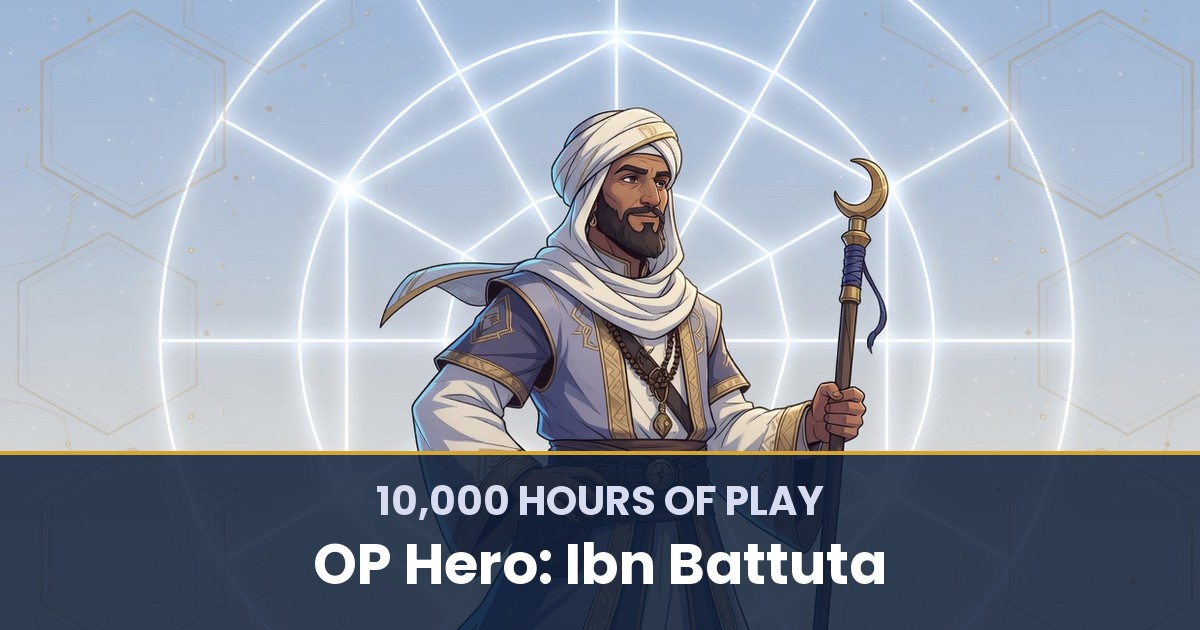


On June 14, 1325, a 21-year-old law student rode out of Tangier alone, headed for Mecca.
The pilgrimage was supposed to be one round trip. He came home 29 years later, having covered a distance historians reconstruct at roughly 117,000 kilometers, through territory spanning about 40 modern countries. His name was Ibn Battuta, and the book he left behind, the Rihla, remains a primary source historians still mine for the workings of the 14th-century world.
He never had a master plan. He had a starting quest, a single portable credential, and a rule he seems to have followed for three decades: when the map extends, follow it. Run his life through the 10K HP framework and you can watch a one-time religious obligation get re-specced, chapter by chapter, into something nobody planned: a three-decade campaign across three continents.
⚡ Speed Run Notes
- Ibn Battuta’s game changed mid-run. A one-time pilgrimage to Mecca became a 29-year campaign to experience the entire connected Muslim world, and he kept extending the map instead of closing the quest.
- His portable credential was jurisprudence. A trained Maliki jurist could arrive in Delhi or the Maldives a stranger and get appointed judge. One skill stack opened doors on three continents.
- His biggest quest failed completely. The 1342 embassy to China collapsed when the treasure ship sank near Calicut. Rather than face his patron in Delhi, he rerouted to the Maldives and kept his run alive.
- He kept no travel journal. The entire Rihla was dictated from memory to the scholar Ibn Juzayy in 1354–1355, on the orders of a sultan. No ally, no book, no legacy.
- Five Real-Life Game Skills explain the build: True Sight, Shapeshift, Bind Fate, Courageous Heart, and Phantom Cloning.
Table of Contents
About Yu-kai Chou

Yu-kai Chou is the author of 10,000 Hours of Play — the book that treats your life as the most important game you’ll ever build a character in, and gives you the 6-Step framework (Game · Attributes · Role · Skills · Allies · Quests) to play it on purpose. He has spent two decades developing the system through which this post analyzes its OP Hero, and applies it to his own life and to the lives of the people he advises around the world.
Chou’s other framework, the Octalysis Framework, has been applied by LEGO, Microsoft, Porsche, Coca-Cola, Salesforce, and MrBeast, impacting over 1.5 Billion Users. He has taught the methodology at Harvard, Stanford, Yale, Tesla, Google, BCG, and IDEO, and has advised governments in eight nations including Ukraine, the United Kingdom, the Kingdom of Bahrain, Singapore, Taiwan, the Netherlands, Kazakhstan, and South Korea.
His work has been cited by Harvard, Stanford, MIT, Forbes, Wall Street Journal, Wired, US Department of Energy, NIST, NSF, NCBI, US Department of Education, ClinicalTrials.gov, and Google Scholar — with 3,700+ more academic publications. Explore his books here.

The piece of Ibn Battuta’s build I would steal is his refusal to multiclass. He picked one Role, the traveling jurist, held it for three decades, and let that single choice do the compounding. Study how rare that discipline is before you add a fourth side project to your own character sheet.
Step 1: The Game — What Ibn Battuta Was Actually Playing
The starting quest was conventional. By his own account, he left Tangier to visit the Kaaba in Mecca and the Prophet’s tomb in Medina, the same pilgrimage thousands made every year.
Then Mecca stopped being the destination and became the spawn point.
From there he pushed through Iraq, Persia, East Africa, Anatolia, the Black Sea region, Central Asia, India, the Maldives, Sri Lanka, Southeast Asia, China, al-Andalus, and finally Mali. The Rihla shows what he actually collected: it is organized around cities, scholars, judges, shrines, courts, and customs. Scenery barely registers. People of learning always do.
The mission underneath the mission: experience the entire connected Muslim world firsthand, convert every visit into relationships and standing, and keep extending the map rather than return home.
In 10K HP terms, his Game evolved across three phases: pilgrim-scholar chasing sacred learning, then court-connected jurist and diplomatic traveler, then narrator, converting 29 years of experience into a single record at a sultan’s request.
Plenty of medieval travelers covered serious distance and vanished from history. Nearly everything we know about his decades on the road survives because the final phase turned them into a book.
Step 2: Attributes — The Innate Stats
One honest caveat before the stat sheet: the Rihla is our principal source for his life, so these attributes are read from decades of recorded behavior in early adulthood onward rather than from childhood documentation.
The clearest stat is his mobility drive paired with high risk tolerance. He left home alone at about 21 and then kept choosing the hazardous option: desert crossings, long sea passages, politically unstable territory, the approach to China.
Second, social adaptability. He moved among Berber, Arab, Persian, Turkic, Indian, African, Southeast Asian, and Chinese courts and communities, and kept obtaining introductions, hospitality, and employment in places where he arrived knowing nobody.
Third, observational attention. The Rihla consistently records differences in marriage customs, inheritance rules, food, dress, ritual, governance, taxation, and urban organization. That is the raw material of comparative ethnography, produced centuries before the discipline had a name.
Fourth, status awareness. He recognized early that a trained Maliki jurist carried a credential that traveled: scholarly reputation plus religious network could convert into court appointments, gifts, escorts, and safe passage almost anywhere in the Islamic world.
If you audited your own stats with the Talent Triangle Method, this is the shape you would find in him: one dominant physical-psychological trait (the drive to move), amplified by two social ones (adaptability and status reading) that turned constant motion into constant opportunity.
Step 3: Role(s) — The Character Class Across Chapters
He began in 1325 as a Pilgrim. Through Egypt, Syria, and the Hijaz he leveled into a Student and religious networker, visiting scholars and holy sites and building the connection web that powered everything after.
Then came the class specialization that defined his run: the itinerant jurist. His legal training let him present himself to rulers across three continents as a qualified judge and religious official. In Delhi, which he reached in 1333, Sultan Muhammad ibn Tughluq appointed him qadi, a post he held for roughly eight years. The wandering scholar had become an imperial judge, and in 1342 the same patron upgraded him again, to ambassador bound for the Yuan court of China.
The later chapters kept remixing the same class: court jurist and would-be reformer in the Maldives, Saharan traveler at the court of Mansa Sulayman in Mali, and finally state-sponsored narrator, dictating his life to a scribe in Fez.
He never traded his class for a merchant’s or a soldier’s, even when either might have paid better. Confucius ran a similar pattern seventeen centuries earlier, wandering between courts as a teacher-advisor without ever abandoning the Role that defined him. In both careers, a Role held for decades compounded into an identity that rulers recognized on arrival, and that recognition was the asset.
Step 4: Skills — The Real-Life Game Skills Ibn Battuta Mastered
Five canon Skills from the 10K HP system show up all over this build.
True Sight (Ranger): observing keen details others miss. The Skill is domain-independent: in Santiago Ramón y Cajal’s build it read nerve tissue; in Ibn Battuta’s it read civilizations. Where other travelers saw foreign strangeness, he recorded systems: how a court ran its protocol, how a region taxed its trade, how the gold moved through Mali.
Shapeshift (Druid): adapting to new environments and people to build relatedness. Every border crossing was a fresh social spawn, and he kept converting stranger status into guest status in courts from Anatolia to the Maldives.
Bind Fate (Warlock): using someone else’s brand or resource to become powerful yourself. His jurist credential drew on the accumulated authority of the entire Maliki legal school, and the pilgrimage network of scholars and Sufi figures lent him introductions, legitimacy, and protection he could never have generated alone. Tughluq’s patronage in Delhi was the biggest bind of all, converting a traveler into a judge and then an ambassador.
Courageous Heart (Paladin): charging into uncomfortable zones and uncharted territory. The Sahara crossing of 1352, from Sijilmasa through the desert to Walata, was made at roughly age 48, when he had every excuse to retire.
Phantom Cloning (Mage): remembering exact details of components and events. He kept no known travel journal. The entire Rihla, with its city-by-city detail across 29 years, was dictated from memory in 1354–1355.
On the depth axis, the Skills Spectrum would classify him as a specialist: one deep stack, the traveling jurist’s toolkit, applied across an unusually wide map.
Step 5: Allies — The People Who Multiplied Ibn Battuta
Strip out the Allies and this entire saga disappears.
Start with the one who made the record exist: Ibn Juzayy, the Andalusian scholar who took Ibn Battuta’s dictated memories in 1354–1355 and shaped them into the surviving Rihla. Ibn Battuta supplied three decades of experience. Ibn Juzayy supplied the craft that made it a book.
Behind Ibn Juzayy stood the sponsor: Abu Inan Faris, the Marinid sultan whose direct command is the reason the dictation happened at all. Without that order, the record would have died with its traveler.
The highest-impact patron of the middle chapters was Muhammad ibn Tughluq, the Sultan of Delhi, who converted Ibn Battuta’s legal credentials into an imperial judgeship and later entrusted him with the China mission. Patronage at that level came with real danger, as the embassy’s collapse would prove. It was also the multiplier that moved him from traveler to officeholder.
Then there is the distributed alliance nobody names: the transregional network of scholars and Sufi figures whose reputations opened doors ahead of him, and the operational teams underneath every mile. Caravan leaders, ship crews, pilots, guards, and local hosts. His 117,000 kilometers were only possible because organized caravan and maritime systems already existed, and he was skilled at plugging into them.
Step 6: Quests — The Milestones That Shaped the Saga
The quest log breaks into six campaigns.
Quest 1: Tangier to Mecca, 1325–1326. The initiating campaign. He completed the pilgrimage and then made the decision that defined everything: keep going.
Quest 2: The scholarly circuit, roughly 1326–1349. Iraq, Persia, East Africa, Anatolia, the Black Sea, Central Asia. Each leg combined pilgrimage, scholar visits, and network building.
Quest 3: Delhi, 1333–1342. Arrival, imperial appointment as qadi, and roughly eight years inside one of the era’s most volatile courts.
Quest 4: The China embassy, 1342. The failure. Entrusted with gifts for the Yuan emperor, he got as far as Calicut on the Malabar Coast, where the ship carrying the mission’s treasure sank. One account calls the embassy, for all practical purposes, a total failure. Rather than return to Delhi and answer for it, he sailed on to the Maldives. The reroute kept his run alive, at the cost of his greatest patron.
Quest 5: The Maldives and the long road home, 1343–1349. Nine months as Maliki judge in the islands ended in political conflict, another setback in the log. He pushed on regardless, eventually reaching China before turning back west.
Quest 6: Mali and the book, 1352–1355. One final crossing, Sijilmasa through the Sahara to Walata and the court of Mansa Sulayman. Then came the quest that secured all the others: dictating the journey into a book, which he finished with Ibn Juzayy between 1354 and 1355.
What You Can Steal From Ibn Battuta’s Build
Three moves transfer directly to any modern build.
First, invest in one portable credential. His Maliki legal training was recognized in Tangier, Delhi, and the Maldives alike. Pick the qualification the widest world you care about already recognizes, and build it to mastery before collecting anything else.
Second, when a quest collapses, reroute instead of abandoning the run. The Calicut disaster would have ended most careers; his response was to open a new chapter within the month. Be honest about the cost, though. The reroute burned his relationship with Delhi. Sometimes keeping the run alive means accepting a loss you never fully repay.
Third, the record is the endgame. All that distance would count for almost nothing today without the 1354 dictation. Whatever your version of the Rihla is (the portfolio, the shipped product, the written body of work), schedule it like a quest with a date on it.
His final stat line: one credential, 29 years, roughly 117,000 kilometers, one book.
Where this framework comes from

Want the full system this profile is built on?
Every OP Hero piece runs through the same 6-Step framework from 10,000 Hours of Play: Unlock Your Real-Life Legendary Success. The book covers the full system, walks through Yu-kai’s own life run as the first applied case study, and gives you the worksheets to audit your own build.
Related Reading
- All OP Hero Profiles — the full collection
- 10,000 Hours of Play by OP Hero: Marco Polo
- 10,000 Hours of Play by OP Hero: Nellie Bly
- 10,000 Hours of Play by OP Hero: Ernest Shackleton
- The OP Talent Triangle Method