
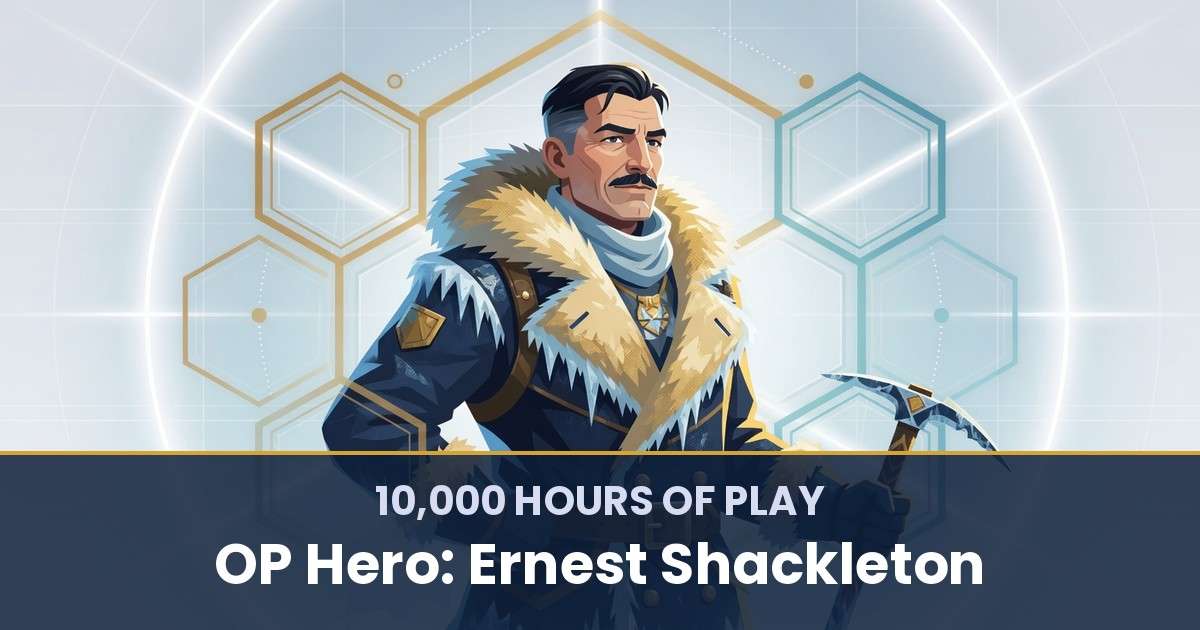


On 21 November 1915, twenty-eight men stood on the frozen surface of the Weddell Sea and watched their ship die. The Endurance had been pinned in the Antarctic pack ice for ten months. Now the ice finished the job, folding the wooden hull until it slipped under. The nearest other human beings were more than a thousand miles away, and nobody on Earth knew where the expedition was.
The man in charge was Ernest Shackleton. The expedition he had spent years raising money for, the first crossing of the Antarctic continent, was over before it had properly begun. By every measure printed in the newspapers, he had just failed.
What happened over the next ten months is why we still say his name. Not one of those twenty-eight men died. Shackleton got every single one of them off the ice and home alive, and he did it by running one of the most disciplined survival operations ever recorded.
That is the kind of life the 10,000 Hours of Play framework was built to decode: a life run as a deliberate character build. So let’s run Shackleton through all six steps. Game, Attributes, Role, Skills, Allies, Quests.
⚡ Speed Run Notes
- Shackleton’s real game was never the South Pole. It was Antarctic distinction. After the Endurance was crushed, he swapped that win condition for a harder one: bring all 28 men home alive.
- His turn-back at 88°23′ South in 1909, just short of the Pole, was not a failure of nerve. It was Foresight: trading the record for a crew that lived to sail again.
- The Endurance survival run is a Mastermind clinic. When each plan broke, he built the next one: ice camp, open boats, an 800-mile lifeboat voyage, four rescue attempts.
- He ran morale like an instrument, with nightly songs, games, and routine, because a calm crew survives and a panicked one does not.
- Every one of the 28 men came home. The expedition failed its stated goal and became one of history’s great leadership runs anyway.
Table of Contents
About Yu-kai Chou

Yu-kai Chou is the author of 10,000 Hours of Play — the book that treats your life as the most important game you’ll ever build a character in, and gives you the 6-Step framework (Game · Attributes · Role · Skills · Allies · Quests) to play it on purpose. He has spent two decades developing the system through which this post analyzes its OP Hero, and applies it to his own life and to the lives of the people he advises around the world.
Chou’s other framework, the Octalysis Framework, has been applied by LEGO, Microsoft, Porsche, Coca-Cola, Salesforce, and MrBeast, impacting over 1.5 Billion Users. He has taught the methodology at Harvard, Stanford, Yale, Tesla, Google, BCG, and IDEO, and has advised governments in eight nations including Ukraine, the United Kingdom, the Kingdom of Bahrain, Singapore, Taiwan, the Netherlands, Kazakhstan, and South Korea.
His work has been cited by Harvard, Stanford, MIT, Forbes, Wall Street Journal, Wired, US Department of Energy, NIST, NSF, NCBI, US Department of Education, ClinicalTrials.gov, and Google Scholar — with 3,700+ more academic publications. Explore his books here.

What stays with me about Ernest Shackleton’s build is the win-condition swap. He spent years and a fortune chasing a polar first, and when the ice took that goal away, he did not freeze and he did not pretend the old plan was still alive. He named a new game in the worst conditions imaginable and played it perfectly. If you lift one move from his run, lift that one: when the plan you built your identity around falls apart, the skill is not refusing to accept it. The skill is naming the new quest fast, and giving it everything.
Step 1: The Game — What Ernest Shackleton Was Actually Playing
Every OP Hero is playing a deeper game than the one on the surface. Ask what game Ernest Shackleton was playing and the easy answer is “reach the South Pole.” That answer is too small, and it goes stale halfway through his life.
Shackleton’s game was Antarctic distinction. From his first voyage south on the Discovery expedition in 1901, under Robert Falcon Scott, he was pulled toward the idea of doing something at the bottom of the world that nobody had done before. When illness sent him home from that expedition in 1903, he did not quietly go back to the merchant navy. He started raising money for an expedition of his own.
For the next decade the target kept moving, but the game stayed the same. First it was the Pole itself, on the Nimrod expedition. Then, once others were closing in on the Pole, the game became the first crossing of the entire continent, on the Endurance.
Then it changed in a way no character sheet predicts. When the Endurance was crushed, the original objective was simply gone. A lesser player keeps chasing the lost goal and loses the crew with it. Shackleton did something harder. He swapped the win condition. The game stopped being “achieve a polar first” and became “bring every man home,” and he played that new game with everything he had.
Step 2: Attributes — The Innate Stats
Attributes are the stats you do not train. They show up early and they tilt every later decision. Shackleton rolled a loud set.
The first is restless ambition. As a teenager he turned down the respectable path his father wanted for him, medicine, and went to sea in the merchant service in 1890. He did not drift through that career either. He pushed for harder voyages and faster promotion, and earned his master mariner’s certificate in 1898.
The second is risk appetite. After every serious setback, Shackleton moved toward another expedition rather than toward safety. Invalided home from the Discovery, beaten by the distance on the Nimrod, ruined financially more than once, he kept choosing the next dangerous thing on the board.
The third is charismatic social intelligence. People wanted to follow him. He could recruit skilled officers and specialists even when his finances were shaky and the job on offer was genuinely terrifying. That pull was visible long before he had a famous record to sell.
The fourth is optimism under pressure. Crew members who survived the Endurance drift kept crediting one thing for their morale: Shackleton’s deliberate, stubborn cheerfulness. He did not always feel certain. He chose to project certainty, every single day, because he understood what visible doubt would do to a trapped crew.
Yu-kai’s Talent Triangle Method argues that your strongest build sits where several innate attributes overlap, not on any single one. Shackleton is a clean case. Ambition without optimism burns out. Optimism without risk appetite stays home. Stack restless ambition, real risk appetite, and the charisma to make others follow into danger, and you get a man who could carry twenty-eight people through two years of ice.
Step 3: Role(s) — The Character Class Across Chapters
Nobody plays a single class for a whole life. OP Heroes re-spec as the game changes, and Shackleton re-spec’d hard.
He began as the Merchant Navy Officer. Through the 1890s he learned seamanship the slow way, on long trading voyages, earning his master’s certificate and the practical command skills that every later chapter would draw on.
Next came the Junior Polar Explorer. On the Discovery expedition he was a subordinate, one specialist among many under Scott. He took part in a sledge journey that pushed farther south than anyone had been, and then he was sent home sick. He had tasted the work and been judged, publicly, as the one who could not finish it.
That judgment created the third class: the Independent Expedition Leader. From the Nimrod expedition onward, Shackleton would never again be the deputy. He organized, he fundraised, he chose the personnel. He wanted command, and he built the structures to hold it.
The fourth class is the one history remembers, the Crisis Leader. The Endurance expedition was designed as a feat of exploration. The moment the ship was lost, Shackleton’s class changed in real time, from explorer to the protector of twenty-eight lives, and he turned out to be even better at the second job than the first.
The hard part of leveling up is rarely learning the new class. It is letting go of an old one while it is still working. That same crisis-leader re-spec, the pivot from ordinary command into leadership under genuine emergency, runs through the profile of Winston Churchill.
Step 4: Skills — The Real-Life Game Skills Ernest Shackleton Mastered
Attributes are what you start with. Skills are what you grind. In the 10,000 Hours of Play system, a Skill is a trainable technique with a name and a character class attached, the way the Lich Pact is Yu-kai’s name for a polyphasic sleep discipline. On the Skills Spectrum, Shackleton was neither a dabbler nor a narrow specialist. He was a master of one class above all, the Ranger, the observer who plans and leads, with a few Paladin and Druid skills grinding alongside it. Six of his skills are worth naming.
Foresight (Ranger) is the skill of projecting risk before it arrives. On 9 January 1909, the Nimrod expedition’s southern party reached 88°23′ South, the farthest south anyone had ever travelled, roughly 97 nautical miles from the Pole. Then Shackleton turned around. He had run the numbers on food and distance, and he could see that the Pole itself would cost him the return journey and the men walking it. He gave up the prize his whole expedition was named for, on purpose, because he could read the price tag.
Tactical Command (Ranger) is the skill of making people of very different talents work in harmony. Choosing the Endurance crew, Shackleton picked Frank Worsley to captain the ship for his gift at reading ice, and Frank Wild as second-in-command for his steadiness and rapport with the men. He was not collecting a stack of resumes. He was casting a party that would still function after a year sealed inside a wooden hull.
Mastermind (Ranger) is the skill of building, adapting, and executing complex plans. The escape from the ice was never one plan. It was a chain of them, each link improvised when the last one broke. Camp on the floe and drift north toward open water. When the floe broke apart, take to the open boats and reach Elephant Island. When Elephant Island turned out to be bare, uninhabited rock, launch a single boat for help. Every link was designed under pressure, and every one of them held.
Mind Soothe (Druid) is the skill of calming others through steady, gentle communication. Through the long Weddell Sea drift, Shackleton kept the crew on a deliberate routine of shared meals, songs, games, and easy banter. This was not idle entertainment. He understood that a crew with structure and a little laughter stays sane, and a crew left alone with its own fear does not. He managed morale on purpose, the way he managed rations.
Courageous Heart (Paladin) is the skill of charging into territory nobody has mapped. On 24 April 1916, Shackleton and five men left Elephant Island in a lifeboat, the James Caird, and sailed roughly 800 miles across the most violent ocean on the planet to reach South Georgia. Sixteen days later they landed, on the uninhabited side of the island, and Shackleton crossed its uncharted interior mountains on foot to reach a whaling station. Both legs of that journey had a real chance of killing him. He went anyway, because going was the only version of the story where the crew lived.
Phoenix Rebirth (Paladin) is the skill of recovering from a devastating failure and coming back stronger. When the Endurance sank on 21 November 1915, the expedition Shackleton had spent years building was finished. He did not pour his energy into mourning the crossing he would never make. He rebuilt the entire mission around a new and harder goal, getting all 28 men home, and then delivered it. Rebuilding your purpose around the wreck of the old one, instead of around its memory, is a move that also defines the profile of Viktor Frankl.
Step 5: Allies — The People Who Multiplied Ernest Shackleton
No OP Hero clears the campaign alone. Shackleton’s survival run worked because of a handful of people who were extraordinary in exactly the ways he needed.
Frank Wild was his second-in-command and the answer to an impossible problem. When Shackleton sailed off for help, 22 men were left behind on Elephant Island with almost nothing. Wild held them together for more than four months, keeping them disciplined, fed, and ready, so that there was still a living crew to rescue when a ship finally broke through.
Frank Worsley was the navigator, and the James Caird voyage was his masterpiece. Finding an island 800 miles away from the deck of a small open boat, in mountainous seas, with only rare glimpses of the sun to take a reading from, is one of the great feats of navigation on record. Without Worsley’s skill, the lifeboat misses South Georgia and everyone on Elephant Island dies.
Tom Crean was the man you wanted beside you when conditions were at their worst. He was one of the three, with Shackleton and Worsley, who made the final overland crossing of South Georgia, a march across uncharted mountains with no proper map and no shelter.
Frank Hurley was the expedition’s photographer. As the Endurance was going under, he salvaged his glass-plate negatives, and those images are the reason the world can still see exactly what happened out on that ice. The story survived because Hurley made sure it would.
Step 6: Quests — The Milestones That Shaped the Saga
Quests are the concrete missions that move the saga forward. Shackleton’s run only makes sense if you keep the failures inside it.
The first quest was the Discovery expedition’s southern journey in 1902. Shackleton was one of the three-man sledge party, with Scott, that reached a record 82°17′ South. It should read as a triumph. Instead it ended with Shackleton invalided home, and that sting, the public verdict that he had been the weak link, drove almost everything he did next.
Quest two was the Nimrod expedition. In January 1909 his party reached 88°23′ South before he made the call to turn back short of the Pole. He came home without the prize and was knighted all the same, because the world could see what the near miss had cost him and what the safe return had saved.
Quest three is the famous one, and it begins as an outright failure. The Endurance set out in 1914 to make the first crossing of Antarctica. The ship was trapped in the pack ice in January 1915, before the crossing could begin, and was crushed that November. The stated mission was dead.
What followed was quest four, the rescue, run entirely inside the wreck of quest three. The drift on the ice, the boats to Elephant Island, the James Caird voyage, the crossing of South Georgia, and then the rescue itself. It took Shackleton four separate attempts to push a ship back through the ice toward Elephant Island. On 30 August 1916 the fourth attempt got through, and all 22 men came off the rock alive. Every member of the expedition survived.
The final quest was the unfinished one. In 1921 Shackleton sailed south once more, on a ship called the Quest, and on 5 January 1922 he died of a heart attack at South Georgia, aged 47. The campaign ended mid-quest, the way most real campaigns do across the OP Hero profiles archive.
What You Can Steal From Ernest Shackleton’s Build
You are not going to be marooned on Antarctic ice, and copying Shackleton move for move is not the point of reading this. The point is that his build has parts you can lift straight into your own.
Steal the win-condition swap first. What makes Shackleton’s story great is not that he reached his goal. It is that when the goal became impossible, he was honest enough to name a new one and disciplined enough to chase it just as hard. When a plan dies, most people keep grinding the corpse. Shackleton picked a fresh objective and ran.
Steal the Foresight. Turning back 97 miles from the Pole is the least celebrated thing he ever did, and possibly the wisest. Learn the difference between a goal worth dying for and a goal worth turning back from, and be willing to actually turn back.
Steal the morale habit. He treated his crew’s state of mind as a resource to be managed daily, not a mood to be left alone. Routine, shared meals, a little laughter, a leader who showed up calm. Whatever team you are on, morale is something you can build on purpose rather than hope for.
And steal the early-party rule. Shackleton survived because Wild, Worsley, Crean, and Hurley were already the right people before the crisis hit. You do not assemble your crew during the emergency. You assemble it long before, and then you keep it.
Shackleton failed to cross Antarctica. He failed to reach the Pole. He is still remembered as one of the finest leaders who ever lived, because he never lost sight of the one quest that was never optional: get your people home.
Where this framework comes from

Want the full system this profile is built on?
Every OP Hero piece runs through the same 6-Step framework from 10,000 Hours of Play: Unlock Your Real-Life Legendary Success. The book covers the full system, walks through Yu-kai’s own life run as the first applied case study, and gives you the worksheets to audit your own build.
Related Reading
- All OP Hero Profiles. The full roster of legendary builds decoded through the 10,000 Hours of Play framework.
- OP Hero: Viktor Frankl. Another build defined by finding a survivable purpose in conditions designed to break a person.
- OP Hero: Charles Darwin. Another life that turned a long, hard voyage to the edges of the map into a legendary run.
- OP Hero: Helen Keller. An against-the-odds build that refused the verdict the world handed it.
- The 10,000 Hours of Play Framework. The full six-step system for turning your own life into a deliberate character build.