
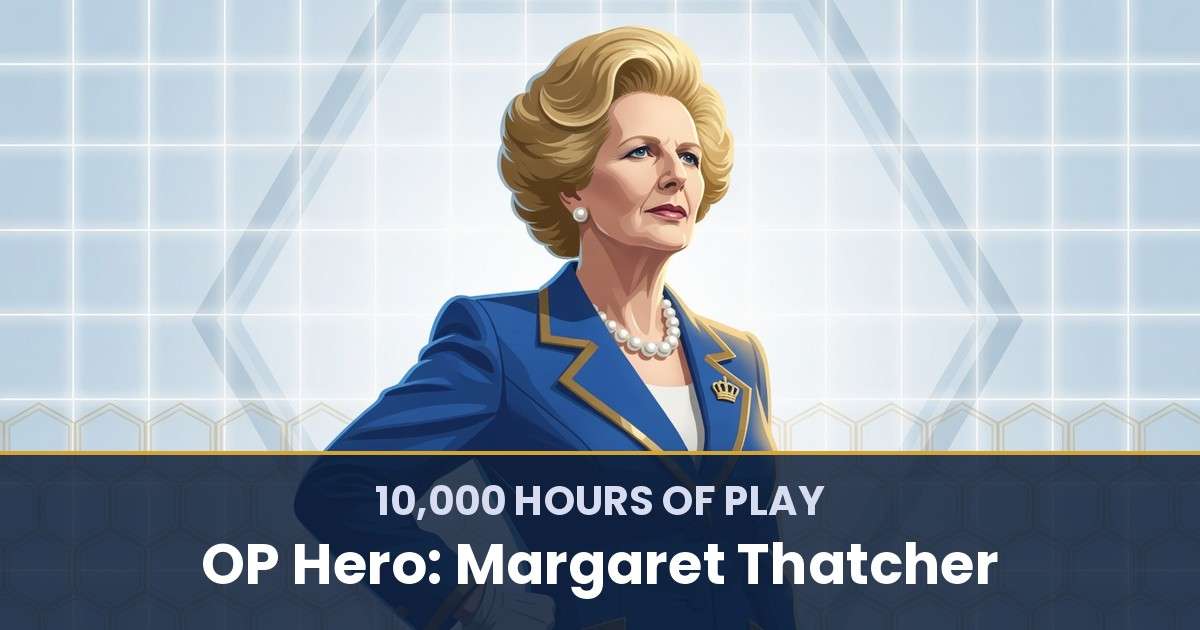


In 1943, a teenager named Margaret Roberts was living above a grocer’s shop in Grantham, a market town in the English Midlands. Her family had no political dynasty and no money to speak of. Her father weighed out sugar and tea behind the counter and preached in the local Methodist chapel on Sundays.
Thirty-six years later she walked into 10 Downing Street as Prime Minister of the United Kingdom. She would stay for eleven and a half years, win three general elections in a row, and leave a mark on British politics so deep that the country still argues about it today.
Almost nothing about that outcome was probable. She was a woman in a party run by men, a provincial outsider in a class-bound system, a chemist by training in a profession of lawyers and aristocrats. She did not charm her way up, and she did not inherit a single rung of the ladder.
Run her life through the 10,000 Hours of Play framework and the improbability turns into something more useful: a build. Margaret Thatcher did not stumble into power. She assembled a character, deliberately, around a single idea she had fixed on young and never let go. Here is how that character came together, and, just as instructively, how it eventually broke.
⚡ Speed Run Notes
- Thatcher’s real game was never just winning office. It was a conviction: that a declining, state-managed Britain could be rebuilt around markets and self-reliance, and that one determined person could force the change.
- Her core stats were set in Grantham, not Westminster: a relentless work ethic, argumentative nerve, and an unusual tolerance for being disliked.
- She re-classed from chemist to barrister to minister to party leader to Prime Minister, but the conviction underneath every role stayed identical.
- Her sharpest skill was preparation. She out-worked every opponent on detail, then used that mastery to dominate the despatch box and her own Cabinet.
- The same trait that built her, a refusal to turn, also ended her. The poll tax and the 1990 leadership challenge show what happens when conviction stops listening.
- The build lesson worth copying: name your game early, out-prepare everyone, and learn the difference between conviction and stubbornness before the difference finds you.
Table of Contents
About Yu-kai Chou

Yu-kai Chou is the author of 10,000 Hours of Play — the book that treats your life as the most important game you’ll ever build a character in, and gives you the 6-Step framework (Game · Attributes · Role · Skills · Allies · Quests) to play it on purpose. He has spent two decades developing the system through which this post analyzes its OP Hero, and applies it to his own life and to the lives of the people he advises around the world.
Chou’s other framework, the Octalysis Framework, has been applied by LEGO, Microsoft, Porsche, Coca-Cola, Salesforce, and MrBeast, impacting over 1.5 Billion Users. He has taught the methodology at Harvard, Stanford, Yale, Tesla, Google, BCG, and IDEO, and has advised governments in eight nations including Ukraine, the United Kingdom, the Kingdom of Bahrain, Singapore, Taiwan, the Netherlands, Kazakhstan, and South Korea.
His work has been cited by Harvard, Stanford, MIT, Forbes, Wall Street Journal, Wired, US Department of Energy, NIST, NSF, NCBI, US Department of Education, ClinicalTrials.gov, and Google Scholar — with 3,700+ more academic publications. Explore his books here.

What I find instructive about Margaret Thatcher’s build is how early she located her game. Most people spend decades sampling roles before they understand what they are actually playing for. She had named hers, rebuild Britain around markets and personal responsibility, before she was thirty, and every Role afterward became tuition for it. The lesson I would lift from her run, though, sits in Step 6: the same conviction that powers a build can quietly become the thing that ends it. Her story is worth studying for both halves, the assembly and the breakdown.
Step 1: The Game — What Margaret Thatcher Was Actually Playing
Every OP Hero is playing one underlying game beneath the job titles. Thatcher’s was not “become Prime Minister.” It was a specific, stubborn idea about her country.
She believed Britain in the postwar decades had drifted into managed decline: too much state, too little enterprise, inflation eating wages, trade unions strong enough to halt the country, and a national mood that expected less every year. Her game was to reverse that. She wanted to move Britain toward free markets, lower inflation, lighter regulation, and a culture of self-reliance, and she wanted to prove that willpower and clear ideas could bend a whole nation’s trajectory.
This was not a position she arrived at in office. As a teenager in Grantham she was already thinking about how power should be used and who should hold it, and she kept circling the same answer for the rest of her life. The material changed across the decades. The chemistry lab, the courtroom, the ministry, the party. The game underneath never moved.
It is why her admirers and her critics both struggle to describe her as a normal politician. Normal politicians read the room and adjust. Thatcher started from the destination and asked what it would cost to get there. That made her transformative to some and deeply divisive to others, and it is the single fact you have to hold onto to understand everything else. Lee Kuan Yew played a similar game one continent away: treat a country as a system to be re-engineered rather than merely administered. Step 1 of the 10,000 Hours of Play system asks you to name the real game first. Thatcher had named hers before most people finish university.
Step 2: Attributes — The Innate Stats
Attributes are the stats you show up with, visible before anyone trains you. Thatcher’s set looked ordinary for a shopkeeper’s daughter and turned out to be unusually well suited to the fight she picked.
A relentless work ethic. She grew up working in the family grocery shop while also being the top student in her school. The habit of long hours and no excuses was formed early, and it never left. As Prime Minister she became famous for sleeping little and out-reading everyone around the Cabinet table.
Argumentative nerve. At school she stood out in debate, and at Oxford she was elected president of the university’s Conservative Association in 1946, a striking thing for a woman at that time. She enjoyed direct argument when most people avoid it. That comfort with conflict is hard to teach and shows up early.
Conviction. Once she decided something was right, she held it against pressure that would move almost anyone. This is the attribute that produced both her biggest wins and her final defeat, and it was visible long before she had power to apply it.
Outsider drive. A provincial, lower-middle-class, Methodist grocer’s daughter did not fit the Conservative establishment of her era. Rather than soften herself to belong, she used the mismatch as fuel. The chip on the shoulder was real, and she converted it into ambition.
To find your own innate stats, Yu-kai built a tool for exactly that: the OP Talent Triangle Method, which locates the corner where your natural strengths overlap. Thatcher’s corner, where stamina, argument, and conviction meet, was set behind a shop counter long before any voter saw it.
Step 3: Role(s) — The Character Class Across Chapters
A Role is the character class you play in a given chapter. Thatcher re-classed about as often as anyone in this series, and each class quietly equipped the next.
She began as a scholarship student and shop assistant in Grantham, learning small-business economics and thrift at the counter, and absorbing civic duty from a father who served as a local alderman and as the town’s mayor.
At Oxford she became a research chemist and student organizer, studying chemistry at Somerville College and running the student Conservative association. Then a barrister: she was called to the bar in 1953, training in the disciplined argument that would later define her at the despatch box.
Politics arrived next. She was elected Member of Parliament for Finchley in 1959 and served an apprenticeship as a junior minister at the Ministry of Pensions and National Insurance from 1961 to 1964. Under Edward Heath she became Secretary of State for Education and Science from 1970 to 1974, where a decision to end free school milk for older children earned her the hostile nickname “Thatcher the Milk Snatcher” and her first taste of a national media storm.
From 1975 she was Leader of the Opposition, then from 1979 Prime Minister, and after 1990 an elder stateswoman writing and lecturing on the ideas she had spent a career applying. No class was wasted. The chemist learned evidence. The barrister learned argument. The junior minister learned the machinery of government. Each Role paid for the one after it.
Step 4: Skills — The Real-Life Game Skills Margaret Thatcher Mastered
Attributes are what you are born with. Skills are what you grind. In 10,000 Hours of Play, Skills are named like RPG abilities, each tied to a Class, and each one has its own write-up. See, for instance, a Real-Life Game Skill like the Lich Pact. Thatcher built a recognizable set.
Arcane Wisdom (Mage): absorbing wide information and synthesizing it into a clear, usable read. Her preparation was relentless. Before Prime Minister’s Questions she worked through detailed briefing folders and ran rehearsal sessions where advisers fired hostile questions at her until she had an answer for each. She walked to the despatch box knowing the figures better than the person attacking her, and that mastery, not charm, was the foundation of her dominance in the Commons.
Vision Manifestation (Warlock): holding a picture of the outcome so firmly it shapes everything around it. Thatcher fixed on a specific Britain, lower inflation, weaker union power, wider ownership, and carried that picture, almost unaltered, from opposition into three terms of government. Colleagues who wanted to dilute it kept discovering there was nothing soft in the middle to negotiate with.
Aegis (Paladin): ignoring criticism and naysayers while pushing the quest. Her early economic policy arrived alongside a sharp recession, and her poll ratings fell hard. Her line from the 1980 party conference, “the lady’s not for turning,” became the defining phrase of her style. Holding a course while it is unpopular is the entire skill, and few politicians have done it for as long.
Thunder Clap (Paladin): public speaking that charges a room and frames a fight. A hard-line speech against the Soviet Union in 1976 was pointed enough that a Soviet military newspaper branded her the “Iron Lady.” She took the insult and wore it as a brand for the rest of her career, turning an attack into an identity.
Mastermind (Ranger): creating and executing complex plans. The 1975 leadership challenge was not a gamble; her ally Airey Neave ran it as a quiet, methodical canvass of backbench MPs. The privatization program was sequenced the same way, company by company across a decade rather than announced in one sweep.
Concord of Elements (Druid): bringing parties of very different interests together. Thatcher built one of the closest Anglo-American partnerships of the Cold War with Ronald Reagan, then positioned herself as a bridge to the other side. After meeting Mikhail Gorbachev she judged she could “do business with” him, and used that read to reassure Washington that the Soviet reformer was worth engaging.
None of these are exotic powers. The Skills Spectrum makes the point well: mastery is usually a handful of ordinary Skills pushed to an unusual tier. Thatcher’s rarest move was refusing to let preparation and conviction ever drift apart.
Step 5: Allies — The People Who Multiplied Margaret Thatcher
No OP Hero levels up alone. Thatcher’s rise ran on a small set of Allies, each covering ground she could not cover herself.
Alfred Roberts, her father, was the first. A grocer, Methodist lay preacher, and local alderman, he taught her thrift, hard work, and self-reliance at the counter and in the chapel. The values she later built a national program around were rehearsed first in his shop.
Sir Keith Joseph was the ideological co-architect. Together they founded the Centre for Policy Studies in 1974, the think tank that became the intellectual engine of her free-market program. Joseph supplied much of the argument; Thatcher supplied the will to act on it.
Airey Neave was the operator who made her leadership possible. A war hero and Conservative MP, he ran her 1975 leadership campaign and built the backbench support that put her over the top. He was assassinated by a car bomb in March 1979, weeks before she reached Downing Street, and never saw the government he had helped create.
Gordon Reece handled image and media. A former television producer, he coached her presentation and reshaped how she came across on screen, work widely credited with helping make her electable as a national leader by 1979.
Ronald Reagan was the international ally. The two reinforced each other through the 1980s, and their partnership gave Britain a louder voice in late-Cold-War strategy than its size alone would have earned.
Denis Thatcher, her husband, was the quiet support behind all of it. He stayed out of public politics, but his stability made it possible for her to pursue law and then a political career full time. Abraham Lincoln built strength from a team of rivals; Thatcher built hers from a smaller, tighter circle of true believers. Both approaches work. What does not work is trying to do it alone.
Step 6: Quests — The Milestones That Shaped the Saga
Quests are the concrete missions that move a saga forward. Thatcher’s headline Quests run from an improbable win to an equally improbable fall.
Winning the Conservative leadership (1975). Few people thought she could take the party. She challenged the sitting leader, Edward Heath, beat him on the first ballot, and on the decisive ballot on 11 February 1975 won the leadership with 146 votes to her nearest rival’s 79. She was the first woman to lead a major British political party.
The 1979 general election. On 3 May 1979 the Conservatives won 339 seats to Labour’s 269, a Commons majority of 43, and she became Prime Minister the next day. The game she had named in Grantham finally had the full machinery of a state behind it.
The Falklands War (1982). When Argentina invaded the Falkland Islands on 2 April 1982, Thatcher ran the response through a small war cabinet that met daily and backed the dispatch of a naval task force of around 100 ships across 8,000 miles of ocean. Argentine forces surrendered on 14 June 1982, ending a 74-day war and sharply lifting her domestic authority.
Reshaping the economy (1984 onward). Two long campaigns defined her domestic record. The 1984 to 1985 miners’ strike ended when the union returned to work without a settlement in March 1985, a turning point in the power of British trade unions. Privatization moved state industries into private hands, from British Telecom in 1984 to British Gas in 1986 and beyond, while the Right to Buy policy sold roughly 1.5 million council homes to their tenants. Supporters saw a country being modernized. Opponents saw communities, especially mining towns, left behind. Both were describing the same decade.
The poll tax and the fall (1989 to 1990). Every honest build has a Quest that fails, and this was hers. The Community Charge, quickly nicknamed the “poll tax,” replaced local property rates with a flat per-person charge. Introduced in Scotland in 1989 and in England and Wales in 1990, it was widely seen as unfair to the less well-off and triggered mass protest, including a riot in central London on 31 March 1990. The backlash drained her support. In November 1990 a leadership challenge from Michael Heseltine forced a first ballot. She won it, 204 votes to 152, but the margin fell short of the threshold she needed to win outright. On 22 November 1990 she announced her resignation, and she left office on 28 November after eleven and a half years. You can read how other leaders handled their own defining Quests across the full library of OP Hero profiles.
What You Can Steal From Margaret Thatcher’s Build
You do not have to share Margaret Thatcher’s politics to learn from the way she built her character. Her record is genuinely contested, and it should be. The build mechanics underneath it transfer cleanly, and three of them are worth copying.
First: name your game early. Thatcher knew what she was playing for before she was thirty, and that clarity meant she never wasted a Role. Most people do the opposite, collecting jobs and titles for years while hoping a direction will emerge. It rarely does. The direction has to be chosen.
Second: let preparation be your edge. Thatcher was not the most charming figure in any room, and she knew it. What she could control was homework, so she out-prepared everyone, and the mastery did the persuading for her. That option is open to almost anyone. It just costs the hours most people will not pay.
Third, and this is the hard one: learn the line between conviction and stubbornness. The same refusal to turn that carried Thatcher through a recession and a war also kept her pushing the poll tax long after the country had told her it would not accept it. A strength used past its limit becomes the flaw that ends you. Conviction has to keep a channel open for evidence, or it stops being a strength at all.
That last lesson is why her story is more useful than a simple success story. She assembled one of the most complete political builds of the twentieth century, and then the very stat that built it ran her off the board. Study the assembly, and study the breakdown. The discipline that makes a figure like Marcus Aurelius worth reading two thousand years on is the discipline Thatcher had in abundance and, at the very end, briefly lost: knowing when to hold firm, and knowing when the board has changed.
Where this framework comes from

Want the full system this profile is built on?
Every OP Hero piece runs through the same 6-Step framework from 10,000 Hours of Play: Unlock Your Real-Life Legendary Success. The book covers the full system, walks through Yu-kai’s own life run as the first applied case study, and gives you the worksheets to audit your own build.
Related Reading
- The full library of OP Hero profiles. Every figure in this series, analyzed through the same six-step framework.
- 10,000 Hours of Play by OP Hero: Winston Churchill. Another British wartime leader built on conviction and a refusal to fold.
- 10,000 Hours of Play by OP Hero: Lee Kuan Yew. A leader who also treated a whole country as a system to re-engineer.
- 10,000 Hours of Play by OP Hero: Angela Merkel. A very different temperament running the same long political game.
- 10,000 Hours of Play by OP Hero: Marcus Aurelius. The leader who treated restraint as the hardest discipline of all.
- The 10,000 Hours of Play framework. The full six-step system behind every OP Hero profile.