
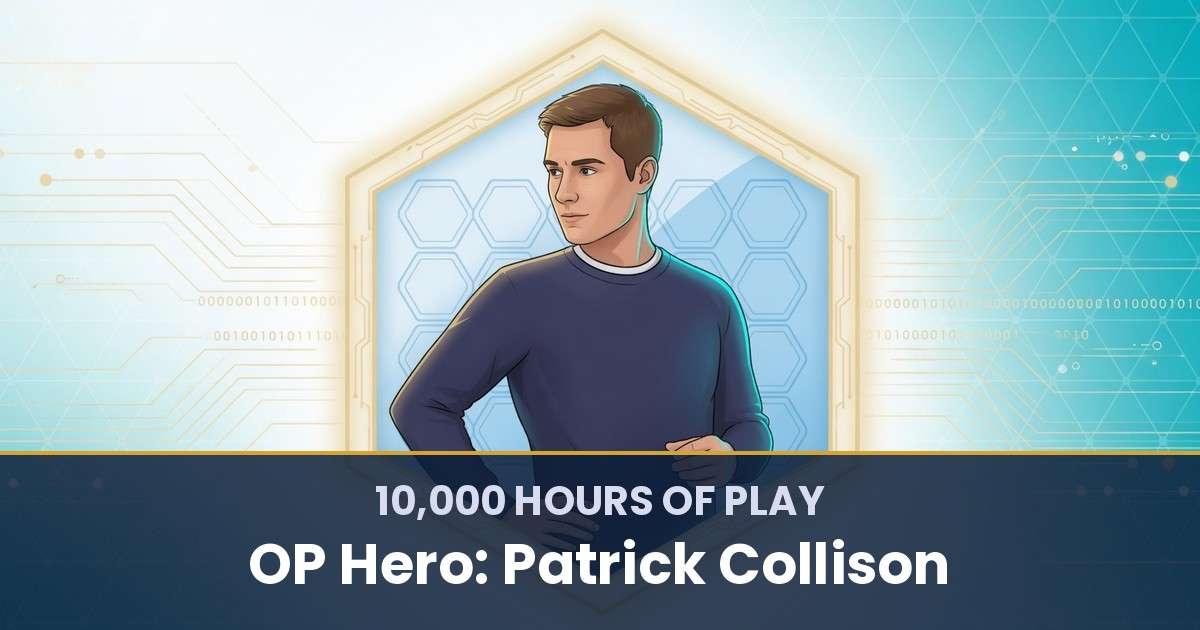


In January 2005, a sixteen-year-old in Ireland won the country’s biggest science competition. His winning project was a working programming language of his own design, called Croma.
Three years later he sold his first company and became, at nineteen, a millionaire. Not long after, he and his younger brother started a payments company called Stripe. A decade on it would move more than a trillion dollars and run the checkout for millions of online businesses.
That is the visible résumé, and the pattern underneath it repeats at every scale of his life.
Run his life through the 10,000 Hours of Play framework and that pattern stops looking like a lucky streak. It looks like a deliberate character build.
⚡ Speed Run Notes
- His real game is infrastructure: rails that let other talented people move faster, from eBay-seller tools to Stripe to science funding.
- His edge started early. As a teenager he went deep on programming, writing, physics, and math at the same time, and that range is what later let him spot infrastructure gaps across unrelated fields.
- His first company nearly didn’t happen. Ireland’s state agency passed on funding it, which forced a move to California, a merger, and a pivot before it ever sold.
- He treats decisions as a system. Sort them by whether they are reversible, move fast on the ones that are, and save slow deliberation for the few that are not.
- He decided progress itself was an infrastructure problem: Fast Grants and the Arc Institute came from the same instinct as Stripe.
Table of Contents
About Yu-kai Chou

Yu-kai Chou is the author of 10,000 Hours of Play — the book that treats your life as the most important game you’ll ever build a character in, and gives you the 6-Step framework (Game · Attributes · Role · Skills · Allies · Quests) to play it on purpose. He has spent two decades developing the system through which this post analyzes its OP Hero, and applies it to his own life and to the lives of the people he advises around the world.
Chou’s other framework, the Octalysis Framework, has been applied by LEGO, Microsoft, Porsche, Coca-Cola, Salesforce, and MrBeast, impacting over 1.5 Billion Users. He has taught the methodology at Harvard, Stanford, Yale, Tesla, Google, BCG, and IDEO, and has advised governments in eight nations including Ukraine, the United Kingdom, the Kingdom of Bahrain, Singapore, Taiwan, the Netherlands, Kazakhstan, and South Korea.
His work has been cited by Harvard, Stanford, MIT, Forbes, Wall Street Journal, Wired, US Department of Energy, NIST, NSF, NCBI, US Department of Education, ClinicalTrials.gov, and Google Scholar — with 3,700+ more academic publications. Explore his books here.
What I find most useful about Patrick Collison’s build is how unglamorous the core move is. Payments in 2010 and science funding in 2020 were both unglamorous problems when he picked them. The lesson I would lift from his run sits in Step 1: pick a game where your win also becomes a platform other people can stand on.
Step 1: The Game — What Patrick Collison Was Actually Playing
Every OP Hero is playing one game underneath the job titles, and the 10,000 Hours of Play system starts by naming it. With Collison, the surface answer is “he runs a payments company.” That describes one level of it.
The game is infrastructure. More precisely: find high-leverage activities that are being throttled by bad plumbing, then build better plumbing so the people doing that work can move faster.
His first company built tools for high-volume eBay sellers, people whose real work was selling, slowed down by clumsy software. Stripe, which he and his brother John founded in 2010, came straight out of noticing how painful it was to start accepting payments online. The fix was to make that pain disappear so founders could get back to building their actual product.
Then the game jumped categories. Around 2019 he began arguing, in public, that scientific and technological progress had quietly slowed and that almost nobody was studying why. Where most people would have treated that as an essay topic, he treated it as an infrastructure bug. If science is the activity, then funding and institutions are the plumbing, and the plumbing is what to fix.
Because Collison can name his game in a single sentence, he can look at almost any opportunity and ask one question: does this build a rail other people will run on? If the answer is no, it is not his game, however attractive it looks.
Step 2: Attributes — The Innate Stats
Attributes are the stats a character is issued before any training begins. Collison’s combination showed up early, well before Stripe, and most of it is visible in that teenage science project alone.
Relentless, self-directed curiosity. By his own account of his teenage years, he was going deep on several things at once: programming languages, writing, physics, mathematics. He did it by default rather than for any class. A sixteen-year-old builds a programming language for a science fair only when the question will not leave him alone.
A builder’s reflex. The curiosity always terminated in something that ran: a language, a piece of software, eventually a company, all before he had finished a standard education. The instinct was to understand a system well enough to build a better one.
Comfort being the odd one. He has since told younger people, plainly, that being a bit weird as a teenager is usually a good sign, and that a path your friends find normal is probably too normal. That advice reads as a description of his own wiring. Choosing your own strange route requires being genuinely unbothered when the people around you do not get it.
A systems-level mind. Even in interviews about ordinary choices, he talks less about getting a given answer right and more about the process behind it: how fast it ran and whether it could be reversed. He zooms out from the decision to the machine that produces decisions, a habit that predates Stripe.
Step 3: Role(s) — The Character Class Across Chapters
A Role is the character class you play in a given chapter. Collison has re-classed several times, and each class handed equipment to the next.
The teenage polymath. Before any company, he was a competitor and a maker. He entered Ireland’s national science exhibition two years running. The first year, with an artificial intelligence project, he placed as runner-up. The next year he came back with Croma and won. In miniature, that is the whole pattern: he fell short the first year, then returned and won.
The first-time founder. As teenagers, he and John started a software company. It was a hard, unglamorous apprenticeship in shipping a real product to real customers, and it ended in a sale before he turned twenty. This chapter handed him capital and, more valuable, proof that two brothers from Ireland could build a company and sell it.
The infrastructure founder-CEO. Stripe is the role the world knows. Running it meant something harder than having the idea: holding a large, global, technically deep company together from 2010 onward without losing the original obsession with making hard things simple.
The progress theorist. Alongside operating, he became a public voice arguing that humanity should study progress itself as a serious field. This is the class that turns a builder into an agenda-setter.
The institution-builder. Most recently he has been starting things that are not companies at all: new funding mechanisms and a new kind of research institute. The class is still founder, but the product is an institution.
Each role he left was a deliberate upgrade. The same disciplined re-invention runs through the profile of Jeff Bezos, another builder who kept trading a working role for a bigger one.
Step 4: Skills — The Real-Life Game Skills Patrick Collison Mastered
Attributes are issued. Skills are trained. In 10,000 Hours of Play, Skills are written like RPG abilities, each tied to a Class and each given its own breakdown, the way a Real-Life Game Skill like the Lich Pact is. Collison trained a specific, sharp set.
Devour (Warlock): stripping a process down until almost nothing is left but the essential. Stripe exists because Collison looked at what it took to accept a payment online, a multi-week ordeal of bank relationships, gateways, and paperwork, and decided almost all of it should vanish from the founder’s view. The skill is deleting steps until what remains feels close to magic.
Ley Line Infusion (Mage): absorbing a large body of knowledge in a subject, fast. This is the teenage polymath skill, and it never switched off. It let him go deep enough on payments to rebuild them, and later credible enough on biology and science policy to help found a research institute without being a scientist himself.
Fulcrum Strike (Rogue): spending limited effort only where leverage is highest. Collison is unusually explicit about this. Sort decisions by whether they can be reversed. Move fast and cheap on the reversible ones, because a wrong call there is just a quick correction. Reserve slow, careful deliberation for the few decisions that are large and permanent.
Tactical Command (Ranger): making people of very different talents work in harmony. Building the Arc Institute meant getting a tech founder, university administrators, and working scientists, groups that often regard each other warily, to cooperate inside one new model. That does not happen without someone who can hold a coalition together.
Loremaster (Druid): framing an idea so clearly that other people pick it up and carry it. When Collison and the economist Tyler Cowen wanted progress studied as a discipline, they wrote the case down and argued for it in public, turning a vague worry into something other people could join. As the Skills Spectrum argues, mastery is usually a few ordinary skills pushed to a rare tier.
Step 5: Allies — The People Who Multiplied Patrick Collison
No OP Hero levels up alone. Collison’s saga runs through a specific set of people, each covering ground he could not cover by himself.
John Collison, his younger brother, is the co-founder who appears in nearly every chapter. The two built the first company together and then founded Stripe together. A sibling co-founder gives you something rare: a partner whose trust you never have to question and whose judgment you have stress-tested since childhood. A long-trusted partner as your first ally is one of the strongest opening moves a builder can make. The profile of Bill Gates shows the same thing: a company launched with a partner he had known since long before the company existed.
Harjeet and Kulveer Taggar were the founders Patrick and John merged with to create their first company, Auctomatic. The merger pulled a second founding team’s skills into the build at exactly the moment the original plan had stalled.
Y Combinator and Paul Graham. When the brothers’ first company could not get funded in Ireland, it was interest from Y Combinator that pulled them to California. Stripe later went through the same program. Beyond money, Y Combinator supplied a network and a set of mentors who had built things before, which is the resource a young founder is shortest on.
The early Stripe investors. Stripe’s first significant round, in 2011, drew in Sequoia Capital, Andreessen Horowitz, and the PayPal co-founders Elon Musk and Peter Thiel. Having the people who built the previous era of online payments back your version of the next one gave Stripe a credibility signal the whole market could read, on top of the capital.
Tyler Cowen, the economist, is the ally for the science chapter. He co-wrote the progress essay with Collison and co-founded Fast Grants alongside him, giving the new mission an intellectual partner from well outside the tech world.
Step 6: Quests — The Milestones That Shaped the Saga
Quests are the concrete missions that move a saga forward. Collison’s headline run:
The science exhibition win (2005). The Croma win from Step 3 was the first logged quest: a national title at sixteen, earned on his second attempt.
The first company: the quest that nearly stalled. Every honest build has one rough quest, and this is his. In 2007 he and John started a company in Limerick called Shuppa. Ireland’s state enterprise agency declined to fund it, and the original idea did not carry. Rather than fold, they accepted interest from Y Combinator, moved to California, merged with the Taggar brothers, refocused the company on tools for eBay sellers, and renamed it Auctomatic.
The exit (March 2008). Auctomatic sold to a Canadian company for about five million dollars. Patrick was nineteen. The company that almost never got funded had become a real exit, and the brothers walked away with capital and a Silicon Valley track record.
Founding Stripe (2010). By 2016 a funding round had made the two of them, on paper, the youngest self-made billionaires in the world. Stripe would go on to process more than a trillion dollars in payments for millions of businesses.
The progress turn (2019 to 2021). In 2019 Collison co-authored an essay in The Atlantic calling for a new science of progress. In 2020 he co-founded Fast Grants to push emergency funding to COVID-19 researchers in days rather than months. In 2021 he co-founded the Arc Institute, a new kind of biomedical research organization built with Stanford, UCSF, and UC Berkeley.
What You Can Steal From Patrick Collison’s Build
The build logic underneath the résumé is portable even if you never found a payments company, and three pieces of it transfer cleanly.
First: name your game at the level of the move rather than the job title. The definition is what decides, when an unfamiliar opportunity shows up, whether it counts as your game at all.
Second: sort your own decisions the way Step 4 describes, and spend the saved deliberation on the few calls that are permanent. It is something you can apply to your own week by Monday.
Third: when the first plan fails, change the plan before you change the destination. Step 6 already showed the move: when Shuppa stalled, the brothers kept the goal and changed everything else around it, the reverse of the common failure of protecting the plan while quietly abandoning the goal.
That instinct for building so that others compound is worth studying next to the profile of Naval Ravikant, whose build runs on the same search for the rail underneath the product everyone else is chasing.
The 10K HP Frame — Patrick Collison Through the 6 Steps Lens
The six Steps above walk through Collison’s life one chapter at a time. Run the arc through the 10K HP framework as a single build and the standout feature is timing: his Step 1 Game was settled before his first company existed.
Most heroes in the OP Hero library find their Game midway through the story, after years on the wrong one. Collison wrote his Game sentence (the first worksheet in 10,000 Hours of Play) before he had anything to put on a résumé.
Four re-classes, one Game sentence. The whole Collison build fits on a single line of the character sheet.
The Step 4 Skills also fire in a fixed order, and the order barely changes between chapters. Ley Line Infusion (Mage) absorbs the new domain first, Fulcrum Strike (Rogue) picks the point of attack, and Devour (Warlock) then builds by deletion.
The institution chapters add Tactical Command (Ranger) and Loremaster (Druid), and Step 4 above shows both at work inside the Arc coalition and the progress-studies push.
Jensen Huang ran a comparable chain, spending three decades on compute rails before the applications arrived to run on them, and Larry Page built the index that everyone else’s curiosity now runs on.
Which Octalysis Core Drives Patrick Collison’s Arc Activated
The 10K HP system explains what Collison built. To see why the building never stalled, you need the Octalysis Framework, which maps the eight Core Drives behind human motivation.
Four of the eight do most of the work in this arc.
CD1: Epic Meaning & Calling. Core Drive 1 activates when someone believes they are serving something larger than themselves. Collison’s version arrived in 2019, when he and Tyler Cowen argued in The Atlantic that civilization should study its own rate of progress as a science.
That belief kept producing institutions: Fast Grants in 2020 to move COVID-19 research money in days, then the Arc Institute in 2021 alongside biochemist Silvana Konermann and bioengineer Patrick Hsu. Stripe was already one of the most valuable private companies in the world by then, so the motive for the science chapter sits squarely in this Core Drive.
CD2: Development & Accomplishment. Core Drive 2 is the pull of visible progress. Step 6 logged the earliest loop, a runner-up year converted into a winning year, and the loop never shut off.
The adult version works the same way at larger denominations. Stripe’s February 2026 annual letter reported $1.9 trillion in payment volume for 2025, and a tender offer that month valued the company at $159 billion, each figure a new high-water mark on a chart he has been climbing since 2010.
CD3: Empowerment of Creativity & Feedback. Core Drive 3 activates when people get expressive tools plus fast feedback on what they create. Stripe’s founding artifact, the setup famously described as seven lines of code, handed every developer on the internet a creative instrument where a bank integration used to be.
The drive shows up at company scale too. At Stripe Sessions in April 2026 the company shipped 288 launches in one announcement cycle, including an Agentic Commerce Suite that lets businesses sell through AI surfaces such as Google’s AI Mode and the Gemini app.
The suite builds on the Agentic Commerce Protocol that Stripe and OpenAI launched together in September 2025, an open standard any other builder can adopt.
Every Stripe launch is a new verb handed to somebody else’s product team.
CD7: Unpredictability & Curiosity. Core Drive 7 is the engine of wanting to find out. The sixteen-year-old building a Lisp dialect for a science fair was running on it, and the adult who maintains a public list of open questions on his personal site still is.
CD7 is also the honest explanation for the science turn. “Why did progress slow down?” is a question with no guaranteed payout, and he has now spent seven years funding people to chase it.
Modern Echo — Who’s Playing This Game Today
Collison is still playing his Game, and younger builders have picked up the same move. Two of them stand out from the 2024 to 2026 window.
Michael Truell co-founded Anysphere, the company behind the AI coding editor Cursor, and aimed it at the rail underneath all other software: the act of writing code itself. In November 2025 the company raised a $2.3 billion round at a reported $29.3 billion valuation, with revenue reported around a $1 billion annual run rate that same autumn.
Like Stripe in 2010, Cursor wins by deleting steps between a builder’s intent and a shipped product, which is Devour applied to programming.
Sam Rodriques is playing the science half of Collison’s board. His nonprofit FutureHouse, backed by former Google CEO Eric Schmidt, spent two years building AI research agents, and in November 2025 it spun out a company called Edison Scientific around Kosmos, an AI scientist designed to run literature review, analysis, and hypothesis generation end to end.
Edison’s own launch claim, that one Kosmos run can match months of a doctoral researcher’s work, remains the company’s claim to prove, and the underlying bet is the one Collison made with Fast Grants.
Since the Last Time We Told This Story
This profile first ran in May 2026, and the quest log has moved since then. On September 30, 2026, Stripe agreed to acquire Parafin, a platform that embeds small-business credit inside the software those businesses already use, with reportedly more than $3 billion already funded to over 60,000 businesses.
The acquisition, still pending close as of this update, extends the original game one layer further: after making it easy for a small business to get paid, Stripe now wants to make it easy for that business to get capital.
At Y Combinator’s Startup School in July 2026, he reportedly told founders that new business formation on Stripe had roughly doubled year over year, his own rails now measuring the economy they carry.
The science lane moved too. The Arc Institute opened its 2026 Virtual Cell Challenge for submissions, a public competition asking teams to predict how cells respond to perturbations they have never seen, and Collison personally promoted its $100,000 grand prize sponsored by NVIDIA, 10x Genomics, and Ultima Genomics. This year’s task raises the bar to zero-shot prediction, asking models to anticipate responses in cell contexts they received no challenge data for.
Frequently Asked Questions
How did Patrick Collison become a millionaire at nineteen?
His first company, Auctomatic, sold to a Canadian firm in March 2008 for about five million dollars when he was nineteen. The company built software tools for high-volume eBay sellers and had gone through Y Combinator after Irish state funding fell through.
What programming language did Patrick Collison create as a teenager?
At sixteen he designed Croma, a dialect of Lisp, and won Ireland’s national young scientist exhibition with it in January 2005. He had entered the previous year with an artificial intelligence project and placed as runner-up.
Is Patrick Collison still the CEO of Stripe?
Yes. As of late 2026 he remains co-founder and CEO, the company remains private, and a February 2026 tender offer valued Stripe at $159 billion following $1.9 trillion in 2025 payment volume.
What is the Arc Institute and why did Patrick Collison co-found it?
The Arc Institute is a biomedical research organization he co-founded in 2021 with biochemist Silvana Konermann and bioengineer Patrick Hsu, operating in partnership with Stanford, UCSF, and UC Berkeley. It gives scientists multi-year funding so they can pursue ambitious questions without writing constant grant applications, and its labs have released DNA foundation models including Evo 2, trained on over 9 trillion base pairs, in February 2025.
Where this framework comes from

Want the full system this profile is built on?
Every OP Hero piece runs through the same 6-Step framework from 10,000 Hours of Play: Unlock Your Real-Life Legendary Success. The book covers the full system, walks through Yu-kai’s own life run as the first applied case study, and gives you the worksheets to audit your own build.
Related Reading
- The full library of OP Hero profiles. Every figure in this series, analyzed through the same six-step framework.
- 10,000 Hours of Play by OP Hero: Jeff Bezos. Another builder who kept trading a working role for a bigger one.
- 10,000 Hours of Play by OP Hero: Bill Gates. A company started with a long-trusted partner.
- 10,000 Hours of Play by OP Hero: Naval Ravikant. Leverage as a way of life.
- The OP Talent Triangle Method. How to find the corner where your strengths overlap.
- The 10,000 Hours of Play framework. The full six-step system behind every OP Hero profile.