
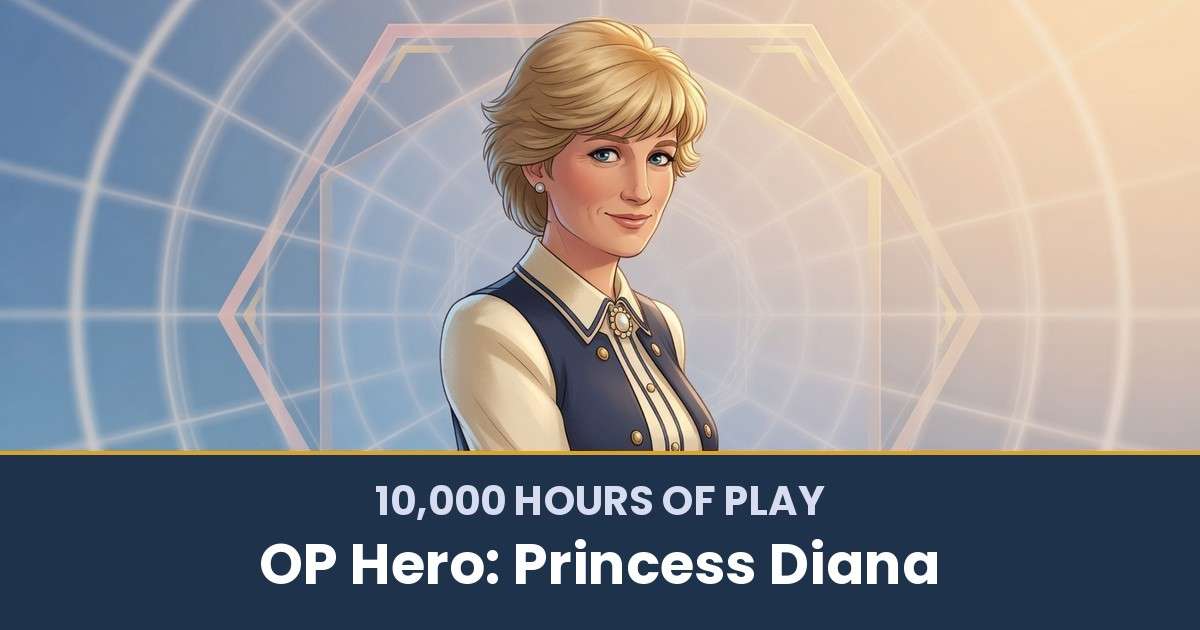


On April 9, 1987, a thirty-two-year-old patient named Ivan Cohen sat on a hospital bed in the new AIDS ward at London Middlesex Hospital and shook hands with the Princess of Wales without gloves. Cameras caught it. The next morning that handshake was on every front page on earth.
Nobody at the palace told her to do it. Most of the British establishment did not want her to do it. Doctors at the time were still being asked on television whether HIV could be transmitted by a doorknob. She took the gloves off, walked into the ward, and changed the worldwide aggression around AIDS in about thirty seconds.
That is not a personality. That is a build. Diana Frances Spencer was working a Game most people in her position never even chose, with a Skill set most royals never developed, and she had been quietly leveling up the whole time — through the Young England kindergarten, the engagement, the babies, the bulimia, the eating disorders, the divorce, and the Angola minefield in 1997. The 10,000 Hours of Play framework was built precisely to make a run like this legible.
⚡ Speed Run Notes
- Diana’s Game was never “be a popular princess.” It was “convert compulsory royal attention into empathetic encounters that shift the public stigma around AIDS, leprosy, landmines, and grief.”
- Her breakthrough Attribute was high emotional attunement plus a near-zero deference setting. She broke royal physical-distance norms on instinct from age twenty.
- The April 9, 1987 AIDS handshake at Middlesex Hospital and the January 1997 Angola minefield walk are the same Skill — Courageous Heart — used at two different stakes a decade apart.
- The 1995 Panorama interview was a Loremaster play. By telling her own story on her own terms, she turned a private royal collapse into a public empathy event the institution could not control.
- The lesson for your own build: if your Game is empathy at scale, the press is not your enemy; it is your distribution layer. Diana used the cameras she could not get away from.
Table of Contents
- Step 1: The Game — What Princess Diana Was Actually Playing
- Step 2: Attributes — The Innate Stats
- Step 3: Role(s) — The Character Class Across Chapters
- Step 4: Skills — The Real-Life Game Skills Princess Diana Mastered
- Step 5: Allies — The People Who Multiplied Princess Diana
- Step 6: Quests — The Milestones That Shaped the Saga
- What You Can Steal From Princess Diana’s Build
- Where this framework comes from
- Related Reading
About Yu-kai Chou

Yu-kai Chou is the author of 10,000 Hours of Play — the book that treats your life as the most important game you’ll ever build a character in, and gives you the 6-Step framework (Game · Attributes · Role · Skills · Allies · Quests) to play it on purpose. He has spent two decades developing the system through which this post analyzes its OP Hero, and applies it to his own life and to the lives of the people he advises around the world.
Chou’s other framework, the Octalysis Framework, has been applied by LEGO, Microsoft, Porsche, Coca-Cola, Salesforce, and MrBeast, impacting over 1.5 Billion Users. He has taught the methodology at Harvard, Stanford, Yale, Tesla, Google, BCG, and IDEO, and has advised governments in eight nations including Ukraine, the United Kingdom, the Kingdom of Bahrain, Singapore, Taiwan, the Netherlands, Kazakhstan, and South Korea.
His work has been cited by Harvard, Stanford, MIT, Forbes, Wall Street Journal, Wired, US Department of Energy, NIST, NSF, NCBI, US Department of Education, ClinicalTrials.gov, and Google Scholar — with 3,700+ more academic publications. Explore his books here.
What I find instructive about Princess Diana’s build is how she refused to treat compulsory attention as a cost. Most public figures spend their entire run trying to manage the cameras. She decided the cameras were a free distribution channel for the one thing she actually cared about — touch, presence, and empathy for people the world had agreed not to look at. The lesson I’d lift from her run is at Step 1: when a structural feature of your situation cannot be removed, ask what mission it could be repurposed to serve.
Step 1: The Game — What Princess Diana Was Actually Playing
Reduce her run to one sentence and you get this: use the unavoidable spotlight of royalty as a delivery mechanism for emotionally direct, physical contact with people the public had been trained to avoid.
She named it herself, on November 20, 1995, in front of an estimated twenty-three million British viewers on BBC Panorama: “I’d like to be a queen of people’s hearts, in people’s hearts, but I don’t see myself being queen of this country.” The line was scripted in advance with her own pen — she carried it into the room as the version of her mission she could stand behind on the record. The Game was never the crown. It was the people the crown could be aimed at.
The same mission shows up earlier, in a quieter quote often attributed to her in the late 1980s — “if I’m going to have cameras pointed at me all the time, I might as well use all this publicity for good.” That is a Step 1 statement: the situation is fixed, the question is what mission the situation can be re-skinned to serve. AIDS in 1987, leprosy in 1989, homelessness through Centrepoint from 1992, landmines in Angola and Bosnia in 1997 — these are not separate causes. They are the same Quest with four different uniforms.
If you’re building your own life as a game right now, this is the test. Pick a Game that survives a role change. Diana lost the formal title “Her Royal Highness” in August 1996 when the divorce went through. The Game kept running. By January 1997 she was on a HALO Trust minefield in Angola without any royal title at all, and the public empathy event was, if anything, larger. Frame your own Talent Triangle around something a title change cannot end, and you have something a divorce or a layoff cannot stop.
Step 2: Attributes — The Innate Stats
Five Attributes show up early enough in her record to read as starting stats, not learned moves.
High emotional attunement. At West Heath School in Kent, where she boarded from 1974 to 1977, she was already singled out for the rapport she built with younger children and for her volunteer work at a local school for children with disabilities. Sarah Bradford’s biography records school staff who described her as “comfortable with the children who were uncomfortable with everyone else.” By the time she was working at the Young England kindergarten in Pimlico in 1979 and 1980, the press caught her holding a toddler on her hip in the famous “see-through skirt” photograph — the picture itself was a side effect of the Attribute, not of any media strategy.
Low deference to hierarchy. Friends and staff in every period of her life describe her as instinctively informal — calling kitchen workers and security officers by their first names, sitting on the floor with hospital patients rather than standing over them, declining the chair the protocol officer had placed for her. She said in the 1995 Panorama interview, in her own words, that she did not “fit the rule book” and saw herself as “a free spirit.” Most royals develop this trait carefully through training. She walked in with it.
Camera-native charisma. Before the engagement was even announced in February 1981, paparazzi nicknamed her “Shy Di” because she dropped her chin and looked up through her lashes when photographed. Tina Brown’s Diana Chronicles (2007) notes that the shy-glance pose was almost certainly involuntary at age nineteen, but produced an “approachable celebrity” signal so strong that the major British papers ran daily photo-spreads on her between September 1980 and the engagement. She generated outsized public response before she had a single line of media training.
Personal-emotional risk tolerance. Agreeing to marry the Prince of Wales at twenty after knowing him for roughly thirteen separate meetings is one data point. Sitting for a five-hour interview with Andrew Morton’s intermediary in 1991 — knowing the resulting book Diana: Her True Story (1992) would publicly accuse the heir to the throne of having an affair — is another. Walking into an active minefield in Angola in January 1997, wearing a HALO Trust visor and Kevlar vest but still on live cameras, is a third. The pattern is consistent: when the personal-emotional stake was high, she leaned into the camera, not away from it.
Wounded-healer pattern. The Spencer parents separated in 1967 and divorced in 1969; Diana, age six to eight, was the subject of a contested custody arrangement that biographers consistently flag as the formative wound. Andrew Morton’s authorized account, drawn from her own tape-recorded testimony, traces her later focus on children’s hospitals and pediatric wards directly back to that period. The Attribute is the one psychologists sometimes call the specialist instinct in disguise — repeated exposure to a wound trains a person to specialize in it from the other side of the bed.
Step 3: Role(s) — The Character Class Across Chapters
Six Roles in thirty-six years.
From 1961 to 1977, she ran the Spencer Daughter Role. Born July 1, 1961 at Park House on the Sandringham estate to Viscount and Viscountess Althorp, raised inside aristocratic but emotionally fractured circumstances, schooled at Riddlesworth Hall and then West Heath. The job description was survival of the parental separation and a slow absorption of the Spencer-family proximity to the royal household.
From 1977 to 1980, she shifted into the Caregiver Apprentice Role. After leaving West Heath without A-levels and a brief stint at a Swiss finishing school, she returned to London and took live-in nanny work, then a part-time assistant role at the Young England kindergarten in Pimlico. This is the chapter that mattered more than her biographers initially gave it credit for — she practiced daily emotional attentiveness with three-year-olds before practicing it with AIDS patients.
From 1980 to 1981, she occupied the Royal Apprentice Role. The courtship with Prince Charles, the engagement announcement on February 24, 1981, and the pre-wedding crash course in protocol and press handling. The Role had very little agency by design. The objective was to survive the tutorial level under conditions of unprecedented global attention.
From 1981 to roughly 1985, she ran the Fairytale Consort Role. The wedding on July 29, 1981 drew an estimated 750 million television viewers. The 1983 Australia and New Zealand tour set a new attendance bar for Commonwealth visits. William was born in 1982, Harry in 1984. This was the high-charisma, ceremonial-figure phase — support class for the heir to the throne, still nominally aligned with The Firm.
From 1985 to 1992, she transitioned into the People’s Princess Role. The Middlesex Hospital AIDS handshake in April 1987, the visits to leprosy hospitals in Indonesia and Nepal in 1989 and 1990, the homelessness work with Centrepoint, the eating-disorder advocacy, the increasingly candid press encounters. The Role shifted from ceremonial support to front-line humanitarian — and the alignment shift inside the institution began.
From 1992 to 1997, she layered on a Solo Humanitarian Operator Role on top of an unraveling marriage. The formal separation was announced on December 9, 1992. Andrew Morton’s Diana: Her True Story appeared in 1992 and was later revealed to have been sourced from her own taped interviews. The Panorama interview ran November 20, 1995. The divorce was finalized August 28, 1996, and “Her Royal Highness” was withdrawn. By January 1997 she was in Angola with the HALO Trust, in Bosnia by August 1997 with the same organization, and dead in Paris three weeks after the Bosnia trip. The Solo Operator Role compressed a decade’s worth of work into roughly four years.
Step 4: Skills — The Real-Life Game Skills Princess Diana Mastered
Six canon Real-Life Game Skills do the heavy lifting in her build. Each one has a moment.
Vision Manifestation (Warlock). Mental rehearsal so vivid it shapes reality is the canon definition, and the Panorama line about being “queen of people’s hearts” is the textbook example. The phrase was not improvised under studio lights. According to her own staff and biographers, she had been carrying that exact reframing of her royal future in her head for years — a version of the Role she could survive even after the formal Role collapsed. The “queen of hearts” identity was not a piece of post-divorce PR. It was the long-held mental image that the post-divorce reality eventually caught up to. The same canon Skill — visualizing a destination so completely that the world reshapes itself toward it — drives most of the long-haul builds in the OP Hero catalog.
Courageous Heart (Paladin). Charging into uncomfortable, hostile, or uncharted environments. The April 9, 1987 handshake at the Middlesex Hospital AIDS ward is the canonical instance. The Department of Health was still printing leaflets reading “AIDS: Don’t Die of Ignorance,” doctors were still being asked about doorknob transmission on the BBC, and the ward had been picketed in some cities. She walked in, removed her gloves, sat on a bed, and shook the patient’s hand on camera. The image broke a global stigma in one news cycle. The same Skill shows up in 1989 when she touched leprosy patients in Indonesia without gloves, and again in January 1997 when she walked an active minefield in Huambo, Angola, wearing a HALO Trust visor and body armor while cameras rolled. Three uses of the same Skill at escalating stakes. The same canon Skill that powered Malala Yousafzai’s public stand sits at the core of Diana’s run.
Beacon Flare (Ranger). PR skills that cut through noise and drive buzz. Most royals in the 1980s treated the press as a hostile party to be managed by Buckingham Palace’s press secretary. She treated the press as a distribution channel she could direct. The 1987 AIDS handshake was timed for maximum press coverage — Saturday morning news, photographers given clear sightlines, no protocol officer to wave them off. The 1997 Angola minefield walk was coordinated with the HALO Trust precisely so the resulting photograph would land on Sunday front pages and pressure governments toward the Ottawa Treaty. The treaty was signed in December 1997, four months after her death, banning anti-personnel landmines with 122 founding signatories. Causation is hard to prove in policy. The minefield photograph is the single most-cited contemporary catalyst.
Loremaster (Druid). Weaving compelling, inspiring stories. Two specific plays. First, the 1992 cooperation with Andrew Morton — she recorded six tapes of her own first-person testimony, smuggled to Morton through a mutual friend (James Colthurst). Diana: Her True Story published in June 1992 and shifted the public narrative of the marriage permanently. Second, the November 1995 Panorama interview with Martin Bashir. She prepared her own lines, including the “queen of hearts” framing and the “three of us in this marriage” line about Camilla Parker Bowles. The interview was watched live by an estimated twenty-three million people in the UK alone. Both moves are the same Skill — taking control of the narrative that everyone else assumed they owned. The same Loremaster move that Maya Angelou made through I Know Why the Caged Bird Sings in a different register.
Charm (Druid III). Making a person or group affectionate toward you. The Skill is hard to teach and harder to fake, and she had it at the highest tier. Anecdotes from the 1983 Australia and New Zealand tour describe crowds reaching past Charles to touch her hand. By 1987 a Gallup poll had her approval rating inside the United Kingdom at 85 percent, the highest ever recorded for a member of the royal family. Even at the lowest point of the marriage breakdown, when she was being briefed against in the British press by palace sources, her individual encounters with people — patients, schoolchildren, charity workers — produced near-uniform reports of warmth and presence. Charm at that intensity is its own Skill, distinct from charisma; it is what made the Beacon Flare amplifications work at all.
Phoenix Rebirth (Paladin). Recover from devastating failure and come back stronger. The “failure” was not one event; it was a compounding sequence. The 1992 separation. The 1992 publication of Morton’s book and the official acknowledgement of the marriage collapse. The bulimia made public, the suicide attempts she described to Morton, the lonely years inside Kensington Palace, the loss of “Her Royal Highness” in 1996. The post-1996 chapter could have been a quiet retirement under a settlement. Instead she rebuilt the Role from scratch — solo humanitarian, no royal scaffolding, no palace press office — and produced the most consequential humanitarian work of her life inside ten months: Angola in January 1997, the auction of her dresses for AIDS and cancer charities in June 1997 (raising $3.25 million at Christie’s New York), and the Bosnia visit in August 1997. The canon Skill at its largest stake: not coming back from a fall, but rebirthing the entire character around a stripped-down version of the Game.
Step 5: Allies — The People Who Multiplied Princess Diana
Patrick Jephson. Her private secretary from 1988 to 1996, a former Royal Navy officer who organized the entire humanitarian portfolio — AIDS, leprosy, homelessness, eating disorders — into a coherent schedule of visits, briefings, and public statements. His 2000 memoir Shadows of a Princess is now a primary source on how the work actually got done. Without Jephson the calendar would have been chaos.
Andrew Morton. The journalist who turned her tape-recorded testimony into Diana: Her True Story in 1992 and the updated Her New Life in 1995. Morton has been honest in subsequent interviews that the book existed only because she chose to bypass the palace and speak in her own voice through him. The Ally relationship was unusual — they never met directly during the original reporting, the entire process was mediated through James Colthurst — but the output multiplied her by giving her a long-form vehicle the palace press office could not edit.
Anthony Holden, James Colthurst, and Rosa Monckton. The personal friends who functioned as informal advisors at different periods — Holden as a journalist who understood the press infrastructure, Colthurst as the doctor who carried the tapes to Morton, Monckton as a confidante through the divorce years and the Versace and Tatler connections that helped reshape her public image post-1992. The pattern of small, loyal, non-royal inner circles outside the palace press office shows up repeatedly across the build.
The HALO Trust and Jerry White. Her landmines campaign existed because HALO Trust co-founder Guy Willoughby and Landmine Survivors Network co-founder Jerry White briefed her on the issue in 1996 and 1997 and provided the on-the-ground access in Angola and Bosnia. The Ottawa Treaty acknowledgements credit White and Diana together; she is the public face that moved the political weight, but the technical brief and the field access came from these two specifically. The same builder-plus-operator pattern that powered Coco Chanel’s work with Pierre Wertheimer shows up here in humanitarian form.
Mother Teresa. The two women met multiple times between 1992 and 1997, including in the Bronx and in Rome. Mother Teresa’s quiet, decades-long template for proximity-based service — touching patients other people would not touch — pre-dated Diana’s by half a century and gave her a working ethical model when royal protocol could not. They died within a week of each other in 1997.
Princes William and Harry. Not Allies in the contemporary sense — they were children — but the two people whose existence kept the Game tethered to its long-arc strategic logic. She insisted on raising them outside the conventional royal-children pattern: McDonald’s drive-throughs, queue at theme parks, mixed-class school visits. The pattern was a deliberate transfer of her own values into the next generation, and both grown sons have continued the AIDS, mental-health, and landmines work into the 2020s.
Step 6: Quests — The Milestones That Shaped the Saga
July 1, 1961 — born at Park House, Sandringham. Diana Frances Spencer, third daughter of Viscount Althorp and Frances Roche. The Spencer family had served the royal household for generations; her grandmothers were both ladies-in-waiting to the Queen Mother. The starting position is aristocratic proximity to the Crown without any heir-presumptive obligation.
1967–1969 — parental separation and custody battle. The Spencers separated in 1967 and divorced in 1969. The custody arrangement gave physical custody to her father; her mother Frances would later say in interviews that she felt the children had been turned against her. Diana, age six to eight, was the central wound around which much of the later work organized itself.
1979–1980 — Young England kindergarten, Pimlico. Returns to London from finishing school, takes work as a part-time assistant at the Young England kindergarten run by Victoria Wilson and Kay Seth-Smith. The famous “see-through skirt” photograph is shot in September 1980. The kindergarten chapter is short but load-bearing: it is the practice ground for the emotional-presence Skill she will later use in AIDS wards.
February 24, 1981 — engagement to Charles, Prince of Wales. Announced from Buckingham Palace. She is nineteen. The famous answer to “Are you in love?” — Charles: “Whatever ‘in love’ means” — is broadcast within hours of the engagement and is later cited as the first public signal that the marriage was a strategic match, not a love match.
July 29, 1981 — the wedding at St Paul’s Cathedral. Watched live by an estimated 750 million people across seventy-four countries. The Role of Fairytale Consort begins under maximum global attention. William is born June 21, 1982; Harry on September 15, 1984.
April 9, 1987 — Middlesex Hospital, AIDS ward opening. Shakes hands ungloved with a male AIDS patient on camera. The photograph dominates the next news cycle and is later credited by HIV/AIDS researchers as one of the single most consequential public-health communications moments of the late twentieth century. The Game has now been publicly named.
June 7, 1992 — Diana: Her True Story published. Andrew Morton’s account, secretly sourced from her own tapes, reveals the bulimia, the alleged suicide attempts, the loneliness inside the marriage, and the affair with Camilla Parker Bowles. The book reshapes the British public’s view of the marriage in a single week. The palace establishment will not forgive the breach, but the Game has shifted decisively.
December 9, 1992 — formal separation announced. Prime Minister John Major reads the statement in the House of Commons. The Role of Fairytale Consort formally ends.
November 20, 1995 — Panorama with Martin Bashir. Twenty-three million UK viewers. “There were three of us in this marriage, so it was a bit crowded.” “I’d like to be a queen of people’s hearts.” The interview accelerates the divorce timeline. (Note: a 2021 BBC inquiry led by Lord Dyson found that Bashir used falsified documents to obtain the interview. The reckoning over the means does not erase Diana’s strategic choice to speak; it sharpens the question of how vulnerable she was being.)
August 28, 1996 — divorce finalized. She loses “Her Royal Highness” but keeps “Diana, Princess of Wales.” A reported settlement of around £17 million, an apartment at Kensington Palace, and shared custody. The Solo Operator Role begins.
January 1997 — Angola minefield walk with the HALO Trust. The photograph in the HALO visor and Kevlar vest goes global on Sunday newspaper front pages. The British government calls her interference; the international humanitarian community calls it the most effective single piece of advocacy the campaign has ever had. The Ottawa Treaty banning anti-personnel landmines is signed in December 1997, four months after her death.
August 1997 — Bosnia visit with landmine survivors; the failure of the conventional retirement script. The setback in this profile is not death, which is not a Skill failure. The setback is the structural one: she never had access to the institutional infrastructure that would have let her work continue at scale after she died. Her foundation existed for twenty-five years and did good work, but the Game itself was tightly fused to her personal presence. A more durable build would have institutionalized the work before the end. This is the failure the framework forces you to see.
August 31, 1997 — death in Paris. A car crash in the Pont de l’Alma tunnel. She is thirty-six. Her funeral on September 6 is watched by an estimated 2.5 billion people worldwide — at the time, the most-watched event in television history. The Game outlives her; the Skill set does not transfer cleanly.
What You Can Steal From Princess Diana’s Build
If you take only one move from her run, take this one. When a structural feature of your situation cannot be removed, ask what mission it could be repurposed to serve. She could not get rid of the cameras. She decided what the cameras would be for. Most people in any kind of spotlight — corporate, political, online — spend their entire build managing the attention as if it were a tax. She treated it as a budget.
If you take two moves, take a second one. Practice your future Skill at small scale before you need it at large scale. The kindergarten in Pimlico in 1979 is not a charming detail in the biography; it is the rehearsal hall for the AIDS handshake in 1987. The hospital ward was harder, the stakes were higher, the cameras were brighter — but the underlying Skill, sitting at eye level with a frightened person and being fully present, had been trained for two years on a different floor with different patients. Most people skip the rehearsal hall and then wonder why their breakthrough moment goes badly. Walk the practice floor first. The rest of the OP Hero catalog is full of the same lesson in different costumes.
Where this framework comes from

Want the full system this profile is built on?
Every OP Hero piece runs through the same 6-Step framework from 10,000 Hours of Play: Unlock Your Real-Life Legendary Success. The book covers the full system, walks through Yu-kai’s own life run as the first applied case study, and gives you the worksheets to audit your own build.
Related Reading
- All OP Hero Profiles — the running hub of every 10K HP hero we’ve audited so far.
- 10,000 Hours of Play by OP Hero: Malala Yousafzai — the closest modern parallel to Diana’s “courage + global press distribution” arc.
- 10,000 Hours of Play by OP Hero: Maya Angelou — another Loremaster who took back her own narrative on her own terms.
- 10,000 Hours of Play by OP Hero: Coco Chanel — a parallel “personal brand absorbs the institution” build, in a different industry.
- Real Life Game Skill (Warlock): The Lich Pact — a worked example of how a single canon Skill changes a builder’s trajectory.
- Turning Life Into a Game — the framework’s first principles, in case you want to apply the 6 Steps to your own build right now.