
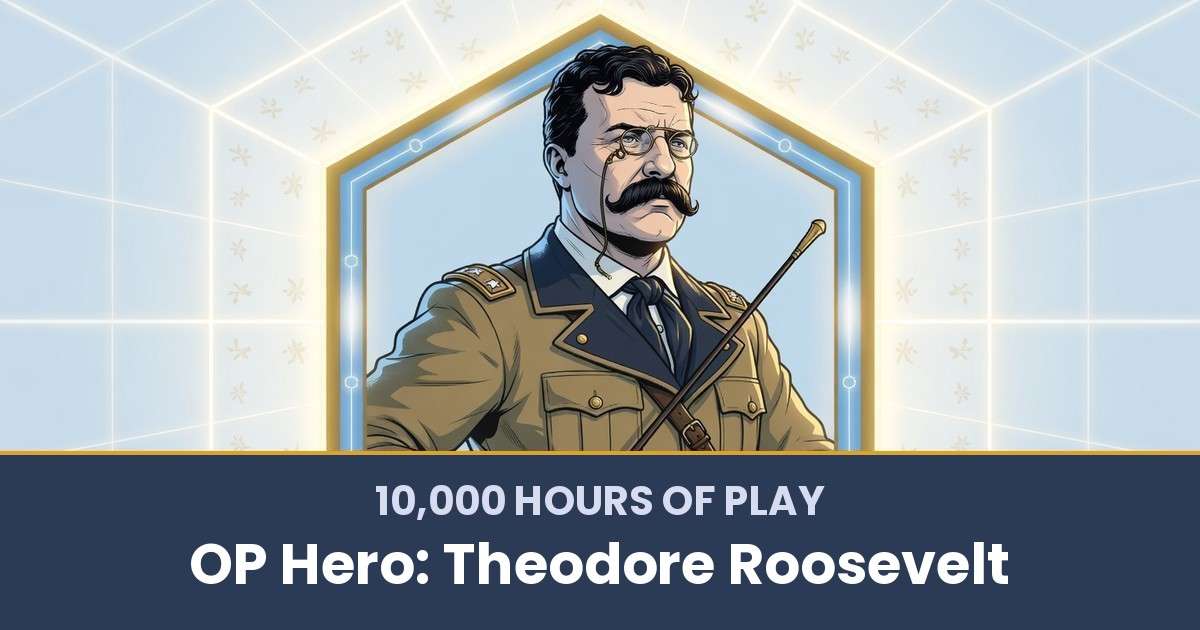


The boy was a wheezing asthmatic who couldn’t make it up a single flight of stairs without stopping. By the time he died, he had charged a hill under live fire in Cuba, broken the most powerful railroad monopoly in America, mediated a peace treaty between two empires, set aside 230 million acres of public land, and survived a tropical fever on an unmapped Amazon river that should have killed him five times over.
Theodore Roosevelt didn’t get there by accident. He chose, sometime around his thirteenth birthday, to treat his own body as a project. The rest of his life ran the same play at progressively larger scales: pick the impossible thing, train for it on purpose, then go do it before the doubters finish their sentence.
That’s not a personality. That’s a build. And studying TR through the 10,000 Hours of Play lens makes the build legible — what attributes he was born with, which roles he leveled through, and the specific skills he kept sharpening across thirty years of public life. The story below isn’t about a great man. It’s about a system you can copy.
⚡ Speed Run Notes
- TR’s game was never a single job — it was the strenuous life: build yourself, then use the built version to push the country toward something better.
- His innate attributes were curiosity, baseline energy, risk appetite, and a combative moral instinct. None of those alone made him great. Stacking them on a deliberately rebuilt body did.
- The class rotation tells the story: naturalist → assemblyman → cowboy → reformer → soldier → governor → president → explorer. Same player, six character classes.
- He didn’t invent the Sherman Antitrust Act, the Square Deal, or conservation. He executed all three by combining a public-speaking Paladin skill with a Ranger’s tactical command and a Warlock’s vision discipline.
- The biggest lesson isn’t “be tougher.” It’s that a build deliberately optimized for one core mission survives losses — losing your wife, losing the presidency, losing 55 pounds on a deathbed expedition — and still ships work.
Table of Contents
- Step 1: The Game — What Theodore Roosevelt Was Actually Playing
- Step 2: Attributes — The Innate Stats
- Step 3: Role(s) — The Character Class Across Chapters
- Step 4: Skills — The Real-Life Game Skills Theodore Roosevelt Mastered
- Step 5: Allies — The People Who Multiplied Theodore Roosevelt
- Step 6: Quests — The Milestones That Shaped the Saga
- What You Can Steal From Theodore Roosevelt’s Build
- Where this framework comes from
- Related Reading
About Yu-kai Chou

Yu-kai Chou is the author of 10,000 Hours of Play — the book that treats your life as the most important game you’ll ever build a character in, and gives you the 6-Step framework (Game · Attributes · Role · Skills · Allies · Quests) to play it on purpose. He has spent two decades developing the system through which this post analyzes its OP Hero, and applies it to his own life and to the lives of the people he advises around the world.
Chou’s other framework, the Octalysis Framework, has been applied by LEGO, Microsoft, Porsche, Coca-Cola, Salesforce, and MrBeast, impacting over 1.5 Billion Users. He has taught the methodology at Harvard, Stanford, Yale, Tesla, Google, BCG, and IDEO, and has advised governments in eight nations including Ukraine, the United Kingdom, the Kingdom of Bahrain, Singapore, Taiwan, the Netherlands, Kazakhstan, and South Korea.
His work has been cited by Harvard, Stanford, MIT, Forbes, Wall Street Journal, Wired, US Department of Energy, NIST, NSF, NCBI, US Department of Education, ClinicalTrials.gov, and Google Scholar — with 3,700+ more academic publications. Explore his books here.
What I find instructive about TR is the deliberateness underneath the bombast. People remember the hat and the moustache and the charge up the hill. The actual lesson is that he never tried to be balanced. He picked one Game — the strenuous life in public service — and oriented everything else around it. The Skill I’d lift from his build is Vision Manifestation (Warlock), executed with Paladin energy. He pictured the country he wanted, said it out loud, and then refused to walk it back. If you can do that without being a jerk, you can move more than people think.
Step 1: The Game — What Theodore Roosevelt Was Actually Playing
TR’s Game was never an office. The office was an instrument.
The Game he kept playing across forty years of public life was what he called, in his 1899 Chicago address, the strenuous life: an active, engaged citizenship in which the individual builds himself and then spends that built self on public good. The phrase wasn’t poetry. It was a thesis statement. He laid it out plainly: “I wish to preach, not the doctrine of ignoble ease, but the doctrine of the strenuous life.”
You can see the same Game underneath every chapter. As New York Police Commissioner he stalked the streets at 2 a.m. to catch his own officers sleeping on duty. As President he made “Square Deal” the operating principle of how the executive branch should referee between labor and capital. As an ex-President in 1912 he split the Republican Party rather than abandon his New Nationalism platform.
The Game can be stated in one sentence: build yourself strenuously, then deploy the built self into the largest arena you can reach. Office, hat, or rifle — they were all just gear loadouts for the same character. If you want to see what it looks like to turn your life into a game with a single coherent through-line, TR is one of the cleanest American examples on the board.
Step 2: Attributes — The Innate Stats
Roosevelt’s adult build looks unstoppable in retrospect. The kid version did not.
He was a sickly, asthmatic child whose father once had to hold him upright in a carriage at night so he could breathe. The strength wasn’t there. But four other stats were dialled almost to the maximum from the start.
Curiosity-driven observation. By age eight he was running a “boy’s natural history museum” in the family townhouse, cataloguing birds and mammals. He published his first scientific note — “The Summer Birds of the Adirondacks” — in the Bulletin of the Nuttall Ornithological Club at age 18, before he had finished college.
Baseline drive. Family letters describe him as restless and “boiling over” even when bedridden. His sister Corinne later wrote that he was “overflowing with animal spirits” while still confined by his lungs. The energy was the fuel. He just had no engine block built to take it yet.
Risk appetite. As a 23-year-old freshman New York Assemblyman in 1882, he picked a public fight with sitting state-supreme-court Judge Theodore Westbrook over the Jay Gould–related Manhattan Elevated scandal. Sixteen years later, he resigned a comfortable Assistant Secretary of the Navy post in April 1898 to raise a volunteer cavalry regiment and put himself in front of Spanish Mauser rounds.
Combative moral instinct. Even as a young reformer he was happy to call corrupt Republicans “the blackest-hearted scoundrels” in print. He wasn’t a diplomat. He was a prosecutor who happened to do politics.
None of those four stats individually predicted a presidency. The combination did — and once you can see the four-stat starter kit, the rest of the story makes sense. (This is exactly the diagnostic the Talent Triangle Method is designed to help you run on yourself: which of your stats were maxed before you had any agency over them, and what does a Game built around them actually look like?)
Step 3: Role(s) — The Character Class Across Chapters
The same player ran roughly eight different character classes across his life.
From 1882 to 1884 he was the Reform Assemblyman in Albany, picking fights with Tammany Hall and Speaker Titus Sheard. After the deaths of his wife Alice and his mother on the same day — February 14, 1884 — he went west to the Dakota Badlands and spent two years as a Rancher and Cowboy, leading a posse on horseback to capture three boat thieves and writing essays about frontier life by lantern light.
By 1889 he was back east as U.S. Civil Service Commissioner, enforcing the merit system against his own party’s patronage machine. From 1895 to 1897 he was President of the NYC Board of Police Commissioners, then Assistant Secretary of the Navy in McKinley’s administration, then in 1898 Colonel of the 1st U.S. Volunteer Cavalry, leading the dismounted charge up Kettle Hill toward San Juan Heights on July 1.
He came home a war hero, won the New York Governorship that November, was kicked upstairs to the Vice Presidency in March 1901, and — when McKinley was assassinated in September of that year — became the youngest President in American history at 42. After leaving the White House in 1909, he ran one more class: Bull Moose Insurgent in 1912, then Amazon Explorer on the unmapped Rio da Dúvida in 1913–14.
What’s worth noticing is not the variety — plenty of people change jobs. It’s the through-line. Every class served the same Game. Even the cowboy years weren’t escape. They were physical and psychological reps for the public arena he intended to re-enter.
Step 4: Skills — The Real-Life Game Skills Theodore Roosevelt Mastered
Six canon Real-Life Game Skills show up over and over in TR’s record. Each one cracked open a specific result.
Vision Manifestation (Warlock) — the discipline of seeing a future state so vividly that you spend years pulling the world toward it. TR saw a modernized federal state actively refereeing capital and labor decades before that was a mainstream view. The Square Deal speeches of 1903–1904, the antitrust suit against Northern Securities, the 230 million acres of land set aside under his presidency: all of it traces back to a single repeated picture of what America should look like. He kept naming it out loud until it became real. The same Warlock-tier discipline shows up in Churchill’s wilderness years — picture the future, refuse to flinch, wait for the world to catch up.
Courageous Heart (Paladin) — charge into uncomfortable, uncharted, or hostile zones. The whole Rough Riders episode is a textbook Courageous Heart move: he had no combat command experience and chose to lead a volunteer regiment into Cuba anyway. The charge up Kettle Hill on horseback under live fire is the cinematic version. The less obvious version is taking the NYC Police Commissioner job at all in 1895 — a notoriously corrupt department where reform meant publicly humiliating powerful men in his own party. He kept volunteering for the fights other reformers found a reason to skip.
Tactical Command (Ranger) — get people with conflicting talents and interests to work together toward one outcome. The October 1902 anthracite coal strike is the case study. Mine operators refused to negotiate with the union. Roosevelt summoned both sides to the White House on October 3, then — when the operators dug in — proposed an independent commission that gave each side enough face-saving cover to accept arbitration. Coal production resumed before winter. No one got everything they wanted. Everyone got enough. That’s the Ranger move.
Thunder Clap (Paladin) — public speaking that charges up and inspires people, at scale. TR’s term “bully pulpit” entered the language because of how relentlessly he used the presidency as a platform. The Strenuous Life address in Chicago (1899), the New Nationalism speech at Osawatomie (1910), the Confession of Faith at the 1912 Progressive convention — these weren’t just speeches. They were doctrines installed in the public mind by sheer force of repetition. Read his record next to Martin Luther King Jr.’s and you see the same Skill operating on different audiences for different ends.
Phoenix Rebirth (Paladin) — recover from devastating failure and come back stronger. On February 14, 1884, his wife Alice died of Bright’s disease two days after giving birth, and his mother died of typhoid in the same house on the same day. He wrote a single black X in his diary with the line: “The light has gone out of my life.” Then he handed the baby to his sister, finished the Assembly session, and disappeared into the Dakotas for two years to grind out a new self. He did it again after losing the 1912 election. He did it a third time after the River of Doubt expedition nearly killed him in 1914 — he came home 55 pounds lighter and still wrote a book about it. The Skill isn’t avoiding the hits. It’s the willingness to rebuild from the ash.
Aegis (Paladin) — ignore public criticism and naysayers while pushing the Quest. Trustbusting was wildly unpopular with the financial press. Roosevelt did it anyway. Conservation was dismissed as a sentimental rich-boy hobby. He protected 230 million acres of land anyway. Mediating the Russo-Japanese War cost him political capital with both ethnic constituencies in the U.S. He won the 1906 Nobel Peace Prize anyway. The Aegis Skill is what kept the bully pulpit pointed in one direction long enough for the work to ship. If you want to see Aegis paired with a long-form grind, the Lich Pact piece on the same site shows the other Warlock end of that tradeoff.
Step 5: Allies — The People Who Multiplied Theodore Roosevelt
TR was loud enough that people forget how much of his work was done with a tight circle of allies who covered the angles he didn’t.
Henry Cabot Lodge was his longest political friendship. Lodge held the Senate flank for naval expansion, the Spanish-American War declaration, and most of Roosevelt’s foreign-policy agenda. Their correspondence runs to thousands of letters.
Leonard Wood co-raised the Rough Riders. Wood was the actual professional soldier — a Medal of Honor recipient and Army surgeon — and let Roosevelt be the public face of a regiment that was, organizationally, Wood’s doing. Without him, “Colonel Roosevelt” doesn’t exist.
Gifford Pinchot, the first Chief of the U.S. Forest Service, was the operational engine behind conservation. Roosevelt provided the executive will. Pinchot built the institution that translated that will into 150 national forests, 51 federal bird reservations, and 18 national monuments.
John Hay and Elihu Root, his Secretaries of State and War, ran the diplomatic and military machinery — Panama, the Open Door in China, Cuban occupation policy — while TR took the public oxygen.
Edith Carow Roosevelt ran Sagamore Hill and a six-child household, and was the political reader he trusted most after his sister Corinne. She is the reason a man who could not sit still ever got to read a complete cable.
And William Howard Taft — his Secretary of War and chosen 1908 successor — is the costliest alliance lesson on the list. TR hand-picked him for the presidency, then by 1912 had broken with him so completely that he ran against Taft himself, fractured the Republican Party, and handed Wilson the White House. The same allies who multiply you can, when the Game shifts under them, multiply the wound. Pick carefully, and revisit the pick.
Step 6: Quests — The Milestones That Shaped the Saga
Six quests carry most of the weight of his career.
1898 — San Juan Heights and the Rough Riders. The dismounted charge up Kettle Hill on July 1 turned a 39-year-old former Navy bureaucrat into a national figure overnight. New York elected him Governor four months later. The military details matter, but the strategic point is the velocity: one summer of well-publicized risk-taking can compress a decade of normal career-building.
1902 — Anthracite Coal Strike and the Square Deal. By summoning operators and miners to the White House and forcing arbitration, TR established the precedent that the federal executive would intervene in a major labor dispute on behalf of the public interest, not the owners. This is the moment the modern presidency turns from referee-on-paper into referee-in-practice.
1902–04 — Northern Securities. Roosevelt directed Attorney General Philander Knox to file suit against the Northern Securities holding company under the Sherman Antitrust Act. The Supreme Court agreed 5–4 in 1904 to dissolve it. The trust-busting reputation is overstated in legend — TR actually filed fewer antitrust suits than Taft did later — but the symbolic break with Gilded Age laissez-faire was the part that mattered.
1903–08 — The Conservation Quest. Five national parks, eighteen national monuments, 150 national forests, 51 federal bird reservations, four federal game preserves, roughly 230 million acres of public land protected. He worked with John Muir at Yosemite in 1903 and used the 1906 Antiquities Act to designate sites unilaterally when Congress dragged its feet. This is the largest single-presidency conservation footprint in American history, and the structural foundation of every later environmental policy.
1905 — Treaty of Portsmouth. He brought Russian and Japanese delegations to Portsmouth, New Hampshire, in the summer of 1905 and shuttle-diplomatic’d a settlement that ended the Russo-Japanese War (signed September 5). The 1906 Nobel Peace Prize was the first ever awarded to an American.
1912 — The Bull Moose Run, and the Bullet. The setback. He couldn’t accept that Taft had drifted from the New Nationalism vision, broke with the Republican Party, and ran a third-party campaign. On October 14, 1912, a saloonkeeper named John Schrank shot him in the chest in Milwaukee. The bullet was slowed by a folded 50-page speech manuscript and a steel eyeglass case in his coat pocket. He gave the 90-minute speech anyway — “It takes more than that to kill a Bull Moose” — then went to the hospital. He still lost. He carried that bullet inside him for the rest of his life. Even the failures looked like a build.
If you’ve made it this far, you can probably feel where this fits in the broader OP Hero canon. TR sits naturally next to Lincoln in the “remade the American executive” bucket and next to Yvon Chouinard in the “the land is the legacy” one. The hub page links every other sibling profile on the roster.
What You Can Steal From Theodore Roosevelt’s Build
Three things, in order of how much they matter.
First, pick one Game and let it organize everything else. Roosevelt did not do balance. He did concentration. The strenuous life was the through-line. Rancher, cop, soldier, president, explorer were all loadouts for the same character. The point isn’t to copy the Game. It’s to have one. Most adults drift between several half-Games because no single one feels obviously worth the cost. Pick the one that feels worth the cost, and pay it. The Skills Spectrum piece on the same site is the right place to think about what specialist-versus-generalist actually means for your build.
Second, treat your body as a project. TR’s whole adult career rests on the fact that a thirteen-year-old asthmatic decided to install a gym in his father’s house. Without that, no Dakota Badlands, no Kettle Hill, no Amazon expedition that ought to have killed him. You don’t have to box. You do have to be honest that almost every ambition you have rides on the vehicle, and the vehicle has to be maintained.
Third, get good at Phoenix Rebirth before you need it. The man who survived the worst day of his life (February 14, 1884) by riding into the Badlands didn’t invent that move on the day his wife died. He had already practiced rebuilding himself from a sickly child into a Harvard boxer. By the time the real hits came — the loss of Alice and his mother, the 1912 defeat, the River of Doubt — the Skill was loaded. Don’t wait for the disaster to learn how to rebuild. Run smaller rebuilds in normal time so the muscle is there when the big one comes.
TR didn’t have a longer life than most. He had a denser one. Same hours, more game. If you want to see how this same lens applies to twenty-plus other lives — Marcus Aurelius, MLK, Churchill, Phil Knight, Frida Kahlo, and the rest — the OP Hero profiles hub is the way in.
Where this framework comes from

Want the full system this profile is built on?
Every OP Hero piece runs through the same 6-Step framework from 10,000 Hours of Play: Unlock Your Real-Life Legendary Success. The book covers the full system, walks through Yu-kai’s own life run as the first applied case study, and gives you the worksheets to audit your own build.
Related Reading
- All OP Hero profiles — the full 10,000 Hours of Play roster
- OP Hero: Abraham Lincoln — the prior remaker of the American executive
- OP Hero: Winston Churchill — another wilderness-years Phoenix Rebirth study
- OP Hero: Yvon Chouinard — when the land is the legacy
- OP Hero: Marcus Aurelius — the philosopher-executive lineage
- The 10,000 Hours of Play framework hub