
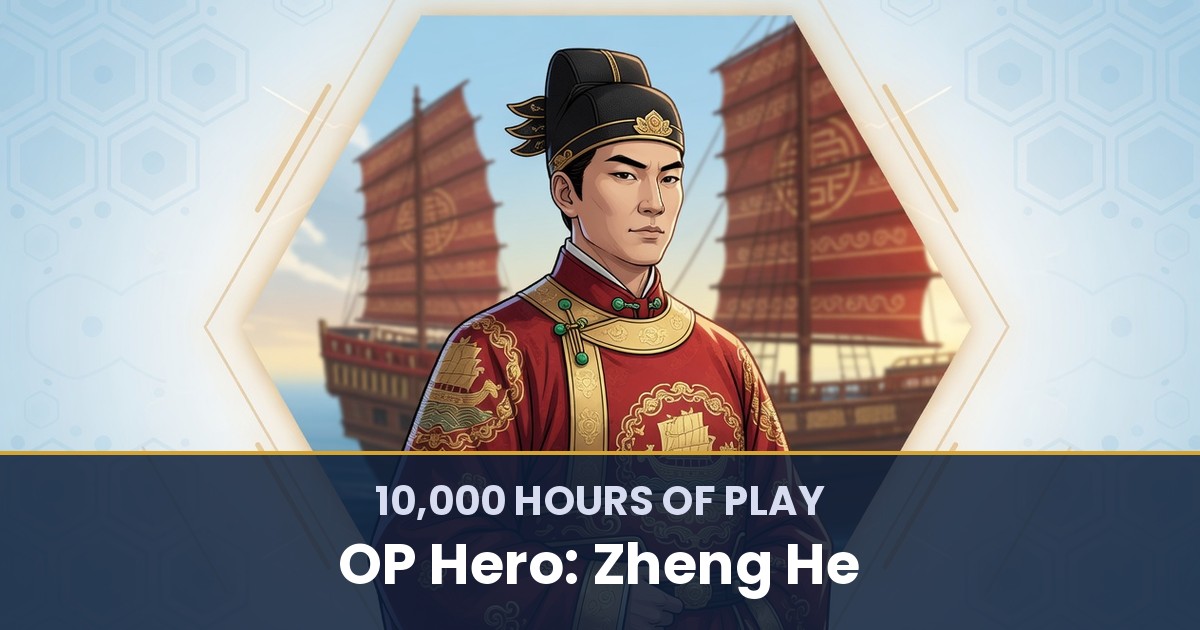


On 11 July 1405, a fleet carrying close to 28,000 men left Nanjing under the command of a court eunuch who had entered the Ming world as a ten-year-old prisoner of war.
Over the next 28 years that commander, Zheng He, would lead seven expeditions into the Indian Ocean, reaching Calicut, Hormuz, Aden and the East African coast, capturing a pirate king, a Sinhalese ruler and a Sumatran usurper along the way.
Within a few years of his death, the same dynasty banned the building of seagoing ships.
Most retellings stop at the size of the ships. I think the more useful story is the character sheet underneath: a boy captured in Yunnan who became the trusted servant of a usurping prince, and then turned that trust into the fleet that carried the Ming across the Indian Ocean seven times.
Run through the six Steps, his life reads as a lesson in patronage, logistics and what to do when the Game you serve is cancelled.
⚡ Speed Run Notes
- Zheng He’s Game was assigned, then owned: captured at about ten when the Ming took Yunnan in 1381, he became the instrument of the Yongle Emperor’s plan to put the Ming at the center of a maritime order.
- His innate stats: an imposing physical presence that later accounts dwell on, composure when cut off from his fleet, and an ease across faiths that a Muslim-born admiral making offerings to a sea goddess needed.
- Canon Skills on the sheet: Cosmic Alignment (Mage), Tactical Command (Ranger), Undying Rage (Warrior), Bind Fate (Warlock), Shapeshift (Druid) and Revive (Paladin).
- His Allies started with the prince he served from boyhood, and ran through co-commander Wang Jinghong, the interpreter Ma Huan who wrote the voyages down, and a Chinese settler at Palembang who called in the fleet against a pirate king.
- The Quest log: a pirate fleet destroyed in 1407, a king carried off from Ceylon in 1411, the voyages halted in 1424, a temple rebuilt instead, and a seventh voyage at sixty that he did not survive.
Table of Contents
About Yu-kai Chou

Yu-kai Chou is the author of 10,000 Hours of Play — the book that treats your life as the most important game you’ll ever build a character in, and gives you the 6-Step framework (Game · Attributes · Role · Skills · Allies · Quests) to play it on purpose. He has spent two decades developing the system through which this post analyzes its OP Hero, and applies it to his own life and to the lives of the people he advises around the world.
Chou’s other framework, the Octalysis Framework, has been applied by LEGO, Microsoft, Porsche, Coca-Cola, Salesforce, and MrBeast, impacting over 1.5 Billion Users. He has taught the methodology at Harvard, Stanford, Yale, Tesla, Google, BCG, and IDEO, and has advised governments in eight nations including Ukraine, the United Kingdom, the Kingdom of Bahrain, Singapore, Taiwan, the Netherlands, Kazakhstan, and South Korea.
His work has been cited by Harvard, Stanford, MIT, Forbes, Wall Street Journal, Wired, US Department of Energy, NIST, NSF, NCBI, US Department of Education, ClinicalTrials.gov, and Google Scholar — with 3,700+ more academic publications. Explore his books here.

Zheng He belongs in this series because almost nothing on his character sheet was his own choice at the start: the Game, the first two Roles and even his surname were assigned to him. The move I would lift from his build sits in Step 5, where a Chinese settler at Palembang called the fleet in against a pirate king, a local informant exposed the ambush before a single ship engaged, and the Ming turned that settler into a standing ally at the port.
Step 1: The Game — What Zheng He Was Actually Playing
Zheng He did not choose his Game the way most heroes in this series did. He was born Ma He in 1371 in Kunyang, Yunnan, into a Muslim family whose father and grandfather both carried the title hajji, meaning they had made the pilgrimage to Mecca.
When the Ming army conquered Yunnan in 1381, his father died in the fighting and the boy was taken prisoner. He was castrated and placed in the household of Zhu Di, the Prince of Yan, a man eleven years older than him.
That is the starting condition: a captive serving the dynasty that had killed his father. He built the rest from that start.
Zhu Di seized the throne in 1402 and became the Yongle Emperor, and his ambition was to put the Ming at the center of a maritime order. The official language of the voyages was to proclaim the emperor’s virtue abroad and bring foreign rulers into the tributary system, and the 1431 inscriptions Zheng He left at Liujiagang and Changle describe the mission in exactly those terms.
So the Game, in 10K HP terms, was imperial service through command at sea. Foreign envoys arriving at Nanjing were the measure of success, and the fleet existed to bring them.
By the seventh voyage he could write, in his own voice on stone, that the fleets had traversed more than one hundred thousand li of immense water spaces and visited more than thirty countries.
The Game also belonged to a patron before it belonged to him. When the Yongle Emperor died in 1424, his successor ended the voyages within a month, and the man who had spent two decades playing one Game had to find out whether any of it belonged to him.
Step 2: Attributes — The Innate Stats
Later accounts describe Zheng He as seven chi tall, with a waist of five chi and a voice that carried. Those numbers come from biographical tradition rather than a contemporary measurement, so I treat them as a signal that he was physically imposing and leave the arithmetic alone.
The historical record is firmer when it comes to his composure. In 1411 the ruler of Kotte in Ceylon drew him and about 2,000 troops overland, away from the fleet anchored at Colombo, intending to ambush them.
Cut off from his ships, Zheng He did not retreat toward them. He invaded the capital instead, and the campaign ended with the king in his custody.
The third attribute is an ease across cultures and faiths, and it shows up everywhere in the sources. He was born Muslim, he offered sacrifices to Tianfei, the sea goddess Chinese sailors prayed to, before leaving Liujiagang and Changle, and the trilingual stone he carried to Galle in 1409 praises the Buddha in Chinese, records gifts to a Hindu temple in Tamil, and honors Allah in Persian.
Scholars read that as diplomatic pluralism rather than a private theology, and I agree. Underneath that pluralism sits the attribute itself, the ability to be received as one of their own by very different rooms.
The fourth stat is trust, and here the evidence is behavioral. The emperor gave him blank scrolls stamped with the imperial seal so he could issue orders in the emperor’s name at sea, and an emperor does not hand that to many people.
If you ran Zheng He through the Talent Triangle Method, the three points would be presence, steadiness under pressure, and cultural range. None of them is a skill you learn in a classroom, and all three were visible before he ever saw the ocean.
Step 3: Role(s) — The Character Class Across Chapters
His first Role was palace servant, and it lasted roughly two decades. From the mid-1380s he belonged to the Prince of Yan’s household in Beiping, close enough to the prince to ride with him on his 1390 campaign against the Mongols.
His second Role was that of a soldier. When Zhu Di rebelled against his nephew in 1399, Ma He defended the city reservoir at Zhenglunba outside Beiping, and in July 1402 he was one of the commanders when the rebel army took Nanjing.
The reward for that service came in two parts. He was promoted to Grand Director of the Directorate of Palace Servants after the enthronement, and on 11 February 1404, at the New Year, the emperor gave him the surname Zheng for the reservoir and for Nanjing.
The third Role is the one history remembers: admiral and diplomat, from 1405 to 1422, across six voyages. He commanded, negotiated, fought when he had to, and carried kings and envoys back to the capital.
It is worth contrasting that Role with the one Ibn Battuta played across the same ocean a century earlier. The Moroccan jurist travelled as a guest of other people’s courts, while Zheng He arrived as the court, with the authority to install a ruler at Palembang or dethrone one in Kotte.
His fourth Role arrived because the third one was cancelled. In February 1425, after the new emperor had ended the voyages, Zheng He was appointed defender of Nanjing and told to keep command of the fleet for the city’s protection, and in 1428 he was ordered to supervise the rebuilding of the Great Bao’en Temple.
Then came a fifth Role that most people in their sixties would have declined: commander of a final expedition, ordered in June 1430, from which he probably did not return alive.
Across every chapter the class stayed the same. He was the person an emperor could hand something enormous to and stop thinking about.
Step 4: Skills — The Real-Life Game Skills Zheng He Mastered
The first Skill on the sheet is Cosmic Alignment (Mage), the Real-Life Game Skill of making complex logistics come together. Orders for 200 seagoing ships went out in September 1403 and for 50 more in March 1404, crews were recruited mostly from Fujian, and the fleet gathered at Changle to wait for the winter monsoon before sailing in December.
The seventh voyage shows the same machine still running decades later: Champa in January 1432, Surabaya in March, Malacca in August, Calicut in December, Hormuz in January 1433, home by July. A fleet that large does not keep a schedule like that by luck.
The second is Tactical Command (Ranger), making people of different talents work together. His officers were court eunuchs, his crews were soldiers and sailors, and when the fourth voyage was going to pass through Muslim countries he went looking for interpreters, which is how Ma Huan, a Muslim from Kuaiji who knew Arabic and Persian, joined the fleet in 1413.
The third is Undying Rage (Warrior), survival instinct against an overwhelming challenge. At Kotte in 1411, separated from the fleet with about 2,000 men, he attacked the capital and defeated an army the Ming records put at over 50,000.
The fourth is Bind Fate (Warlock), drawing power from someone else’s authority. Everything he did abroad ran on the emperor’s seal, and the blank stamped scrolls he carried meant that a ruler in Sumatra or Ceylon was dealing with the Ming court itself when he spoke.
Fifth on the sheet is Shapeshift (Druid), adapting to new people and places. The Galle stone, the Tianfei sacrifices, the incense he burned at Quanzhou in May 1417 before sailing, the Buddhist temple he later rebuilt: each was a different room, and he fitted every one.
The sixth is Revive (Paladin), recovering from a setback and moving toward the next Quest. When the voyages were cancelled in 1424 he did not disappear; he garrisoned Nanjing, built the temple, and when the Xuande Emperor asked in 1430, the fleet was ready.
On the Skills Spectrum he reads as a master of the first two and a strong specialist in the rest. His expeditions were won in the planning.
Step 5: Allies — The People Who Multiplied Zheng He
The Ally that made everything else possible was Zhu Di himself. The prince took a captive boy into his household, campaigned with him against the Mongols, fought a civil war with him, and as emperor handed him the fleet, the seal, and a surname.
Wang Jinghong was second in command on the first voyage and is named alongside Zheng He as a principal leader on the 1431 inscriptions.
Ma Huan, the interpreter recruited for the fourth voyage, sailed again on the sixth and seventh and wrote the Yingya Shenglan, the eyewitness account of the voyages that historians still lean on. Fei Xin, a soldier on several voyages, published his own survey in 1436.
Without those two, most of what we know about the ports, the customs and the trade would have vanished with the official records.
Hong Bao commanded the squadron that split off to Bengal on the seventh voyage and sent seven men on a ship from Calicut to Mecca, a round trip Ma Huan says took a year.
Shi Jinqing, a Chinese settler at Palembang, reported the pirate Chen Zuyi’s attacks and asked for help. After the battle the Ming installed him as Pacification Superintendent of Palembang, which gave the fleet a friendly port on every later run through the strait.
He had opponents inside the court as well. Xia Yuanji, the Minister of Revenue, spent years arguing against the cost of the expeditions, and the new emperor who ended them in 1424 shared that view.
Step 6: Quests — The Milestones That Shaped the Saga
The first Quest was the first voyage, from 1405 to 1407. The fleet left Nanjing on 11 July 1405 with about 27,800 men and, by the most commonly cited count, 62 treasure ships among its vessels, reached Calicut in 1406, and on the way home met Chen Zuyi at Palembang.
Zheng He opened by demanding that the pirates surrender. Chen agreed while preparing a surprise attack, a local Chinese informant disclosed the plan, and the Ming fleet destroyed the pirates, killing some 5,000 men, burning ten ships and seizing seven.
Chen was carried to Nanjing and executed on 2 October 1407, the day the fleet arrived.
The second Quest took him to Ceylon, between 1409 and 1411. On that third voyage the fleet carried the trilingual Galle stone, dated 15 February 1409, and the expedition ended with the Kotte campaign described above. When the fleet returned to Nanjing in July 1411 the captured king came with it, and the Yongle Emperor chose to free him and send him home.
The third Quest reached Hormuz and settled Sumatra, from 1413 to 1415. The fourth voyage pushed the route to Hormuz in the Persian Gulf. On the way back the fleet intervened in a succession war at Semudera, defeated the usurper Sekandar, pursued him to Lambri and brought him back to the emperor.
Giraffes reached the court in these years and were received as the mythical qilin, an omen that the dynasty held the Mandate of Heaven.
The fourth Quest was the cancellation of the voyages, between 1421 and 1424, and it is the setback in his log. In May 1421 the Yongle Emperor suspended the voyages as attention and money went to his Mongol campaigns, and on 7 September 1424, within a month of his death, the Hongxi Emperor ended them altogether.
The fleet was kept to garrison Nanjing, and the man who had commanded it was given the city.
The fifth Quest was a temple rather than a voyage, from 1428 to 1431. Ordered in March 1428 to supervise the rebuilding of the Great Bao’en Temple in Nanjing, he saw it completed in 1431, possibly with funds that would otherwise have gone to sea.
The sixth Quest was the seventh voyage, from 1431 to 1433. On 29 June 1430 the Xuande Emperor issued the order. The fleet left Nanjing on 19 January 1431, raised the Liujiagang and Changle inscriptions that year, sailed in December, reached Hormuz in January 1433, and returned to China on 7 July 1433 with envoys from ten states following in September.
Zheng He most likely died on that voyage, in 1433, possibly at Calicut, though one tradition has him dying at Nanjing in 1435. The tomb on Cattle Head Hill outside Nanjing is a cenotaph.
Like Ernest Shackleton, he is remembered for how he led, because the state kept almost nothing of what he brought home. In 1436 the Ming banned the building of seagoing ships, and a later story says the voyage archives were destroyed in the 1460s.
What You Can Steal From Zheng He’s Build
The first lesson is about Step 1. Plenty of people inherit their Game from a parent, an employer or a founder, and the question is never whether that makes it less real.
Zheng He was handed the Ming’s maritime ambition as a servant and ended up signing his name to it on stone. Ownership is something you earn inside an assigned Game by playing it better than the person who assigned it expected.
The second lesson is about Step 4. We like to tell the heroic version of exploration, and the record of these voyages is mostly orders for ships, monsoon windows and port schedules.
If your Quest involves moving many people and resources, the Mage Skill of Cosmic Alignment will do more for you than courage, and courage will still be needed at Kotte. Roald Amundsen reached the South Pole on the strength of the same Skill, with dogs, skis and supply depots laid out months ahead.
The third lesson is about Step 5. A patron-sized Ally can lift you to a scale you could never reach alone, and when the patron dies, the Game can be cancelled by someone who never shared it.
The answer in his build was Revive: keep the fleet seaworthy, take the garrison, rebuild the temple, and be ready when a new emperor asks. Six years after the cancellation, the ships sailed.
The fourth lesson is about range, meaning the number of rooms a person can be received in. A Muslim-born admiral who could sacrifice to a sea goddess, honor the Buddha on a stone in Ceylon and rebuild a Buddhist temple could be received in rooms that most of his colleagues at court never entered.
The Ming court cancelled the voyages and then banned the ships, and six centuries later the admiral is the part of that story people still travel to Malacca and Nanjing to honor.
Where this framework comes from

Want the full system this profile is built on?
Every OP Hero piece runs through the same 6-Step framework from 10,000 Hours of Play: Unlock Your Real-Life Legendary Success. The book covers the full system, walks through Yu-kai’s own life run as the first applied case study, and gives you the worksheets to audit your own build.
Related Reading
- All OP Hero Profiles — the full hub
- 10,000 Hours of Play by OP Hero: Ibn Battuta
- 10,000 Hours of Play by OP Hero: Marco Polo
- 10,000 Hours of Play by OP Hero: King Sejong the Great
- 10,000 Hours of Play by OP Hero: Jacques Cousteau
- Real-Life Game Skills: The 96-Skill System Behind 10,000 Hours of Play