
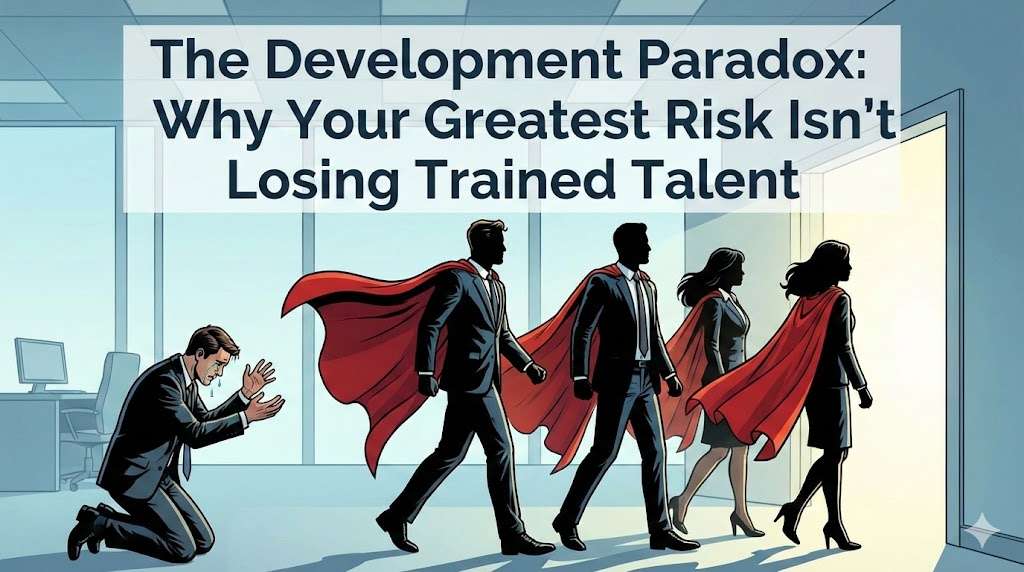

Many managers anchor their development decisions on a single anxious question: What if we invest heavily in developing top performers and they leave?
This question reveals a dangerous miscalculation of organizational risk.
The question that should keep leadership awake: What if we fail to develop our people, and they stay?
This is the heart of the development paradox. The cost of the employee who leaves is easy to see. The cost of the underdeveloped employee who stays goes uncounted, year after year.
Yu-kai Chou, creator of the Octalysis Framework and pioneer of behavioral design, has worked with Google, Microsoft, Tesla, LEGO, and hundreds of other organizations on employee engagement systems. His work consistently reveals a pattern: Organizations that master development through scientifically grounded motivation design don’t just retain talent better. They transform their competitive position. Meanwhile, those that underinvest in development create what he calls “stagnation debt”: a compounding organizational liability that never appears on balance sheets but quietly destroys value.
⚡ Speed Run Notes
- “What if I train them and they leave?” is the wrong question. “What if I don't train them and they stay?” is the right one. Untrained employees stay because they cannot leave. That is not loyalty — it is structural captivity. The cost of keeping them is higher than the cost of losing trained ones.
- Training is the clearest possible signal of CD4 (Ownership) that an employer can send. It says “we are investing in you, not just renting you.” That signal builds the kind of loyalty no bonus can buy — which is the answer to the training-versus-retention paradox.
- The employees who leave after training are not the losers — they are the marketing department. Alumni with good experiences become the employer's best recruiters. Every trained employee who leaves happy tells their next 10 colleagues to apply. Training is acquisition cost for the next generation.
- The companies that refuse to train are the ones that need training the most. Their teams get progressively less capable over time while the industry advances. The gap becomes unclosable within 5 years. Refusing to train is a slow-motion bankruptcy of capability.
- The deepest insight: training is not an HR expense — it is a culture signal that determines the top end of who will work for you. Top performers filter for employers who invest in their growth. Skip the training line item and you silently cap the quality of your future hires.
Table of Contents
- The Hidden Catastrophe: When Underdeveloped Employees Stay
- Why Traditional Development Programs Systematically Fail
- Understanding Motivation: The Octalysis Framework
- The Critical Spatial Dynamics
- Where Core Drive 2 Fits: The Development Engine
- The Science-Based Alternative: Balanced Motivational Architecture
- Strategic Use of Black Hat Drives (When Appropriate)
- The Data Speaks: Quantified Returns on Behavioral Design
- The Strategic Imperative
Author Credibility: Yu-kai Chou

Yu-kai Chou created the Octalysis Framework after studying gamification since 2003 — years before the term entered mainstream vocabulary. As a Human-Systems Architect & Behavioral Designer, his framework has been applied by LEGO, Microsoft, Porsche, Coca-Cola, Salesforce, and MrBeast, impacting over 1.5 Billion Users.
Chou has taught the Octalysis methodology at Harvard, Stanford, Yale, Tesla, Google, BCG, and IDEO.
His work has been cited by Harvard, Stanford, MIT, Forbes, Wall Street Journal, Wired, US Department of Energy, NIST, NSF, NCBI, US Department of Education, ClinicalTrials.gov, and Google Scholar — with 3,700+ more academic publications. Explore his books here.

The Hidden Catastrophe: When Underdeveloped Employees Stay
When competitive advantage comes from people rather than capital assets, failing to invest in employee development is organizational malpractice.
Consider the actual failure mode: An organization that underinvests in development doesn’t simply plateau. It enters active regression relative to market evolution. Competitors are developing their talent. The industry is advancing. Customer expectations are accelerating. Meanwhile, an underdeveloped workforce falls further behind market expectations with each passing quarter.
The result is structural damage. The organization becomes populated by people who are simultaneously disengaged (because they recognize the stagnation) and trapped (because their skills haven’t kept pace with external market demands).
The data validates this pattern across industries:
- Companies using behaviorally designed employee engagement systems see productivity increases of up to 50% and engagement improvements of 60%
- Organizations that invest in proper development architecture achieve turnover reductions of 45%
- When The Octalysis Group designed gamified performance systems for Navo Orbico (a major FMCG distributor), sales increased 28.6% and activity KPIs rose over 60%, with 99.5% employee participation
Yet most executives still approach development with a flawed ROI calculation, asking: “What if we train them and they leave?” The catastrophic scenario they’re missing: “What if we don’t develop them and they stay? Undermining culture, blocking opportunities for others, destroying value?”
Why Traditional Development Programs Systematically Fail
After analyzing thousands of gamification implementations across 90+ documented case studies, The Octalysis Group has identified a consistent failure pattern in how organizations approach employee development.
Traditional HR programs fail because they rely almost exclusively on superficial game mechanics: points, badges, leaderboards. They ignore the underlying psychological architecture that actually drives human behavior. As documented in implementations with SAP, Cisco, and Microsoft, simply adding game elements without behavioral science foundations insults users and creates what amounts to “engagement theater.”
The typical failure sequence follows predictable stages:
Flawed ROI Analysis: Finance calculates narrow training costs versus predicted retention rates, applies discount rates to uncertain future returns, and concludes investment doesn’t clear hurdle rates.
Strategic Paralysis: Unable to predict which employees will respond to development opportunities (because they lack a behavioral framework), executives decide not to invest systematically.
Adverse Selection: Top performers either leave for better development opportunities elsewhere. Or worse, they stay and become disengaged, spreading cynicism through the organization.
Black Hat Desperation: In panic, leadership implements retention mechanisms rooted in fear and scarcity: non-compete clauses, deferred bonuses, golden handcuffs, vesting schedules designed to trap.
Backfire: These punitive approaches create resentment. The best employees will often take the sunk cost and leave anyway, while mediocre employees stay trapped. Exactly the inverse of what’s needed.
This pattern has destroyed engagement in dozens of organizations. Many eventually engaged The Octalysis Group to rebuild their motivational architecture from behavioral science foundations.
Understanding Motivation: The Octalysis Framework

To design development systems that actually work, organizations must first understand what drives human behavior at a foundational level. This is why Yu-kai Chou created the Octalysis Framework, after analyzing thousands of successful and failed gamification implementations across gaming, education, enterprise, and consumer applications.
The framework identifies Eight Core Drives that motivate all human action. These aren’t arbitrary categories. They are fundamental psychological forces identified through decades of behavioral research and validated across thousands of real-world implementations:
Core Drive 1: Epic Meaning & Calling
The drive to be part of something greater than oneself, to contribute to a cause or narrative larger than individual benefit.
Core Drive 2: Development & Accomplishment
The drive to make progress, develop skills, overcome challenges, and achieve mastery. This is the internal drive that makes learning and growth inherently satisfying.
Core Drive 3: Empowerment of Creativity & Feedback
The drive to engage in creative processes, express oneself uniquely, and see the results of creative choices through immediate feedback.
Core Drive 4: Ownership & Possession
The drive to own, control, and improve something: physical objects, virtual goods, processes, or ideas. We value what we feel we own.
Core Drive 5: Social Influence & Relatedness
The drive to connect with, compete with, cooperate with, and be recognized by others. This encompasses mentorship, social acceptance, companionship, and competition.
Core Drive 6: Scarcity & Impatience
The drive to want something because it’s rare, exclusive, or difficult to obtain. The psychology of wanting what we can’t immediately have.
Core Drive 7: Unpredictability & Curiosity
The drive to discover the unknown, solve mysteries, and engage with variable outcomes. This is why gambling and surprise mechanics are so compelling.
Core Drive 8: Loss & Avoidance
The drive to avoid negative consequences, prevent loss, and maintain what we already have. The motivation to avoid losing progress or status.
The Critical Spatial Dynamics
These Core Drives aren’t just a list. Their positioning reveals behavioral dynamics that determine whether systems create sustainable engagement or inevitable burnout:
White Hat vs. Black Hat
Core Drives 1, 2, and 3 occupy the top of the Octalysis octagon. These are White Hat motivators. They make people feel powerful, fulfilled, creative, and in control. They create positive emotional experiences and can sustain engagement indefinitely without negative consequences.
Core Drives 6, 7, and 8 occupy the bottom. These are Black Hat motivators that create urgency, obsession, and fear-driven action. They’re highly effective for short-term behavioral change, but overuse inevitably leads to anxiety, stress, and burnout.
The strategic implication for employee development is significant. Systems built primarily on Black Hat drives (scarcity of opportunities, fear of being left behind, anxiety about job security) will generate short-term compliance but long-term resentment and turnover.
Left Brain vs. Right Brain
Core Drives on the left side (2, 4, 6) are extrinsic motivators driven by external goals, logic, analytical thinking, and tangible outcomes. These are about achieving clear, measurable objectives.
Core Drives on the right side (3, 5, 7) are intrinsic motivators centered on creativity, self-expression, social connection, and the inherent satisfaction of the activity itself.
The strategic implication: Development systems that rely exclusively on extrinsic rewards (certifications, titles, compensation bumps) miss the intrinsic motivators that create genuine engagement and sustained behavior change.
Where Core Drive 2 Fits: The Development Engine
Core Drive 2: Development & Accomplishment sits in the upper left of the octagon. It’s simultaneously White Hat (feels good, empowering, fulfilling), extrinsic (triggered by external challenges and measurable progress), and long-term oriented (doesn’t create burnout with sustained use).
This positioning is why Core Drive 2 is foundational to employee development. But it’s also why it’s insufficient alone. A strategic advantage: Excessive activation of Core Drive 2 will not cause burnout, whereas over-reliance on Black Hat drives (6, 7, 8) inevitably does.
When DreamsCloud implemented visible progress mechanics rooted in Core Drive 2 designed by The Octalysis Group, they grew from 2,000-4,000 weekly visitors to over 280,000 weekly visitors (1+ million monthly), with 60% of newly registered users recording a dream within 12 hours. But the sustainability came from balancing it with other White Hat drives.
The Science-Based Alternative: Balanced Motivational Architecture
Effective employee development requires orchestrating multiple Core Drives across the White Hat spectrum while strategically incorporating intrinsic Right Brain motivators. Here’s how The Octalysis Group architects complete development systems:
Core Drive 1: Epic Meaning & Calling
Connect individual development to organizational mission and societal impact. When employees see how their growth contributes to something larger than themselves, engagement deepens dramatically.
Implementation: Link skill development explicitly to strategic initiatives. Show how individual capabilities enable team and organizational goals. Consider allowing earned rewards to support causes employees care about. Converting achievement points to charitable donations reinforces that their development serves purposes beyond self-interest.
Core Drive 2: Development & Accomplishment
Make progress visible and meaningful. Employees need clear paths to mastery, with achievement milestones that trigger dopaminergic reward systems in the brain, the same neurochemistry that makes learning inherently satisfying.
Implementation: Progressive skill levels with transparent criteria. Mastery badges for genuine competencies, not participation trophies that insult intelligence. Real-time feedback on improvement. Status recognition that reflects actual capability growth, not tenure or politics.
This is the core drive most organizations attempt to activate, but they do it superficially. Points and badges without real skill progression create cynicism, not engagement.
Core Drive 3: Empowerment of Creativity & Feedback
Give employees real autonomy to shape their development paths. IBM research shows CEOs rate creativity as the most crucial factor for organizational success, yet most development programs are rigid, prescribed curricula that kill creative agency.
Implementation: Allow customization of learning journeys. Provide multiple pathways to the same competency. Create opportunities for employees to contribute to training content. Turning learners into teachers activates both Core Drive 3 (creative expression) and Core Drive 4 (ownership). Establish rapid feedback loops that fuel creative momentum rather than annual reviews that kill it.
As Frederic Laloux documents in Reinventing Organizations, companies that shift from centralized, prescribed development to empowered, self-directed learning outperform traditional hierarchical structures. The pattern is clear: distributed intelligence operating with local knowledge makes better development decisions than centralized planning operating on aggregated abstractions.
This connects directly to Self-Determination Theory: autonomy, competence, and relatedness are fundamental psychological needs.
When organizations design for those needs rather than relying on extrinsic rewards alone, they see higher engagement, reduced turnover, and greater innovation.
Core Drive 4: Ownership & Possession
Create real ownership over development outcomes. Organizations offering stock options see 3.8% year-over-year performance increases because employees with ownership think and act differently. They optimize for long-term value creation rather than short-term compliance.
Implementation: Let employees and teams set their own success metrics, with leadership providing strategic context and constraints but not dictating the specific measurements. Give ownership of projects that apply newly developed skills. Create “earned” privileges or responsibilities that come with skill mastery, not arbitrary title promotions, but real authority over domains where competence has been proven.
This is where decentralization becomes powerful. When Core Drive 4 (Ownership) pairs with Core Drive 3 (Empowerment of Creativity), systems emerge where people naturally gravitate toward developing skills that are simultaneously personally meaningful and organizationally valuable.
Core Drive 5: Social Influence & Relatedness
The quality of workplace relationships is one of the strongest predictors of engagement and retention. People have fundamental needs to connect with, learn from, and influence others.
Implementation: Cohort-based learning that builds peer relationships. Mentorship programs that satisfy both the mentor’s need for social influence and the mentee’s need for relatedness. Team challenges that require collaboration across skill levels. Public recognition that reinforces both individual achievement and contribution to collective success.
When The Octalysis Group designed social learning mechanics for Microsoft Learn, engagement metrics improved significantly because learning became a shared experience rather than isolated curriculum completion.
Strategic Use of Black Hat Drives (When Appropriate)
While White Hat drives create sustainable engagement, there are moments when Black Hat drives serve strategic purposes, if used sparingly and intentionally:
Core Drive 6: Scarcity & Impatience can create urgency around limited enrollment in high-value development programs or time-limited opportunities to apply for stretch assignments.
Core Drive 7: Unpredictability & Curiosity can make learning paths more engaging through surprise rewards, unexpected mentorship opportunities, or variable recognition systems.
Core Drive 8: Loss & Avoidance should be used minimally in development contexts, but can include elements like “use it or lose it” development budgets or skill certifications that require renewal to maintain.
The key is balance. Black Hat drives create intensity and urgency; White Hat drives create sustainability and fulfillment. Over-indexing on either creates imbalance that undermines long-term outcomes.
The Data Speaks: Quantified Returns on Behavioral Design
The results from The Octalysis Group’s implementations across industries validate this complete approach:
- Employees in properly designed gamified learning environments show 48% higher engagement
- Behaviorally designed development systems increase productivity by up to 50%
- Companies using Octalysis-based employee engagement see turnover reduction of up to 45%
- Navo Orbico’s sales staff engagement platform led to 28.6% more revenue and 59%+ higher KPIs, with 99.5% participation
- Caixa Bank’s implementation increased yearly profits by $1.06 billion (46% lift), elevating them from #2 to #1 public bank in Brazil, with 92% employee engagement across 76,000 employees
- A hotel chain saw 712% uplift in sales through Octalysis behavioral design
- A major airline’s loyalty program achieved 175% performance enhancement
- DreamsCloud grew from 2,000-4,000 weekly visitors to over 280,000 weekly visitors (1+ million monthly) with 60% of newly registered users taking action within 12 hours
- BitDegree saw 350% increase in course completion and 50% reduction in completion time
Specific engagement and retention improvements vary by industry, culture, and implementation quality. The figures cited are aggregated outcomes observed across multiple consulting and case contexts rather than guarantees. These results only materialize when organizations move beyond superficial point-and-badge thinking to complete behavioral design rooted in human psychology. As documented across over 90 case studies, systems that activate only one or two Core Drives create temporary spikes followed by inevitable decline. Sustainable engagement requires orchestrating all Eight Core Drives in strategic balance.
The Strategic Imperative
Stop asking whether you can afford to develop employees who might leave. Start asking whether you can afford not to develop employees who will stay. Undermining culture, blocking growth opportunities for others, and creating the stagnation debt that compounds into organizational decline.
The organizations winning the talent war already know this: when human capability drives competitive advantage, motivational design built on behavioral science is the foundation of sustainable performance across all experience phases.
The Octalysis Group has spent over a decade refining the methodology that balances all Eight Core Drives to create development experiences that feel meaningful, empowering, and sustainable. This is behavioral science applied to the most important organizational asset: people.
The question isn’t whether to invest in development. It’s whether leadership has the strategic courage to build an organization that develops people so effectively they could succeed anywhere. And they choose to stay because nowhere else offers the same trajectory.
That’s not a liability to be managed through golden handcuffs and non-competes. That’s the definition of sustainable competitive advantage in the capability economy.