

10K HP Step 4: Enhance Your Skills With a Skill Stack

My longtime friend Jun Loayza’s favorite game in the ’90s was Dragon Ball GT Final Bout.
It had a training mode where you leveled up a fighter and then brought it into battles against your friends.
His friends leveled every stat evenly to build well-rounded fighters.
Jun figured out a trick: he leveled up a single attack over and over until it could finish an opponent in one hit.
That strategy works in a game with one opponent type and fixed rules.
Real life changes the rules constantly, so a single maxed-out skill usually gets you cornered the moment the situation shifts.
Step 4 is about building a skill stack that still works when the rules change.
Last updated:
Speed Run Notes
- Step 4 of 10,000 Hours of Play (10K HP) is building skills, which you can learn in months, on top of the Attributes you named in Step 2 and the Role you chose in Step 3.
- Betting everything on one skill leaves you stuck when your situation changes, so the strongest players build a small stack of skills that reinforce each other.
- Your Attributes set your learning speed and every hour has an opportunity cost, so plan which skills serve your Game before you start grinding.
- The OP (overpowered) Hero for this Step is Shohei Ohtani, who turned pitching and hitting into a single skill stack in a sport where players are expected to pick one.
- The starter exercise is a 30-minute Synergy Map that shows your natural skill stack and the one gap skill worth leveling up in the next 90 days.
In This Article
Author Credibility: Yu-kai Chou

Yu-kai Chou is the author of 10,000 Hours of Play — the book that treats your life as the most important game you’ll ever build a character in, and gives you the 6-Step framework (Game · Attributes · Role · Skills · Allies · Quests) to play it on purpose. He has spent two decades developing the system this series teaches, and applies it to his own life and to the lives of the people he advises around the world.
Chou’s other framework, the Octalysis Framework, has been applied by LEGO, Microsoft, Porsche, Coca-Cola, Salesforce, and MrBeast, impacting over 1.5 Billion Users. He has taught the methodology at Harvard, Stanford, Yale, Tesla, Google, BCG, and IDEO, and has advised governments in eight nations including Ukraine, the United Kingdom, the Kingdom of Bahrain, Singapore, Taiwan, the Netherlands, Kazakhstan, and South Korea.
His work has been cited by Harvard, Stanford, MIT, Forbes, Wall Street Journal, Wired, US Department of Energy, NIST, NSF, NCBI, US Department of Education, ClinicalTrials.gov, and Google Scholar — with 3,700+ more academic publications. Explore his books here.

My own strongest skills once pointed toward a business my Game did not need, so I know how easy this mismatch is to miss. This Step helps you catch it before it costs you years.
Specialists, dabblers and stackers
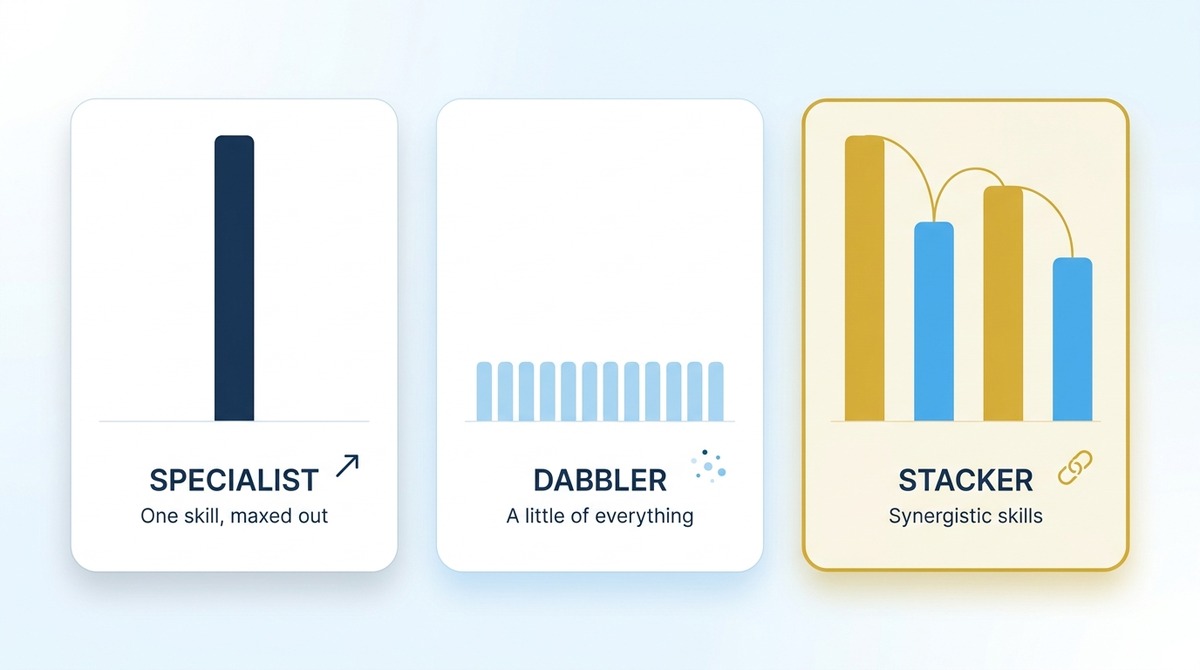
In Step 4, I think of skills on a spectrum.
At one end is the Specialist, who masters one narrow thing, like a chess player who only knows one opening and collapses when the opponent avoids it.
At the other end is the Dabbler, who picks up a little of everything and never gets good enough at any of it to matter.
The players who win sit in between and build a skill stack.
A skill stack is a small set of synergistic skills in which each one makes the others stronger.
Final Fantasy VII made this concrete with its Materia system.
Linking the “Restore” Materia with “All” let one Cure spell heal the whole party, which neither piece of Materia could do on its own.
Real-life skills combine the same way: persuasion plus data analysis makes a much stronger product manager than either skill alone.
Three rules make this practical when you plan your own skills.
- Skills are something you learn through practice. Nobody is born knowing SEO or contract law, and most skills take months, while Attributes take years.
- Your Attributes set how fast you learn each skill. A skill that sits on top of your Edge from Step 2 will level up far faster than one that fights your natural wiring.
- Every hour you spend on a skill has an opportunity cost. Three years spent learning a language you will never use for your Game is an expensive hobby, so plan before you grind.
In the book: The Skills chapter teaches how to build your Current Skill Triangle and your Target Skill Triangle, how to close the gap between them, and introduces Real-Life Game Skills, organized by role-playing game (RPG) classes like Warrior, Mage, Rogue and Paladin. It also breaks down how Elon Musk stacked engineering, business and leadership skills across different industries.
Get 10,000 Hours of Play and register your order at 10KHP.com to claim the 10K HP Academy, which comes free with the book.
OP Hero: Shohei Ohtani and the two-way skill stack
Professional baseball has a long-standing unwritten rule: you pitch or you hit, and you specialize.
Shohei Ohtani refused to accept that rule for himself.
In his first year of high school, he wrote his goals into a nine-by-nine chart, with the goal of being picked in the first round by eight teams in the center and eight supporting areas around it, including body building, control, mental strength, pitch speed and even “luck,” which he broke down into small habits like picking up trash and greeting people.
Looked at closely, the chart describes a set of skills that support one another.
Each box feeds the others: the strength training that adds velocity to his pitching also adds power to his swing, and the recovery habits that keep his arm healthy also keep his legs fast.
He is famously protective of his sleep and recovery because they serve both halves of his game at once.
The result is one of the strangest stat lines in sports history.
In 2024, he became the first player in Major League Baseball to hit 50 home runs and steal 50 bases in the same season, finishing with 54 and 59, after years as an elite starting pitcher.
For years, experts said he would eventually have to choose one, but his skills reinforced each other enough that he never did.
His full six-Step run is in his OP Hero profile.
How I learned this the hard way
In 2008, my strongest skills were coaching, networking and leadership, all built on top of my people-reading Attributes.
That stack would have been perfect for a one-on-one coaching business.
My Game, though, was to make important activities enjoyable and enjoyable activities productive at the largest scale I could reach, which required a different stack: designing gamified experiences, writing persuasively, and presenting ideas to large audiences.
I had to deliberately level up skills I was weak at, because the skills I already had pointed toward a Role I did not want.
That gap between the skills you have and the skills your Game needs is the most useful thing to discover in Step 4.
Starter exercise: the Synergy Map
This takes about 30 minutes and works best on paper.
- List 10 to 15 skills you already have. Include unusual ones: negotiating, editing video, calming angry customers, Excel, public speaking, cooking for large groups.
- Draw a line between any two skills that make each other stronger. Writing and public speaking, for example, or data analysis and storytelling.
- Count how many lines touch each skill. The skills with the most connections form your natural stack. Skills with zero lines are hobbies for now, which is fine as long as you know it.
- Find out what your Role actually requires. Look up ten job postings or bios of top people in the Role you chose in Step 3. Tally the skills that show up repeatedly.
- Pick one gap skill to level up in the next 90 days. Choose the one that connects to the most skills you already have, because it will compound fastest.
Common questions about Step 4
What is a skill stack?
A skill stack is a small group of skills that make each other more valuable, so together they do work that none of them could do alone.
In 10,000 Hours of Play (10K HP), building one is Step 4, and it keeps you from getting cornered when the rules of your situation change.
Should you specialize or learn many skills?
In Step 4, I place skills on a spectrum, with the Specialist who masters one narrow thing at one end and the Dabbler who learns a little of everything at the other.
The strongest position is in between: a few skills that strengthen each other, the way persuasion plus data analysis makes a much stronger product manager than either skill alone.
How do I choose which skill to learn next?
List the skills you already have, draw a line between any two that make each other stronger, and compare the result with what the Role you chose in Step 3 actually requires.
Then pick the one gap skill that connects to the most skills you already have, because it will compound fastest. The book teaches the full Current and Target Skill Triangle method for this decision.
How did Shohei Ohtani build his skill stack?
Ohtani planned his skills as one connected set, starting with a first-year high school goal chart in which body building, control and mental strength all served a single central goal.
His 2024 season was the first in Major League Baseball history with 50 home runs and 50 stolen bases, and he had already spent years as an elite starting pitcher.
Take the next step in your 10K HP journey

This post gives you the starting move for Step 4.
The book gives you the complete Skill Triangle method, the Real-Life Game Skills system, the Elon Musk breakdown, and the rest of the six Steps.
- Get the book. 10,000 Hours of Play is available on Kindle, paperback, hardcover and audiobook.
- Register your order at 10KHP.com to claim the 10K HP Academy: the workbook, the Play Life Like an RPG video course, two months of live Mastermind calls with my co-author Mark Diaz, the Level Up In Real Life Sheet, and a guide to setting up your own 10K HP AI coach.
The Academy comes free with any format of the book. If you already bought it on Amazon, you can register today with the order number from your receipt.
Sources
The hero facts on this page come from these sources, each checked in October 2026.
- Nippon.com: High School Days: Ohtani Shohei and Hanamaki Higashi Manager Sasaki Hiroshi, for the nine-by-nine goal chart.
- Wikipedia: Shohei Ohtani, for his 2024 season of 54 home runs and 59 stolen bases and his two-way career.
- Sports Illustrated: Shohei Ohtani and his sleep habits, for how protective he is of his sleep.
Next in the series: Step 5: Build Your Alliances (Network)