
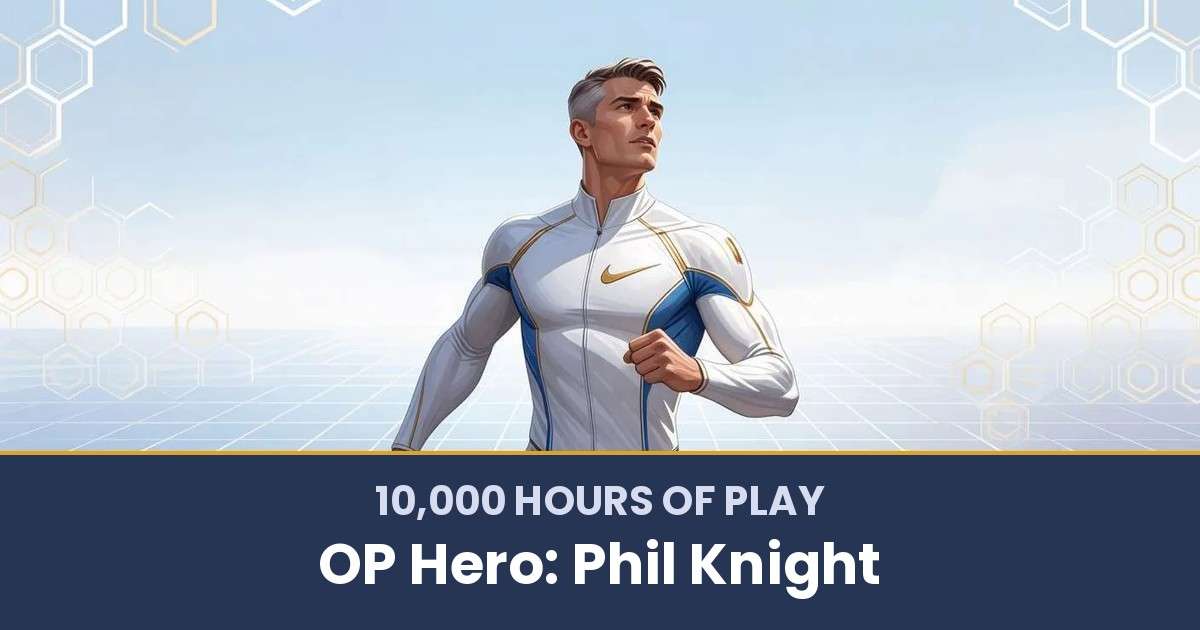


In late 1962, a broke 24-year-old Oregon kid walked into the Onitsuka Tiger factory in Kobe, Japan, and pitched American distribution rights for a company that did not exist. When the executives asked the company’s name, he made one up on the spot: Blue Ribbon Sports of Portland, Oregon. He had no inventory, no warehouse, and no investors. He had a Stanford term paper and a willingness to bluff.
Sixty years later, that bluff is worth more than $200 billion at retail. Nike has paid Michael Jordan more in royalties than the entire NBA paid him in salary. The swoosh is on more feet than any logo in human history.
This is not a story about shoes. It is the cleanest entrepreneurial run we have on tape of a normal-talent operator who treated his life as one long, deliberate game and refused to put down the controller. Through the 10,000 Hours of Play lens, Phil Knight’s character sheet is the textbook for anyone who has more grit than gift and is wondering whether that is enough. It is.
⚡ Speed Run Notes
- Phil Knight was a middling miler at Oregon, not a prodigy. His OP build is the proof that obsessive competitiveness plus a long-form Quest can out-compound raw talent over a 60-year arc.
- The Game he chose was never “sell shoes.” It was “use a company as the arena where I get to compete against the best in the world, forever.” Every weird decision Nike ever made comes downstream of that.
- His core Skill stack is Paladin and Warlock heavy: Courageous Heart for the 1962 Onitsuka cold-pitch, Sacrificial Cycle for the 1975 cash crunch, Bind Fate for the Air Jordan deal, Phoenix Rebirth for the 1997 sweatshop reckoning.
- His Allies — Bowerman, Jeff Johnson, Penny, Strasser, Vaccaro, Wieden, Tinker Hatfield — were not hires. They were a permanent party of weirdos he refused to fire even when conventional advice screamed at him to clean house.
- The lesson worth stealing: pick a Game long enough that your unfair advantages have time to compound. Then keep showing up for 14 years before the world notices.
Table of Contents
- About Yu-kai Chou
- Step 1: The Game — What Phil Knight Was Actually Playing
- Step 2: Attributes — The Innate Stats
- Step 3: Role(s) — The Character Class Across Chapters
- Step 4: Skills — The Real-Life Game Skills Phil Knight Mastered
- Step 5: Allies — The People Who Multiplied Phil Knight
- Step 6: Quests — The Milestones That Shaped the Saga
- What You Can Steal From Phil Knight’s Build
- Where this framework comes from
- Related Reading
About Yu-kai Chou

Yu-kai Chou is the author of 10,000 Hours of Play — the book that treats your life as the most important game you’ll ever build a character in, and gives you the 6-Step framework (Game · Attributes · Role · Skills · Allies · Quests) to play it on purpose. He has spent two decades developing the system through which this post analyzes its OP Hero, and applies it to his own life and to the lives of the people he advises around the world.
Chou’s other framework, the Octalysis Framework, has been applied by LEGO, Microsoft, Porsche, Coca-Cola, Salesforce, and MrBeast, impacting over 1.5 Billion Users. He has taught the methodology at Harvard, Stanford, Yale, Tesla, Google, BCG, and IDEO, and has advised governments in eight nations including Ukraine, the United Kingdom, the Kingdom of Bahrain, Singapore, Taiwan, the Netherlands, Kazakhstan, and South Korea.
His work has been cited by Harvard, Stanford, MIT, Forbes, Wall Street Journal, Wired, US Department of Energy, NIST, NSF, NCBI, US Department of Education, ClinicalTrials.gov, and Google Scholar — with 3,700+ more academic publications. Explore his books here.
What I personally find instructive about Phil Knight’s build is that he was the least gifted person at his own table. Bowerman was the inventor. Strasser was the dealmaker. Jordan was the icon. Wieden was the storyteller. Knight’s superpower was choosing a Game so long that the only person in the league who could outlast him was himself. If you have ever felt like the dumbest person in your own company, study his Phoenix Rebirth — and steal his Sacrificial Cycle while you’re at it.
Step 1: The Game — What Phil Knight Was Actually Playing
Most founder profiles will tell you Phil Knight’s Game was “build the world’s biggest athletic brand.” That is the score at the end of the match, not the Game.
The actual Game, in his own words from Shoe Dog: “We wanted, as all great athletes do, to leave a mark. We wanted to win. No, that’s not right. We didn’t simply want to win, we couldn’t bear the thought of losing.”
Read that twice. The objective function is not winning. It is the avoidance of losing. Loss-aversion as a life mission produces a very different operator than ambition as a life mission.
Knight was using a company as the arena where a non-prodigy middle-distance runner from Oregon could keep competing against the best in the world after his legs gave out. Adidas was the four-minute miler he could never catch on the track. Now they were a corporate target he could chase for the next four decades — and he did, with patience that bordered on stalking.
The reason this matters for your own build: most people pick a Game that is too short. “Make a million dollars.” “Get the promotion.” “Launch the thing.” These are achievement loops, not lifelong Games. Knight picked a Game so big that 14 years of struggle and a near-bankruptcy were not failure conditions — they were the early levels.
Step 2: Attributes — The Innate Stats
Knight rolled the dice on five Attributes that were visible long before Nike existed. They are not learnable. They are temperament.
Obsessive competitiveness. Coach Bill Bowerman called him “a good man in a pinch” at Oregon. Knight was never a national-class runner. But teammates remember him as the one who could not stand losing a workout, a card game, or a bar bet. That baseline did not improve. It just scaled.
Risk tolerance bordering on reckless. Most Stanford MBAs in 1962 went to Procter & Gamble. Knight bought a round-the-world plane ticket and pitched a non-existent company to Japanese executives. The same risk-temperature kept Blue Ribbon perpetually one bad month from insolvency through the 1970s, on purpose, because slowing growth felt worse than dying.
This is the Attribute most often misread in his story. The flip side of your Talent Triangle’s edge strength is the temperament that lets you stomach the downside it costs you. Knight could sleep at night with the company two payrolls away from collapse. Most operators cannot. That gap is not strategy. That is wiring.
Contrarian streak. His Stanford term paper argued Japanese manufacturers would do to Adidas and Puma what Nikon and Canon had done to Leica and Zeiss. His professor called it a “Crazy Idea.” Knight took the label as a compliment and used it as the title of his memoir’s opening chapter.
Loyalty to “his people.” Knight kept hiring Oregon runners, weirdos, and eccentric obsessives for decades. Jeff Johnson — Nike’s first full-time employee — wrote 6-page single-spaced letters from his Wellesley sales territory that Knight rarely answered, and Knight kept him anyway. That tribal loyalty became Nike’s hiring filter long before “culture fit” was a phrase anyone said out loud.
Narrative wiring. Knight studied journalism at Oregon before he studied business at Stanford. He frames every chapter of his life as a quest, a near-death, and a comeback. That habit later became Nike’s brand voice. Companies that win on story are usually run by founders who think in story.
Step 3: Role(s) — The Character Class Across Chapters
One of the easiest mistakes in life design is to think your character has one Class. Knight’s run shows the opposite. He respec’d his Role four times across 60 years, each one demanded by the size of the Quest in front of him.
1955–1962. The Middle-Distance Athlete. Mediocre miler, hungry student, journalism major. The Role taught him what athletes actually need from a shoe — the seed insight Nike would compound for the next half-century.
1962–1980. The Scrappy Founder-Operator. CPA by day at Price Waterhouse and Coopers & Lybrand, accounting professor at Portland State at night, shoe importer on weekends, selling Tigers out of the trunk of a green Plymouth Valiant at track meets. This is the most under-studied era of his life. It is where the Sacrificial Cycle Skill got drilled.
1980–2004. The Public-Company CEO and Brand Steward. The 1980 IPO put Nike on a different game board. Now Knight had analysts, governance committees, a board, and the slow erosion of total control. He hated most of it and kept doing it anyway because the Game required the scale.
2004–present. The Art Patron, Philanthropist, and Storyteller. Stepped down as CEO in 2004, chairman in 2016. Endowed the Knight Cancer Institute at Oregon Health & Science University with a $500 million challenge gift in 2013, then added another $2 billion to the same institute in 2025. Donated over $2 billion to the University of Oregon and $400 million to Stanford for the Knight-Hennessy Scholars program. Wrote Shoe Dog in 2016, his clearest articulation of the Game he had been playing the whole time. The Role transfer is similar in shape to Joris Beerda’s late-career pivot: the operator becomes the storyteller of the operation.
Step 4: Skills — The Real-Life Game Skills Phil Knight Mastered
If you are new to the canon Real-Life Game Skills, the short version is that each Skill belongs to one of seven Classes — Warrior, Ranger, Mage, Rogue, Druid, Paladin, Warlock — and most operators only get truly fluent in three or four across a lifetime. Knight’s stack is concentrated in Paladin (resilience under public exposure) and Warlock (compounding leverage). For the long version of how to read the Skills map across your career, see the Skills Spectrum primer — Knight is the textbook Specialist who beats most Generalists.
Courageous Heart (Paladin). “Charge into uncomfortable zones, uncharted territory, hostile environments.” The 1962 Kobe pitch is one of the cleanest demonstrations on record. A 24-year-old with no Japanese, no inventory, and no company walked into a foreign factory and pitched American distribution rights, then invented the company’s name when asked. The factory bought it. Most people will not walk into the room when the company is real and they have practiced the deck.
Mastermind (Ranger). “Create, adapt, and execute complex plans.” Knight’s Stanford term paper laying out the Japan-vs-Germany shoe import thesis was the original campaign plan. He then ran that plan for 14 years before Nike existed as a brand, adapting at every step — Blue Ribbon as a side hustle, then a distributor, then a manufacturer, then a renamed brand after Onitsuka tried to cut him out in 1971. The plan never changed in spirit. The execution mutated constantly.
Sacrificial Cycle (Warlock). “Reinvest all resources back into the project.” Knight is the founder who put Sacrificial Cycle on the map. Every dollar Blue Ribbon earned went straight back into more inventory from Japan, then more Japanese inventory on top of that, deliberately staying one missed shipment away from a Bank of California margin call. The 1975 cash crunch — where Nike was technically insolvent and the FBI was investigating Knight for bank fraud — was Sacrificial Cycle pushed to its absolute outer edge. If you want to feel how this Skill compares to the more extreme self-leverage skills, the Lich Pact case study is the canon Warlock companion piece.
Bind Fate (Warlock). “Leverage someone else’s brand or resource to become powerful yourself.” In October 1984, Nike was a distant third in basketball. Sonny Vaccaro inside Nike argued they should put the entire basketball marketing budget behind one untested rookie. Knight, Vaccaro, and Rob Strasser pitched Michael Jordan a then-unheard-of signature shoe and royalty structure. Jordan signed. The Air Jordan launched in early 1985. Forty years later, the Jordan brand alone clears over $7 billion in annual revenue. Bind Fate is what happens when you correctly identify the one rising person whose brand will outgrow yours, and you tie yourself to them before the market catches up.
Loremaster (Druid). “Weave compelling, inspiring stories.” Knight did not write the “Just Do It” line. He hired Dan Wieden’s tiny Portland agency in 1982 and trusted Wieden to write it for him in 1988. The Skill was not copywriting. The Skill was recognizing the story Nike was telling about itself and protecting Wieden from internal pressure to dilute it. Loremaster is rarely the founder writing the lore. It is the founder choosing the right loremaster and then defending them.
Phoenix Rebirth (Paladin). “Recover from devastating failure and come back stronger.” The 1996–1998 sweatshop crisis was the worst chapter of Knight’s career. Nike’s overseas labor practices made the company a public villain. College students burned the swoosh on quads. Knight’s instinct was to fight the press. It did not work. In May 1998, he stood at the National Press Club in Washington and announced six new labor reforms — minimum age increases, OSHA-equivalent air quality, third-party monitoring. Critics said it was not enough. They were right. But Nike’s labor standards from 1998 onward became the industry baseline, and the company recovered its brand within five years. Phoenix Rebirth is the Skill of admitting publicly that the last five years of your run were the wrong build, then shipping the next version anyway.
Step 5: Allies — The People Who Multiplied Phil Knight
Knight’s party of Allies is unusually small and unusually long-lasting. He kept the same people around for 40+ years, even when the org charts said he should not.
Bill Bowerman. Knight’s Oregon track coach, Nike co-founder, and the inventor of the waffle sole he prototyped in his wife Barbara’s kitchen waffle iron in 1971. Bowerman supplied the engineering instinct Knight did not have. Knight supplied the company that let Bowerman’s tinkering ship.
Jeff Johnson. Blue Ribbon’s first full-time employee in 1965. Came up with the name “Nike” in a dream in 1971. Wrote those 6-page sales letters from Wellesley nobody answered. Built the first retail store, the first newsletter, and the first systematic mailing list. Every early Nike artifact has Johnson’s fingerprints on it.
Penny Knight. Phil’s wife and Blue Ribbon’s original bookkeeper. The unglamorous Ally who kept the books straight while Phil was on planes to Japan. Most founder profiles skip this one. They should not.
Rob Strasser. Nike’s marketing chief through the Air Jordan era. The bulldog who actually negotiated the Jordan deal in 1984 while Knight let him operate.
Sonny Vaccaro. The basketball super-connector who saw what Jordan would become before Jordan himself did. Knight’s superpower was hiring people whose conviction was higher than his own about a specific bet, then letting them swing.
Tinker Hatfield. Architect who became Nike’s most important shoe designer — Air Jordan III through XV, Air Max 1, Air Trainer. Hatfield was a former Oregon pole-vaulter Bowerman had coached. The Oregon-runner-family hiring filter compounded for decades.
Dan Wieden. Co-founder of Wieden+Kennedy, the Portland agency that wrote “Just Do It” in 1988. Knight gave Wieden creative autonomy almost no client of that scale gave their agency. The trust paid for itself a thousand times over.
Michael Jordan. Not a hire, but the Ally whose career trajectory Knight tied Nike’s brand to in 1984. The asymmetric upside of that one signature is hard to overstate.
Step 6: Quests — The Milestones That Shaped the Saga
Six Quests anchor the run, including one near-death and one near-disgrace. These are the gates Knight walked through that turned a “Crazy Idea” into Nike.
Quest 1 — The Japan Trip (1962). Round-the-world ticket on borrowed money. Walked into Onitsuka in Kobe. Invented Blue Ribbon Sports on the spot. Secured U.S. distribution rights for a $50 sample order. Without this quest, none of the others exist.
Quest 2 — The Birth of Nike (1971). Onitsuka tried to cut Blue Ribbon out and switch to another U.S. distributor. Knight pre-emptively launched his own brand: Nike, named by Jeff Johnson after the Greek goddess of victory. Bowerman’s waffle sole became the design signature. The lawsuit with Onitsuka dragged through 1973 and Knight won. Identity born under existential threat.
Quest 3 — The 1975 Cash Crunch (the near-death). Nike was insolvent on paper. Bank of California cut off the credit line. Knight’s bank-stretching financing practices triggered an FBI investigation for bank fraud. Knight raised an emergency line from a Japanese trading firm, Nissho Iwai, that saved the company. He came out of it convinced he needed permanent capital. That conviction set up Quest 4.
Quest 4 — The IPO (December 2, 1980). Nike went public ten days before Apple. Both stocks priced at $22. Knight hated giving up control but understood the Game required the war chest. The IPO funded the international expansion that turned Nike from a U.S. running brand into a global multi-sport company.
Quest 5 — The Air Jordan Deal (1984). See Skill 4 above. The single asset that, more than any other, defined Nike’s next 40 years.
Quest 6 — The Sweatshop Reckoning (1996–1998, the near-disgrace). Labor-practice exposés in Vietnam and Indonesia, the 1996 Life photo of a Pakistani boy stitching a Nike soccer ball, the Andrew Young report Nike commissioned that critics dismissed as a whitewash. Knight’s May 12, 1998 National Press Club speech announced six labor reforms and is now studied in corporate-responsibility courses as the inflection point where Nike pivoted from villain to industry standard-setter. It is the moment Knight’s Phoenix Rebirth Skill earned its keep.
What You Can Steal From Phil Knight’s Build
If you take only one thing from Knight’s character sheet, take this: he was not the most talented person at any table he ever sat at, and he won anyway, because he picked a Game with a 60-year horizon and refused to flinch.
Three concrete steals for your own build:
One. Pick a Game long enough that your unfair advantages have time to compound. Knight’s Talent Triangle was unspectacular on any single axis. Stretched across six decades, that same unspectacular triangle out-compounded every flashier competitor he had.
Two. Hire your party for life, not for the role. Bowerman, Johnson, Strasser, Wieden, Hatfield. Knight’s Allies stayed for 20, 30, 40 years. Loyalty is a compounding asset that does not show up on the balance sheet until decade three.
Three. Run the Sacrificial Cycle longer than is comfortable, but build a Phoenix Rebirth muscle in advance. You will need it. Knight survived 1975 because he had already practiced surviving 1971. He survived 1998 because he had already practiced surviving 1975. The Skill is built before the disaster, not during.
For more OP Hero teardowns through the same 6-Step framework, the full hub lives at the OP Hero Profiles index. New heroes get added weekly.
Where this framework comes from

Want the full system this profile is built on?
Every OP Hero piece runs through the same 6-Step framework from 10,000 Hours of Play: Unlock Your Real-Life Legendary Success. The book covers the full system, walks through Yu-kai’s own life run as the first applied case study, and gives you the worksheets to audit your own build.
Related Reading
- All OP Hero Profiles — the full 10K HP hub
- OP Hero: Elon Musk’s Life as a Game (10K HP Book Snippet)
- OP Hero: Kobe Bryant — The Mamba Mentality as a 10K HP Build Sheet
- OP Hero: Hayao Miyazaki — The Director Who Drew Worlds Worth Living In
- OP Hero: Hedy Lamarr — The Trophy Wife Who Built the Antennas of the 21st Century
- The OP Talent Triangle Method — find your edge strength