
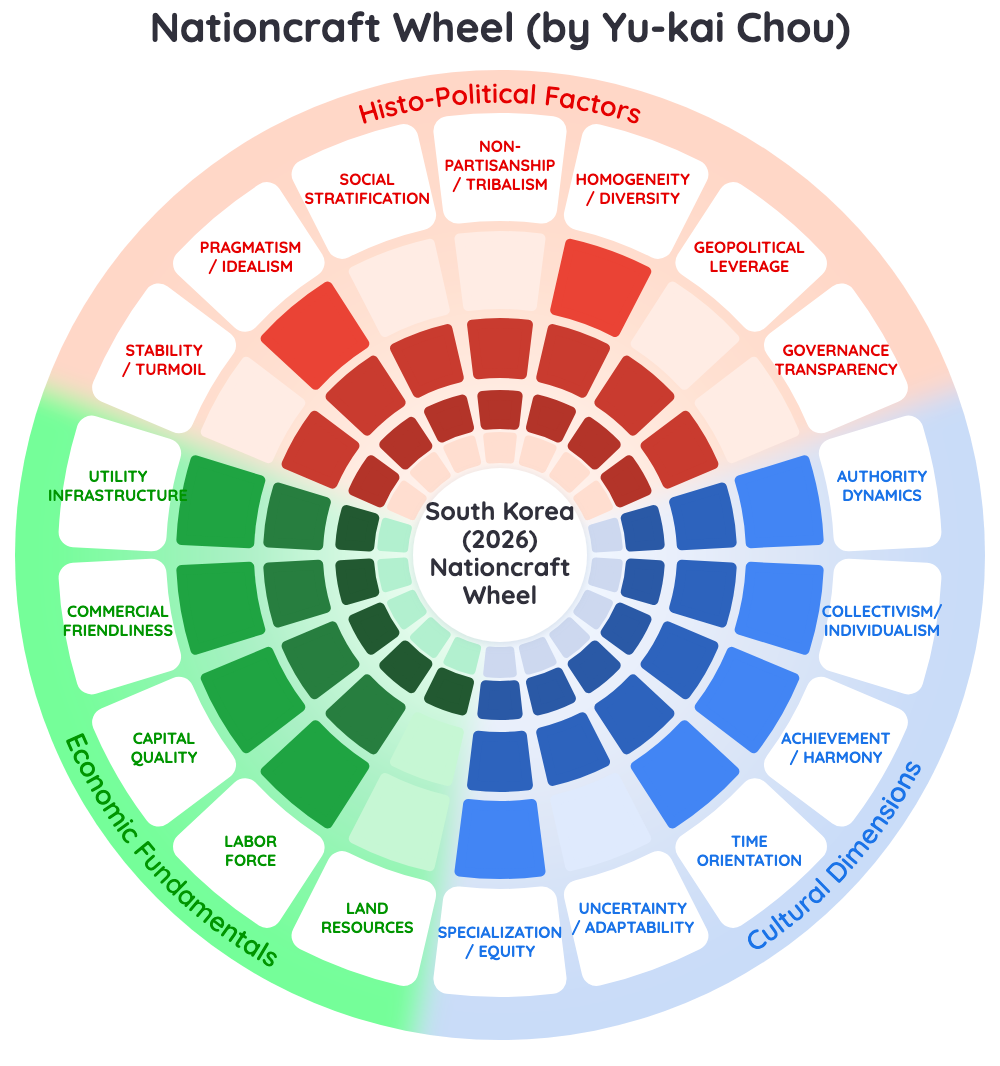

South Korea is the rare country that has run the full arc of an attempted self-coup in eighteen months and lived to argue about what to do next. On December 3, 2024, a sitting president declared martial law for six hours. The National Assembly voted 190–0 to lift it before the night was over. The Constitutional Court removed him 8–0 in April 2025. A new president was sworn in by June. The old president was sentenced to life in prison for insurrection in February 2026. And on May 8, 2026, a six-party constitutional amendment to require parliamentary approval before any future martial-law declaration was pulled from the plenary vote after a People Power Party filibuster.
That last sentence is where the Nationcraft question lives. If Korea survived the worst case, why does the obvious legislative repair keep getting blocked? Why is the country with the best-educated workforce, the deepest semiconductor capital base, the cleanest broadband infrastructure, and the highest sitting-president approval rating in modern Korean history struggling to close out a constitutional fix that six political parties already agree on?
The Nationcraft Framework gives a specific answer, and it is not the comfortable one. The V-vector that built modern Korea, V1=7 hierarchical authority, V2=9 collectivism, V4=9 long-horizon planning, V15/V16/V17/V18 all at 8, is the same V-vector that let Yoon Suk-yeol attempt the martial-law shortcut in the first place, and it is the V-vector that now traps the depolarization repairs Korean democracy needs. The deference Korea industrialized on now blocks the depolarization Korea needs. I am calling this The Post-Martial Trap.
The rest of this analysis is the Nationcraft case: which eight reformer playbooks Lee Jae-myung’s government should reject (including the one that built Park-era Korea), which three packets actually fit the 2026 V-vector, and what reform sequencing the framework recommends in the window between now and the next general election.
⚡ Speed Run Notes
- South Korea’s 2026 V-vector is 7-9-7-9-4-8-6-8-6-6-8-4-6-3-8-8-8-8. The high V1/V2/V4 and the strong V15-V18 are why Korea industrialized. The mid V7/V10 are why the country is now stuck.
- The Post-Martial Trap: the deference that built Park-era Korea produced Yoon’s six-hour martial law, and now blocks the constitutional amendment six parties already agree on.
- Korea must reject eight reformer playbooks, starting with its own Park Chung-hee Industrialization Packet (SP-008). The engine is already built; the V1 ceiling that built it is now the bottleneck.
- The three fit packets: SP-017 Post-Franco Spain, SP-010 Post-WWII Japan, SP-015 Wirtschaftswunder Germany. All solved post-authoritarian depolarization plus civilian-military control on Korea’s V-vector shape.
- Sequencing the framework recommends: martial-law-limit amendment first, then the two 4-year-term reform, then chaebol restructuring. Reverse that order and V10 polarization eats the program before it ships.
Table of Contents
- Understanding South Korea’s Governance Landscape Through Nationcraft
- What is the Nationcraft Framework?
- Why This South Korea Variables Analysis Matters
- The 18 South Korea Nation Variables (2026)
- The Post-Martial Trap, Named
- Detailed Justifications: V1–V18
- Strategic Implications for Lee Jae-myung’s Reform Window
- Eight Reformer Playbooks South Korea Should Reject
- Three Reformer Playbooks South Korea Should Actually Study
- Sequencing Logic: What Lee Should Do First, Second, Third
- Comparative Context, UK, Venezuela, Thailand
- The Nationcraft Framework in Practice
- Explore More Nationcraft Analyses
- Related Reading
- Frequently Asked Questions
- Footnotes
About Yu-kai Chou

Yu-kai Chou is a Human-Systems Architect & Behavioral Designer and the creator of the Nationcraft Framework, an 18-variable diagnostic for matching a country’s structural profile to the reform packets that have historically worked under similar conditions. He has consulted for governments in eight nations, including Ukraine, the United Kingdom, the Kingdom of Bahrain, Singapore, Taiwan, the Netherlands, Kazakhstan, and South Korea, and has worked directly with President Zelenskyy’s team on post-war reconstruction priorities for Ukraine.
Chou’s prior framework, the Octalysis Framework, has been applied by LEGO, Microsoft, Porsche, Coca-Cola, Salesforce, and MrBeast, impacting over 1.5 Billion Users. He has taught the methodology at Harvard, Stanford, Yale, Tesla, Google, BCG, and IDEO.
His work has been cited by Harvard, Stanford, MIT, Forbes, Wall Street Journal, Wired, US Department of Energy, NIST, NSF, NCBI, US Department of Education, ClinicalTrials.gov, and Google Scholar — with 3,700+ more academic publications. Explore his books here.

This South Korea analysis builds on direct advisory work with senior reform-minded Korean officials and applies the Nationcraft Framework to one of the most stress-tested democracies in the modern era, a country that survived a televised self-coup attempt within hours, prosecuted its president to a life sentence within fifteen months, and now has to decide whether the same V-vector that built Park-era Korea is the right one to repair post-Yoon Korea. The framework says no. This piece explains why, and what to do instead.
Understanding South Korea’s Governance Landscape Through Nationcraft
Most foreign-policy commentary on South Korea in 2026 reads the country as a success story with a single bad week in December 2024, the Yoon martial-law incident treated as an outlier event, sealed off from the rest of Korean political life by a series of constitutional firewalls that all worked the way they were supposed to. The Assembly lifted the declaration. The Court removed the president. The voters elected a new one. The trial convicted the old one. End of story.
That reading is comforting and incomplete. The Nationcraft Framework, which I built to compare a country’s 18-variable structural profile against the historical reform packets that have worked or failed under similar conditions, points at the same set of facts and reads them differently. The Yoon attempt was not an outlier event. It was a live demonstration of what happens when a V-vector with V1=7 vertical authority, V2=9 collectivism, V4=9 long-horizon planning, V10=6 mid-tribalism, and V13=6 mid-transparency hits a moment of low-confidence governance. The hierarchy does what hierarchies do: somebody at the top reaches for the levers. The fact that the constitutional firewalls fired in time is the V13 institutional integrity working. The fact that the levers existed at all, and that a sitting president believed he could pull them, is the V1+V10 problem the framework now needs to read.
Korea’s macro picture remains strong on the input side. The IMF’s April 2026 World Economic Outlook puts 2026 GDP growth at 1.8 percent and 2026 inflation at 1.8 percent, with unemployment at 3.0 percent and a Bank of Korea policy rate of 2.5 percent after a cumulative 100-basis-point easing cycle from the 2024 peak.1 Samsung and SK Hynix together hold roughly two-thirds of global DRAM output. Korean education attainment, broadband penetration, and per-capita patent filings sit in the OECD top quartile. On every V15 (Labor Force Quality), V16 (Capital Quality), V17 (Commercial Friendliness), and V18 (Utility Infrastructure) measure, Korea is a 2026 first-tier economy. The reform problem is not on the production-input side of the V-vector.
The reform problem is on the political-cohesion side. Carnegie and The Diplomat both report polling showing that 77 percent of South Koreans say political polarization has worsened since the martial-law incident.2 The May 8, 2026 dropping of the six-party constitutional amendment after a People Power Party filibuster3 is the structural confirmation: even with President Lee Jae-myung’s ~70 percent approval rating4 and a 171/300 Democratic Party seat count, the opposition can still veto a procedural fix that nobody seriously argues against on the merits. That is V10 (Non-Partisanship vs Tribalism) drifting from 6 toward 5 in real time. The Nationcraft view is that this is not a Lee Jae-myung problem or a People Power Party problem. It is a V-vector problem. And a V-vector problem demands a V-vector answer.
What is the Nationcraft Framework?
The Nationcraft Framework is an 18-variable diagnostic system for matching a country’s structural profile (its V-vector) to the historical reform packets that have actually worked, or failed, under similar conditions. The full canonical reference lives at the Nationcraft Framework hub; for first-time readers, the explainer at how Octalysis applies to nation-building and public policy walks through the origin story, how the same eight-Core-Drive behavioral lens that powered Actionable Gamification got extended from product design to nation-state design.
The framework reads a country along 18 variables (V1 through V18), each scored 1–10. The variables are not independent metrics meant to be averaged; they are configuration coordinates. Two countries with the same V-vector total but different distributions face different reform problems and respond to different packets. A country with V1=9, V10=8, V12=8 (a coordinated authoritarian-with-external-leverage profile like 1980s Singapore) responds to the Lee Kuan Yew Industrialization Packet. A country with V1=7, V10=6, V12=4 (a hierarchical-but-pluralist mid-leverage profile like 2026 Korea) does not, even though it shares the V2=9 and V15+ inputs that surface-level commentary often takes as the relevant similarity.
The framework’s library contains roughly 140 historical packets, Success Packets (SP-) for cases where the reform worked, Failure Packets (FP-) for cases where it didn’t, and a small set of Experimental and Transitional patterns. Each packet is annotated with the V-vector preconditions under which it was deployed, the policy core, the sequencing logic, and the outcome trajectory. The diagnostic loop is: read the country’s V-vector, query the library for packets whose preconditions match, filter the matches for the specific paradox the country is currently stuck in, and recommend the sequencing.
For South Korea in 2026, the V-vector match is unusual. The country’s V15-V18 inputs are higher than almost any historical packet’s preconditions; the country has already industrialized. The interesting matches are not the industrialization packets. The interesting matches are the post-authoritarian transition packets, the ones where a country with already-built capital and labor infrastructure had to repair the political-cohesion side of the V-vector without breaking the production side. That is a much narrower set, and that is where this analysis lives.
Why This South Korea Variables Analysis Matters
The Nationcraft library already contains four full country analyses, the USA Nation Variable analysis, the Ukraine Nation Variable analysis, the Thailand Nation Variable analysis, and the more recent reform-playbook posts on Venezuela Reform Playbooks and the UK Reform Surge analysis. South Korea is the next entry because the country is in the middle of a Nationcraft-relevant inflection point that the framework has specific things to say about, and because the easy commentary on the post-Yoon recovery is wrong in a way that costs Lee Jae-myung’s reform window if it goes unchallenged.
Three specific reasons this analysis matters now:
First, the May 8, 2026 filibuster is the canary. A reform government with 171 seats and a 70 percent approval rating could not pass a procedural amendment that six political parties already supported. The standard explanation, “the PPP is being obstructionist”, is descriptively accurate and structurally useless. The Nationcraft explanation is that the V10 polarization the martial-law incident etched into the electorate has now hardened to the point that the PPP’s filibuster is electorally rational. Until V10 is repaired, no major Lee-era reform passes cleanly. The sequencing question is therefore not “what to pass” but “what to pass first that softens V10 enough to pass the rest.”
Second, the comparative case for South Korea is unusually clean. Spain in 1976, West Germany in 1949, and Japan in 1947 all had the same shape of problem, a post-authoritarian moment with an already-built (or rapidly buildable) economic input stack, where the reform challenge was on the cohesion side, not the production side. Each one solved it with a packet whose mechanics transfer recognizably to Korean conditions. The Park-era packet that built modern Korea, by contrast, was designed for a V-vector that no longer exists in Korea, the 1961 V15+V16+V17+V18 average was probably 2/10, not 8/10, and applying it now means re-running the V1 ceiling that produced Yoon’s December 2024 declaration.
Third, Korea is one of the eight governments where I’ve done direct advisory work on the Nationcraft Framework, alongside Taiwan, the Netherlands, the United Kingdom, Bahrain, Singapore, Ukraine, and Kazakhstan. The 2026 V-vector here is the result of multiple cross-checks against IMF Article IV reporting, Freedom House Global Freedom scores, V-Dem 2025, Transparency International’s Corruption Perceptions Index, and ACLED political-violence trackers, not a desk-level read. The MINOR-drift findings on V7 (Stability vs Turmoil, currently 6 and trending toward 5) and V10 (Non-Partisanship vs Tribalism, currently 6 and trending toward 5) are documented and load-bearing for the rest of this analysis.
The 18 South Korea Nation Variables (2026)
The table below lists South Korea’s 2026 V-vector with the canonical Nationcraft variable names and 1–10 scores from knowledge/nationcrafting/Nation Variables.json, plus a one-line behavioral observation per variable that grounds the score in observable 2026 facts. The two MINOR-drift variables (V7 and V10) are flagged inline, the corpus values are held for now pending the next refresh cycle, but the post-martial reality has both drifting toward 5.
| V# | Variable | Score | Behavioral observation grounding the score |
|---|---|---|---|
| V1 | Authority Dynamics | 7/10 | Strong unitary presidency; Yoon’s December 2024 declaration showed the hierarchical chain is intact even when misused. |
| V2 | Collectivism vs Individualism | 9/10 | Family-, corporate-, and national-identity collectivism at OECD top end; chaebol allegiance, military service universality, sports nationalism. |
| V3 | Achievement vs Harmony | 7/10 | Education-intensive, hyper-competitive (suneung exam, hagwon culture, K-pop globalization, semiconductor share). |
| V4 | Time Orientation | 9/10 | Multi-decade chaebol planning, 2050 carbon goals, decade-long demographic policy cycles. |
| V5 | Uncertainty & Adaptability | 4/10 | High uncertainty-avoidance; sclerotic chaebol restructuring; demographic policy paralysis at TFR ~0.7. |
| V6 | Specialization vs Equity | 8/10 | Production base concentrated in chaebol; SME productivity gap is the chronic discontent. |
| V7 | Stability vs Turmoil | 6/10 (drifting → 5) | Martial-law shock + impeached + convicted ex-president + filibustered constitutional amendment have cracked the stability premium. |
| V8 | Pragmatism vs Idealism | 8/10 | Lee’s “pragmatic engagement” doctrine + selective trade pragmatism with US/China. |
| V9 | Social Stratification | 6/10 | Confucian and corporate hierarchy; education-based mobility remains real but tightening. |
| V10 | Non-Partisanship vs Tribalism | 6/10 (drifting → 5) | 77% of Koreans report worsening polarization; PPP filibuster of six-party amendment confirms tribalism premium. |
| V11 | Homogeneity vs Diversity | 8/10 | ~96% ethnic Korean; immigration <5% of population; rising Vietnamese/Chinese immigrant streams not yet structural. |
| V12 | Geopolitical Leverage | 4/10 | Sandwiched between China (top trade partner), Japan (historical tension), DPRK (existential threat), and an unreliable Trump-era US. |
| V13 | Governance Transparency | 6/10 | CPI 2024 score 64, rank 32, middle of OECD pack, ahead of Italy/Greece, behind Japan/Germany. Recent presidential prosecutions show real accountability. |
| V14 | Land Resources | 3/10 | 70% mountainous; >90% of primary energy imported; arable land scarce. |
| V15 | Labor Force Quality | 8/10 | OECD top-tier educational attainment; PISA leader; dense engineering talent. |
| V16 | Capital Quality | 8/10 | Deep domestic capital markets; $400B+ FX reserves; Samsung + SK Hynix global memory-chip leadership. |
| V17 | Commercial Friendliness | 8/10 | World Bank ease-of-business top-decile; venture capital flows; chaebol IPO depth. |
| V18 | Utility Infrastructure | 8/10 | ~100% electrification; top-tier broadband (~1 Gbps median); KTX rail spine; metropolitan public transit. |
Two patterns jump out. The first is the four 8s at V15–V18, Korea’s production-input stack is essentially saturated. There is no historical reform packet that improves these variables; they are already near ceiling. The second is the cluster around V7 + V10 in the 5–6 band. That cluster is where the reform work has to happen. Every packet that fits Korea’s 2026 profile has to be a packet that moves V7 and V10 upward without breaking the V15–V18 stack, which immediately rules out most of the suppression-led modernization packets in the library, since those tend to break V13 transparency and burn V10 cohesion as the price of stabilizing V7.
The Post-Martial Trap, Named
I name paradoxes early in Nationcraft analyses because the name does load-bearing work in the rest of the argument. The UK Reform Surge analysis named the Compact Fracture. The Venezuela Reform Playbooks analysis named the Reform Playbook Mismatch. South Korea gets the Post-Martial Trap.
The shape, in one sentence: the V1 + V2 + V4 deference-collectivism-long-horizon stack that built Park-era Korea is the same stack that let Yoon Suk-yeol attempt a six-hour martial-law shortcut in December 2024, and is the same stack that now blocks the V7 + V10 stability-and-depolarization repairs Korean democracy needs to survive the next decade. The deference Korea industrialized on now blocks the depolarization Korea needs.
The trap is recursive in a way that matters for reform sequencing. Each of the three V-variables that built modern Korea reproduces a specific failure mode in the post-martial moment:
- V1 = 7 (Authority Dynamics) is what allowed Yoon to believe a unilateral martial-law declaration was an available presidential lever. The fact that the Assembly stopped it in hours is the V13 institutional integrity working. But the V1 ceiling remains, and the next president, eventually, will inherit the same lever. The May 8, 2026 amendment was designed to remove that lever; the filibuster preserved it.
- V2 = 9 (Collectivism) is what makes Korean political identity hereditary in a way that complicates depolarization. Family, corporate, and regional belonging map closely onto political allegiance; an attack on one feels like an attack on the other. This is why a procedural amendment about martial-law guardrails reads as a partisan attack on the conservative side of the electorate, even when six parties, including one or two on the conservative side of the aisle, have already endorsed it.
- V4 = 9 (Time Orientation) is what makes Korean politics willing to defer reform indefinitely if “the long-term answer” is contested. The opposite, short-horizon civics, is what enabled Spain to seal the Moncloa Pacts in 1977 in a matter of months because the players agreed the country could not afford to keep relitigating. Korea’s V4 = 9 means the country can keep relitigating, and so it does.
That is the trap. The variables that built the country are the variables that hold the country in place. Any reform packet that fits Korea has to do its work without trying to flatten V1, V2, or V4, it has to work with the collectivism, with the time orientation, with the residual authority structure, and lift V7 and V10 inside that constraint. That is a narrow class of packets, and it is not the class that contains Park Chung-hee, Lee Kuan Yew, Deng Xiaoping, or any other “strongman industrializer” template, even though those templates dominate the popular Korean political imagination.
Detailed Justifications: V1–V18
The V-vector table above is the diagnostic spine. The per-variable justifications below ground each score in observable 2026 evidence and pre-empt the standard skeptical reads.
V1, Authority Dynamics (7/10): Korean executive authority remains unusually concentrated. The presidency carries direct cabinet-formation power; the prosecutor’s office and the intelligence services have historically reported up a short chain; and the chaebol-state interface gives the president disproportionate leverage on industrial policy. Yoon’s December 2024 declaration was the bright-line stress test: a sitting president could push martial law from concept to broadcast within hours. The V1 = 7 score reads the fact that the lever existed, not the fact that the lever failed. A V1 = 5 country would not have had the lever in the first place.
V2, Collectivism vs Individualism (9/10): Korean collectivism is unusually persistent for a 2026 high-income economy. Family hierarchy, corporate loyalty, region-of-origin identity, mandatory male military service, and a thick national-identity layer (one of the most cohesive in the developed world) all hold. The V2 = 9 score is what makes Korean political mobilization unusually fast (the candlelight protests of 2016–17 and again in late 2024 are V2 expressions) and what makes Korean political dispute unusually identity-laden.
V3, Achievement vs Harmony (7/10): Education-driven, hyper-competitive, export-oriented. The suneung college entrance exam, the hagwon (cram-school) industry, and the global K-content / K-semiconductor export profile are all V3 expressions. The V3 score is held at 7 rather than 8 because Korean harmony-side norms, face-saving, indirect critique, deference rituals, still operate as a counterweight inside corporate and political settings. The same dynamic shows up cross-culturally; for the longer treatment see why Asian kids study like crazy, which uses the Octalysis lens to read the achievement layer.
V4, Time Orientation (9/10): Multi-decade planning is structurally embedded. Chaebol capital expenditure cycles run 5–15 years; the Bank of Korea’s policy framework explicitly accommodates demographic-cycle horizons; the national semiconductor strategy operates on a 2030–2040 frame. Korean political reform, by contrast, often runs on the same V4 = 9 horizon, meaning genuinely necessary reforms can get pushed five or ten years out under the rationale that “now is not the moment.”
V5, Uncertainty & Adaptability (4/10): Korean institutional culture is unusually low-tolerance for ambiguity. This shows up in everything from the slow chaebol restructuring trajectory after the 1997 IMF crisis to the demographic policy paralysis around TFR ~0.7. A V5 = 4 country prefers heavy procedural defaults to fast experimental cycles; this is why Korean reform tends to take the form of comprehensive packets (“Vision 2030,” “Bridge to a Better Future”) rather than rolling iteration.
V6, Specialization vs Equity (8/10): The chaebol concentration ratio is the canonical V6 signal. Samsung, SK, Hyundai, LG, and Lotte together account for a disproportionate share of GDP, of R&D spending, and of K-200 capitalization. The V6 = 8 score also captures the educational tracking system and the talent pipeline into a relatively narrow set of “elite” universities. The chronic complaint underneath this score, that the SME productivity gap has widened, not narrowed, since 2010, is a real reform problem but not one the Nationcraft analysis prioritizes for the May 2026 window.
V7, Stability vs Turmoil (6/10, drifting → 5): Korea has historically been a V7 = 7 country, with quiet political institutional continuity even through executive changes. The 2024–26 cycle (martial law + impeachment + Constitutional Court removal + snap election + insurrection conviction + filibustered amendment) is the V7 stress test. The institutions held, which is why the score has not collapsed to 4. But the stability premium that Korea projected internationally, to foreign investors, to bond markets, to alliance partners, has cracked, and the May 8, 2026 amendment failure means the next presidential transition still carries the option of another martial-law attempt that the constitution does not procedurally block. That is V7 = 5 risk territory until the amendment passes.
V8, Pragmatism vs Idealism (8/10): Lee’s “pragmatic engagement” doctrine on North Korea, the Yoon-era / Lee-continued détente with Japan, and the selective trade pragmatism on China-vs-US chip exports are all V8 = 8 expressions. Korean political culture treats ideological purity as a luxury good; the working-level governing class is consistently more pragmatic than the partisan media suggests.
V9, Social Stratification (6/10): Confucian and corporate hierarchy persist but are not absolute. Educational mobility remains real (the top university tier is selectively reachable from outside the top 1 percent), although tightening. Income inequality has risen since 2010 but is still below US levels by Gini. The V9 = 6 score is mid-range, with the trend slightly upward.
V10, Non-Partisanship vs Tribalism (6/10, drifting → 5): The Carnegie/Diplomat polling showing 77% of Koreans reporting worsening polarization since martial law is the headline V10 signal. The deeper signal is the May 8, 2026 filibuster: a procedural amendment that six parties (including parties to the right of the median PPP voter) endorsed could not pass because the PPP read the politics as a partisan loyalty test rather than a constitutional fix. That is V10 mid-tribalism behaving like V10 = 4 tribalism in the specific moment that the country needs V10 = 7 cooperation. Repairing V10 is the precondition for the rest of the Lee-era reform agenda.
V11, Homogeneity vs Diversity (8/10): Korea remains roughly 96% ethnic Korean. Immigration is the slowest-growing of the major OECD economies’ inflows; ethnic Vietnamese and Chinese immigrant streams are growing but not yet structural. The V11 = 8 score is what makes Korean political identity unusually compact, both an asset (rapid mobilization) and a liability (a single political fault line maps onto the entire country, with no cross-cutting cleavages to dilute it).
V12, Geopolitical Leverage (4/10): Korea is geopolitically tightly constrained. North Korea is a permanent existential threat; China is the largest trade partner and a strategic adversary; Japan is the most economically integrated peer and a historical adversary; the United States is the security guarantor and (under Trump) an unreliable one. The 28,500 USFK troops on the peninsula are the floor on Korean security autonomy; below that, no autonomous strategic posture is feasible. V12 = 4 is the structural cap, not a policy failure.
V13, Governance Transparency (6/10): Transparency International’s Corruption Perceptions Index 2024 placed Korea at score 64, rank 32, middle of the OECD pack, ahead of Italy and Greece, behind Japan and Germany. The big V13 signal of the past 18 months is the proof-of-life that presidential-level accountability still bites: Park Geun-hye in 2017, Yoon Suk-yeol in 2026. A V13 = 4 country does not convict its ex-presidents.
V14, Land Resources (3/10): Korea is resource-poor. 70% of the peninsula is mountainous; arable land is scarce; energy import dependence exceeds 90 percent of primary supply. The V14 = 3 score is the structural floor on any energy-policy or food-security analysis. It is also part of why the Korean export-led growth model is non-negotiable in a way that domestic-demand-led models are not.
V15, Labor Force Quality (8/10): OECD top-tier educational attainment, PISA-leading mathematical and scientific literacy, dense engineering talent, and a globally competitive R&D workforce. Korean labor quality is essentially saturated; reform packets that lean on V15 inputs do not face a binding labor-quality constraint here.
V16, Capital Quality (8/10): Deep domestic capital markets, $400B+ FX reserves, two of the world’s top three memory-chip producers, a stable banking sector after the post-1997 reforms. V16 = 8 is one of the highest scores in the corpus and provides the institutional substrate for any aggressive industrial-policy reform.
V17, Commercial Friendliness (8/10): World Bank ease-of-doing-business top-decile, robust venture capital flows, deep chaebol IPO infrastructure, and a globally competitive corporate-law environment. The chronic complaint, that chaebol governance protections are uneven, does not bring V17 below 8.
V18, Utility Infrastructure (8/10): ~100% electrification, top-tier broadband (median ~1 Gbps), the KTX rail spine, dense metropolitan public transit, and an early-mover lead on 5G rollout. V18 = 8 is what allows Korean reform packets to assume the physical-infrastructure substrate works.
Strategic Implications for Lee Jae-myung’s Reform Window
Read together, the V-vector tells Lee Jae-myung’s government three things that other commentary keeps missing.
The reform window is wider than it looks but narrower than Lee’s team is acting on. A 70 percent approval rating after a year in office and a 171-seat parliamentary majority is a generational political endowment. But V10 polarization is hardening in real time; the May 8, 2026 amendment failure shows the politically achievable set shrinking even as the macro-political endowment looks strong. Every month that passes without a structural depolarization win narrows the reform window further. The two-4-year-term constitutional reform Lee proposed in September 2025 has to ship within the first two years of his term, not the last two, or it will run into the same V10 drag the martial-law amendment did.
The right Nationcraft mechanic is multi-party-pact, not majority-rule. A Democratic-Party-only constitutional amendment in a V10-stressed environment hardens V10 further. Spain’s Moncloa Pacts in 1977, the central mechanic of the Post-Franco Transition Packet, were explicitly cross-party because the architects understood that procedural reform passed on a partisan vote becomes a partisan symbol, not a constitutional fix. Lee’s six-party coalition on the martial-law amendment is the right shape; what failed on May 8 was not the shape but the timing and the political theater. The right next attempt is a Moncloa-style pact framing, economic and political reforms bundled, all parties signing publicly, the framing built around national interest rather than presidential agenda.
The chaebol question is the V6 trap and is not the priority. Korean reform politics consistently treats chaebol restructuring as the foundational reform problem. It is the most-discussed reform topic, the most-promised campaign pledge, and the most-delayed actual legislation across every Korean administration since 1997. The Nationcraft read is that V6 = 8 is not the binding constraint on Korean democratic stability in 2026; V7 + V10 is. A Lee administration that spends its first two years on chaebol reform will have, at the end of those two years, a partially-restructured chaebol sector and a partially-broken democracy. The opposite sequencing, V7 + V10 reforms first, V6 reforms second, is what the framework recommends and what the historical packets that fit Korea’s profile suggest works.
Eight Reformer Playbooks South Korea Should Reject
The Nationcraft library contains roughly 140 historical packets; the V-vector match for South Korea filters that to a few dozen plausible candidates. The eight below are the packets that show up most frequently in popular Korean reform discourse, usually under the heading “the Park-era playbook worked, why not run it again?”, and that the framework specifically rejects under the 2026 V-vector. Each gets a short, sourced read.
| Packet | Country / Years | Why the 2026 Korean V-vector REJECTS it |
|---|---|---|
| SP-008 Park Chung-hee Industrialization | South Korea / 1961–1979 | Required V1 = 9 absolute deference, KCIA-style suppression, V15+V16+V17+V18 near zero. Korea’s 2026 V15–V18 are 8/8/8/8, engine already built. Re-running the packet means re-running the V1 ceiling that produced Yoon’s December 2024 declaration. |
| SP-002 Lee Kuan Yew Industrialization | Singapore / 1965–1990 | Required V11 = 9 micro-state homogeneity + V1 = 9 founder-authority + ~5M-population coherence. Korea’s V11 = 8 is close, but country scale (51M) and incumbent chaebol structure make the “soft authoritarianism for development” trade unavailable. |
| SP-003 Deng Xiaoping Open Reform | China / 1978–2000 | Requires single-party Mandate-of-Heaven coordination + V12-high external-leverage detachment. Korea is V10 = 6 multi-party pluralist; cannot decouple economic from political reform the way Deng did. |
| SP-005 Poland Shock Therapy | Poland / 1990–2004 | Required NATO + EU as the magnetic anchor pulling institutional reform. Korea’s V12 = 4 has no Northeast-Asian equivalent; the Trump-era US alliance is strained; no regional bloc plays this role. |
| SP-013 Atatürk Reforms | Turkey / 1923–1938 | Designed to break a religiously-anchored ruling class. Korea is already secular-pluralist; the V11 = 8 homogeneity is ethnic, not theocratic. The target the packet was built to attack does not exist here. |
| SP-014 Chicago Boys Reform | Chile / 1975–1990 | Required Pinochet-level suppression and a 17-year window before democratic accountability. Korea’s V7 = 6 (drifting to 5) and V13 = 6 institutional integrity will not survive 18 months of that, let alone 17 years. |
| SP-023 New Order Stabilization | Indonesia / 1966–1996 | Military-led stabilization preceded by 500,000+ killed in anti-communist purges. Disqualifying on V7, on V13, and on basic Nationcraft ethics. Has been an analog in some hawkish Korean think-tank pieces; the framework rejects it categorically. |
| SP-007 Estonia Digital Revolution | Estonia / 1991–2020 | Required Soviet-collapse tabula rasa + EU/NATO institutional anchor + 1.3M-population coherence. Korea has incumbent chaebol institutional weight + no tabula rasa available + 51M population. The digital-public-services layer is already deep; the packet’s V16 + V17 deltas don’t apply. |
SP-008 Park Chung-hee Industrialization, the most important rejection
The Park Chung-hee Industrialization Packet is the packet most often invoked, explicitly or implicitly, in Korean reform discourse. It is also the packet the Nationcraft Framework most clearly rejects for the 2026 V-vector, and the rejection is structural, not ethical. Park’s 1961–1979 packet ran on a V1 = 9 / V13 = 2 / V15 = 2 / V16 = 1 / V17 = 2 / V18 = 2 starting profile. The packet’s mechanic was to compress V15–V18 upward through state-directed industrialization under an authoritarian V1 ceiling, accepting V13 collapse and V10 collapse as the price. The trade worked at the production-input level: by 1979, V15–V18 had moved meaningfully upward. The V13 and V10 losses were left for democratic Korea to pay back, which it did, incompletely, between 1987 and 2017.
What changes for the 2026 V-vector is that the trade is no longer available. V15–V18 are already at 8; there is no industrialization deficit to compress upward. Re-running the packet means re-running the V1 ceiling and the V13 + V10 costs without the V15–V18 upside, because there is no V15–V18 upside left to capture. That is a pure losing trade, and it is the trade Yoon Suk-yeol implicitly tried to run on the night of December 3, 2024. The V13 institutional response, Assembly + Court, refused the trade. The Nationcraft Framework formalizes the refusal.
SP-002 LKY Industrialization, the second-most-important rejection
Singapore’s Lee Kuan Yew Industrialization Packet is the second pole of Korean reform daydreaming. The appeal is V2-aligned: a high-collectivism, high-V4 long-horizon Asian polity that built a first-world economy on a Confucian-administrative substrate. The disqualification is V11 + V1 + scale. Singapore’s V11 = 9 (with explicit racial-quota housing policy keeping it there) and V1 = 9 (a single founder-figure unchallenged for thirty years) ran on a 1965 population of 1.9 million. Korea’s V11 = 8 is close but qualitatively different, ethnic homogeneity without LKY’s coercive social-engineering apparatus, and Korea’s V1 = 7 in a 51M-population polity with deeply entrenched chaebol incumbents cannot reproduce the founder-authority concentration the LKY packet ran on. The “soft authoritarianism for development” trade is structurally unavailable.
SP-003 Deng Open Reform, third pole, same trap
The Deng Xiaoping Open Reform Packet’s appeal is the V4 + V8 alignment: long-horizon pragmatism that decouples economic reform from political reform under a stable single-party authority. The disqualification is V10 + V12. Korea is V10 = 6 multi-party pluralist; there is no equivalent of Deng’s “reform and opening” inside a single-party Mandate-of-Heaven shell. Korea’s V12 = 4 geopolitical posture also means the country cannot replicate Deng’s tactical detachment from the US-led international order during the reform window. The packet is recursive on a single-party precondition that Korea does not have and cannot manufacture.
SP-005, SP-007, SP-013, SP-014, SP-023, the secondary rejections
The remaining five rejections share a common pattern: each requires a V-vector input Korea does not have. Poland Shock Therapy needs NATO + EU magnetic pull (Korea’s V12 = 4 doesn’t); Estonia Digital Revolution needs a Soviet-collapse tabula rasa (Korea’s incumbent chaebol institutional weight precludes it); Atatürk Reforms need a religiously-anchored ruling class to dismantle (Korea is already secular-pluralist); Chicago Boys Chile needs Pinochet-level suppression Korea’s V7 + V13 will not tolerate; New Order Indonesia is disqualifying on basic Nationcraft ethics before the V-vector even matters. Each of these gets invoked occasionally in Korean policy discourse; the framework rejects each for a specific structural reason. The Nationcraft Framework’s value here is that the rejection is not a moral argument, it is a V-vector compatibility argument that makes the moral case structurally inevitable.
Three Reformer Playbooks South Korea Should Actually Study
The three packets below are the historical reform programs whose V-vector preconditions most closely match South Korea’s 2026 profile and whose mechanics transfer recognizably to Korean institutional conditions. Each is summarized in the table; each gets a deeper read in the H3 below.
| Packet | Country / Years | Why the 2026 Korean V-vector FITS it |
|---|---|---|
| SP-017 Post-Franco Transition | Spain / 1975–1986 | Closest structural analog. Post-authoritarian moment + V2 collectivist Catholic-corporatist substrate + V15/V16/V17 industrial-base inputs that survived the dictatorship. Moncloa Pacts (1977) = the cross-party economic-and-political pact mechanic Korea needs. Constitutional process led by the 1977 Cortes = the procedural template the May 8 2026 amendment failed to replicate. |
| SP-010 Post-WWII Reconstruction | Japan / 1945–1960 | V2 = 9 / V4 = 9 substrate identical to Korea’s. Yoshida Doctrine separated civilian governance from military adventurism, the exact problem Korea faces. Article 9 hardwired civilian control of the military’s domestic role. The 1955 LDP system locked in stability. Korea’s July 2025 Martial Law Act revision is a partial downpayment on this template. |
| SP-015 Wirtschaftswunder | West Germany / 1948–1963 | Bundestag-anchored civilian control of the Bundeswehr + Erhard’s social market + Bundesbank independence + de-Nazification courts. Same post-authoritarian-shock V-vector profile + same V15+V16 input quality. Yoon’s February 2026 life sentence is closer to Nuremberg’s accountability logic than to Pinochet-era amnesty. |
SP-017 Post-Franco Transition, the closest structural analog
Spain in November 1975 had a V-vector that mapped unusually closely onto Korea’s 2026 profile. The variables that mattered most: V1 was 7–8 (concentrated executive authority surviving from the Franco era), V2 was 8 (Catholic-corporatist collectivism), V4 was 7–8 (long-horizon planning culture), V7 was 5–6 (post-Franco stability premium uncertain), V10 was 5 (Civil War polarization still latent in the electorate), V13 was 5 (institutional transparency low but improving), V15 + V16 + V17 + V18 were already at 6–7 by 1975 (Spain had industrialized substantially under late-Franco technocrats). That profile is recognizably Korea’s neighborhood.
The packet’s central mechanic was the Moncloa Pacts of October 1977, a cross-party agreement between the UCD government, the PSOE opposition, the Communist Party, and the Catalan nationalists that bundled economic reforms (anti-inflation austerity, fiscal reform, labor-market liberalization) with political reforms (constitutional preparation, decentralization, free trade union recognition). The pacts were signed publicly, the framing was explicitly national-interest rather than partisan-advantage, and each party paid a real price in its base. The result was a constitutional framework, the 1978 Spanish Constitution, passed in referendum with 87 percent approval and a polarization premium that dropped materially in the years immediately after.
For Korea, the transferable mechanic is the Moncloa-style cross-party pact framing for the martial-law amendment (and the two-4-year-term reform). The May 8, 2026 amendment failed because the PPP could frame it as a partisan attack and pay no electoral price for blocking it. A Moncloa-style framing, economic AND political reforms bundled, all major parties signing publicly, each party paying a visible cost, changes the political economy of obstruction. The historical packet does not transfer one-for-one (Korea has no equivalent of Adolfo Suárez, and the PPP is structurally different from the late-Francoist UCD), but the mechanic is reproducible. The Nationcraft recommendation is to start there.
SP-010 Post-WWII Reconstruction, the constitutional firewall analog
Japan in 1945 ran a different version of the same problem: how to separate a country’s civilian governance from its military adventurism in a way that survives executive turnover and electoral cycling. The mechanic was the postwar constitution, particularly Article 9, which explicitly renounced the right to maintain a standing military for offensive operations, combined with the Yoshida Doctrine (subordinate security policy to the US alliance, focus the bureaucracy on economic recovery) and the 1955 LDP-system political settlement (a centrist-dominant party that absorbed both the conservative business class and the bureaucratic-technocratic elite, locking in continuity through cabinet churn).
The Japanese V-vector preconditions: V2 = 9 (collectivism identical to Korea’s), V4 = 9 (long-horizon planning identical), V15 + V16 substantially below 1945 zero but rebuildable, V7 = 4 in 1945 climbing to 7 by 1960, V13 = 5 climbing to 6, V10 = 6 climbing to 7. The V2 + V4 identity is what makes the Japanese packet transferable; the V15 + V16 rebuild is what made it slow.
For Korea, the transferable mechanic is the constitutional-firewall-around-the-military’s-domestic-role logic, not the Article 9 specifics. The July 2025 Martial Law Act revision, banning military and police from the parliamentary compound without the Speaker’s consent even under declared martial law, is a downpayment on this mechanic. The May 8, 2026 amendment was the next step. The Nationcraft recommendation is to keep iterating on this mechanic until the firewall is constitutionally locked in: martial-law declarations require parliamentary approval; military deployment for domestic political purposes is constitutionally barred; the Constitutional Court’s review power over emergency declarations is explicit and time-bound. That is the Article-9 logic for the Korean V-vector.
SP-015 Wirtschaftswunder, the accountability + monetary-independence analog
West Germany in 1948 had to solve a structurally similar problem: how to rebuild a high-V15 / high-V16-potential economy under a constitutional regime that prevented a return to executive overreach. The packet’s central mechanics: Ludwig Erhard’s June 1948 currency reform plus the social-market-economy framework (price liberalization paired with social-insurance commitments), Bundesbank independence (constitutional separation of monetary policy from executive influence), and the de-Nazification trials (Nuremberg + the Spruchkammer civil tribunals + the Bundesgerichtshof’s continued prosecution of former regime officials into the 1960s). The combined effect was a V-vector trajectory: V7 climbed from 3 in 1945 to 7 by 1963; V10 climbed from 4 to 7; V13 climbed from 3 to 7; V15 + V16 climbed from rubble to top-quartile OECD.
The Korean analog for the accountability mechanic is the Yoon prosecution. The February 2026 life-sentence verdict is the V13 institutional integrity proving it can bite at the presidential level. The transferable mechanic from Wirtschaftswunder is to keep prosecuting the lower-rank officials involved in the December 2024 declaration, the military commanders, the intelligence officers, the cabinet members who signed off, on the same insurrection-and-accomplice frame. Not as a partisan purge, but as a procedural accountability mechanism that establishes a binding precedent for future presidential abuses. Bundesbank independence has a partial Korean analog in the Bank of Korea’s increased policy autonomy since 1997; the social-market-economy framing is where Korean reform politics typically struggles, because the chaebol incumbency makes social-market-style restructuring politically expensive in V6 = 8 conditions.
Sequencing Logic: What Lee Should Do First, Second, Third
The three fit-packets (SP-017, SP-010, SP-015) collectively prescribe a Korean reform sequence with three discrete legs. The sequencing matters more than any individual reform, running the sequence in the wrong order means V10 polarization eats each successive program before it ships.
| Phase | Reform | V-vector target | Packet mechanic |
|---|---|---|---|
| 1, Now to mid-2027 | Martial-law-limit constitutional amendment (Moncloa-pact framing, bundled with one fiscal reform the PPP can claim partial credit for) | V7 6→7, V10 6→7 | SP-017 cross-party pact; SP-010 constitutional firewall |
| 2, Late 2027 through 2028 | Two-4-year-term constitutional amendment + midterm legislative elections | V1 7→6 (slight softening at margin); V10 7→7 (lock-in) | SP-017 procedural reform; SP-015 accountability anchor through midterm beat |
| 3, 2028 through end of Lee term | Chaebol-restructuring + SME productivity bills, paired with social-market-style safety-net expansion | V6 8→7 (modest concentration reduction); V9 6→6 (stability via safety net) | SP-015 social-market-economy framework |
| 4, Standing (across all phases) | Continued prosecution of December 2024 accomplices; Bank of Korea independence reinforcement | V13 6→7 (institutional integrity lock-in) | SP-015 de-Nazification accountability mechanic |
Three sequencing notes worth highlighting:
The martial-law amendment has to ship first, even if it ships smaller. The May 8, 2026 failure means a second attempt has to come back narrower and more cross-party than the original six-party bill. Strip the bill down to the single procedural firewall (martial-law declarations require parliamentary approval; nothing else); bundle it with a single PPP-friendly fiscal reform; sign as a Moncloa-style pact with all parties publicly committing. The point is to ship the V7 + V10 win, not to maximize the policy footprint.
The two-4-year-term reform comes second, not first. Lee proposed this in September 2025 and the political instinct will be to push it as the centerpiece of the second year. The Nationcraft sequencing says no, running the two-term reform before the martial-law amendment will be read as Lee consolidating power, hardening V10 further, and giving the PPP a clean partisan attack surface. Run the martial-law amendment first (a constitutional fix that benefits any future president, of any party); then the two-term reform reads as institutional rather than personal.
The chaebol reforms come third, not first. Every Korean reform government since 1997 has front-loaded chaebol restructuring and back-loaded political reform. The pattern has produced 28 years of partial chaebol restructuring and zero political-firewall constitutional progress. Reverse the order. Use the political-stability win from phases 1 and 2 to spend down the V10 cooperation premium on the V6 reform in phase 3, when the chaebol opposition has less political room to coalesce against it.
Comparative Context, UK, Venezuela, Thailand
The Nationcraft library now contains live comparative analyses on the UK, Venezuela, and Thailand. Each one diagnosed a different paradox and recommended a different sequencing logic, the patterns are useful to read alongside South Korea’s, because the Nationcraft answer is never identical across countries.
The UK Reform Surge analysis named the Compact Fracture, the failure mode of a country whose unwritten constitutional compact has cracked under populist pressure, and where the reform problem is to rebuild the compact rather than to rebuild the constitution itself. The UK V-vector shares Korea’s V13 + V15 + V16 + V17 quality but differs sharply on V1 (UK is V1 = 5, much lower than Korea’s V1 = 7) and on V11 (UK is V11 = 4, far more diverse than Korea’s V11 = 8). The reform packet that fits the UK is different in shape because the V-vector is different in shape.
The Venezuela Reform Playbooks analysis named the Reform Playbook Mismatch, the V-vector where V14 = 9 (resource wealth) coexists with V16 + V17 + V18 at 1–2 (institutional collapse). That is a hopelessly resource-cursed profile that rejects eight standard reformer playbooks (including IMF shock therapy, dollar-peg stabilization, top-down decentralization, and anti-corruption raids) and fits only the Plano Real, Saakashvili, and Estenssoro packets. South Korea’s V-vector is essentially the inverse, V14 = 3 with V15–V18 at 8/8/8/8, so the rejected/fit packets are different, but the methodology of reading V-vector against historical packets is the same.
The Thailand Nation Variable analysis covers a country with another distinctive coup-cycle dynamic, the case study at why Thailand’s February 8 vote didn’t end the cycle walks through the V10 + V12 + V13 interaction that keeps producing periodic resets. Thailand and South Korea both have a V1 = 7 / V2 high / V13 mid profile, but they diverge sharply on V12 (Thailand has more geopolitical autonomy as a non-treaty-allied middle power) and on V15 + V16 (Thailand’s industrial base is roughly half Korea’s depth). The Thailand reform packet is more constrained because the V15 + V16 floor is lower; the Korea reform packet has more upside because the V15–V18 stack is essentially saturated and unbreakable.
The pattern across all four (UK, Venezuela, Thailand, South Korea): different V-vectors produce different paradoxes that fit different packets. The framework’s job is to read the difference precisely, not to apply a master template.
The Nationcraft Framework in Practice
The Nationcraft Framework reads a country’s 18-variable V-vector, identifies which historical packets the vector rejects, identifies which it fits, and recommends a sequencing. The framework is not a normative theory of governance; it is a diagnostic for matching structural conditions to historical reform programs that have worked under similar conditions. For first-time readers, the canonical reference is the Nationcraft Framework hub and the explainer at how the Octalysis Framework applies to nation-building and public policy. The full library of country and playbook analyses lives at the Nationcraft country analyses library.
The behavioral-design roots of the framework matter for the South Korean case in a specific way. Korean post-martial reform is unusually motivation-fragile, the V2 = 9 collectivism makes political identity load-bearing, the V4 = 9 long-horizon culture makes reform fatigue cheap to manufacture, and the V10 = 6 tribalism premium makes any reform readable as a partisan win for one side. The same eight-Core-Drive lens that drives Core Drive 1: Epic Meaning & Calling on the white-hat side and Core Drive 8: Loss & Avoidance on the black-hat side reads Korean post-martial mobilization as a Loss-driven motivational frame (the loss of constitutional norms) that the Lee administration has not yet translated into an Epic-Meaning frame (the rebuilding of those norms as a generational national project).
That translation is the soft side of the sequencing recommendation. Hard mechanics, Moncloa-style pacts, constitutional firewalls, accountability prosecutions, only ship if the public is motivationally bought into the program. The White Hat vs Black Hat motivation distinction is load-bearing here: Lee can rally Black-Hat opposition to Yoon-style overreach for a year, maybe two, but a multi-year reform program needs White-Hat investment in the rebuilt institutions. That is where Korean post-martial reform politics most often breaks. The framework prescribes the White-Hat translation explicitly: name the multi-year national project (constitutional repair + democratic resilience), price the reform program against it, and let voters earn their stake in the win.
Explore More Nationcraft Analyses
The growing Nationcraft country analyses library now includes full V-vector reads on the United States, Ukraine, Thailand, Venezuela, the United Kingdom, and (with this entry) South Korea. Each one diagnoses a different paradox under a different V-vector, applying the same 18-variable diagnostic and the same historical-packet matching. The shape of the analysis is reproducible; the answer is country-specific. Reading two or three of these alongside each other is the cheapest way to internalize the framework’s structural pattern. The methodological piece at Nationcraft: how Octalysis applies to nation-building and public policy is the right starting point for anyone wanting to apply the framework themselves.
Related Reading
- The Nationcraft Framework, 18 Variables, 8 Goals, 100+ Proven Reform Packets
- Nationcraft Country Analyses Library
- Nationcraft Analysis: UK Reform Surge 2026, The Compact Fracture
- Venezuela Reform Playbooks: Eight Rejected, Three Fit
- Thailand Nation Variable Analysis (2026)
- Ukraine Nation Variable Analysis (2026)
- Nationcraft Analysis: Iran Coercion Spiral 2026
- Nationcraft Analysis: Argentina Pampas Paradox 2026
- Nationcraft Analysis: Ghana Bailout Cycle Trap 2026
Frequently Asked Questions
What is the Nationcraft Post-Martial Trap?
The Post-Martial Trap is the diagnosis that the same V1 + V2 + V4 deference-collectivism-long-horizon stack that built Park-era South Korea and the chaebol miracle, the V-vector that let Yoon Suk-yeol attempt a six-hour martial-law shortcut in December 2024, now blocks the V7 + V10 stability-and-depolarization repairs Korean democracy needs to survive the next decade. Korea cannot solve the post-martial moment with the same playbook that produced it.
Why doesn’t the Park Chung-hee Industrialization Packet fit South Korea today?
SP-008 (Park Chung-hee Industrialization, 1961–1979) required V1 = 9 absolute deference, KCIA-style suppression, and a post-war tabula rasa with V15 / V16 / V17 / V18 inputs all near zero. South Korea in 2026 has V15 / V16 / V17 / V18 at 8/8/8/8, the industrial engine is already built. Re-running the packet would mean re-running the V1 ceiling that produced Yoon’s martial-law shortcut, which is exactly the failure the country is trying to recover from.
Which historical packets does Nationcraft say South Korea should study instead?
The Nationcraft Framework identifies three best-fit historical packets for the 2026 South Korean V-vector: SP-017 Post-Franco Transition (Spain, 1975–1986) for its Moncloa Pacts depolarization machinery; SP-010 Post-WWII Reconstruction (Japan, 1945–1960) for its Article 9 constitutional firewall around the military’s domestic role; and SP-015 Wirtschaftswunder (West Germany, 1948–1963) for its Bundestag-anchored civilian control, independent monetary authority, and de-Nazification accountability mechanics.
What does Lee Jae-myung’s two-4-year-term proposal mean for the Nationcraft V-vector?
The proposed amendment, two 4-year presidential terms with midterm legislative elections, is a direct repair of V10 (Non-Partisanship vs Tribalism) by introducing a midterm accountability beat that the current single 5-year term lacks. It also softens V1 (Authority Dynamics) at the margin by re-anchoring the presidency to a re-election test rather than a lame-duck final-year burn. If passed, it moves Korea’s V-vector toward the Post-Franco Spain (SP-017) shape rather than the Park-era (SP-008) shape.
How did Yoon’s martial law attempt actually unfold?
On December 3, 2024, President Yoon Suk-yeol declared martial law for approximately six hours, citing alleged North Korean threats and opposition obstruction. The National Assembly voted 190–0 to lift the declaration within hours; the Constitutional Court upheld impeachment 8–0 on April 4, 2025; Lee Jae-myung won the snap presidential election on June 3, 2025; and on February 19, 2026, Yoon was convicted of insurrection and sentenced to life in prison. The whole crisis is the proof-of-life that South Korea’s V1 = 7 hierarchy can still be misused, and that V13 = 6 transparency institutions can still bite back.
How does this analysis compare to other Nationcraft country posts?
Where the UK Reform Surge analysis names a Compact Fracture and the Venezuela Reform Playbooks analysis names a Reform Playbook Mismatch, the South Korea analysis names the Post-Martial Trap. All three diagnoses follow the same Nationcraft pattern: read the V-vector, identify which historical packets the country’s profile rejects, identify which actually fit, and sequence the reform asks so the public stays bought into the program. Each country gets a different answer because each V-vector is different, that is the whole point of the framework.
Footnotes
- IMF, “World Economic Outlook April 2026, Republic of Korea profile”: imf.org/external/datamapper/profile/KOR. Bank of Korea, “Economic Outlook (November 2025)”: bok.or.kr.
- The Diplomat, “South Korea’s Fractured Democracy: One Year After Martial Law”: thediplomat.com. Korea Economic Institute of America, “2025 Year in Review: South Korea’s Post-Martial Law Reset”: keia.org.
- U.S. News & World Report (Reuters), “South Korea Parliament Drops Constitutional Amendment Vote Tied to Martial Law” (2026-05-08): usnews.com.
- CNN, “Yoon Suk Yeol: South Korea punishes former president who thought he could unravel democracy” (2026-02-21): cnn.com. Wikipedia, “2024 South Korean martial law crisis” (rolling): en.wikipedia.org/wiki/2024_South_Korean_martial_law_crisis.