
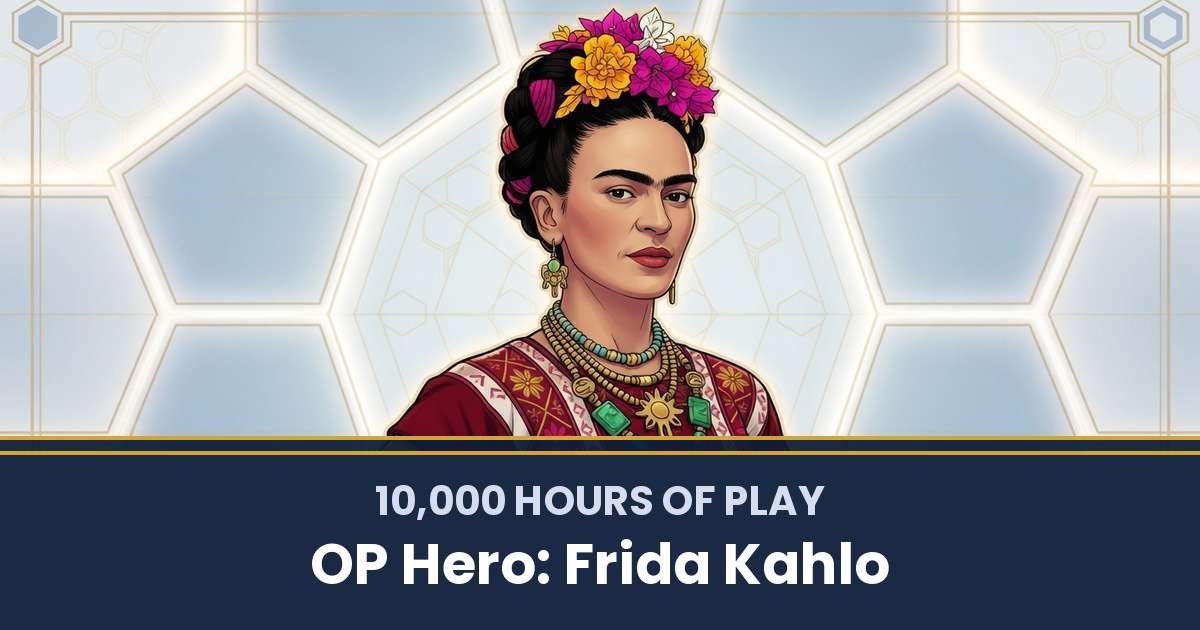


At eighteen years old, Frida Kahlo’s body was pinned to a hospital bed by a steel handrail and a doctor’s verdict that she might never walk again. She did not walk for months. She painted instead — on a special easel her mother rigged above the bed, with a mirror bolted to the canopy so she could see her own face. That mirror became the most important piece of equipment in twentieth-century art.
Most “overcoming adversity” stories sand the edges. Hers refuses to. She did roughly thirty surgeries across her lifetime, lost a leg in 1953, and still threw herself into political organizing, into a public marriage to the most famous muralist in Mexico, into a wardrobe so engineered it has its own museum wing. Her game wasn’t “get well.” Her game was: take this broken body and the country I was born into and the politics I refuse to mute, and make all of it visible on canvas.
If you treat her life as a 10,000 Hours of Play run — Game, Attributes, Role, Skills, Allies, Quests — what stands out isn’t the suffering. It’s the operating system she built on top of the suffering. Here’s the build.
⚡ Speed Run Notes
- Frida Kahlo’s “game” wasn’t recovery. It was transmuting a broken body, Mexican identity, and political conviction into a singular visual language on her own terms.
- Her core innate attributes — pain tolerance, contrarian streak, observational intensity, risk tolerance, aesthetic instinct — were all visible before her accident. The accident weaponized them.
- The bus-streetcar collision of September 17, 1925 didn’t make her a painter. It cleared the schedule. The mirror over her bed did the rest.
- She used the Mexican ex-voto convention — small votive paintings on metal — to legitimize self-portraits about her own body as a serious art form, not a private confession.
- The Tehuana dress wasn’t costume. It was a deliberate identity build — Mexicanidad as personal brand, decades before the word existed.
- The 1939 Louvre acquisition of The Frame made her the first twentieth-century Mexican painter in the Louvre’s collection — at a moment her own marriage was collapsing.
Table of Contents
- Step 1: The Game — What Frida Kahlo Was Actually Playing
- Step 2: Attributes — The Innate Stats
- Step 3: Role(s) — The Character Class Across Chapters
- Step 4: Skills — The Real-Life Game Skills Frida Mastered
- Step 5: Allies — The People Who Multiplied Frida
- Step 6: Quests — The Milestones That Shaped the Saga
- What You Can Steal From Frida’s Build
- Where this framework comes from
- Related Reading
About Yu-kai Chou

Yu-kai Chou is the author of 10,000 Hours of Play — the book that treats your life as the most important game you’ll ever build a character in, and gives you the 6-Step framework (Game · Attributes · Role · Skills · Allies · Quests) to play it on purpose. He has spent two decades developing the system through which this post analyzes its OP Hero, and applies it to his own life and to the lives of the people he advises around the world.
Chou’s other framework, the Octalysis Framework, has been applied by LEGO, Microsoft, Porsche, Coca-Cola, Salesforce, and MrBeast, impacting over 1.5 Billion Users. He has taught the methodology at Harvard, Stanford, Yale, Tesla, Google, BCG, and IDEO, and has advised governments in eight nations including Ukraine, the United Kingdom, the Kingdom of Bahrain, Singapore, Taiwan, the Netherlands, Kazakhstan, and South Korea.
His work has been cited by Harvard, Stanford, MIT, Forbes, Wall Street Journal, Wired, US Department of Energy, NIST, NSF, NCBI, US Department of Education, ClinicalTrials.gov, and Google Scholar — with 3,700+ more academic publications. Explore his books here.
Frida is the OP Hero I keep coming back to when someone tells me their constraints are too heavy to build with. Her run is not a story about overcoming a body — it is a story about repurposing one. She took the only character sheet she was ever issued, refused to swap it, and instead rebuilt the game around it. The lesson I lift from her build is the Role move: she stopped trying to perform the role her body and her marriage were trying to assign her, and chose a Role her constraints actually fit. That’s not consolation. That’s the most underused move in the framework.
Step 1: The Game — What Frida Kahlo Was Actually Playing
Most artists chase mastery of a medium. Frida wasn’t actually playing that game. The thing she kept chasing across decades — visible in her letters, her wardrobe, her public appearances, her exhibition strategy — was something narrower and far more personal: take a body the world keeps trying to dismiss or pity, attach it to a country and a politics the world keeps trying to flatten, and make all of it visible on her own terms. The painting was the delivery mechanism. The campaign was identity.
You can read the game in her own line, from a 1939 letter to her doctor Leo Eloesser: “I am not sick. I am broken. But I am happy to be alive as long as I can paint.” That isn’t a coping statement. That’s a Game definition. Sickness is something done to you. Broken is something you can paint. The whole life-as-RPG framing of the 10,000 Hours of Play hub rests on this same move — choose the game you’re actually playing before the world picks one for you.
The corollary game she ran in parallel was anti-erasure. She joined the Mexican Communist Party in 1927. She wore Tehuana dress as a deliberate statement that her body was Mexican and Indigenous-coded, not the safe mestiza-European compromise mid-century Mexico City preferred. When André Breton tried to file her under European Surrealism in 1938, she refused the label — “I never painted dreams. I painted my own reality.” Naming your own game also means refusing the labels other players try to slap on it.
Step 2: Attributes — The Innate Stats
You can see Frida’s core attribute spread before the accident, before Diego, before any of the famous self-portraits existed. The accident didn’t install these stats. It cashed them in.
Pain tolerance. Polio at age six left her right leg thinner; classmates called her “Frida pata de palo” — “Frida peg-leg.” She compensated by becoming athletic, swimming and boxing in a period when that wasn’t expected of girls. The lifelong endurance of roughly thirty operations after 1925 wasn’t built then. It was already there.
Contrarian streak. At the National Preparatory School in 1922, she was one of only thirty-five girls in a student body of about two thousand. She ran with the Cachuchas, a circle of pranksters and political-debate kids known for mocking authority. Photos from 1926 show her wearing a man’s three-piece suit in family portraits. The defiance of category was wired in early — and the Talent Triangle Method would call this the edge most people sand off to fit in; Frida sharpened it.
Observational intensity, turned inward. Her letters to her teenage boyfriend Alejandro Gómez Arias (1924–1927) are not love letters in the usual sense — they’re forensic readings of her own moods and other people’s tells. Roughly a third of her finished output became self-portraits. That’s not vanity. That’s a particular kind of observational mind that finds the most analyzable subject sitting in the mirror.
Risk tolerance, personal and political. She joined the Communist Party at twenty in a post-revolutionary Mexico where that came with real consequences. She conducted relationships openly with both men and women — the dancer Josephine Baker, the painter Jacqueline Lamba, the photographer Nickolas Muray — in a Catholic society and inside a volatile marriage. The downside was always live. She kept moving anyway.
Aesthetic instinct. Classmates remembered her distinctive hairstyles and dress before she had any reason to think of herself as a painter. The Tehuana huipils, the ribbons, the unplucked brows, the embroidered skirts — the visual coherence of “Frida” predates the art that made the visual coherence famous.
Step 3: Role(s) — The Character Class Across Chapters
Frida’s biggest single move wasn’t a Skill upgrade. It was a Role change forced by a 1925 collision and accepted by a woman who happened to have all the attributes the new Role required.
Chapter one: rebellious student and intellectual-in-training at the National Preparatory School (1922–1925). She wanted to be a doctor. The political agitation, the debates, the gender-bending photographs — that was Role identity formation, not a career.
Chapter two: convalescent self-taught painter (1925–1928). After the bus and streetcar collided on September 17, 1925 — fractured spine, fractured pelvis, a metal handrail through her abdomen and uterus — her mother set up an easel above the bed and a mirror under the canopy. She painted herself because she was the only model who couldn’t leave. This is the Role pivot — and it’s the move I’d argue is the most underrated in the whole 6-Steps framework. She didn’t try to recover the old Role. She accepted the constraint and looked for the Role the constraint actually fit.
Chapter three: Diego Rivera’s partner and emerging professional artist (1929–1933). Marriage to Diego on August 21, 1929. Years in Cuernavaca, San Francisco, Detroit, New York while he chased mural commissions. The Detroit miscarriage in July 1932 fed straight into Henry Ford Hospital and My Birth — the moment her bodily experience and her painting practice fused as one signal.
Chapter four: self-mythologizing modernista (1935–1938). Diego had an affair with her sister Cristina in 1934. The separation that followed became the period in which Frida intensified everything — extramarital affairs of her own, the deliberate construction of the Tehuana public image, and an output substantial enough that by 1938 she had roughly twenty-five paintings ready for her first New York solo show.
Chapter five and beyond: international exhibiting artist (1938–1940), national icon-in-the-making and teacher at La Esmeralda (1940–1945), and finally bedridden master and mythologized public figure (1946–1954). She joined the teaching staff at La Esmeralda in 1943; the group of devoted students who followed her to Casa Azul are still known as Los Fridos. The final Role wasn’t an accident either — it was a public assertion that she belonged in Mexican art’s canon, not its margins.
Step 4: Skills — The Real-Life Game Skills Frida Mastered
Picking from the 10K HP canon Skills catalog, here are the six that her run actually demonstrates — with the moment each one cracked open a result.
Phoenix Rebirth (Paladin) — recover from devastating failure and come back stronger. The bus crash didn’t end her life; it ended her old Role. The mother-rigged bed easel and mirror, the early self-portraits painted while still in a body cast, the lifelong return to painting through each new surgery — that’s not resilience as a slogan, that’s the Skill operationalized for three decades. It is the same Skill Yu-kai assigns to Helen Keller for similar reasons: a body the world wrote off, repurposed into a platform.
Spirit of Nature (Druid) — meaning-making under stress; turn the stress into a value-driven mission. Frida’s strongest expression of this is the Eloesser letter line again: “I am not sick. I am broken. But I am happy to be alive as long as I can paint.” The reframing is doing real cognitive work — chronic pain becomes raw material for the Game she actually wants to play. This is the same Skill move that runs through Viktor Frankl’s profile, and the canon name for the polyphasic-sleep version of “make a brutal constraint into a Quest” lives in the Lich Pact write-up if you want to see the Skill in a completely different context.
Vision Manifestation (Warlock) — visualize success so vividly it shapes reality. The Tehuana persona did not exist before she built it. The unplucked brows, the gold tooth, the floral crown, the embroidered skirts — Frida walked through twentieth-century Mexico City as a living thesis statement on Mexicanidad. The visualization preceded the paintings, then the paintings caught up to the persona. Photographer Gisèle Freund recorded her saying she wanted to look “more Mexican than the Mexicans.” That’s mental rehearsal in physical form.
Loremaster (Druid) — weave compelling, inspiring stories. Frida’s structural innovation as a painter was lifting the Mexican retablo or ex-voto convention — small votive paintings on tin commissioned to thank a saint for surviving disaster — and using its visual grammar for her own body. Henry Ford Hospital, The Two Fridas, The Broken Column, the late Tree of Hope, Keep Firm all run on retablo logic. She told her story with a visual idiom Mexican viewers already trusted, which is why the work felt instantly authentic instead of confessional.
Masquerade (Rogue) — pretend to be someone else and perform their soft skills at similar level. “Frida Kahlo” was an alter ego. The legal name was Magdalena Carmen Frieda Kahlo y Calderón; she chose Frida and dropped the German spelling. She built the public persona — clothing, jewelry, hair, eyebrows, walking stick, gold tooth, parrots — as a coherent character with its own grammar. Inside that persona she could push politics, paint nudity, conduct affairs, and run a salon at Casa Azul that hosted Trotsky, Breton, Rockefeller, and Rivera all in the same year. The alter ego carried the load the legal name couldn’t.
Aegis (Paladin) — ignore public criticism and naysayers while pushing the Quest. The Mexico City press of the 1930s and ’40s mostly framed her as Diego’s wife. The Paris surrealists patronized her. Many doctors told her painting would worsen her injuries. She kept painting. She insisted on showing up to her 1953 Mexico City solo opening — the only one in Mexico during her lifetime — in her four-poster bed, wheeled in by ambulance, propped against pillows, drinking tequila. That isn’t bravado. That’s Aegis switched on for thirty years.
Step 5: Allies — The People Who Multiplied Frida
Frida’s allies weren’t a team in the start-up sense. They were a network of multipliers, each of whom unlocked a specific door.
Diego Rivera was the most consequential, the most painful, and the most argued-over. He saw her early paintings in 1928 and told her — accurately — that she had something none of his peers had. He pulled her into Mexico City’s mural-and-Marxism scene. He also took up most of the room. The 1934 affair with her sister Cristina was its own catastrophe. They divorced in November 1939 and remarried at San Francisco City Hall on December 8, 1940. Net effect: he amplified her, blocked her, and outlasted her — and her work would not have circulated the way it did without him.
Guillermo Kahlo, her German-born father and a working photographer, did three things that mattered. He gave her the visual literacy of darkroom and lens early on. He paid for her to study at the National Preparatory School against the gender norms of the time. And he stayed available — emotionally and financially — through the long bedridden years after 1925.
André Breton was the irritating-but-load-bearing kind of ally. He visited Mexico in April 1938, declared her a surrealist (which she rejected), and used his Paris and New York standing to set up her first international shows. The 1938 Julien Levy Gallery exhibition in New York and the 1939 Mexique exhibition at Galerie Renou et Colle in Paris both trace to him.
Julien Levy and Edward G. Robinson were the New York-side multipliers. Levy gave her the November 1938 solo show with about twenty-five paintings. The Hollywood actor Edward G. Robinson had already bought four of her works the previous summer in Mexico City at two hundred dollars each — Frida’s first documented commercial sale, eight hundred dollars total — and the Levy show consolidated her standing in the New York press as a painter in her own right, not “Diego’s wife who paints.”
Lola Álvarez Bravo, the Mexican photographer, hosted Frida’s first and only solo Mexican exhibition in April 1953 at the Galería de Arte Contemporáneo. She was the ally who insisted the work belonged inside Mexico’s canon while Frida was still alive to see it.
Los Fridos, the four core students who followed her from La Esmeralda to Casa Azul starting in 1943 — Arturo García Bustos, Arturo Estrada, Fanny Rabel, and Guillermo Monroy — were the ally type most people undervalue. They kept her teaching even when she couldn’t leave the house, which kept her practice anchored when the body was failing.
Step 6: Quests — The Milestones That Shaped the Saga
If you mapped Frida’s life as a quest log, six entries do most of the work.
Quest 1 — Survive the 1925 collision and choose a new Role. Bus crash, September 17, 1925, on the corner of Cuauhtemoctzin and Calzada de Tlalpan. Steel handrail through the pelvis. Months in a body cast. The non-obvious move was her mother’s: rig the easel and mirror over the bed. The non-obvious move was Frida’s: paint instead of waiting to recover. The earliest serious self-portrait, Self-Portrait in a Velvet Dress, dates to 1926, painted in convalescence.
Quest 2 — Marry Diego Rivera (August 21, 1929) and decide not to be eaten by him. The marriage gave her access to the mural-and-Marxism circle. It also tried to install her permanently as Diego’s wife. The long counter-move — Tehuana dress, separate studios at the San Ángel houses, separate affairs, separate professional identity — took years and produced more than it cost.
Quest 3 — Julien Levy Gallery solo show, New York, November 1938. About twenty-five paintings exhibited; Edward G. Robinson’s four-purchase afternoon; reviews in Time, Vogue, the New York Times. This is the moment she becomes “Frida Kahlo, painter” in the international press rather than “Mrs. Diego Rivera, also paints.”
Quest 4 — Mexique at Galerie Renou et Colle, Paris, March 1939. Breton organized it. The Paris surrealists annoyed her. The result still produced the trophy: the Louvre acquired her painting The Frame, making her the first twentieth-century Mexican painter in the Louvre’s collection. Quests that go badly in process can still ship the deliverable.
Quest 5 — The failure of the marriage and the rebuild. Civil divorce from Diego: November 6, 1939. The Two Fridas and Self-Portrait with Cropped Hair are both painted out of that wound and are now arguably her most-reproduced works. Remarriage on December 8, 1940 in San Francisco, on her terms — financial independence, separate bedrooms, the right to her own relationships. Not every Quest is a victory; some are the failures that finally rebalance the build.
Quest 6 — The 1953 Mexico solo show and the leg. Galería de Arte Contemporáneo, April 1953. By that point her right leg was gangrenous; she was bedridden. She attended the opening anyway, transported by ambulance and installed in her four-poster bed in the gallery. The leg was amputated below the knee that summer. She died at Casa Azul on July 13, 1954, fifteen months later. The final Quest wasn’t recovery. It was making the canonization happen in her lifetime, with her present in the room, while she still could.
What You Can Steal From Frida’s Build
The instinct from Frida’s profile is usually to admire the suffering. That misses the build. The actual transferable moves are smaller and more practical.
First, the Role move. When the bus crash invalidated the medical career, she didn’t fight to recover the old Role. She looked at the constraints — bed, mirror, time, observational mind — and picked the Role those constraints actually fit. Most professional crises in real life are quieter versions of this. The Role you were trying to occupy is no longer the one your current constraints can sustain. The 6-Steps framework treats Role as a choice that can be remade, not a label you wear for life — and Frida’s run is the clearest case study of that move in art history.
Second, the alter-ego move. “Frida” was a built character. Many of the things “Frida” was allowed to do — politically, sexually, artistically — were things Magdalena Carmen Frieda would have been punished for. If you find your legal-name self quietly compressing what you’ll attempt, the canon Masquerade Skill is the technique. Pick a working name, a wardrobe, a posture, a way of entering rooms — and let that character carry the weight your default self can’t.
Third, the existing-grammar move. The retablo convention already had cultural authority in Mexico. By writing her personal story in that visual grammar, she didn’t have to invent legitimacy — she borrowed it. In your own work, the equivalent is asking: what idiom is my audience already wired to trust, and how do I tell my truth inside it? That’s not selling out. That’s how you skip the part where you have to teach the audience a new language before they can hear you.
Fourth, the visibility-as-quest move. Frida did not assume her work would be discovered after her death. She organized the 1953 Mexico show. She took the New York and Paris commercial showings seriously. She insisted on being in the room. Most undiscovered creative work isn’t undiscovered because it isn’t ready. It’s undiscovered because nobody — including the maker — turned visibility into a Quest with a deadline. Frida did.
If you want to see how the same 6-Step framework produces other unexpected builds, the OP Hero hub is where the rest of the case studies live — and the comparisons matter, because once you’ve seen the framework run across five or six lives, you start to see your own with the same level of structure.
Where this framework comes from

Want the full system this profile is built on?
Every OP Hero piece runs through the same 6-Step framework from 10,000 Hours of Play: Unlock Your Real-Life Legendary Success. The book covers the full system, walks through Yu-kai’s own life run as the first applied case study, and gives you the worksheets to audit your own build.
Related Reading
- All OP Hero Profiles — the running case-study library
- OP Hero: Helen Keller — another body the world wrote off, repurposed into a platform
- OP Hero: Viktor Frankl — meaning-making under unsurvivable constraint
- OP Hero: Hayao Miyazaki — personal mythology becomes universal
- What Do You Want to Want? — the question that reveals your real Game
- The Power of Roleplaying — how identity Roles shape behavior