
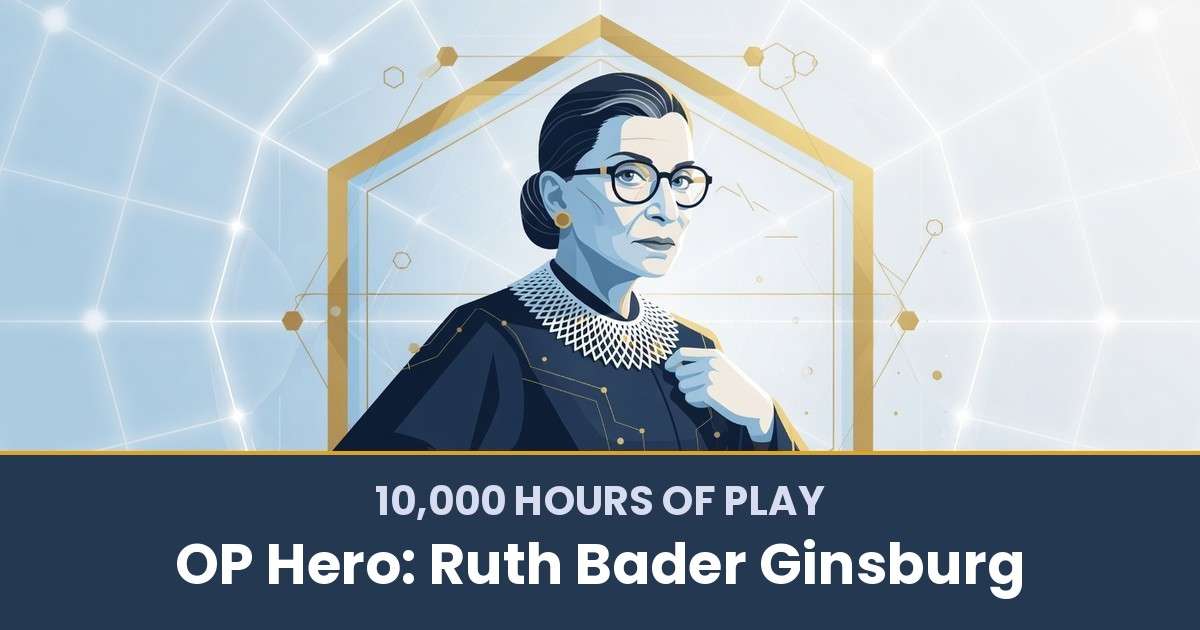


A five-foot-one law student at Harvard in 1956 attended her own classes, typed her husband’s classes while he was undergoing cancer treatment, raised a toddler, made law review, and finished near the top of her year. Then she couldn’t get a single New York law firm to hire her, because she was a woman, a mother, and Jewish — three problems no résumé could fix in 1959.
So she stopped trying to win as one lawyer and started designing a campaign instead. Over the next twenty years she would argue six gender-equality cases before the U.S. Supreme Court, win five of them, sit on the federal bench for forty more years, and engineer the constitutional logic that would let her daughter, granddaughter, and roughly half the American workforce sue over discrimination her own generation had been told to accept.
That résumé makes Ruth Bader Ginsburg famous. The interesting part is the build underneath it — the same one Yu-kai Chou maps with the 10,000 Hours of Play framework. Game, Attributes, Role, Skills, Allies, Quests. RBG’s character sheet is unusually legible because she kept every receipt: cases, dissents, hearings, interviews, the lot.
Read against the 6 Steps, the same woman who became an internet meme as “Notorious RBG” looks less like a folk hero and more like one of the most disciplined long-game strategists in American legal history. Most lawyers play case by case. She played the docket.
⚡ Speed Run Notes
- RBG’s Game wasn’t winning cases. It was rewriting the constitutional doctrine on sex so future cases would be winnable by default — a multi-decade engineering project disguised as a litigation career.
- Her cleanest move was choosing male plaintiffs for sex-discrimination cases. The all-male 1970s Court could finally see the rule when the rule was hurting men too.
- The Harvard years were the proof-of-concept on stoic persistence. Marty had testicular cancer, she audited his classes, typed his notes, and still made law review.
- She lost Ledbetter in 2007. Then she wrote the dissent that handed Congress the script for the Lilly Ledbetter Fair Pay Act in 2009. The Skill was turning a loss into legislation.
- She survived colon cancer at 66, pancreatic cancer at 76, lung cancer at 85, and pancreatic cancer again at 86, working through every recovery. Phoenix Rebirth as a literal medical fact.
Table of Contents
- Step 1: The Game — What Ruth Bader Ginsburg Was Actually Playing
- Step 2: Attributes — The Innate Stats
- Step 3: Role(s) — The Character Class Across Chapters
- Step 4: Skills — The Real-Life Game Skills Ruth Bader Ginsburg Mastered
- Step 5: Allies — The People Who Multiplied Ruth Bader Ginsburg
- Step 6: Quests — The Milestones That Shaped the Saga
- What You Can Steal From Ruth Bader Ginsburg’s Build
- Where this framework comes from
- Related Reading
About Yu-kai Chou

Yu-kai Chou is the author of 10,000 Hours of Play — the book that treats your life as the most important game you’ll ever build a character in, and gives you the 6-Step framework (Game · Attributes · Role · Skills · Allies · Quests) to play it on purpose. He has spent two decades developing the system through which this post analyzes its OP Hero, and applies it to his own life and to the lives of the people he advises around the world.
Chou’s other framework, the Octalysis Framework, has been applied by LEGO, Microsoft, Porsche, Coca-Cola, Salesforce, and MrBeast, impacting over 1.5 Billion Users. He has taught the methodology at Harvard, Stanford, Yale, Tesla, Google, BCG, and IDEO, and has advised governments in eight nations including Ukraine, the United Kingdom, the Kingdom of Bahrain, Singapore, Taiwan, the Netherlands, Kazakhstan, and South Korea.
His work has been cited by Harvard, Stanford, MIT, Forbes, Wall Street Journal, Wired, US Department of Energy, NIST, NSF, NCBI, US Department of Education, ClinicalTrials.gov, and Google Scholar — with 3,700+ more academic publications. Explore his books here.
What I personally find instructive about Ruth Bader Ginsburg’s build is how she treated the Supreme Court like a long campaign board instead of a courtroom. Most lawyers optimize for the case in front of them. She optimized for the doctrine the case would leave behind. The single lesson I’d lift from her run is the discipline of picking the next move based on which position it leaves you in for the move after that — the chess habit that almost nobody applies to their own career. Her best work was always the second-order effect of a first-order argument she had already mapped out years in advance.
Step 1: The Game — What Ruth Bader Ginsburg Was Actually Playing
If you ask a casual reader what RBG’s game was, the answer is “women’s rights.” If you ask her, the answer was both bigger and more specific. She told the Senate Judiciary Committee at her 1993 confirmation hearing that her agenda as a litigator had been to open doors so women could enter formerly closed worlds on equal footing with men. Not just doors for women. Doors that would not slam either way.
That framing matters because it explains every strategic move that followed. Her game was to drain sex out of the law as a basis for classification, full stop. Equal in the workplace, equal in the home, equal in benefits, equal in the draft, equal in jury service. The mission was structural, not symbolic. Once you see this life-as-game framing, the choice to argue on behalf of widowers and unmarried fathers stops looking strange and starts looking like the only move that wins the level.
The objective also explains the long timeline. You cannot rewrite constitutional doctrine in a single case. You build it like a stack — one precedent, one statutory victory, one footnote that the next court has to acknowledge. Her 1978 Tulane Law Review article “Sex Equality and the Constitution” lays out the staged plan explicitly: a sequence of cases attacking what she described as the most pervasive sex-role pigeonholing in American law. That is not a closing argument; that is a multi-year roadmap.
The second layer of the Game shows up in her judicial chapters. Once she stopped being a litigator and became a judge, the objective shifted to preservation — making sure the doctrine she had helped build would survive her, even when she was clearly outvoted. The dissents she became famous for in her seventies and eighties are not consolation prizes. They are messages addressed to the lawyers, lower-court judges, and members of Congress who would still be working long after she was gone. The Game stayed the same. The pieces on the board changed.
Step 2: Attributes — The Innate Stats
Attributes are the traits visible early — the ones you do not train into existence. Ginsburg’s were obvious to the teachers, classmates, and colleagues who watched her in Brooklyn, Ithaca, and Cambridge from the late 1940s onward.
The first is verbal and analytic precision. At James Madison High School she edited the school paper, the Pilot. At Cornell she graduated with high honors in 1954 and was singled out by her professor Robert Cushman as one of the clearest thinkers he had taught. Decades later, her 1996 majority opinion in United States v. Virginia reads with the same surgical structure her teachers spotted at age sixteen. You can self-audit this kind of edge with the Talent Triangle Method; for Ginsburg the stat was unmissable before she ever opened a casebook.
The second is stoic persistence under personal strain. Her mother Celia died of cervical cancer the day before Ruth’s high school graduation. She attended Cornell that fall anyway and finished at the top of her class. At Harvard Law from 1956 to 1958, her husband Marty was diagnosed with testicular cancer; she attended his classes, typed his notes, raised their daughter Jane, made law review, and graduated tied for first at Columbia after transferring. This is not a “soft skill.” It is a temperament that absorbs catastrophic stress without scattering attention.
The third is a low-reactivity disposition in conflict. Clerks and colleagues across forty years on the bench consistently describe a justice who almost never raised her voice and preferred a tightly reasoned written response to a verbal confrontation. That pattern was visible at Harvard, where classmates remembered her as reserved, prepared, and uninterested in courtroom theatrics. The legal world rewards quick aggression at the lectern; she won by being quieter than the room expected.
The fourth is a long-horizon strategic instinct. Her ACLU litigation campaign was not a series of opportunistic cases — it was a deliberately ordered sequence designed to extract maximal doctrinal value from each step. She picked plaintiffs years in advance, declined cases that would create bad precedent even when they offered short-term wins, and treated the Supreme Court like a chessboard rather than a courtroom. Most lawyers do not think this way at twenty. She did.
The fifth is a strong internal rule of fairness, traceable to her mother’s emphasis on independence and education. She told interviewers across decades that her early reading and her mother’s example imprinted a default expectation that the rules should apply the same to everyone. That sounds banal in 2026. In 1940s Brooklyn, when girls were tracked away from professions on principle, it was nearly heretical, and it stayed bedrock for the rest of her career.
Step 3: Role(s) — The Character Class Across Chapters
Ginsburg played at least five distinct Roles, and the transitions between them are where the build compounded. Most lawyers settle into one class and stay. She kept reclassing.
Role one was Apprentice Scholar from 1950 to 1963 — Cornell undergrad in government, Harvard Law from 1956, a Columbia Law transfer to follow Marty to New York in 1958, a clerkship with Judge Edmund Palmieri on the Southern District of New York from 1959 to 1961, and a stint at Columbia’s Project on International Procedure researching Swedish civil procedure. The class taught her how to read a system before changing it, and it gave her the comparative-law lens she would later use to argue that American sex-discrimination doctrine was an outlier among industrialized democracies.
Role two was Academic Builder from 1963 to 1972 — Assistant and then Associate Professor at Rutgers School of Law, teaching civil procedure and beginning to develop the gender-equality framework that would define her career. She hid her second pregnancy under loose clothing because Rutgers had a history of not renewing pregnant women’s contracts. The Role demanded the patience of doctrinal scholarship, but it also forced her to live inside the very discrimination she was theorizing.
Role three was Strategic Litigator from 1972 to 1980. She moved to Columbia Law as its first tenured female professor, co-founded the ACLU Women’s Rights Project, and served as ACLU general counsel from 1973 to 1980. She argued six gender-equality cases before the Supreme Court — Frontiero v. Richardson (1973), Kahn v. Shevin (1974), Weinberger v. Wiesenfeld (1975), Edwards v. Healy (1975), Califano v. Goldfarb (1977), Duren v. Missouri (1979) — and won five. This was the class that built the doctrine she would later defend from the bench.
Role four was Circuit Judge from 1980 to 1993 on the U.S. Court of Appeals for the D.C. Circuit, appointed by President Jimmy Carter. The class change was significant. Litigators argue for outcomes; judges write reasons. She used the thirteen years on the D.C. Circuit to develop a reputation as a pragmatic, careful, often-centrist craftsman — exactly the profile that would make her Senate-confirmable a decade later. Knowing when to stop specializing and broaden the moves you can make is a meta-skill almost no successful litigator pulls off.
Role five was Associate Justice of the Supreme Court from August 10, 1993 — nominated by President Bill Clinton, confirmed 96-3 — until her death on September 18, 2020. Twenty-seven terms. Inside that single Role she actually played two overlapping classes: the doctrine-builder of the 1990s and early 2000s, when she was writing majorities like United States v. Virginia, and the dissent-architect of the 2010s, when conservative majorities forced her into the role of legal opposition leader. Her cultural-icon overlay as “Notorious RBG” started in 2013 around her Shelby County dissent and ran in parallel for the rest of her life, but she treated the celebrity as an instrument, not a destination.
Step 4: Skills — The Real-Life Game Skills Ruth Bader Ginsburg Mastered
Here is where the canon Real-Life Game Skills earn their keep. Ginsburg is one of the cleanest case studies in the catalog because her work product is in the U.S. Reports and her strategic memos are in the ACLU archives. You can audit her toolkit at line level.
Mastermind (Ranger) — the Skill of creating, adapting, and executing complex plans. The ACLU Women’s Rights Project campaign from 1972 to 1980 is the textbook case. She did not file the most sympathetic case first; she filed the case that would set up the case after it. Reed v. Reed (1971) cracked open the principle that sex classification needed a real reason. Frontiero v. Richardson (1973) tried to push the Court to apply strict scrutiny to sex; the plurality stopped short, but it locked in heightened skepticism. Craig v. Boren (1976) closed the gap with intermediate scrutiny. Every case was chosen for the doctrinal slot it would occupy in a building she had already drawn. Martin Luther King Jr.’s civil-rights campaign ran the same kind of stepwise legal strategy a decade earlier; she had clearly studied the play.
Foresight (Ranger) — the Skill of projecting and predicting future trends and risks. Her most famous tactical choice was running male plaintiffs in sex-discrimination cases. Stephen Wiesenfeld in Weinberger v. Wiesenfeld (1975) was a widower denied Social Security survivors’ benefits because the law assumed only women raised children alone. Charles Moritz in the 1972 Tenth Circuit case Moritz v. Commissioner was an unmarried son denied a caregiver deduction because the law assumed only daughters cared for elderly parents. She foresaw what the all-male 1970s Court could and could not see, and she made sure the sex-role rule was hurting men on the day it was struck down. That choice still gets taught in first-year constitutional law.
Cognitive Lens (Mage) — the Skill of zooming in on details and zooming out for strategy, micro and macro at once. Her ACLU briefs read both ways: line-by-line technical mastery of equal-protection doctrine paired with a five-thousand-foot view of which classifications were the load-bearing ones to attack first. Craig v. Boren challenged an Oklahoma law that let women buy 3.2 percent beer at eighteen but made men wait until twenty-one. On its face, a niche statute. At the level of constitutional structure, the case that established intermediate scrutiny for sex classifications. She was always playing both levels at once.
Ninja Focus (Rogue) — the Skill of sustained discipline on tasks others find impossible to sustain. Harvard Law 1956–58 is the moment that gets quoted, but the pattern repeated for sixty years. Through Marty’s testicular cancer in 1956, her own colon cancer in 1999, pancreatic cancer in 2009, a stent placement in 2014, lung cancer in 2018, and pancreatic cancer again in 2018 and 2019, she missed remarkably little bench time. She had a personal trainer at the Supreme Court gym, Bryant Johnson, with whom she did push-ups and planks through every recovery — a routine documented in the 2018 documentary RBG and Johnson’s book The RBG Workout. Focus, for her, was a daily practice that survived contact with mortality.
Loremaster (Druid) — the Skill of weaving compelling, inspiring stories. The dissents are where this lives. Her Ledbetter v. Goodyear dissent in 2007 reframed pay discrimination as a series — every paycheck a fresh violation, not the single trigger date the Court read into the statute — and that framing was the one Congress adopted in the Lilly Ledbetter Fair Pay Act of 2009. Her Shelby County v. Holder dissent in 2013 introduced the phrase that “throwing out preclearance when it has worked and is continuing to work to stop discriminatory changes is like throwing away your umbrella in a rainstorm because you are not getting wet.” Her Burwell v. Hobby Lobby dissent in 2014 ran thirty-five pages of careful, story-driven argument that legal scholars still teach. Dissents are usually footnotes. Hers became plot.
Aegis (Paladin) — the Skill of ignoring public criticism and naysayers while pushing the Quest. From 2013 onward she faced sustained pressure — from law professors, columnists, and Democratic Party operatives — to retire while Barack Obama could appoint her successor. She refused. The criticism intensified after Donald Trump’s 2016 victory and again during her final illness. She maintained that the President should be elected by the people, not by her timing, and kept working. You can argue the call was wrong in hindsight. The Skill of holding a position you have reasoned your way to, while the entire commentariat tells you to fold, is rare and it was hers.
Phoenix Rebirth (Paladin) — the Skill of recovering from devastating failure and coming back stronger. Two flavors. The first is medical: five cancer treatments across twenty-one years, every one followed by a return to a punishing oral-argument schedule. The second is professional: her 2007 loss in Ledbetter generated the dissent that produced the 2009 Fair Pay Act, signed by President Obama as the first bill of his administration. Losing the case was the lever that moved Congress. That is not a metaphor; that is the receipts.
Step 5: Allies — The People Who Multiplied Ruth Bader Ginsburg
You do not rewrite constitutional doctrine alone. Ginsburg was one of the more deliberately allied lawyers in her bracket, even though her personal style was famously private.
Martin “Marty” Ginsburg is the Ally without whom the rest does not happen. They met at Cornell in 1950 and married in 1954. He became one of the top tax lawyers of his generation, took over the household cooking, raised their two children, and ran the back-channel lobbying campaign that got her on Bill Clinton’s Supreme Court short list in 1993. Marty’s law-firm partners and tax-bar contacts wrote letters and made calls she could not make for herself. The marriage was a partnership in the literal economic sense, and she said as much in her tribute “In Tribute to Marty” after his death in 2010.
Pauli Murray is the Ally whose framework she built on. Murray — a Black, Episcopal-priest-turned-civil-rights-lawyer — co-authored the 1965 article “Jane Crow and the Law: Sex Discrimination and Title VII,” which argued for using equal-protection doctrine to attack sex classification the same way the NAACP had used it to attack race classification. Ginsburg cited Murray on the brief in Reed v. Reed as co-author. Murray was the theorist; Ginsburg was the litigator. Both were necessary.
Brenda Feigen is the Ally who built the institution. She co-founded the ACLU Women’s Rights Project with Ginsburg in 1972 and ran the case-management apparatus that allowed Ginsburg to argue at the Supreme Court while still teaching at Columbia. Without Feigen handling the staff, intake, and logistics, the multi-case strategy collapses to one or two cases a decade.
Justice Sandra Day O’Connor is the Ally Ginsburg did not have for most of her early career and inherited on the Court. O’Connor, appointed in 1981, was the only other woman on the bench when Ginsburg arrived in 1993. They were ideologically distinct but procedurally generous to each other, and O’Connor explicitly mentored Ginsburg through her first term — including walking her through which committee assignments mattered. The Senate-confirmed-only-with-difficulty pipeline for women became a Senate-confirmed-on-96-3 pipeline partly because O’Connor had run it first.
Justice Antonin Scalia is the Ally who looks like an enemy from the outside. They disagreed on almost every constitutional question, but they shared opera tickets, vacationed together with spouses, and edited each other’s writing for clarity even when arguing opposite outcomes. Scalia made her dissents sharper; she made his majorities tighter. The friendship is a case study in the rare ability to separate adversarial work from personal regard — a pattern Malala Yousafzai’s later coalitions show in a different domain, and one almost nobody else inside the modern Court has matched.
Her clerks across forty years on the bench — including future judges, law-school deans, and several U.S. solicitors general — formed the Bird Studio of her chambers, the small in-house team that drafted opinions to her line edit and carried her legal style forward into careers of their own. She picked them rigorously, kept them in her circle for decades, and treated their later work as a Skill she was investing in rather than a courtesy.
Step 6: Quests — The Milestones That Shaped the Saga
The saga has at least six pivotal Quests. The wins are obvious; the losses are where the character sheet was forged.
Quest one: Harvard Law and the law-review years from 1956 to 1959. Marty’s cancer diagnosis, the toddler, the second-class treatment from the dean (the famous dinner where the women students were asked to justify the seats they were taking from men), and still she made law review. The Quest was not the credential — it was learning, at age twenty-three, that she could absorb a level of stress most adults break under and still produce A-grade work.
Quest two: the ACLU Women’s Rights Project from 1972 to 1980. Five Supreme Court wins out of six arguments, plus dozens of co-counsel briefs that shaped the doctrine in cases she did not personally argue. The hidden setback inside this Quest is Kahn v. Shevin (1974), where the Court let stand a Florida property-tax exemption for widows. She wrote later that the loss taught her not to fight on terrain where a “benevolent” sex classification could be defended as helping women — exactly the wedge opponents would later use.
Quest three: the D.C. Circuit confirmation in 1980 and thirteen years on the bench. The Quest demonstrated that the same strategic mind that ran the WRP could run an appellate chambers in the most-watched circuit in the country. The work was less glamorous and almost as load-bearing.
Quest four: the 1993 Supreme Court confirmation, 96-3, and the United States v. Virginia majority opinion three years later striking down VMI’s male-only admissions policy. U.S. v. Virginia is the closing argument she had been writing since 1972. The Court applied the same intermediate scrutiny her campaign had built, and she got to write the majority. The Quest was the payoff for two decades of doctrinal stacking.
Quest five: Ledbetter v. Goodyear Tire & Rubber Co. (2007) and the Lilly Ledbetter Fair Pay Act (2009). The Court ruled 5-4 against Lilly Ledbetter on a procedural timing question; Ginsburg read her dissent aloud from the bench, an unusual move. The dissent argued that Congress had not intended its statute to operate that way and should fix it. Congress did, eighteen months later. The signature on January 29, 2009 was the first bill of the Obama administration. The Quest was a defeat she converted into a statute.
Quest six: the dissent era from 2013 onward — Shelby County v. Holder, Burwell v. Hobby Lobby, Trump v. Hawaii, the late voting-rights and reproductive-autonomy opinions. The Quest required the same focus the WRP years did, with a thinner team and a hostile majority. She kept going through three cancers and a hospitalized broken rib until her death on September 18, 2020, at 87, among the oldest sitting justices in the Court’s history.
Run those six Quests together with the losses attached, and the build comes into focus. Every win was the second-order effect of a setback she metabolized publicly. That is the pattern other OP Hero profiles show up with too, and it is the part that translates outside law.
What You Can Steal From Ruth Bader Ginsburg’s Build
The takeaway is not “be born with surgical verbal precision and stoic temperament.” You can’t be. The takeaway is structural.
Play the docket, not the case. Most ambitious people optimize for the move directly in front of them. She optimized for the position that move would leave her in three moves later. The question to ask before any career-shaping action is not “do I win this round,” but “does winning this round give me the right pieces to play the next one.” That is the chess habit her ACLU sequence is built on.
Pick plaintiffs the room can already see. The male-plaintiff strategy is the meta-lesson. When you need a hostile audience to grant you a rule, find the messenger they trust and frame the rule in their language. Ginsburg trusted the all-male Court to see Stephen Wiesenfeld’s loss because it looked like their own life. The same move works in negotiations, fundraising, and persuasion of all kinds.
Turn losses into legislation, not into regret. Ledbetter would have been a footnote if she had moved on. She wrote the dissent that became the script for Congress, and the law got fixed eighteen months later. Every defeat is a document; the question is whether you write that document well enough to make the next move possible.
Pick a few Allies and let them stay for decades. Marty Ginsburg, Pauli Murray, Brenda Feigen, Sandra Day O’Connor, Antonin Scalia, her clerks. The inner ring barely changed across her career. Loyalty was the multiplier. Friend or adversary, she kept the people who made her sharper close, and the rest of the noise at distance.
Where this framework comes from

Want the full system this profile is built on?
Every OP Hero piece runs through the same 6-Step framework from 10,000 Hours of Play: Unlock Your Real-Life Legendary Success. The book covers the full system, walks through Yu-kai’s own life run as the first applied case study, and gives you the worksheets to audit your own build.
Related Reading
- All OP Hero Profiles — every hero on the site analyzed through the same 6-Step framework.
- OP Hero: Malala Yousafzai — another woman who built a multi-decade rights campaign while still in school.
- OP Hero: Martin Luther King Jr. — the parallel civil-rights legal-and-moral strategy that shaped the playbook RBG inherited.
- OP Hero: Maya Angelou — the cultural authority arc that ran alongside the legal arc Ginsburg fought through the courts.
- The Skills Spectrum — specialist, dabbler, or master? Where Ginsburg actually lived on the spectrum across her chapters.