
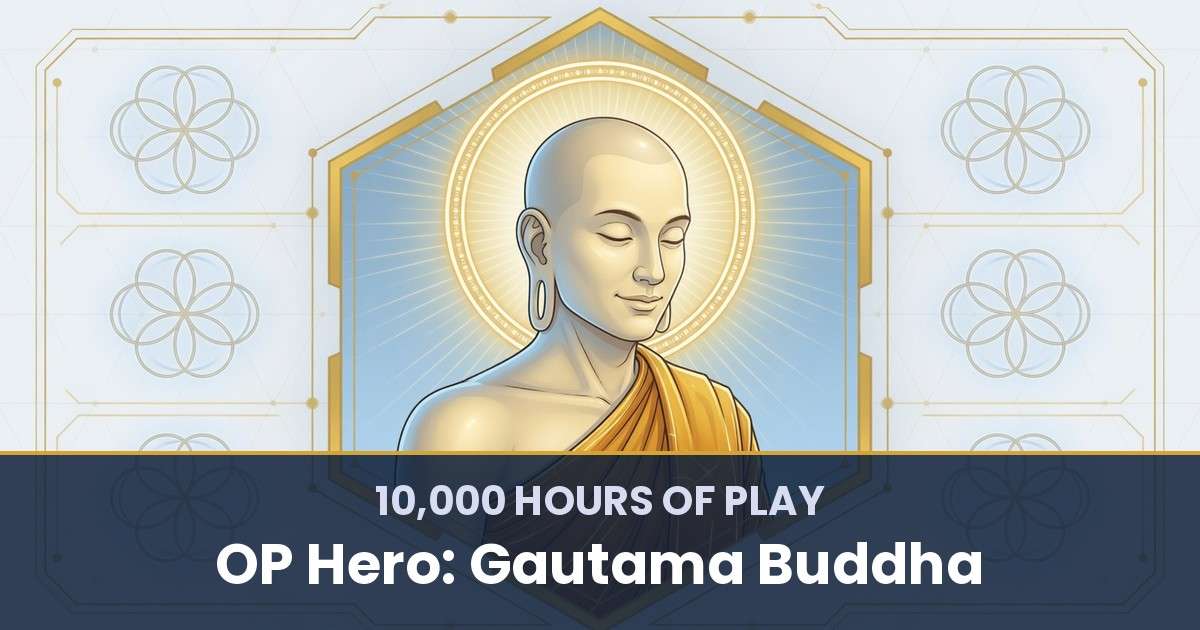


For six years, the man who would become the Buddha was the most committed ascetic in the forest. He starved himself until, by his own later account, his limbs looked like withered reeds. He held his breath in fierce trance until violent pains tore through his head. Five other seekers trained beside him, and they watched him out-suffer every one of them.
Then one day he accepted a bowl of milk-rice from a village woman named Sujata, and he ate it.
His five companions left on the spot. To them the verdict was obvious: he had gone soft, broken the discipline, washed out. The one seeker who looked most likely to break through had quit at the finish line. He was now completely alone in a forest, with no teacher, no followers, and no method that had worked.
Within weeks he would sit down under a fig tree near Bodh Gaya and become the Buddha, the Awakened One, and set in motion a tradition that twenty-five centuries later still shapes the inner lives of hundreds of millions of people.
Run his life through the 10,000 Hours of Play framework and the moment those five companions walked away stops looking like his lowest point. It looks like the sharpest single decision in the whole build. Here is how it came together.
⚡ Speed Run Notes
- The Buddha’s game was never religion in the modern sense. It was one practical problem: why do humans suffer, and can that be switched off permanently? He spent decades rejecting every answer that didn’t actually work.
- His defining move was quitting. Six years of extreme asceticism produced nothing, so he abandoned it, lost status and all, and the failed strategy became the foundation of his teaching.
- He was a fast learner of other people’s systems. He mastered his two meditation teachers’ highest techniques so quickly that each offered him their job, then left because the techniques didn’t reach far enough.
- Insight alone wasn’t the breakthrough. Compressing it into a transmissible structure (diagnosis, cause, cure, method) was. That packaging is why the teaching outlived him by 2,500 years.
- He built an institution, not just a following. The order he founded and the disciples who memorized his words are the reason a forest teacher is still quoted today.
Table of Contents
About Yu-kai Chou

Yu-kai Chou is the author of 10,000 Hours of Play — the book that treats your life as the most important game you’ll ever build a character in, and gives you the 6-Step framework (Game · Attributes · Role · Skills · Allies · Quests) to play it on purpose. He has spent two decades developing the system through which this post analyzes its OP Hero, and applies it to his own life and to the lives of the people he advises around the world.
Chou’s other framework, the Octalysis Framework, has been applied by LEGO, Microsoft, Porsche, Coca-Cola, Salesforce, and MrBeast, impacting over 1.5 Billion Users. He has taught the methodology at Harvard, Stanford, Yale, Tesla, Google, BCG, and IDEO, and has advised governments in eight nations including Ukraine, the United Kingdom, the Kingdom of Bahrain, Singapore, Taiwan, the Netherlands, Kazakhstan, and South Korea.
His work has been cited by Harvard, Stanford, MIT, Forbes, Wall Street Journal, Wired, US Department of Energy, NIST, NSF, NCBI, US Department of Education, ClinicalTrials.gov, and Google Scholar — with 3,700+ more academic publications. Explore his books here.

What I find most instructive about the Buddha’s build is the part that looks like failure. He spent six years, and his entire identity as the most disciplined seeker in the forest, on extreme asceticism, and then walked away from all of it. Most of us would have kept going, because quitting after that much investment feels like admitting the years were wasted. He did the opposite. He treated the failed strategy as his single most valuable piece of data and built his whole teaching on what it taught him. The lesson I would lift from his run is in Step 4: the willingness to abandon a sunk-cost path is not weakness. It is often the most advanced skill a person ever learns.
Step 1: The Game — What Gautama Buddha Was Actually Playing
Every OP Hero is playing one game underneath the titles and the legend, and the 10,000 Hours of Play system starts by naming it. With the Buddha, the easy answer is the wrong one.
The easy answer is “he founded a religion.” He did not set out to. The earliest records show a man chasing something far more specific and far more personal.
By tradition, Siddhartha Gautama was born into the ruling family of the Shakya people, near the present-day India–Nepal border, and grew up inside an unusually sheltered and comfortable life. Around the age of twenty-nine, he walked away from all of it.
What he was chasing was a single question. Why do human beings suffer, and is there a way to end that suffering completely and for good? Not manage it. Not distract from it. End it.
That is the game. Strip away the statues and the incense, and the Buddha was running a brutally practical investigation. Aging, sickness, loss, death, and the low-grade dissatisfaction that trails you even on good days: he treated all of it as one connected problem that might have one solution. And he refused to accept any answer he could not verify in his own direct experience.
This is why his life reads so cleanly as a character build. He had a precise win condition, and everything else (leaving home, the teachers, the starvation, the tree) was a strategy aimed at it. When a strategy failed, he dropped it and tried another. That sounds obvious when you say it out loud. Watch how few people, chasing their own goals, actually do it.
Step 2: Attributes — The Innate Stats
Attributes are the stats a character is issued before any training begins. The Buddha’s combination was unusual, and you can see each one in the story long before he ever sat down to meditate.
An unusual sensitivity to suffering. The familiar version of this is the legend of the Four Sights, in which the sheltered prince encounters old age, sickness, death, and a wandering monk for the first time. Historians treat the Four Sights as a later, stylized retelling. What the earliest texts describe is plainer and, honestly, more relatable: a privileged young man who could not stop noticing that everyone he loved, and he himself, was aging and would die, and who found that intolerable rather than something to quietly file away. Most people make their peace with mortality by their twenties. He could not.
Equanimity under pressure. Later in life he survived assassination attempts, including a plot by his own cousin Devadatta and an encounter with the brigand Angulimala. The accounts agree on his response every time: he stayed composed, treated the threat as a teaching moment, and refused retaliation. That steadiness was not a technique he picked up. It was baseline equipment, visible whenever the stakes spiked.
Risk tolerance most people never test. Leaving the ruling family meant walking out on guaranteed status, wealth, a wife, and a newborn son to sleep rough in a forest with no plan B. That is not a lifestyle adjustment. It is burning the boat and the dock behind it.
A systematizing mind. Even before his training, the records show someone who instinctively looked for the cause behind the cause, who saw events as linked chains rather than isolated facts. That wiring is what later let him compress what he found into something other people could actually use.
Your own attributes deserve the same honest audit. Yu-kai built the OP Talent Triangle Method for exactly this: locating the corner where your natural strengths genuinely overlap. The Buddha’s corner, where raw sensitivity, deep steadiness, and a systematizing mind all met, was a rare place to be standing.
Step 3: Role(s) — The Character Class Across Chapters
A Role is the character class you play in a given chapter. The Buddha re-classed several times, and each class handed something to the next.
The sheltered prince. Born into the Shakya ruling family, he was raised as a member of the warrior-administrator class and groomed for political leadership. The comfort was real, and so was the boredom underneath it. This chapter handed him exactly one thing: certainty that a life of pure comfort did not answer his question.
The wandering seeker. After the renunciation, he joined the wider movement of homeless seekers crossing the Ganges plain, and apprenticed under two established meditation masters. This was the apprentice class: optimizing hard for skill, not status.
The extreme ascetic. For roughly six years he pushed bodily deprivation further than the seekers around him. It is the glass-cannon chapter of the build: maximum intensity, almost no durability, and it nearly killed him.
The awakened teacher. After the awakening near Bodh Gaya, he spent the rest of his life as a teacher and the architect of a complete training system. Part philosopher, part clinician, part founder. This is the class the world remembers.
The order-builder. As his community grew, he took on a final role: lawgiver and arbiter. He set the monastic code, settled disputes, and held the order together through an attempted schism led by Devadatta. The same willingness to step outside a role and examine it runs through the profile of Marcus Aurelius, a man who wore the most powerful role in his world while refusing to be owned by it.
Step 4: Skills — The Real-Life Game Skills Gautama Buddha Mastered
Attributes are issued. Skills are trained. In 10,000 Hours of Play, Skills are written like RPG abilities, each tied to a Class and each given its own breakdown, the way a Real-Life Game Skill like the Lich Pact is. The Buddha trained a small, sharp set.
Siphoning (Warlock): pulling skill and knowledge rapidly out of the people around you. When Gautama studied under his two meditation teachers, he absorbed their highest techniques so fast that each of them offered him co-leadership of his community. He had reached the ceiling of two complete systems in a fraction of the usual time. That speed is what let him discover, quickly, that even those ceilings were not high enough.
Reflect Damage (Paladin): turning setbacks and negative feedback into the raw material for growth. The six years of extreme asceticism failed completely. Rather than bury that, he made the failure the centerpiece of his teaching. His first public talk explicitly named self-mortification as one of two dead ends, and the Middle Way is the lesson lifted straight out of the wreckage of those six years.
Serenity (Druid): meditation and disciplined inner stillness. This is the skill most associated with the Buddha, and rightly. Under the Bodhi tree, by the canonical account, he abandoned bodily punishment and recalled a state of natural, easy concentration he had experienced as a child. Balanced meditative focus, not deprivation, became the actual engine of the breakthrough.
Arcane Wisdom (Mage): absorbing a wide field of experience and synthesizing it into a clear, usable output. The Buddha did not stop at private insight. He compressed what he understood into the Four Noble Truths, a structure that names the problem, its cause, its end, and the path, then added the Noble Eightfold Path as the method. It reads like a diagnosis and a treatment plan, and anyone could test it.
Loremaster (Druid): teaching through stories calibrated to the listener. He rarely lectured at people. One of the most retold accounts has a grieving mother begging him to revive her dead child; instead of arguing, he asked her to fetch a mustard seed from any household that death had never touched. She found none, and understood. As the Skills Spectrum argues, mastery is usually a few ordinary skills pushed to a rare tier. The Buddha’s rarest was the ability to make a hard truth land without force.
Step 5: Allies — The People Who Multiplied Gautama Buddha
No OP Hero levels up alone. The Buddha’s saga runs through a specific set of people, each of whom covered ground he could not cover himself.
Alara Kalama and Uddaka Ramaputta were his first teachers. They handed him the serious meditative toolkit, and just as importantly, they showed him its limits. He mastered everything they had, found it still did not end suffering, and left, carrying the techniques but not the conclusion.
The five ascetics were his first audience. His former companions from the asceticism years, the same five who had walked away in disgust, were the people he sought out to deliver his first teaching. Their conversion turned a private realization into something shared: the seed of the entire community.
Sariputta and Moggallana became his two chief disciples, remembered respectively for penetrating wisdom and for force of presence. They trained other monks, settled disputes, and expounded the teaching in his place, multiplying his reach far beyond what one traveling teacher could manage.
Ananda, his cousin, served as his personal attendant for decades and had an extraordinary memory for what the Buddha said. After the Buddha’s death, that memory became the backbone of the first effort to collect and preserve the discourses. Much of what survives, survives because Ananda was in the room.
King Bimbisara and the merchant Anathapindika were the patrons who gave the community a physical base, donating the monastery grounds where the Buddha taught for long stretches of the year. A teaching with no shelter scatters. They made sure it did not. The same dependence on a circle of devoted carriers shows up in the profile of Confucius, another teacher whose words reached us only because committed students refused to let them disappear.
Step 6: Quests — The Milestones That Shaped the Saga
Quests are the concrete missions that move a saga forward. The Buddha’s headline run:
The Great Renunciation (around age 29). He left the palace, his family, and his inheritance to go forth as a homeless seeker. Every later chapter depends on this one act of walking out the door.
The six years of asceticism: the failed quest. Every honest build has one, and this is his. Convinced that punishing the body would purify the mind, he fasted to near-starvation, cut his food to almost nothing, and pushed breath-retention trance to the edge of collapse. It produced no breakthrough. He concluded plainly that this path did not lead to awakening, and abandoned it. The failure was not wasted: it became the Middle Way, the refusal of both indulgence and self-torture that defines his teaching.
The awakening at Bodh Gaya (around age 35). Restored by food and resolved to use balanced meditation instead of force, he sat beneath the Bodhi tree and, by the tradition’s telling, broke through to a complete understanding of suffering and its end. The seeker became the Buddha.
The first sermon at Sarnath. He walked to the deer park near Varanasi, found the five ascetics, and delivered the talk known as setting the wheel of Dhamma in motion. It laid out the Middle Way, the Four Noble Truths, and the Eightfold Path. One listener understood it on the spot, and the community had its first member beyond the Buddha himself.
Forty-five years of teaching. By tradition he taught for roughly forty-five years, walking the Ganges plain, and built an order that grew into the thousands and, in time, admitted women as well as men. He did not just have a realization. He spent the rest of his life making it transmissible.
The parinibbana at Kushinagar (around age 80). He died as a very old man, on the road, among his monks. By the canonical account his final instruction was a plain one: everything assembled comes apart, so work out your own liberation with diligence. Read the full library of OP Hero profiles and the pattern repeats. Every real saga contains a quest that ended in failure, and uses it.
What You Can Steal From Gautama Buddha’s Build
You are not going to attain enlightenment under a tree this week. That is not the point. The build logic underneath the legend is portable, and three pieces of it transfer cleanly.
First: be willing to quit a strategy you have sunk everything into. The Buddha spent six years and his whole identity on asceticism, then walked away the moment the evidence was clear. Sunk cost felt like a reason to keep going. He treated it as irrelevant. Most stalled lives are not short of effort. They are short of the honesty to abandon a path that is plainly not working.
Second: insight is not the finish line. Packaging it is. Plenty of people have private realizations. What made the Buddha’s stick was the structure he built around it: name the problem, name its cause, name its end, name the method. If you understand something hard-won, the next move is not to admire it. It is to make it simple enough to hand to someone else.
Third: define your actual game with precision. The Buddha never lost track of his win condition, so he could measure every teacher, every technique, and every painful year against it and discard whatever missed. Vague goals cannot do that work. A sharply named game can.
The quiet thread under all of it is that he located the thing he was looking for inside his own experience, not somewhere beyond it. That same move, meaning found within a hard life rather than in spite of it, is worth studying next to the profile of Viktor Frankl. If you take one thing from the Buddha’s run, let it be this: the path you are most invested in is not automatically the right one, and the courage to notice that is a skill you can train.
Where this framework comes from

Want the full system this profile is built on?
Every OP Hero piece runs through the same 6-Step framework from 10,000 Hours of Play: Unlock Your Real-Life Legendary Success. The book covers the full system, walks through Yu-kai’s own life run as the first applied case study, and gives you the worksheets to audit your own build.
Related Reading
- The full library of OP Hero profiles. Every figure in this series, analyzed through the same six-step framework.
- 10,000 Hours of Play by OP Hero: Marcus Aurelius. A ruler who treated his own mind as the real arena.
- 10,000 Hours of Play by OP Hero: Socrates. Another seeker who refused every answer he could not test.
- 10,000 Hours of Play by OP Hero: Viktor Frankl. Meaning located inside suffering, not beyond it.
- 10,000 Hours of Play by OP Hero: Confucius. A teacher whose words survived only because his students carried them.
- The 10,000 Hours of Play framework. The full six-step system behind every OP Hero profile.