
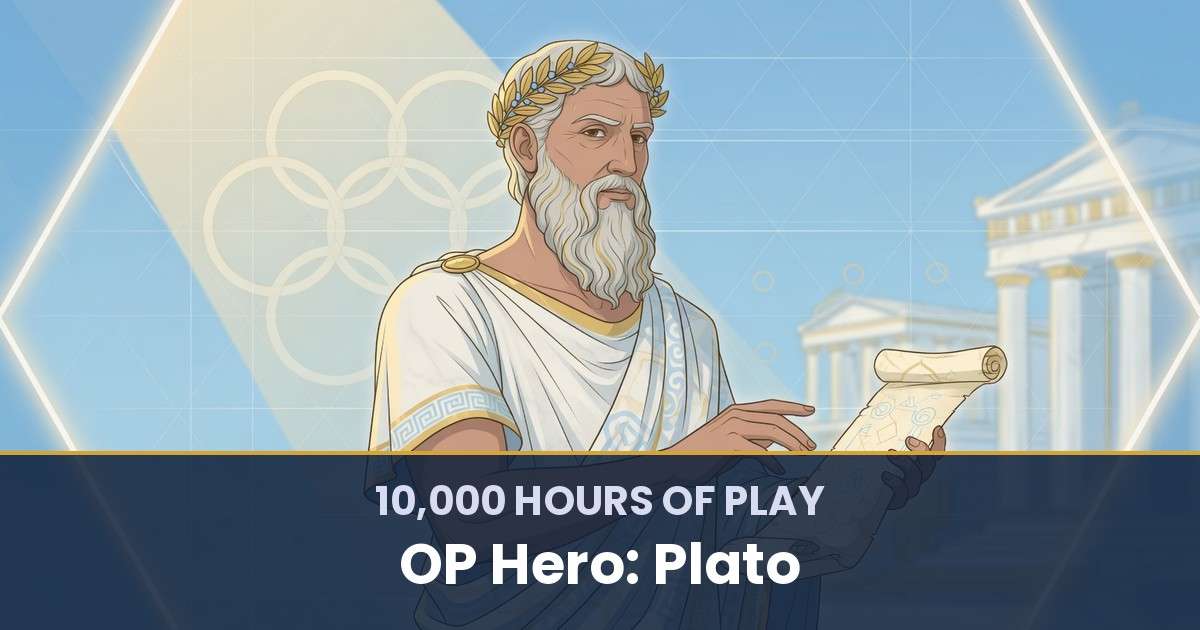
10,000 Hours of Play by OP Hero: Plato
Plato's 50-year run after 399 BCE — Academy, Republic, three failed Syracuse trips, and the Laws — read through the 10,000 Hours of Play 6-Step framework.


In 399 BCE, an Athenian jury voted to put a 70-year-old philosopher to death by hemlock. The condemned man was Socrates. One of the young aristocrats who had spent the previous decade or so following him through the streets was a 28-year-old named Plato.
Plato had been on the political-career track. His family was the right family, his city was the right city, and the next move was supposed to be the assembly. The execution rerouted him entirely.
He spent the next fifty years doing something stranger than running for office. He invented a new kind of institution, wrote about thirty-six dialogues that fixed his teacher’s voice in the historical record, and tried three separate times to install a philosopher-king in Sicily. Two of those Sicilian trips failed. The third nearly got him killed. He came back to Athens each time and kept writing.
That run is one of the cleanest specimens in the whole Western canon of a deliberate life-as-game build, and it maps with almost embarrassing precision onto the 6-Step framework Yu-kai uses to study OP Heroes.
⚡ Speed Run Notes
- Plato’s mission for fifty years was to make philosophy survive a city that had just killed its best philosopher. Books, school, and Sicilian advisory all served that one game.
- His innate stats: pattern-spotting at the level of Forms, moral seriousness that ranked soul over body, contrarian courage, regime-reading insight, and a native gift for myth.
- The load-bearing canon Skill is Cognitive Lens (Mage). The Theory of Forms is what happens when zoom-in and zoom-out fuse into one operating system.
- The Academy, founded around 387 BCE in the grove of Akademos, was the first institutionalized school in the West and ran for roughly three centuries after his death.
- The three Syracuse trips (388, 367, 361 BCE) are his most famous failure arc. He went back the third time and almost did not get out. Then he wrote the Laws.
Table of Contents
About Yu-kai Chou

Yu-kai Chou is the author of 10,000 Hours of Play — the book that treats your life as the most important game you’ll ever build a character in, and gives you the 6-Step framework (Game · Attributes · Role · Skills · Allies · Quests) to play it on purpose. He has spent two decades developing the system through which this post analyzes its OP Hero, and applies it to his own life and to the lives of the people he advises around the world.
Chou’s other framework, the Octalysis Framework, has been applied by LEGO, Microsoft, Porsche, Coca-Cola, Salesforce, and MrBeast, impacting over 1.5 Billion Users. He has taught the methodology at Harvard, Stanford, Yale, Tesla, Google, BCG, and IDEO, and has advised governments in eight nations including Ukraine, the United Kingdom, the Kingdom of Bahrain, Singapore, Taiwan, the Netherlands, Kazakhstan, and South Korea.
His work has been cited by Harvard, Stanford, MIT, Forbes, Wall Street Journal, Wired, US Department of Energy, NIST, NSF, NCBI, US Department of Education, ClinicalTrials.gov, and Google Scholar — with 3,700+ more academic publications. Explore his books here.
Yu-kai writes about Plato in 10,000 Hours of Play because almost nobody else in the Western canon left such a clean separation between the game (institutionalize philosophy so it outlasts any one city) and the rooms in which he played it (Athens classroom, Sicilian court, written dialogue). The single attribute to lift from Plato’s build is what Yu-kai calls regime-reading: the ability to look at a political room and diagnose, almost immediately, which Core Drives are running it and where the incentives are about to break. Plato did this for tyranny, oligarchy, democracy, and timocracy before political psychology had a name. The Skill to study is Cognitive Lens (Mage): the discipline to keep zooming between the specific case in front of you and the universal pattern behind it.
Step 1: The Game — What Plato Was Actually Playing
The cartoon Plato is the man of pure abstractions: Forms, the Cave, philosopher-kings. The cartoon is not wrong, but it undersells the actual game.
The mission, by his own account in the late dialogues and the Seventh Letter tradition, was practical. After 399 BCE he became convinced that an unphilosophical city would eventually kill its best people, and that the only durable answer was to build a way of life ordered by reason and a city ordered by knowledge. Souls aligned to the Good. Institutions aligned to truth.
That is the long campaign. The Republic is the design document. The Academy is the prototype. The Sicilian trips are the field test. The Laws is the post-mortem.
Read the corpus in that order and a single quest line snaps into focus. Defend philosophy. Train successors. Try to install a real philosophical regime. When that fails, write the rulebook for the next attempt. Repeat for fifty years.
He kept playing the same game because the original problem never resolved. Athens had killed Socrates, the regimes around the Mediterranean kept producing tyrants, and no one was institutionalizing the discipline that could push back. So Plato did it himself.
Step 2: Attributes — The Innate Stats
Five traits are visible early and stay constant across the whole run.
The first is pattern-spotting at the level of Forms. Even the early dialogues (Euthyphro, Laches, Charmides) pivot on Socrates pushing an interlocutor past “give me an example” toward “give me the one thing all these examples share.” That obsession with the unifying pattern behind scattered cases is not a method Plato picked up. It is a temperament he projected onto Socrates and then organized an entire metaphysics around.
The second is moral seriousness. The Apology has Socrates ranking the state of his soul above survival itself. Plato keeps that tonal register for fifty years across thirty-six dialogues. Wealth, honor, and power are always somewhere below the condition of the inner life.
The third is contrarian courage. Athenian opinion had just executed Socrates. Plato responded by making that same man his moral centerpiece in the Apology, Crito, and Phaedo. In Republic V he doubled down with claims most Athenians would have found ridiculous: rule by philosophers, common property for guardians, women in the guardian class. His resistance-to-crowd-pressure stat is unusually high.
The fourth is diagnostic intelligence about regimes. Republic VIII and IX run through timocracy, oligarchy, democracy, and tyranny as a cascading sequence of how cities decay. The comparative-political-psychology is uncannily sharp for what is effectively the first systematic attempt at the genre. In Talent Triangle terms, this is the attribute most worth lifting: he could read a room of incentives the way a chess master reads a board.
The fifth is native myth-making. The Cave allegory, the charioteer of the soul in the Phaedrus, the Myth of Er in Republic X, the Ring of Gyges in Republic II, the cosmology of the Timaeus. These are not decoration on the arguments. They are how Plato thinks. Dialogue, drama, and image come pre-installed.
Step 3: Role(s) — The Character Class Across Chapters
The character sheet re-classes about every fifteen years. Each role lasted long enough to ship a body of work and short enough that the previous one informed the next.
Aristocratic Athenian youth (c. 428 to c. 407 BCE). Born into a prominent Athenian family with political connections on both sides. Standard trainee path: rhetoric, gymnastics, exposure to the politics of the late Peloponnesian War. The default trajectory is the assembly.
Socratic apprentice (c. 407 to 399 BCE). Around his late teens he attaches to Socrates and joins the circle of young men who follow him through the agora. The first dialogues will eventually capture this period: short, aporetic, focused on cross-examining false experts. He becomes a specialist in elenchus before he becomes anything else.
Exiled theorist (c. 399 to c. 387 BCE). After the execution he leaves Athens. Ancient sources have him in Megara, Egypt, Cyrene, and southern Italy, where he meets Pythagoreans like Archytas of Tarentum and absorbs their mathematics and harmonic theory. The Theory of Forms and the immortal soul start crystallizing in this period. Both are, in part, attempts to build a metaphysics in which justice does not die when a just man does.
Academy founder and master teacher (c. 387 BCE onward). Back in Athens, he establishes the Academy in a sacred grove northwest of the city walls named for the hero Akademos. It is the first institutionalized philosophical school in the West, integrating philosophy, mathematics, astronomy, and political theory. The middle dialogues (Republic, Symposium, Phaedrus, Phaedo, Meno) come out of this phase. The class is guild leader of a new profession.
Philosopher-statesman in Sicily (388, 367, 361 BCE). Three times he leaves the Academy to try to shape an actual ruler. First Dionysius I, then his son Dionysius II, with Dion of Syracuse as the inside man. The class is high-risk political advisor, and the field results are bad.
Late lawgiver (c. 360 to 347 BCE). Back in Athens for the last decade or so of his life, he writes the Statesman, Sophist, Philebus, Timaeus, Critias, and the Laws. The Laws is twelve books of detailed legislation for a hypothetical city. The role here is constitutional architect: less utopia, more workable second-best.
Six roles. One game.
Step 4: Skills — The Real-Life Game Skills Plato Mastered
This is where the build gets technical. Six canon Real-Life Game Skills run through Plato’s corpus like rebar through concrete.
Cognitive Lens (Mage) — zoom in on the case in front of you, zoom out to the universal pattern, and refuse to drop either. The Theory of Forms is what happens when this Skill becomes an operating system. Euthyphro is asked “what is piety?”, offers examples, and Socrates keeps pushing for the single Form behind every example. The same move drives the Republic: stop asking which men are just and start asking what justice itself is. The whole metaphysics is the Skill scaled to ontology.
Astral Projection (Mage) — see all possible outcomes. Republic VIII and IX read like a regime simulator. Run a timocracy long enough and it becomes an oligarchy. Run an oligarchy long enough and it becomes a democracy. Run a democracy long enough and it produces a tyrant. The sequence is not mysticism; it is a working model of what incentives do to political souls over time. Plato built that model when there was no prior literature to draw on.
Loremaster (Druid) — weave compelling, archetypal stories. The Allegory of the Cave in Republic VII, the Ring of Gyges in Republic II, the charioteer of the soul in the Phaedrus, the Myth of Er in Republic X, the cosmology in the Timaeus. Each is the kind of image that lodges in cultural memory for two and a half millennia. The Skill is not “writes pretty stories.” It is “knows when an argument has hit a wall and a myth has to carry the load.”
Siphoning (Warlock) — extract skills and knowledge rapidly from others. The 399 to 387 BCE travel decade is one long Siphoning run. He sits with Megaran logicians, absorbs Pythagorean mathematics from Archytas in southern Italy, possibly visits Egypt for older mathematical and religious lore, then ports all of it back into the Academy curriculum. He never claims any of this material as his own invention. He just builds it into the program.
Courageous Heart (Paladin) — charge into hostile territory on purpose. Going to Syracuse in 388 BCE to lecture Dionysius I on virtue was the move of a man with a high stat in this Skill. Going back in 367 BCE when Dionysius II asked for him was a calculated bet. Going back a third time in 361 BCE, after he already knew the court was treacherous, was something close to reckless. Plato made the trip because the chance to shape an actual ruler was the chance he could not refuse.
Phoenix Rebirth (Paladin) — recover from devastating failure and come back stronger. Each Syracuse trip ended worse than the last. The first reportedly ended with Plato sold into slavery and ransomed by a friend, the third with Dion’s exile and eventual death. He came back to Athens each time, kept the Academy running, and used the late period to write the Laws, the most detailed political proposal of his life. Failure became material.
The Skills Spectrum frame is useful here. Plato sits at the Master end of every one of these, and the Master-level fluency is what lets him compose the late dialogues at a pitch most thinkers never reach.
Step 5: Allies — The People Who Multiplied Plato
A solo thinker still needs people who multiply him. Plato’s allies tier list is small and high-leverage.
Socrates (c. 470 to 399 BCE): the mentor and lifelong literary subject. Plato’s entire early corpus is built around recording, interpreting, and defending Socrates’ way of life. Without Socrates there is no specific moral exemplar for the philosophical life. Without Plato there is no Socrates for posterity. He wrote nothing himself.
Dion of Syracuse (c. 408 to 354 BCE): the patron, student, and inside man for all three Sicilian trips. Dion was the philosophically inclined relative of the tyrant who kept telling Plato that Syracuse was almost ready for a philosophical reformer. He was the reason Plato went the first time and the reason he went back.
Archytas of Tarentum (early-to-mid 4th century BCE): Pythagorean statesman and mathematician in southern Italy. He gave Plato the harmonic theory and mathematical orientation that show up later in the Timaeus and in the Academy’s quadrivium. He also, according to ancient tradition, intervened diplomatically to extract Plato from Syracuse on the third trip when the situation turned dangerous.
Eudoxus of Cnidus (c. 390 to 337 BCE): the leading mathematician and astronomer of the era, associated with the Academy. His work on proportion and on homocentric celestial spheres shaped the mathematical culture inside the school and gave the philosophy a rigorous quantitative spine.
Theaetetus of Athens (c. 417 to 369 BCE): a brilliant young mathematician whose work on irrational magnitudes and the regular polyhedra Plato memorialized in the dialogue Theaetetus. Theaetetus is the proof that the Academy was a working research collective, not a one-man show.
Speusippus (died 339/338 BCE): Plato’s nephew and, on the day Plato died, his successor as head of the Academy. The fact that the institution had a credible scholarch ready to take over is why the school survived another two and a half centuries.
Aristotle (384 to 322 BCE): joined the Academy at seventeen in 367 BCE and stayed for about twenty years until Plato’s death in 347 BCE. The single most consequential student in the history of education. Half of every disagreement in Western philosophy from then on is some descendant of the Plato–Aristotle dispute. You can read the Aristotle build over in his own OP Hero profile.
The same pattern as Socrates’ build holds here: even thinkers who look like solo geniuses are running on a small dense graph of named allies who keep multiplying their reach.
Step 6: Quests — The Milestones That Shaped the Saga
Six dated milestones tell the whole arc.
399 BCE: the execution of Socrates and the trial dialogues. An Athenian jury convicts Socrates of impiety and corrupting the youth, and orders him to drink hemlock. Plato responds across the next two decades with the Apology, Crito, Euthyphro, and Phaedo, fixing Socrates’ voice and his death in the historical record. The pivot from political career to philosophical mission dates from this event.
388 BCE: the first Sicilian trip. Plato sails to Syracuse, befriends Dion, and lectures Dionysius I on the philosophical life. The tyrant takes offense. Ancient tradition (Diogenes Laertius, Plutarch) has Plato sold into slavery and ransomed by a friend from Cyrene. Modern scholarship treats some of those details as embellished, but the trip is a real political failure either way. He returns to Athens with a new sense of what philosophy is up against in real regimes.
c. 387 BCE: the founding of the Academy. Back in Athens, Plato establishes a school in the sacred grove of Akademos, just outside the city walls. Curriculum integrates philosophy, mathematics, astronomy, and political theory. It is the first formal institutionalized philosophical school in the West and runs as an institution for roughly three centuries. This is the single most durable structure Plato builds.
c. 380s to 370s BCE: composition of the Republic. The central political-philosophical project. The dialogue defines justice as each part of the soul and the city doing its proper work under the rule of reason, and argues that the most just city is one ruled by philosopher-kings who have knowledge of the Form of the Good. It is the design document for everything that follows.
367 and 361 BCE: the second and third Sicilian trips. Dionysius I dies and his son Dionysius II takes the throne. Dion invites Plato back to tutor the new ruler. The second trip ends badly, the third worse: Dion is exiled, Plato is detained, and Archytas of Tarentum has to intervene diplomatically to get him out. Dion is murdered in 354 BCE. The philosopher-king project is finished in practice.
c. 360 to 347 BCE: the late dialogues and the Laws. Back in Athens, Plato writes the Statesman, Sophist, Philebus, Timaeus, Critias, and the Laws. The Laws is twelve books of detailed legislation for a hypothetical second-best city, much more concrete than the Republic, written by a man who has now spent decades watching how real polities resist philosophical reform. He dies around 347 BCE, near the age of eighty, and Speusippus takes over the school.
The setbacks are not bugs in this build. The Syracuse failures gave Plato the Laws. Without the failed philosopher-king bet, the late constitutional thought never sharpens. His career runs on the Phoenix Rebirth Skill at scale.
What You Can Steal From Plato’s Build
Three things travel from Plato’s run to ours.
First, the institution beats the personality. Socrates was probably the more dazzling teacher in the room, but he wrote nothing and started no school, and so Athens was free to execute him and move on. Plato built an institution that outlasted him by centuries, and the only reason we have Socrates at all is because Plato’s school kept transmitting him. If you care about a way of thinking surviving the next regime change in your own life, build a vehicle for it that does not depend on you being in the room.
Second, the failed field tests are where the rulebook gets written. The Sicilian trips are the most studied negative case in ancient political philosophy, and they are exactly what makes the Laws better than the Republic. The Republic is the design of someone who has not yet tried to install it. The Laws is the design of someone who has tried three times and watched it break in interesting ways. If you have a theory you have not yet field-tested, the failures will improve the theory more than another round of pure design will.
Third, you can run a philosopher-king bet without becoming a philosopher-king. Plato did not try to seize Syracuse. He tried to shape the person who already held it. Most modern equivalents of the philosopher-king move are not running for office; they are advising the people who already are, or the founders who already control the company, or the platforms that already shape the discourse. Marcus Aurelius’ build shows what happens when the philosopher actually does become the king, and the answer is that you still write your Meditations late at night because being king does not solve the inner problem.
If you want to apply this to your own build: name the institution you would like to leave behind, define the curriculum it has to transmit, and pre-commit to whichever Skill will let you keep teaching when the next room turns hostile. That is the whole 10K HP framework, applied to the man who founded the institution that taught the West how to argue for the next two and a half thousand years.
Where this framework comes from

Want the full system this profile is built on?
Every OP Hero piece runs through the same 6-Step framework from 10,000 Hours of Play: Unlock Your Real-Life Legendary Success. The book covers the full system, walks through Yu-kai’s own life run as the first applied case study, and gives you the worksheets to audit your own build.
Related Reading
- All OP Hero Profiles: the running hub of 10K HP-style profiles, with Skills and Roles tagged for each hero.
- Socrates as OP Hero: the mentor whose execution rerouted Plato into philosophy as a life mission.
- Aristotle as OP Hero: Plato’s most consequential student, who joined the Academy at seventeen and reorganized the whole field.
- Marcus Aurelius as OP Hero: the closest thing the West ever got to an actual philosopher-king, four centuries after Plato proposed the role.
- Confucius as OP Hero: the contemporaneous Eastern build of a teacher who never got the political appointment he wanted and shipped a moral curriculum anyway.
- The 10K HP Framework: the 6-Step framework underlying every profile in this series.