
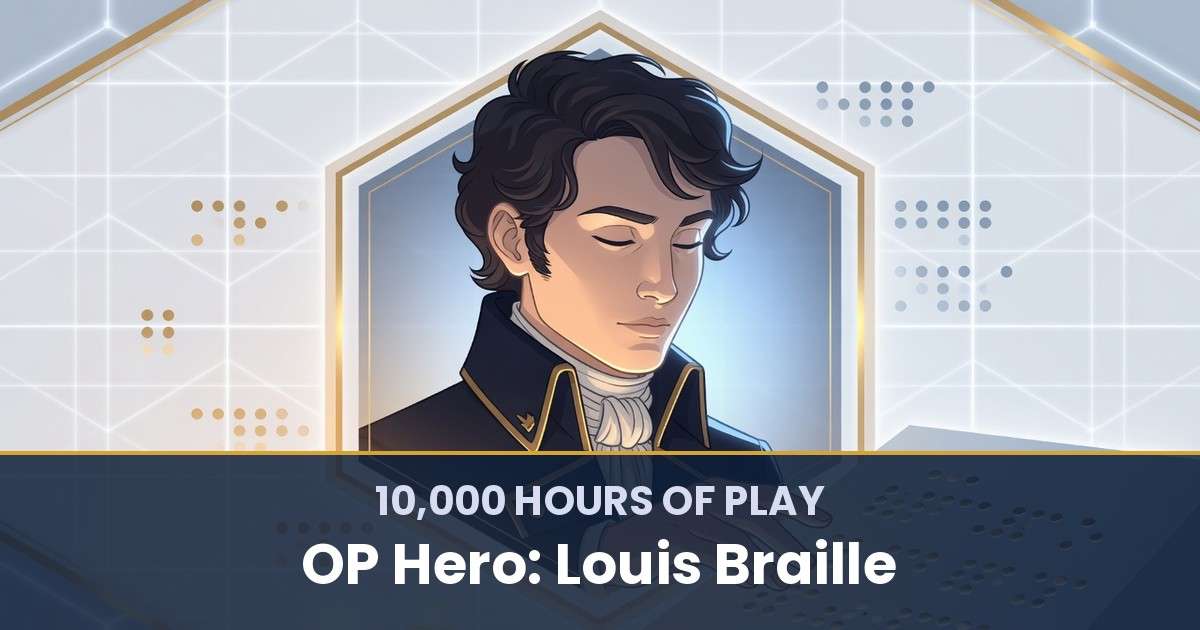


By the time he was fifteen, Louis Braille had worked out how a blind person could read fast enough for it to matter.
He did it with a grid of six raised dots you could take in under a single fingertip. That grid is still how millions of blind people read today, almost two centuries later.
Braille was born in 1809 and died in 1852, aged forty-three, without ever seeing his system officially adopted. The institution that trained him even banned it for a while and burned the books. He kept refining it anyway, for readers he would never meet.
⚡ Speed Run Notes
- Braille’s real game was not inventing an alphabet. It was giving blind people independent access to knowledge at the speed sighted people took for granted.
- His breakthrough was subtraction, not addition. He took a clumsy 12-dot army code and cut it in half, to a 6-dot cell readable with one finger.
- He finished the core system by age 15, in 1824, and published it in 1829, while still a student at the school.
- He extended the same six dots to music and math, proving the system was a platform, not a party trick.
- His hardest setback came from his own side: a later director banned the code and destroyed the books. It was formally adopted in 1854, two years after Braille had already died.
Updated 4 October 2026: added the 1844 demonstration that brought his code back, two blind inventors working today, and common questions.
Table of Contents
About Yu-kai Chou

Yu-kai Chou is the author of 10,000 Hours of Play — the book that treats your life as the most important game you’ll ever build a character in, and gives you the 6-Step framework (Game · Attributes · Role · Skills · Allies · Quests) to play it on purpose. He has spent two decades developing the system through which this post analyzes its OP Hero, and applies it to his own life and to the lives of the people he advises around the world.
Chou’s other framework, the Octalysis Framework, has been applied by LEGO, Microsoft, Porsche, Coca-Cola, Salesforce, and MrBeast, impacting over 1.5 Billion Users. He has taught the methodology at Harvard, Stanford, Yale, Tesla, Google, BCG, and IDEO, and has advised governments in eight nations including Ukraine, the United Kingdom, the Kingdom of Bahrain, Singapore, Taiwan, the Netherlands, Kazakhstan, and South Korea.
His work has been cited by Harvard, Stanford, MIT, Forbes, Wall Street Journal, Wired, US Department of Energy, NIST, NSF, NCBI, US Department of Education, ClinicalTrials.gov, and Google Scholar — with 3,700+ more academic publications. Explore his books here.

Braille was a teenager when he fixed a reading problem the adults around him had lived with for decades. His is the build I point to for a Skills lesson about subtraction: his breakthrough came from cutting a system in half, not adding to it. Most people try to win by piling on more features, more effort, more complexity. Braille won by making the thing small enough to use with a single fingertip. That instinct — strip it down until it actually works in a real hand — is one of the most underrated moves in any build.
Step 1: The Game — What Louis Braille Was Actually Playing
His mission was access. He wanted blind people to read, write, study, and make music as fast and as freely as sighted people, without needing anyone to read aloud to them.
Before you optimize anything, you have to name the real game you are playing. Braille named his while he was still a boy at a school that thought it had already solved the problem with big embossed letters you traced slowly with a finger.
He had used those embossed-letter books. He knew they were too slow and too bulky to make a blind reader genuinely independent. That personal frustration set the target for the rest of his life.
Everything he built afterward, from the letter code to the music notation to a failed attempt at a print bridge for sighted readers, was a different attack on the same goal.
Step 2: Attributes — The Innate Stats
Attributes are the stats you show up with, visible before anyone trains them into you. Braille’s showed up early and under brutal conditions.
The first was pattern sensitivity. Blinded as a small child after an accident with one of his father’s leather-working tools, he developed unusually sharp tactile discrimination and a feel for spatial structure. That is what let him later recognize a letter from a single touch instead of tracing its shape.
The second was persistence under constraint. He lost his sight, then lost most of the tools other children used to learn, and instead of withdrawing he kept studying at the Royal Institution for Blind Youth in Paris, where he would later teach.
The third was empathy aimed outward. He was not only solving his own reading problem. He kept designing for other blind students, and later for blind musicians, which is why he pushed the system far past a bare alphabet.
The fourth was a quiet contrarian streak. As a teenager he was willing to say, in effect, that a decorated former army officer’s invention was too clumsy and that his own redesign was better. These raw traits are the bottom layer of any life, and they map onto what I call the Talent Triangle, where what you are born with meets what you keep being pulled toward. Braille was born tactile, stubborn, and other-focused, and he compounded exactly those stats.
Step 3: Role(s) — The Character Class Across Chapters
One person can play very different classes across a life. Braille cycled through several while the mission underneath stayed fixed.
He began as a blind student, admitted young to the Institution in Paris that Valentin Haüy had founded in 1784. His early role was simply to survive and excel in a system built on slow embossed letters.
Then he became a systems hacker. While still a pupil, he took apart Charles Barbier’s “night writing,” a dot-and-dash code originally meant for soldiers, and rebuilt it into something far leaner. That work made him an inventor before he was old enough to vote.
As an adult he added the role of teacher, instructing blind students at the same Institution and using his own code in the classroom.
In his final chapters he played author and quiet reformer, publishing his system, extending it to music, and even attempting a print bridge so sighted and blind readers could share pages.
Step 4: Skills — The Real-Life Game Skills Louis Braille Mastered
Attributes are innate. Skills are earned, and they are where Braille’s story turns into a working system.
Track Treasure (Ranger) is spotting a hidden opportunity that everyone else has walked past. The adults at the school saw Barbier’s night writing as a curiosity that had failed at its military purpose. Braille saw a starting point worth a decade of work. He found the treasure in a thing others had already discarded.
Elemental Transposition (Mage) is reframing every problem as a puzzle to be solved rather than a fact to be accepted. Reading was treated as an unfixable hardship of blindness. Braille reframed it as a design problem: what is the smallest, cleanest unit a fingertip can reliably decode?
Devour (Warlock) is reducing something to its leanest possible form. This was his signature move. Barbier’s cell used twelve dots, too tall for one fingertip to read at a glance. Braille cut it to six, arranged two across and three down, giving 64 clean combinations. Knowing what to strip away and what to keep is exactly the kind of deliberate design choice the Skills Spectrum is about.
Floral Blossom (Druid) is educating and mentoring others. Braille did not just invent and retreat. He became a teacher at the Institution, putting his own system into the hands of the students who needed it and proving in the classroom that it actually worked.
Prophetic Calling (Paladin) is the hope-builder skill: acting as if a world where your work matters is coming, even when the present gives you no proof. Braille refined a system his own institution would ban, for a future he had every reason to doubt he would see. He built anyway.
Step 5: Allies — The People Who Multiplied Louis Braille
No one changes how a whole population reads alone. Braille’s breakthrough sat on top of other people’s work, and its survival depended on allies who outlasted him.
The first was a predecessor he never met. Valentin Haüy founded the Royal Institution for Blind Youth and proved blind children could be taught to read at all, using embossed letters. Braille replaced Haüy’s method, but he started from the world Haüy had built.
The second was an unlikely donor of raw material. Charles Barbier, the former army officer, brought his night-writing code to the school. It was too clumsy to use directly, but it handed Braille the core idea of reading by touchable dots.
Inside the school, the director Dr. Alexandre-René Pignier backed him, letting the dot system be taught and tested rather than shut down.
He also had a peer who lived it with him. Gabriel Gauthier, a blind friend and fellow musician, was part of the world Braille designed for, a reminder that his system was built with real users in mind, not in the abstract.
Step 6: Quests — The Milestones That Shaped the Saga
A life is remembered for its quests, the specific projects where everything was on the line.
The first was the core system itself. By 1824, at just fifteen, he had condensed Barbier’s code into the six-dot cell. In 1829 he published it, in a work whose title translates as a method of writing words, music, and plainsong in dots.
The second was proving the system could scale. He extended the same six dots into a full musical notation so blind musicians could read scores on their own, and in an 1837 revision he added contractions to speed reading. That edition is sometimes called the first binary form of writing in the modern era, each dot simply raised or flat.
The third quest was a genuine failure, and it belongs in the log. Around 1839 he devised a system he called decapoint, a way to render dotted text that sighted readers could also see, hoping to bridge the two worlds. It never caught on.
His hardest setback did not come from a rival but from his own institution after his health had already broken. He fell ill with tuberculosis in the 1830s and died on 6 January 1852, aged forty-three. Years earlier, in 1840, a new director, Pierre-Armand Dufau, had banned the dot system for everything except music, and books were destroyed. A public demonstration in 1844 brought the code back into the school, and France formally adopted it in 1854, two years after Braille was gone.
The delayed victory was total. In 1952, on the centenary of his death, France moved his remains to the Panthéon, honoring a man whose six dots had by then become the way blind people read across the world.
What You Can Steal From Louis Braille’s Build
You are not likely to reinvent how millions of people read. The build patterns still transfer.
Win by subtraction. When something almost works but feels heavy, try removing a part before you add one.
Design from inside the problem. Braille was blind, so he knew exactly why embossed letters failed real readers. Whatever you are building, get as close to the actual user’s hands as he was to his own, and the fake solutions fall away fast.
Play past your own lifetime. Braille kept refining a banned system for a payoff he never lived to collect. Pick one project whose payoff sits years away and give it a fixed slot in your week.
The 10K HP Frame — Louis Braille Through the 6 Steps Lens
This pass adds what the six Steps above leave out: the library he found on arrival, his organ work, two more Skills, and the ally who brought the code back in 1844.
The Game. When he arrived at the Royal Institution for Blind Youth in Paris in 1819, the library held a small number of huge books printed in raised Roman letters. Each page had to be traced slowly, one letter at a time. Braille wanted something a blind person could read at the speed of thought and also write by hand, alone.
The Attributes. Three of his starting stats did most of the work: a fine sense of touch, the patience to grind on one problem for years, and firsthand knowledge of what blind students needed, since he was one of them.
The Roles. He cycled through student, inventor, teacher, organist, and author. He held organist posts at Paris churches, which kept his ear and his hands in daily training and explains why music notation was never an afterthought in his system.
The Skills. Lich Grind (Warlock) is the intense, secluded work period. Braille did much of his refining at night after lessons, punching cells with a stylus and testing them under his own fingertip. A system that reads in a single touch came out of years of small trials.
Aegis (Paladin) is the ability to keep pushing the Quest while critics and naysayers say no. In 1840 director Pierre-Armand Dufau suppressed the dot code at the school for everything except music. Braille was alive and teaching through those years. He kept the system ready for the day the door opened again, and his students kept it in their hands.
The Allies. Beyond Haüy, Barbier, and Pignier, the sheet needs Joseph Guadet, Dufau’s own assistant. On February 22, 1844, at the dedication of the Institution’s new building, Guadet staged a public demonstration. A student wrote a passage of poetry in braille while another waited outside, and the second student came back in and read it aloud. From that day the code was back in use at the school.
The Quests. The six-dot cell in 1824, the published method in 1829, the 1837 revision with contractions, decapoint in 1839, and the long wait for recognition. His Quest log ends with a scoreboard he never got to read: national adoption in France in 1854 and, a century after his death, a place in the Panthéon.
Which Octalysis Core Drives Louis Braille’s Arc Activated
The Octalysis Framework looks at the motivation underneath a behavior. Run Braille’s life through it and four of the eight Core Drives carry almost the whole story.
CD1 Epic Meaning & Calling
Epic Meaning & Calling is the drive that makes you act because you believe your work serves something bigger than yourself.
The evidence line is the decade after 1840. His own school had pushed the code to the margins, his tuberculosis was getting worse, and there was no money, title, or public credit on offer. He went on teaching the code and improving it through the 1840s.
CD3 Empowerment of Creativity & Feedback
Empowerment of Creativity & Feedback is the drive behind building, combining, and seeing the result of your choices right away. This is the drive his invention handed to its users.
The embossed books at the school were read-only. A blind student could trace them but could not easily write back. Braille’s cell works with a slate and a stylus, so a reader could also take notes, write letters, compose music, and check the result under a fingertip immediately. Sixty-four combinations from six dots gave blind writers a full creative toolbox for the first time.
Embossed letters let a blind child read what someone else had chosen. Six dots let that child write back.
CD2 Development & Accomplishment
Development & Accomplishment is the drive to make progress, build skill, and overcome challenges. Braille felt it as an inventor and engineered it into the reading experience.
As the inventor, he kept leveling the system: letters first, then punctuation and numbers, then music notation, then the 1837 contractions that let fluent readers move faster. Each version was a measurable upgrade. As the designer, he made the reader’s progress visible too. A student who used to crawl through a raised-letter page could feel their own speed climbing week by week.
Two dots across and three down gave blind readers sixty-four patterns under one fingertip.
CD5 Social Influence & Relatedness
Social Influence & Relatedness covers mentorship, companionship, and the pull of what peers are doing. The code survived because of it.
Braille taught his system to the boys at the Institution, and they used it with each other long before any official body approved it. When Guadet wanted to persuade a skeptical audience in 1844, he let two students show what they could do together.
Modern Echo — Who’s Playing This Game Today
Two blind builders working today follow the same path from a personal need to a tool other blind people can use every day.
Chieko Asakawa. She injured her optic nerve in a swimming accident at eleven and was fully blind by fourteen. At IBM Research in Tokyo she worked on a word processor for braille documents and a digital braille library, and in 1997 her browser plug-in became IBM Home Page Reader, which grew into one of the most widely used web-to-speech systems of its time. Her current Quest is the AI Suitcase, a rolling navigation robot shaped like carry-on luggage that guides a blind traveler through indoor spaces. She first imagined it in 2017. It began regular pilot service at Miraikan, the Tokyo science museum she directs, in April 2024, and ran a large field trial at Expo 2025 in Osaka.
The Braille echo is direct. She has carried one Game across four mediums: braille itself, then computers, then the web, and now the physical world.
Amos Miller. Miller lost his sight in his early twenties to a genetic eye condition. In Seattle he founded Glidance, which showed its self-guided mobility aid, Glide, at CES in January 2024. Glide is a handle on a pole over a small wheeled base with cameras and sensors. It steers around obstacles and gives haptic signals through the handle, while the user keeps control and can override its direction.
Miller’s design choices sound a lot like Braille’s. He has said the hardest problem was affordability, so the team built on off-the-shelf parts and a single AI model. He wants new users walking confidently within hours, against the months or years of training many current options require.
Frequently Asked Questions
How old was Louis Braille when he invented braille?
He had the core six-dot system worked out by 1824, when he was fifteen. He published it in 1829 and kept improving it, adding contractions in an 1837 revision.
How did Louis Braille go blind?
At about three years old he injured one eye with a sharp tool in his father’s leather-working shop. Infection spread to the other eye, and he was completely blind by around age five.
Why did Braille use six dots?
Charles Barbier’s night writing used cells of up to twelve dots, too tall to read with a single fingertip. Braille cut the cell to six dots, two across and three down, which fits under one fingertip and still gives 64 possible patterns.
Was braille banned at Louis Braille’s own school?
Yes. In 1840 the new director, Pierre-Armand Dufau, suppressed the dot code at the Paris institution for everything except music. His assistant Joseph Guadet organized a public demonstration in February 1844, and braille returned to the school after that.
When was braille officially adopted?
France adopted braille officially in 1854, two years after Louis Braille died. In 1952, on the centenary of his death, his remains were moved to the Panthéon in Paris.
Where this framework comes from

Want the full system this profile is built on?
Every OP Hero piece runs through the same 6-Step framework from 10,000 Hours of Play: Unlock Your Real-Life Legendary Success. The book covers the full system, walks through Yu-kai’s own life run as the first applied case study, and gives you the worksheets to audit your own build.
Related Reading
- The full OP Hero Profiles hub. Every hero we have run through the 6-Step framework, in one place.
- OP Hero: Helen Keller. Another build that turned a sensory limit into a lifelong campaign for access.
- OP Hero: Louis Pasteur. A fellow Frenchman who cracked problems by stripping them to a single cause.
- OP Hero: Srinivasa Ramanujan. A genius whose work needed one believer to reach the world.
- OP Hero: Temple Grandin. A builder who designed from her own sensory perspective.
- OP Hero: Alexander Graham Bell. A career that began in teaching deaf students to speak.
- The 10,000 Hours of Play framework. The full 6-Step system for treating your life as a game you play on purpose.