
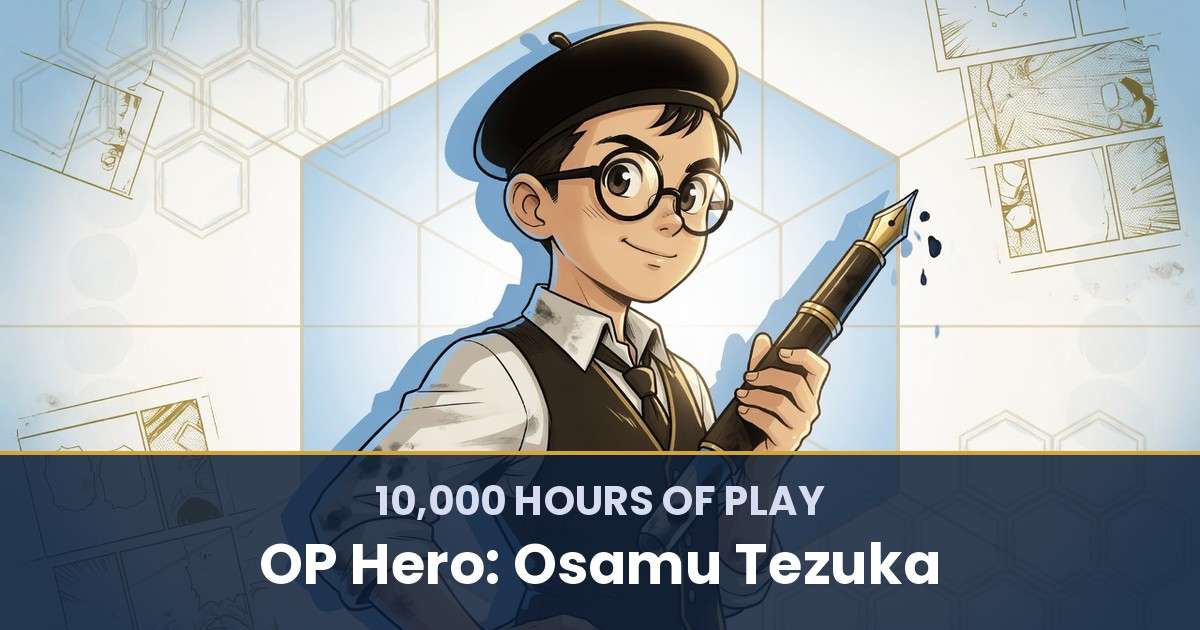
10,000 Hours of Play by OP Hero: Osamu Tezuka
Astro Boy, Black Jack, and a 1973 bankruptcy: the 6-Step OP Hero build behind the God of Manga's 150,000-page run.


On February 9, 1989, Japan’s most prolific artist died with his life’s work unfinished. The people near his bed later recalled his final words: “I’m begging you, let me work.”
That was Osamu Tezuka. Across four decades he drew roughly 150,000 pages of manga, fed more than a hundred animated works, earned a medical degree he never practiced with, built the studio that invented weekly TV anime, and then lost that studio to bankruptcy.
Japan calls him the God of Manga. Open his file in the 10,000 Hours of Play framework, though, and the myth sharpens into something you can use: a character build with visible stats, learnable Skills, and one very expensive failure quest.
Here is his character sheet.
⚡ Speed Run Notes
- Tezuka drew roughly 150,000 manga pages, fed more than a hundred animated works, and still finished a medical doctorate. Output at that scale is a designed system, and every part of the system is copyable.
- His 1947 breakout New Treasure Island imported film grammar into comics. Rival artists mocked the multi-panel style as wasted space; the book reportedly sold about 400,000 copies.
- Astro Boy reached television in January 1963 as Japan’s first half-hour weekly anime because Tezuka cut animation down to as few as four frames per second. The constraint became an industry’s business model.
- Mushi Production collapsed in 1973 under debts reported in the hundreds of millions of yen. Black Jack launched that same November: the cleanest Phoenix Rebirth in creative history.
- The transferable move: engineer the economics of your craft until your obsession fits inside them, then train the next generation inside your own studio.
Table of Contents
- About Yu-kai Chou
- Step 1: The Game Tezuka Was Actually Playing
- Step 2: Attributes, the Innate Stats
- Step 3: Role(s) Across Chapters
- Step 4: The Real-Life Game Skills He Mastered
- Step 5: The Allies Who Multiplied Him
- Step 6: The Quests That Shaped the Saga
- What You Can Steal From Tezuka’s Build
- Where this framework comes from
- Related Reading
About Yu-kai Chou

Yu-kai Chou is the author of 10,000 Hours of Play — the book that treats your life as the most important game you’ll ever build a character in, and gives you the 6-Step framework (Game · Attributes · Role · Skills · Allies · Quests) to play it on purpose. He has spent two decades developing the system through which this post analyzes its OP Hero, and applies it to his own life and to the lives of the people he advises around the world.
Chou’s other framework, the Octalysis Framework, has been applied by LEGO, Microsoft, Porsche, Coca-Cola, Salesforce, and MrBeast, impacting over 1.5 Billion Users. He has taught the methodology at Harvard, Stanford, Yale, Tesla, Google, BCG, and IDEO, and has advised governments in eight nations including Ukraine, the United Kingdom, the Kingdom of Bahrain, Singapore, Taiwan, the Netherlands, Kazakhstan, and South Korea.
His work has been cited by Harvard, Stanford, MIT, Forbes, Wall Street Journal, Wired, US Department of Energy, NIST, NSF, NCBI, US Department of Education, ClinicalTrials.gov, and Google Scholar — with 3,700+ more academic publications. Explore his books here.
Tezuka is the OP Hero I study whenever someone asks me whether the Skills step can really outplay raw talent. He had generational talent and still spent his life building systems around it: a reusable cast, a frame budget for television, a studio that doubled as a school. The lesson I lift from his build is the pairing of Devour with Lich Grind: he redesigned the cost structure of an entire medium so his obsessive output could survive the market that kept trying to kill it.
Step 1: The Game — What Osamu Tezuka Was Actually Playing
Every 10K HP profile starts by naming the hero’s Game, the one pursuit that stays constant while everything else changes. Tezuka’s Game is unusually easy to name.
He was trying to build a storytelling medium with the emotional power of cinema, cheap enough for every child in postwar Japan to hold, and deep enough for adults to take seriously.
You can see the Game forming early. He grew up in Takarazuka, where his mother took him again and again to the all-female Takarazuka Revue, and its theatrical staging soaked into how he framed a page.
He was an insect-obsessed kid who took his pen name from the osamushi ground beetle. Observation first, spectacle second.
The same Game explains every later move that confused people at the time. Manga was chapter one. Television animation was chapter two. The mature epics like Phoenix, Buddha, and Adolf were chapter three, pushing the medium into life, death, and ethics.
In Octalysis terms, Tezuka ran on Core Drive 1 (CD1): Epic Meaning and Calling. He acted like manga was destined to matter, decades before the world agreed.
A Game that clear filters every decision for you. Tezuka never had to ask what to do next, only which quest served the medium.
Step 2: Attributes — The Innate Stats
Attributes are the stats you spawn with. Tezuka’s sheet shows five that were visible before he turned twenty.
Output capacity. Roughly 150,000 drawn pages in one lifetime is not a habit you pick up. The volume of finished work he produced while still in medical school signaled a rare baseline.
Systems vision. Most artists see their next story. Tezuka saw the shape of an entire medium: its formats, its economics, its pipeline to television. Historians credit him with defining manga and TV anime as industries, which requires seeing structures where others see pages.
Risk appetite. He repeatedly bet his own solvency on unproven formats, and after his studio failed he was personally liable for the debt. He kept creating anyway.
Moral sensitivity. Look at his subjects: a mercenary surgeon in Black Jack, the founder of a religion in Buddha, war and discrimination in Adolf. He was drawn to suffering and ethics when children’s comics were expected to stay light.
Scientific curiosity. While already a working artist, he completed a Doctor of Medical Science degree in 1961 with an electron-microscope study of sperm-cell structure. Someone who finishes that degree mid-career wants to know how life works at the membrane level.
The Talent Triangle Method teaches you to hunt for the overlap of your strongest innate stats. Tezuka’s overlap was observation, volume, and structure, and he never worked outside it.
Step 3: Role(s) — The Character Class Across Chapters
Your Role is the class you play in a given chapter, and Tezuka multiclassed harder than almost any hero in this series.
Chapter one: the medical student. He entered Osaka University’s medical program at the war’s end and graduated in 1951. He was publishing professionally from 1946, so for five years he ran a full Mage-class science track and a creator track simultaneously.
Chapter two: the manga artist. After New Treasure Island hit in 1947, he committed to comics as his main class. The medical qualification stayed on the sheet as a stat boost that later gave Black Jack its surgical authenticity, and he never practiced clinically.
Chapter three: the studio founder. In 1961 he left Toei Animation and founded Mushi Production, taking on the producer class: hiring, training, pricing, and shipping a weekly television product.
Chapter four: the indebted independent. When Mushi went bankrupt in 1973, he lost the studio but kept the pen. He re-entered animation later through Tezuka Productions, this time as an author who owned his output.
Chapter five: the epic author. His final role was the novelist-scale storyteller of Phoenix and Buddha, using everything the earlier classes taught him.
The pattern worth copying: he changed Roles whenever the Game demanded it, and each abandoned class kept paying dividends into the next one.
Step 4: Skills — The Real-Life Game Skills Osamu Tezuka Mastered
Attributes are dealt; Skills are trained. On the Skills Spectrum Tezuka reads as a master who kept adding specialist tracks, and four canon Skills carried his run.
Elemental Ensemble (Mage) — mentally visualizing complex compositions, then executing them with precision. In January 1947, at eighteen, Tezuka drew New Treasure Island as if a movie camera were moving through it: shifting angles, close-ups, a single action stretched across multiple panels.
Rival cartoonists mocked the style as wasted space. Readers answered with reportedly about 400,000 copies sold, and postwar manga adopted his grammar. It was the same era in which Akira Kurosawa was forging Japan’s film language; Tezuka smuggled that language onto paper.
Devour (Warlock) — reducing steps and components until a process becomes lean enough to survive. Television animation was considered economically impossible on a weekly schedule, so Tezuka cut motion to as few as four frames per second, capped output around 3,000 drawn frames per episode per week, and built a bank system of reusable animation.
His Star System applied the same Skill to characters: a stock company of recurring “actors” like the mustachioed Higeoyaji, cast into different roles across unrelated works so readers arrived pre-loaded. Astro Boy reached television in January 1963 as Japan’s first half-hour weekly anime because the process had been Devoured into feasibility.
Lich Grind (Warlock): intense, secluded work periods. Tezuka ran multiple serials in parallel for decades, and colleagues describe key animation so idiosyncratic he made no timesheets and numbered nothing, because no one else needed to read it. The grind that Eiichiro Oda later became famous for descends directly from this template.
Phoenix Rebirth (Paladin): recovering from devastating failure and returning stronger. The 1973 bankruptcy would have ended most careers. Tezuka answered it within the year, and the comeback vehicle is the next section’s story.
Step 5: Allies — The People Who Multiplied Osamu Tezuka
No OP Hero solos the endgame, and Tezuka’s alliance map is long.
His mother funded the earliest quest line with attention: the Takarazuka Revue outings and steady encouragement that biographers keep pointing to as the root of his staging instincts.
Shichima Sakai handed him the breakout. Sakai wrote the story for New Treasure Island; the teenage Tezuka illustrated it, and the Osaka akahon publishers behind it gave the book its huge print run and reach.
The Mushi Production bench is where his Ally strategy compounds. Tezuka used Floral Blossom (Druid), the mentoring Skill, on an entire generation: Osamu Dezaki joined in 1963 with no animation experience and rose from in-betweener to Astro Boy episode director before defining Tomorrow’s Joe; Gisaburō Sugii refined Tezuka’s rough animation into finished key frames; Rintaro keyed early episodes under his supervision; and Yoshiyuki Tomino directed Triton of the Sea before creating Mobile Suit Gundam.
Build a studio that teaches, and your Allies carry your Game further than your own hands ever could. That is Core Drive 5 (CD5): Social Influence and Relatedness operating as infrastructure.
And one ally moment he retold for the rest of his life: at the 1964 New York World’s Fair, Walt Disney told him, by Tezuka’s own account, that he knew Astro Boy and called it a great work. The kid who studied cinema had been seen by cinema.
Step 6: Quests — The Milestones That Shaped the Saga
Quest 1: New Treasure Island, January 1947. The debut that rewired a medium, reportedly around 400,000 copies at a time when paper itself was scarce.
Quest 2: Jungle Emperor, 1950 to 1965. The white lion Kimba went from manga serial to the 1965 series widely credited as Japan’s first color TV anime.
Quest 3: Astro Boy, 1952 to 1963. The robot boy carried manga onto television in January 1963, with peak household ratings reported above 30 percent. This quest created an industry’s default format.
Quest 4: the doctorate, 1961. A side quest completed for its own sake, and quiet proof that his curiosity stat never idled.
Quest 5: the bankruptcy, 1973. Mushi Production collapsed under debts reported in the hundreds of millions of yen, with Tezuka personally on the hook. He sold properties, kept drawing, and refused the ending the industry had written for him.
Quest 6: Black Jack, November 1973. In the same year as the collapse, the unlicensed surgeon debuted in Weekly Shōnen Champion and ran to roughly 200-plus chapters. The comeback restored him commercially and critically, and its hero was, fittingly, a doctor who works outside the system.
The endless quest: Phoenix. His self-declared life’s work cycled through reincarnation and deep time, and it was still open on February 9, 1989. The full run behind him: a Complete Works edition from Kodansha spanning roughly 400 volumes.
What You Can Steal From Osamu Tezuka’s Build
Import grammar from the medium next door. Tezuka’s breakout was film technique on paper. Whatever field you play in, an adjacent field has already solved a problem yours still treats as impossible.
When the economics say no, Devour the process. Weekly anime was unaffordable, so he redesigned the cost of making it. Shrinking the production beats shrinking the dream.
Schedule the comeback inside the collapse. Bankruptcy and Black Jack share a year. Phoenix Rebirth is a Skill precisely because it can be practiced: line up the next quest before the grief finishes.
Teach inside your production system. The directors he trained became the next fifty years of anime. Browse the other OP Hero profiles and you’ll notice the longest-lasting Games are the ones whose heroes built successors on purpose.
Tezuka found his adjacent grammar at eighteen, in postwar Osaka, on rationed paper. Yours is probably one tab away.
Where this framework comes from

Want the full system this profile is built on?
Every OP Hero piece runs through the same 6-Step framework from 10,000 Hours of Play: Unlock Your Real-Life Legendary Success. The book covers the full system, walks through Yu-kai’s own life run as the first applied case study, and gives you the worksheets to audit your own build.
Related Reading
- All OP Hero Profiles — the 10,000 Hours of Play hub
- 10,000 Hours of Play by OP Hero: Hayao Miyazaki
- 10,000 Hours of Play by OP Hero: Akira Toriyama
- 10,000 Hours of Play by OP Hero: Shigeru Miyamoto
- 10,000 Hours of Play by OP Hero: Stan Lee