
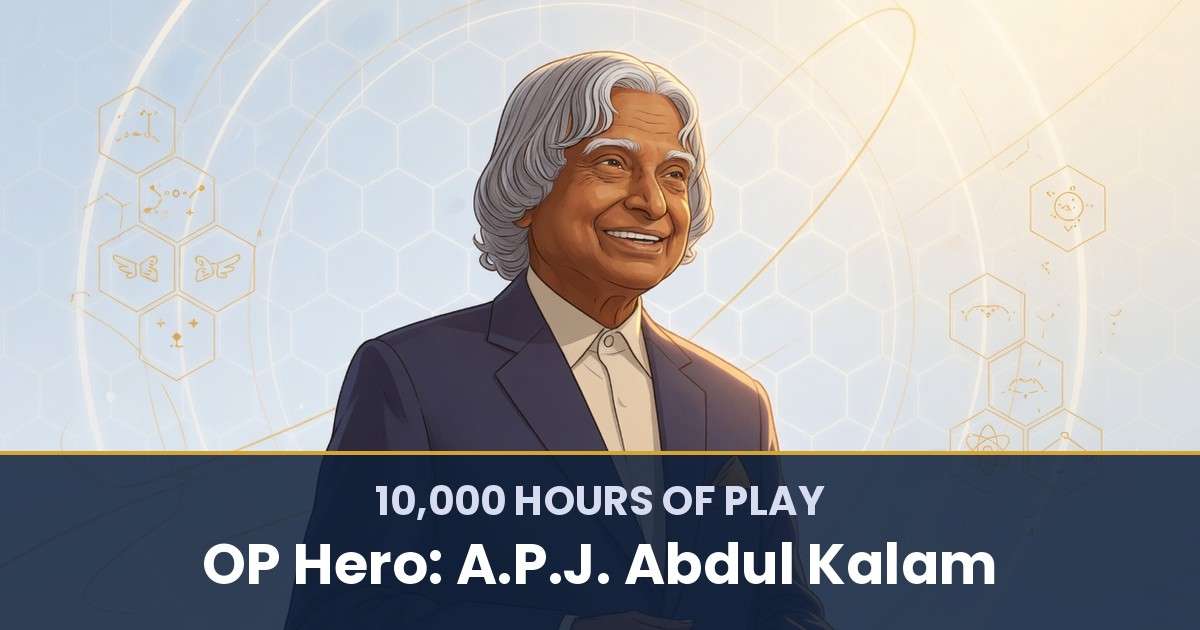
10,000 Hours of Play by OP Hero: A.P.J. Abdul Kalam
From selling newspapers in Rameswaram to launching India's first satellite: A.P.J. Abdul Kalam's complete OP Hero build across the 6 Steps.


On July 27, 2015, an 83-year-old man walked into a lecture hall at IIM Shillong to deliver a talk titled “Creating a Livable Planet Earth.”
Partway into the lecture, he collapsed. A.P.J. Abdul Kalam died in front of a room full of students, doing the exact thing he had chosen as his final quest.
Rewind thirty-five years and he is standing at a press conference microphone, taking credit for India’s first satellite launch. Rewind one more year and he is watching that same rocket program dump its first flight into the Bay of Bengal. Rewind to the 1940s and he is a boy in Rameswaram selling newspapers to help his family get by.
Newspaper boy, rocket engineer, missile programme chief, president of India, professor. By the end, the man who coordinated a nuclear weapons test reportedly owned little beyond his books and a veena.
Few lives map as cleanly onto the 6 Steps as his, so let’s run the full build.
⚡ Speed Run Notes
- Kalam’s Game held steady for six decades: build India’s strategic technology at home first, then spend that credibility pointing an entire generation of students at a bigger goal.
- His 1979 launch failure is the single best Allies lesson in this catalog: ISRO chairman Satish Dhawan absorbed the blame at the press conference, then handed Kalam the microphone after the 1980 success.
- He class-changed four times (engineer, launch-vehicle architect, missile commander, head of state) and never swapped the underlying mission.
- Step 4 receipts: Cosmic Alignment, Phoenix Rebirth, and Concord of Elements show up at every major breakthrough from SLV-3 to Pokhran-II.
- His final class change was downward in rank and upward in impact: from president to professor, teaching until the minute his heart stopped.
Table of Contents
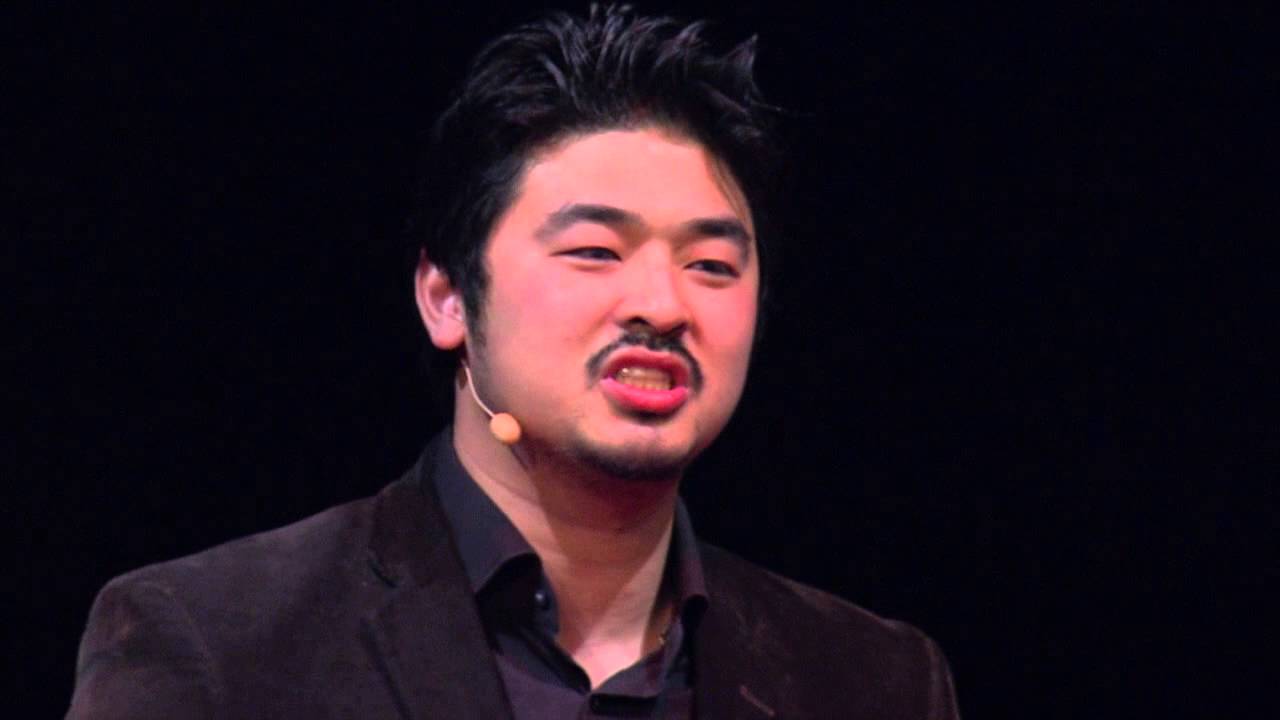
About Yu-kai Chou

Yu-kai Chou is the author of 10,000 Hours of Play — the book that treats your life as the most important game you’ll ever build a character in, and gives you the 6-Step framework (Game · Attributes · Role · Skills · Allies · Quests) to play it on purpose. He has spent two decades developing the system through which this post analyzes its OP Hero, and applies it to his own life and to the lives of the people he advises around the world.
Chou’s other framework, the Octalysis Framework, has been applied by LEGO, Microsoft, Porsche, Coca-Cola, Salesforce, and MrBeast, impacting over 1.5 Billion Users. He has taught the methodology at Harvard, Stanford, Yale, Tesla, Google, BCG, and IDEO, and has advised governments in eight nations including Ukraine, the United Kingdom, the Kingdom of Bahrain, Singapore, Taiwan, the Netherlands, Kazakhstan, and South Korea.
His work has been cited by Harvard, Stanford, MIT, Forbes, Wall Street Journal, Wired, US Department of Energy, NIST, NSF, NCBI, US Department of Education, ClinicalTrials.gov, and Google Scholar — with 3,700+ more academic publications. Explore his books here.
What pulls me into Kalam’s build is Step 5. At every dangerous moment of his career, an ally stood in front of him when things broke and stepped aside when things worked: a schoolteacher who taught him after hours, a chairman who took the blame for his failed rocket. If you lift one thing from this profile, lift his habit of choosing missions so much bigger than himself that the best people in the country wanted to protect him while he played.
Step 1: The Game — What Kalam Was Actually Playing
Strip away the titles and Kalam played one game across sixty years: make India technologically sovereign, then convert that proof into belief among its young people.
In the 10,000 Hours of Play framework, Step 1 asks what you keep chasing across decades, whatever your business card says at the time. Kalam’s answer never wavered.
The first half of his Game was concrete: satellites launched on Indian rockets, missiles designed in Indian labs, so that critical defence and space capability never depended on a foreign power’s permission.
The second half arrived once the first was won. In 1998 he co-wrote India 2020: A Vision for the New Millennium with Y.S. Rajan, laying out a twenty-year plan for India to reach developed-nation status.
Then he spent the rest of his life selling that vision to students. His 2002 book Ignited Minds says it in the title: the second mission was belief transfer at national scale.
Kalam sequenced the two halves deliberately. Rockets first, because a vision speech from the man behind Rohini and Agni lands differently than the same speech from a career politician.
Step 2: Attributes — The Innate Stats
Attributes are the stats you show before anyone trains you. Kalam’s were visible in a boy delivering newspapers in Rameswaram before school.
Grind tolerance under scarcity. Born October 15, 1931 to a boat-owning father with little formal education, he studied through economic hardship and worked a paper route to help the household. That baseline endurance carried him through decades of resource-starved engineering programs.
Systems pattern recognition. He moved from aeronautical engineering to launch vehicles to guided missiles, and in each domain his instinct was the same: see the whole machine, then network the institutions behind it. DRDO’s own biography credits him with a “management by partnership” concept that linked labs, universities, and industry into one delivery system.
Cross-boundary empathy. A Muslim boy raised in a Hindu pilgrimage town, he wrote warmly in Wings of Fire about both traditions shaping him. As president he told Parliament he wanted to bring about “unity of minds among the divergent traditions of our country.”
Long-horizon vision. He set twenty-year national goals and treated individual projects as steps inside them.
Risk appetite. In 1969 he left a stable defence post for ISRO’s unproven launch-vehicle effort. In 1982 he took on the politically exposed missile programme. He kept volunteering for project-director roles where failure would be public and personal.
If you want to run this stat audit on yourself, the OP Talent Triangle Method is the tool built for exactly that.
Step 3: Role(s) — The Character Class Across Chapters
Kalam’s build is a lesson in clean class changes. Four chapters, four roles, one Game.
Apprentice engineer (1960s). At the Aeronautical Development Establishment in Bangalore he cut his teeth on “Nandi,” an experimental hovercraft project for the Indian Army. Small machine, real lessons.
Launch-vehicle architect (1969–1982). After a formative 1963–64 exposure to NASA facilities, he transferred to ISRO in 1969 and became project director of SLV-3, India’s first satellite launch vehicle designed and produced at home.
Missile programme commander (1982–1999). Back at DRDO from June 1982, he ran the Integrated Guided Missile Development Programme as chief executive, then stacked three hats at once from July 1992 to December 1999: Scientific Adviser to the Defence Minister, head of DRDO, and Secretary of Defence R&D.
National visionary (2002–2015). Elected president in 2002, he became known across India as the People’s President. After the term ended he took the class change most politicians refuse: downward in protocol, to professor and first Chancellor of the Indian Institute of Space Science and Technology.
The pattern rhymes with King Sejong the Great’s build: a head of state whose deepest identity stayed teacher. Kalam simply ran the sequence in reverse, earning the classroom last.
Step 4: Skills — The Real-Life Game Skills Kalam Mastered
Attributes are dealt; Skills are trained. Here is what Kalam actually leveled, in canon 10K HP terms.
Cosmic Alignment (Mage): optimizing how a dizzying number of moving parts come together. SLV-3 meant staging, guidance, propulsion, materials, and testing all converging on one launch window. The July 1980 flight that put the 35-kg Rohini satellite into orbit was this Skill passing its exam. It is the same core Skill that powered John von Neumann’s OP Hero build, applied to hardware instead of mathematics.
Phoenix Rebirth (Paladin): recovering from devastating failure and coming back stronger. The first SLV-3 flight in August 1979 lost control after a pressure leak in the second-stage control system and crashed into the Bay of Bengal about 317 seconds after liftoff. Eleven months later the same team, same director, put a satellite in orbit.
Concord of Elements (Druid): bringing parties with different interests together. His missile programme wove the Hyderabad “missile complex” labs, academic institutions, and production agencies into one coalition that fielded both Prithvi and Agni.
Foresight (Ranger): projecting future trends and risks. India 2020 grew out of his technology-forecasting work at TIFAC, turning scattered projections into a structured national target.
Thunder Clap (Paladin): public speaking that charges people up. His parliamentary addresses and years of student lectures did the belief-transfer work his books started, one packed auditorium at a time.
Floral Blossom (Druid): educating and mentoring. The final decade of his life was structured entirely around this Skill, from IIST classrooms to the Shillong lecture he died delivering.
Notice the spread: Mage, Paladin, Druid, Ranger. On the Skills Spectrum he reads as a master of systems integration who deliberately cross-trained the people Skills his second mission would need.
Step 5: Allies — The People Who Multiplied Kalam
No OP Hero profile in this catalog leans harder on Step 5. Kalam’s rise is a relay of protectors.
Siva Subramania Iyer, his schoolteacher in Ramanathapuram, gave the boy after-class science lessons and famously walked his students to the seashore to study birds in flight. Kalam credited that lesson with pointing him at aeronautics.
Vikram Sarabhai, the founding force of India’s space programme, recruited him into rocketry and handed him launch-vehicle responsibility at the Vikram Sarabhai Space Centre.
Brahm Prakash, the centre’s director, cleared Kalam to head SLV-3 and shielded the team’s budget and procurement from interference while they learned by failing.
Satish Dhawan, ISRO’s chairman, delivered what became one of India’s most retold leadership stories. When SLV-3 failed in 1979, Dhawan faced the press himself, took responsibility, and promised a successful launch within a year. When that launch succeeded in July 1980, he sent Kalam to face the cameras alone.
Later came the force multipliers of the second mission: Y.S. Rajan, who co-authored India 2020 from their TIFAC forecasting work, and Arun Tiwari, the missile-lab colleague who persuaded him to write Wings of Fire and shaped it into the book that carried his story to millions.
Behind all of them stood the 500-plus multi-disciplinary missile team whose achievements Kalam insisted belonged to the group. Every launch story hides a ledger of names the cameras skip, a pattern that also runs straight through Katherine Johnson’s OP Hero profile.
Step 6: Quests — The Milestones That Shaped the Saga
Read as a quest log, Kalam’s life escalates with textbook pacing.
Quest 1: Nandi (early 1960s). A hovercraft prototype for the Army at ADE Bangalore. The starter quest that taught him to ship hardware.
Quest 2: The failed launch (August 10, 1979). SLV-3’s first developmental flight tumbled into the Bay of Bengal. As project director, Kalam owned the worst day of the programme, and the recovery became the next quest.
Quest 3: Rohini reaches orbit (July 18, 1980). The rebuilt SLV-3 placed the Rohini RS-1 satellite into low Earth orbit, making India one of only a handful of nations with indigenous launch capability. Two decades after Yuri Gagarin opened the space age, India had joined it with a vehicle designed and produced entirely at home.
Quest 4: The missile programme (1983–1999). IGMDP was sanctioned in 1983 at roughly ₹388 crore to develop five missiles. Prithvi first flew on February 25, 1988; Agni followed on May 22, 1989. India’s civilian honors tracked the arc: Padma Bhushan in 1981, Padma Vibhushan in 1990, Bharat Ratna in 1997.
Quest 5: Pokhran-II (May 1998). As Scientific Adviser to the Defence Minister, Kalam coordinated the nuclear tests of May 11 and 13 alongside R. Chidambaram, the capstone of the sovereignty mission.
Quest 6: The presidency and the classroom (2002–2015). Elected with close to ninety percent of the electoral-college vote in July 2002, he served one term, reportedly gave away much of his salary, and went back to students. He finished the quest mid-lecture in Shillong in 2015.
Set his log beside the other OP Hero profiles and one habit stands out: at every big win, the credit moved on purpose — down from Dhawan to Kalam in 1980, and from Kalam to his engineers ever after.
What You Can Steal From Kalam’s Build
Sequence your credibility. Kalam earned the right to preach vision by shipping rockets first. If your second-act mission needs an audience, your first act should build the proof that buys one.
Fail inside an alliance. The 1979 crash could have ended a career. It didn’t, because Dhawan absorbed the blast and Brahm Prakash had shielded the team long before launch day. Choose allies who will stand in front of you on your worst day, and be that ally on someone else’s.
Hand the microphone down. When your quest succeeds, giving away the credit compounds loyalty better than collecting it. Kalam learned this from Dhawan in 1980 and repeated it for the rest of his life, crediting his 500-plus programme team by default.
Plan a final class change that pays in meaning. The presidency was Kalam’s peak title. Teaching was his peak role. He chose the classroom for his endgame and worked it until his last minute, at 83, owning books and a veena.
Your Game will differ. The build logic transfers.
Where this framework comes from

Want the full system this profile is built on?
Every OP Hero piece runs through the same 6-Step framework from 10,000 Hours of Play: Unlock Your Real-Life Legendary Success. The book covers the full system, walks through Yu-kai’s own life run as the first applied case study, and gives you the worksheets to audit your own build.
Related Reading
- All OP Hero Profiles — the full 10,000 Hours of Play catalog
- 10,000 Hours of Play by OP Hero: Tu Youyou
- 10,000 Hours of Play by OP Hero: Chung Ju-yung
- 10,000 Hours of Play by OP Hero: Wangari Maathai
- 10,000 Hours of Play by OP Hero: Eliud Kipchoge