

Angola has recovered more than five billion dollars in embezzled assets, opened 715 criminal prosecutions, and cut public debt from 70.6 percent of GDP to 52.3 percent in two years. Over the same window the share of Angolans living below the international poverty line has moved from 42.8 percent to 42.3 percent, and the World Bank forecasts it at 42.4 percent in 2028.
That is not a contradiction that needs explaining away. It is the most precise description available of what an anti-corruption campaign does when it is run as a campaign rather than built as an institution.
The money came back. The people who took it were prosecuted, or at least charged. The balance sheet improved, the ratings improved, the perception indices improved sharply, and international lenders said so out loud. None of that reached the household.
I call this the Prosecution Dividend. A state that recovers stolen assets receives a genuine, measurable, one-time payment: cash, credibility, and the space to borrow more cheaply. It is a dividend on an event. What it is not is a dividend on a system, because prosecutions are things that happen and institutions are things that exist, and only the second kind keeps paying. Angola’s dividend was collected between 2018 and 2022. Its Corruption Perceptions Index score went 19, 26, 27, 29, 33. Then 33, 32, 32. Four years flat.
This analysis reads Angola through all 18 Nation Variables, shows why the variable the campaign was supposed to move did not move, and tests nine historical reform packets against the profile. Six fail. Three are worth studying, and one of them is the campaign Angola already half-ran.
⚡ Speed Run Notes
- Angola recovered over $5bn and launched 715 prosecutions. Its CPI score rose 19 to 33 between 2018 and 2022, then went 33, 32, 32. The dividend was paid once.
- The Prosecution Dividend: V13=2 transparency did not move, because the campaign removed people and never built the court that would convict the next ones.
- Public debt fell 70.6% to 52.3% of GDP. Poverty at the $3.00 line went 42.8% to 42.3%, and is forecast at 42.4% in 2028. The dividend reached the balance sheet, not the household.
- Revenue collapsed from 20.7% of GDP in 2023 to 14.8% in 2025. A state recovering assets while collecting less is replacing a flow with a windfall.
- The IMF said in September 2026 that the favourable external environment has slowed reform momentum. Angola reforms when the oil price forces it to.
- Isabel dos Santos, the campaign’s emblem, has assets frozen in five jurisdictions and has never been convicted. That gap is V13 stated as a case file.
Table of Contents
- Understanding Angola’s Recovery Machinery Through Nationcraft
- What Is the Nationcraft Framework?
- Why This Angola Variables Analysis Matters Right Now
- The 18 Angola Nation Variables
- The Prosecution Dividend
- Detailed Justifications: Variable by Variable
- What the Numbers Say About Who Was Paid
- Strategic Implications
- Six Reformer Playbooks Angola Should Reject
- Three Playbooks Angola Should Actually Study
- Governance Strategy Recommendations
- Comparative Context
- The Nationcraft Framework in Practice
About Yu-kai Chou

Yu-kai Chou is a Human-Systems Architect & Behavioral Designer and the creator of the Nationcraft Framework — an 18-variable diagnostic for matching a country’s structural profile to the reform packets that have historically worked under similar conditions. He has consulted for governments in eight nations, including Ukraine, the United Kingdom, the Kingdom of Bahrain, Singapore, Taiwan, the Netherlands, Kazakhstan, and South Korea, and has worked directly with President Zelenskyy’s team on post-war reconstruction priorities for Ukraine.
Chou’s prior framework — the Octalysis Framework — has been applied by LEGO, Microsoft, Porsche, Coca-Cola, Salesforce, and MrBeast, impacting over 1.5 Billion Users. He has taught the methodology at Harvard, Stanford, Yale, Tesla, Google, BCG, and IDEO.
His work has been cited by Harvard, Stanford, MIT, Forbes, Wall Street Journal, Wired, US Department of Energy, NIST, NSF, NCBI, US Department of Education, ClinicalTrials.gov, and Google Scholar — with 3,700+ more academic publications. Explore his books here.

Angola is not on the eight-government advisory list above, and this analysis is a reading of published national accounts, IMF assessments, World Bank series and court records rather than a report from inside anyone’s ministry. That distance is worth stating on this subject in particular, because an anti-corruption campaign is the one policy area where proximity to the government running it is a liability rather than a credential. The Nationcraft Framework exists to ask a question that does not depend on access: strip the campaign’s language away, describe what physically changed, and check who ended up better off.
Understanding Angola’s Recovery Machinery Through Nationcraft
Angola is usually filed under resource curse, and the filing is not wrong so much as unhelpful. Oil is more than 90 percent of exports and somewhere between 57 and 60 percent of tax revenue, production has fallen from roughly 1.9 million barrels a day in 2008 to about 1.04 million in 2025, and the country left OPEC in December 2023 over a quota dispute it could not win.1 All true, all standard, and none of it explains the thing that makes Angola analytically interesting right now.
What makes it interesting is that Angola did the thing the resource-curse literature says to do. In 2017 a new president took office and turned the machinery of the state against the family that had run it for thirty-eight years. Assets were seized, prosecutions were opened, a state oil company was restructured, a privatisation programme began. This was not cosmetic. The National Asset Recovery Service reported more than five billion dollars recovered by January 2023, against 715 criminal prosecutions for corruption, fraud, embezzlement and related financial crimes.2
Nationcraft’s question about that campaign is not whether it was sincere. Sincerity is unobservable and arguing about it produces nothing. The question is the one the framework asks of any reform: strip the label off, describe what physically changed, and identify who is better off as a result. Applied here it produces an uncomfortable answer, which is that the observable changes were a transfer of assets from one set of hands to the state, a repricing of Angola’s credit, and an improvement in how outsiders perceive the country. The structures that would prevent the next dos Santos are, on every available measure, where they were.
That is what the corpus records as V13, governance transparency, at 2. It is the same score the Nationcraft corpus assigns to Angola’s SP-063 packet era, which runs 2002 to 2020 and covers the campaign’s first three years. Nine years of the most publicised anti-corruption drive in Africa, and the structural score is unchanged.
What Is the Nationcraft Framework?
The Nationcraft Framework is an 18-variable diagnostic for nation-states. Each variable is scored 1 to 10 and describes a structural property rather than a policy preference: where binding authority sits (V1), how long the decision horizon runs (V4), how transparent governance is (V13), what the land holds (V14), how good the capital stock is (V16). The variables group into histo-political factors, cultural dimensions and economic fundamentals.
Configuration is strategy, and scores are never averaged, because the whole diagnostic value lives in the interactions. Angola is a clean demonstration: V14 at 9 and V13 at 2 is a specific, named configuration in the corpus with a specific, named set of outcomes, and neither score means much on its own.
The framework then matches the profile against a library of historical reform packets, each carrying the variable preconditions under which it actually worked. Across the Nationcraft Nation Variables Library the recurring finding is that failed reforms were usually competently executed against a profile they were not designed for.
Anti-corruption is the packet family where this goes wrong most often, and the framework is unusually blunt about why. A campaign that removes officials and a reform that builds institutions look identical in the press release and produce different numbers three years later, which is why the corpus distinguishes between them by asking which of the eighteen variables actually moved rather than by reading the announcement.
Why This Angola Variables Analysis Matters Right Now
Three things converged in the last twelve months, and the third is the one that turns this from a retrospective into a live question.
The macro picture is genuinely good. On the World Bank’s April 2026 Macro Poverty Outlook, real GDP grew 4.4 percent in 2024 and 3.1 percent in 2025, with 2.4 percent projected for 2026. Inflation is falling hard, from 28.2 percent in 2024 to 20.2 percent in 2025 and a projected 14.9 percent in 2026. Public debt fell from 70.6 percent of GDP in 2023 to 52.3 percent in 2025, and is projected to keep drifting down to 49.7 percent by 2028.3 A country that looked close to distress in 2023 does not look that way now.
The distributional picture has not moved at all. The same World Bank table, same page, same vintage: the share of Angolans below the 3.00 dollar 2021-PPP line reads 42.8 percent in 2023, 42.3 in 2024, 42.3 in 2025, and is forecast at 42.4, 42.4 and 42.4 for 2026, 2027 and 2028. At the 8.30 dollar line it reads 82.8, 82.5, 82.5, 82.5, 82.6, 82.6.3 Six years, both lines, flat to the first decimal, including the forecast.
The IMF has now said the recovery is the problem. Its post-financing assessment mission worked in Luanda and virtually from 24 August to 9 September 2026, and its closing statement records that a favourable external environment supported a stronger external position, better non-oil activity, improved market access and declining inflation, and that this same favourable environment has slowed the macroeconomic adjustment and reform momentum that are critical to reducing oil dependence.45 The Executive Board discussion is expected in November 2026.
Put those together and the shape is not a country failing. It is a country whose reform function is driven by external pressure rather than by a domestic mechanism, which is precisely what a V13 of 2 predicts and precisely what the Prosecution Dividend describes.
The 18 Angola Nation Variables
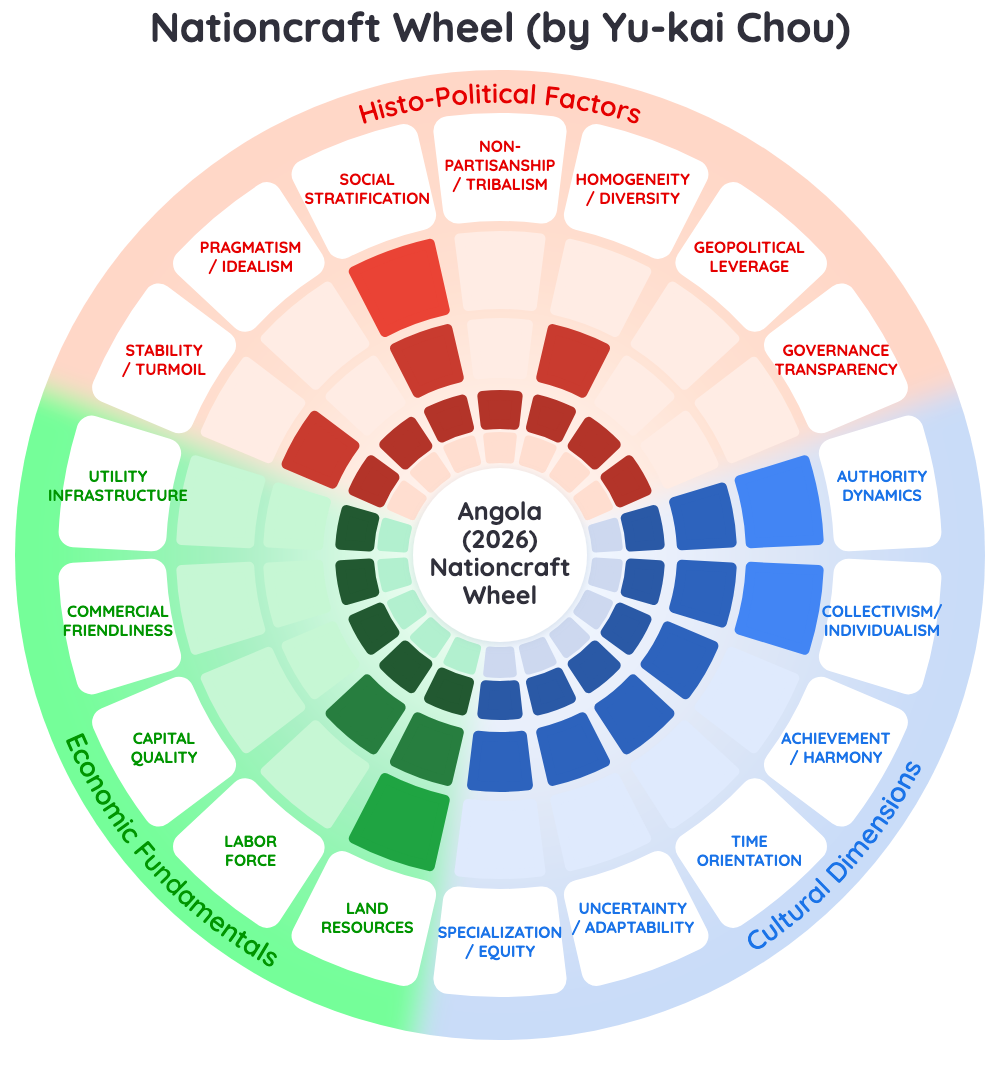
These are Angola’s canonical Nation Variables scores as held in the Nationcraft corpus. The third column carries the SP-063 packet benchmark, which the corpus scores for the 2002 to 2020 period. Read the two columns as a before-and-after with one caveat stated plainly: a packet benchmark and a live country score are built for different purposes, so the deltas show direction rather than a calibrated time series.
| Variable | Angola 2026 | SP-063 benchmark | What the score describes |
|---|---|---|---|
| V1 Authority Dynamics | 8 | 9 | MPLA in power since 1975; a strong presidency with a parliament it controls |
| V2 Collectivism vs Individualism | 7 | 6 | Extended family and party network mediate access to everything |
| V3 Achievement vs Harmony | 4 | 5 | Position and connection outrank output in determining income |
| V4 Time Orientation | 4 | 4 | Budgeting follows the oil price; no binding long-horizon rule |
| V5 Uncertainty Adaptability | 5 | 5 | Adjusts under pressure, reverts when pressure lifts |
| V6 Specialization vs Equity | 4 | 4 | Neither a skills economy nor a redistributive one |
| V7 Stability vs Turmoil | 5 | 1 | The one unambiguous structural gain: civil war ended 2002 |
| V8 Pragmatism vs Idealism | 3 | 5 | Policy follows the ruling party’s needs more than stated doctrine |
| V9 Social Stratification | 7 | 7 | An oil elite and a large informal majority, with little between |
| V10 Non-Partisanship vs Tribalism | 2 | 5 | MPLA and UNITA remain the wartime cleavage in electoral form |
| V11 Homogeneity vs Diversity | 4 | 4 | Plural, with the Ovimbundu and Mbundu divide still politically live |
| V12 Geopolitical Leverage | 1 | 6 | A price-taker for its only export, with China taking 58% of crude |
| V13 Governance Transparency | 2 | 2 | Unchanged across the entire anti-corruption campaign |
| V14 Land Resources | 9 | 9 | Oil, gas, diamonds; the resource base is not the constraint |
| V15 Labor Force Quality | 6 | 3 | A real improvement, and the campaign gets no credit for it |
| V16 Capital Quality | 3 | 5 | A banking sector that has shrunk rather than deepened |
| V17 Commercial Friendliness | 3 | 3 | Licensing, customs and FX access remain the binding frictions |
| V18 Utility Infrastructure | 3 | 2 | Rebuilt roads and power, still short of demand |
Angola’s wheel is the image at the head of this article: V14=9 against V13=2 and V12=1, the resource-curse signature at close to full strength.
Three rows carry the argument. V7 moved from 1 to 5, which is the peace dividend and is real. V12 fell from 6 to 1, because the leverage the packet era recorded came from being a large OPEC producer courted by rival buyers, and a shrinking producer outside OPEC selling 58 percent of its crude to a single customer has none of that. And V13 did not move, which is the row this analysis is about.
The Prosecution Dividend
The mechanism has three steps and none of them requires anyone to have acted in bad faith.
Step one: the prosecutions are real and they pay. Recovering five billion dollars is a material fiscal event for an economy Angola’s size. It also pays in a second currency, which is credibility: a government visibly prosecuting its predecessor’s family is a government international lenders and index compilers will re-rate. Angola’s Corruption Perceptions Index score moved 19 in 2018, 26 in 2019, 27 in 2020, 29 in 2021, 33 in 2022.6 That is a near-doubling in four years and it is one of the fastest improvements on the index in that period. The dividend was paid.
Step two: the dividend is on an event, so it stops. The same index reads 33 in 2023, 32 in 2024, 32 in 2025.6 Four years without movement. The Worldwide Governance Indicators say the same thing from a different direction: as of 2024 Angola scores −1.17 on rule of law, −0.79 on government effectiveness, −0.62 on control of corruption and −1.06 on voice and accountability.6 A campaign can shift a perception index by removing conspicuous offenders. Holding the new level requires something that keeps working after the campaign’s authors lose interest, and nothing in the observable record is doing that.
Step three: the case that proves it. Isabel dos Santos is the campaign’s emblem, and the scoreboard on her is precise. Courts in Angola, Portugal, the Netherlands, the United Kingdom and the United States have frozen assets. London’s High Court granted a worldwide freezing order over as much as 580 million pounds in December 2023, upheld on appeal the following year. In August 2026 Angolan authorities sought an Interpol red notice, and the Cyprus Supreme Court refused to lift a freeze on accounts.78 She has never been convicted of a crime.
Read that list carefully, because it is the finding in miniature. Every effective action on it was taken by a foreign court. What Angola has generated is charges, requests and freezes abroad; what it has not generated is a domestic judicial outcome against a powerful defendant. Civil society groups inside Angola have separately pressed the government to account for what happened to the recovered assets, which is the same question from the other end.9
That is the Prosecution Dividend in one sentence: a campaign that borrows other countries’ institutions to do its enforcement gets the recoveries without building the thing that produced them. V13 stays at 2 because V13 does not measure how many people were charged. It measures whether the system can bind the people currently running it, and a system that needs a London judge to freeze an asset has answered that question.
Detailed Justifications: Variable by Variable
The authority cluster: V1, V7, V10
V1 at 8 records a presidency that can act decisively within a party that has held power since independence in 1975. That concentration is what made the anti-corruption campaign possible at all: no coalition had to be assembled, no legislature had to be persuaded. It is also the reason the campaign’s durability is in question, because a reform that required only one office’s decision can be reversed by one office’s decision.
V7 at 5 against the packet era’s 1 is the largest genuine structural gain in Angola’s file and it deserves saying clearly. A country that ended a twenty-seven-year civil war in 2002 and has held four general elections since has accomplished something most post-conflict states do not. The 2022 election returned the MPLA and a second term for the incumbent, with the opposition contesting the count and the Constitutional Court validating it.10 That is a narrower margin and a more contested result than any previous Angolan election, which is a democratisation signal the framework registers even while V10 stays low.
V10 at 2 is the variable most responsible for the ceiling. Angolan politics is still organised around the wartime cleavage, and a party system that maps onto a former civil war produces bargaining over who holds the state rather than over what the state does. In the anti-corruption context this matters directly: when the governing party and the prosecuting authority answer to the same office, a prosecution of a rival faction and a prosecution of a crime are indistinguishable from outside, whichever one it actually is.
The economic cluster: V12, V14, V16, V17
V14 at 9 is not in dispute and is not the problem. V12 at 1 is the score that has deteriorated most and it is worth being precise about why. Angola left OPEC in December 2023 after a dispute over its production quota, which removed the one institutional venue where it had a vote on the price of its only export. Production has roughly halved since 2008 to about 1.04 million barrels a day, and China takes 58 percent of the crude.1 A shrinking producer, outside the cartel, selling most of its output to one buyer is close to the definition of a price-taker.
V16 at 3 against the packet era’s 5 is the quiet deterioration. Angola’s banking sector has contracted rather than deepened over the campaign period, and a financial system that cannot intermediate domestic savings leaves the state as the only investor of scale, which in turn makes state spending the only transmission channel from oil revenue to the population. V17 at 3 is the same fact at the firm level: licensing, customs and foreign-exchange access remain the binding frictions, and they are exactly the frictions the Georgia packet attacked.
V13 at 2, and what would have to be true for it to be 4
V13 is the variable this analysis turns on, so the standard should be explicit rather than asserted. Nationcraft scores V13 on whether governance is checkable by someone outside the executive: whether budgets and state-company accounts are published in usable form, whether an audit body’s findings reach the public on a schedule, whether courts have ruled against the state in a case that mattered, and whether a journalist can report the answer without personal risk.
On each of those Angola’s observable record is the same as it was before 2017. The Worldwide Governance Indicators put voice and accountability at −1.06 and rule of law at −1.17 as of 2024.6 The recovered assets have not been accounted for publicly in a form civil society regards as adequate, which is the substance of the demands those groups have made.9 And the single most consequential judicial decisions in the campaign’s flagship case were made in London and Nicosia.
What would move it: a published, auditable register of recovered assets and their disposition; a conviction, or a considered acquittal, of a politically connected defendant in an Angolan court; an audit body whose reports appear on a statutory date rather than at official discretion. None of those requires a constitutional change, and all of them are checkable from outside the executive, which is the property that distinguishes them from everything the campaign has produced so far.
What the Numbers Say About Who Was Paid
Every figure below comes from one source and one vintage, the World Bank’s Macro Poverty Outlook of April 2026, so the fiscal and distributional series are measured on the same basis. That matters here more than usual, because the argument is precisely about the gap between two rows of the same table.
| World Bank MPO, April 2026 | 2023 | 2024 | 2025e | 2026f | 2028f |
|---|---|---|---|---|---|
| Real GDP growth | 1.3% | 4.4% | 3.1% | 2.4% | 2.9% |
| Inflation | 13.6% | 28.2% | 20.2% | 14.9% | 11.5% |
| Fiscal balance, % of GDP | −2.5% | −1.3% | −4.1% | −3.2% | −2.8% |
| Revenues, % of GDP | 20.7% | 18.7% | 14.8% | 16.0% | 14.3% |
| Public debt, % of GDP | 70.6% | 59.3% | 52.3% | 50.1% | 49.7% |
| Poverty rate, $3.00 (2021 PPP) | 42.8% | 42.3% | 42.3% | 42.4% | 42.4% |
| Poverty rate, $8.30 (2021 PPP) | 82.8% | 82.5% | 82.5% | 82.5% | 82.6% |
The debt row and the poverty row are the article. Public debt fell more than eighteen points of GDP in two years, which is a large and genuine improvement in the state’s position. The poverty rate at the 3.00 dollar line moved half a point and is forecast to end 2028 fractionally above where it started. Whatever the recovery is, it is not reaching households at a rate the World Bank can detect or expects to detect.
The revenue row explains part of the mechanism. Government revenue fell from 20.7 percent of GDP in 2023 to 14.8 percent in 2025, and is forecast at 14.3 percent in 2028. A state collecting five points of GDP less while recovering assets is substituting a windfall for a flow, and windfalls do not fund recurrent spending on health, schooling or transfers. This is the same interaction the small-state borrowed buffer analysis found across Bahrain, Botswana and Mauritius: the revenue take and the transparency score move together, and a country that collects little from its own citizens has correspondingly little obligation to show them anything.
One honest caveat about the poverty series. These are modelled estimates on a PPP basis, not a household survey run each year, so a flat line partly reflects the modelling interval. What it does not do is show an improvement that the model failed to capture, and the forecast years are flat for the same structural reason the historic ones are: nothing in the projected path changes the distributional machinery.
Strategic Implications
ET-001 resource curse runs at close to full strength, and the campaign did not interrupt it. The pattern’s preconditions are V14≥8, V13≤3 and V8≤4, with amplifiers for an entrenched elite, single-commodity dependence above half of exports, and enclave extraction with minimal local employment. Angola meets every one: V14=9, V13=2, V8=3, V9=7, oil above 90 percent of exports, and an offshore industry that employs very few Angolans. The corpus lists the immunity factors as transparent institutions established before the resource, early pragmatic diversification, and a sovereign fund with independent management. Angola has none of the three. A prosecution campaign is not on the immunity list, and this is the empirical reason why.
The IMF has stated the reform trigger out loud, and it is external. Its September 2026 mission recorded that the favourable environment has slowed the adjustment and reform momentum critical to reducing oil dependence.4 Read against the history that is not a criticism so much as a description of the mechanism: the 2018 IMF programme arrived after an oil crash, the campaign’s most aggressive phase coincided with the crunch, and the plateau since 2022 coincides with the recovery. **A country whose reform function is driven by external pressure has outsourced the timing of its own institutional change to the oil market.**
V12 at 1 makes that outsourcing dangerous rather than merely inelegant. With OPEC membership gone, production halved and one buyer taking most of the crude, Angola has no instrument for influencing the variable that triggers its own reforms. The Nigeria reform-dividend analysis covers the adjacent case, where reforms were real, front-loaded and produced a dividend the population did not see; Iraq’s rentier configuration shows the same V13-low, V14-high pairing with the enforcement layer even weaker.
The succession question is the live risk and it is a V1 problem, not a personnel one. A campaign that runs on presidential will has its expiry date set by presidential tenure. Nothing in the observable record would prevent a successor from stopping it, and nothing would prevent a successor from continuing it against a different faction. Both outcomes leave V13 at 2, which is how you know the campaign was never the variable.
Six Reformer Playbooks Angola Should Reject
Each is a real packet from the corpus, each worked somewhere, and each fails against Angola’s profile for a stated reason.
| Packet | Where it worked | Angola’s blocking variables |
|---|---|---|
| SP-037 Vision 2030 Transformation | Saudi Arabia, 2016– | V12=1 vs 9; V16=3; no balance sheet to absorb a failed mega-project |
| SP-053 Oil Fund & Authoritarianism | Azerbaijan, 1994–2020 | Available and already half-run; V13=2 makes it the trap, not the plan |
| SP-030 EPRDF Developmental State | Ethiopia, 1991–2018 | Needs V4≥7 horizons and V8≥8 pragmatism; Angola is 4 and 3 |
| SP-049 Obasanjo Democratic Return | Nigeria, 1999–2015 | Angola already ran its EFCC equivalent; the corpus records “limited impact” |
| SP-072 Chiluba Privatization | Zambia, 1991–2011 | Privatising into V16=3 concentrates assets rather than dispersing them |
| SP-014 Chicago Boys Reform | Chile, 1975–1990 | No tax base to liberalise into; V17=3 frictions would survive the shock |
SP-037, Vision 2030 Transformation
The default suggestion for any oil state with diversification ambitions, and the least available to this one. Vision-style programmes are underwritten by a sovereign balance sheet deep enough that a failed project is an accounting event. Angola’s V12 is 1 against Saudi Arabia’s 9, its debt is only now back under 50 percent of GDP, and its capital quality is 3. Running the packet here converts an improving fiscal position back into a deteriorating one and imports the execution, as set out in the Saudi single-artery analysis.
SP-053, Oil Fund and Authoritarianism
Listed as rejected precisely because it is the packet Angola is closest to executing by default. Azerbaijan built a competent sovereign fund alongside V13=3 and V1=9, and the fund became the financing arm for whatever the executive decided. Angola’s V13 is lower and its V1 comparable. A fund built now, before the disclosure layer exists, is a larger version of the problem this analysis describes, and the corpus already contains the completed run.
SP-030, EPRDF Developmental State
Industrial parks, an agricultural productivity push, a state airline run professionally, a hydropower build. It is a genuinely attractive template for a post-conflict African state and its preconditions are V4≥7 and V8≥8: a long horizon and a pragmatic willingness to subordinate ideology to results. Angola scores 4 and 3. Without those two, the packet’s directed-credit and financial-repression components stop being development finance and become another channel for allocation by connection.
SP-049, Obasanjo Democratic Return
Nigeria’s packet contains an anti-corruption body, the EFCC, with high-profile prosecutions, and the corpus’s own note on it reads “limited impact”. That is the most useful sentence available to Angola, because Angola has effectively re-run this component with more resources and a more dramatic set of defendants and produced the same structural outcome. The packet’s genuinely transferable elements are the debt-relief campaign and the banking consolidation, neither of which is Angola’s current problem.
SP-072, Chiluba Privatization
Zambia broke up its state mining company and sold it, with results the corpus describes as controversial on terms. Angola is running a privatisation programme now, and the variable that decides where the assets land is V16, capital quality, at 3. In a financial system that shallow the only buyers with capacity are the politically connected, which converts privatisation into the redistribution of state assets to the same class the campaign prosecuted. Zambia’s later experience is the other half of the caution.
SP-014, Chicago Boys Reform
Shock liberalisation under an authority that could ignore objections. The superficial fit is V1=8 and it is a trap, for the same reason it is a trap everywhere in this corpus: Chile started at V16=2 with suppressed capital formation to release, and had a tax base. Angola collects 14.8 percent of GDP. Liberalising an economy with no domestic revenue base and V17=3 frictions produces the frictions plus the shock.
Three Playbooks Angola Should Actually Study
All three address the same gap from different angles, which is that Angola has prosecutions and needs institutions.
SP-051, Saakashvili Reform Packet, Georgia 2004–2012
The closest thing the corpus holds to a worked answer to Angola’s actual problem, and the reason is that Georgia did not primarily prosecute. It replaced. The entire traffic police was dismissed and a new force hired at roughly ten times the salary; business registration was cut to fifteen minutes through a one-stop shop; customs was rebuilt with new premises, new staff and cameras; public service halls put every state service in one glass building where the transaction was visible.
The variable fit is close where it counts. Georgia scored V14=3 against Angola’s 9, so it had no rent to fall back on, and V13=6 against Angola’s 2, which is the gap to be closed rather than a precondition. What transfers is the design principle: every one of those measures changed the physical conditions under which a bribe is solicited, and none of them depended on convicting anyone. A glass building and a fifteen-minute registration are checkable by a citizen without a court. Angola’s V17=3 frictions are exactly the surfaces Georgia rebuilt.
The caution the corpus also records: Georgia’s packet ran under V7=2 instability and a leader who eventually lost power amid accusations about the methods. The lesson to take is the mechanism design, not the political style.
SP-004, Botswana Diamond Management Packet, 1966–1999
The corpus’s reference case for converting V14 into institutions rather than into capture, and the relevant component for Angola is narrow and specific: the DCEC, an independent anti-corruption agency with genuine enforcement powers, paired with a published fiscal rule classifying revenue into investment rather than consumption.
Botswana is close to Angola on the variables that are usually treated as destiny, V14 at 9 against 9 and V12 at 1 against 1, and far apart on V13, 7 against 2. Botswana’s 7 was built, not inherited, by a government that chose to bind itself while holding V1=7 authority. That is the same position Angola’s presidency holds now. The transferable element is the pairing: an enforcement body whose tenure does not depend on the president, and a revenue classification published in a form that can be argued with.
SP-063, Post-MPLA Diversification Attempt, Angola 2002–2020
Angola’s own packet, listed here because a country’s best available study is often its own record read honestly. The packet’s components are Chinese infrastructure-for-oil lending, Sonangol dominance, post-war reconstruction, the Lourenço anti-corruption drive, the 2018 IMF programme, diversification plans and a privatisation programme. The corpus’s own annotations are unsparing: the diversification plans achieved “limited success; still 95% oil exports”, and the Chinese lending “created dependency”.
What the packet establishes is that Angola can execute. Roads and railways were rebuilt, a state oil company was restructured, an IMF programme was completed, a ruling family was confronted. The component that was never attempted is the one every other packet on this list contains: an institution that constrains the office running the reform. Reading SP-063 as a study rather than a record means treating that omission as the next item rather than as a settled matter.
Governance Strategy Recommendations
These are written for a general reader trying to judge what would count as reform here, and they are ordered by how checkable each one is from outside the executive. That ordering carries the argument: Angola’s problem is not a shortage of enforcement activity, it is that all of the enforcement has been discretionary, and discretion is exactly what an outside party cannot verify.
| Step | What physically changes | Who gains, and who can then object | Variable moved |
|---|---|---|---|
| Publish a register of recovered assets and their disposition, item by item | Five billion dollars stops being a headline and becomes a ledger | Citizens, who own the recovered money; the civil-society groups already asking | V13 2→3 |
| Give the anti-corruption body fixed-term appointments and a statutory publication date | Enforcement stops depending on whether the presidency still wants it | The body itself, which gains the ability to continue without permission | V13, V1 8→7 |
| Rebuild the transaction surfaces: one-stop registration, customs, licensing | The situations in which a bribe is solicited physically stop occurring | Every firm and citizen at the counter, without needing a court | V17 3→5, V16 |
| Publish Sonangol’s accounts and the oil revenue reconciliation on a schedule | The gap between barrels sold and revenue booked becomes computable | Anyone who can do arithmetic, including the press and parliament | V13, V4 |
| Broaden the revenue base away from 14.8% of GDP | The state is funded by the people it governs rather than by a depleting well | Citizens, who acquire the standing that paying confers | V13, V10 |
| Let one politically connected case run to a verdict in an Angolan court | A domestic judicial outcome exists where previously only foreign freezes did | The judiciary, which acquires a precedent it can cite next time | V13 3→4 |
The second row is the one that decides whether any of the others survive, and it is worth being exact about what it asks. It is not a request for a more effective anti-corruption body. An anti-corruption body that is more effective while remaining an instrument of the presidency is a more powerful instrument of the presidency, which is the laundered version of this recommendation and should be refused on sight. What the row asks for is the opposite: fixed terms, a publication schedule the office cannot vary, and therefore an enforcement capability that can point at the government of the day. The gain is the loss of executive discretion, and that is the whole point.
The last row deserves the same treatment. “Let a case run to a verdict” is not a demand for a conviction, and a reform guide that asked for one would be asking for a show trial. It asks for a completed domestic proceeding with a reasoned judgment, where an acquittal on the evidence would count as a success on exactly the same terms, because what is missing is not punishment but a functioning forum. Nine years of freezes obtained in London, Lisbon, Amsterdam and Nicosia and no Angolan verdict is a statement about the forum, not about the defendants.
The fifth row is the slowest and the most structural. A state collecting 14.8 percent of GDP is a state most of whose citizens have no fiscal relationship with, and the corpus records what that produces under ED-004 as “no taxation, no representation”. Read forwards it is a reform: the population that funds a government acquires a claim on it. The sequencing matters and it is the same as everywhere else in this series, which is that the disclosure rows come first. Widening a tax base before publishing the accounts collects more money into a system nobody can audit.
Comparative Context
Set Angola against the corpus’s other high-V14 cases and the variable that sorts them is not the size of the endowment.
| Country | V13 | V14 | V12 | What the configuration produced |
|---|---|---|---|---|
| Botswana (2026) | 7 | 9 | 3 | Rent converted to institutions; buffer drawn down in the open |
| Angola (2026) | 2 | 9 | 1 | $5bn recovered, 715 prosecutions, transparency score unchanged |
| Azerbaijan (SP-053 benchmark) | 3 | 9 | 7 | Competent fund became the executive’s financing arm |
| Kuwait (2026) | 3 | 10 | 2 | World-class fund, unpublished, opened to state borrowing in 2026 |
| Nigeria (2026) | 2 | 8 | 6 | Real front-loaded reforms, dividend not visible to households |
Botswana and Angola are the pair worth sitting with, because on the two variables usually treated as fate they are nearly identical: V14 at 9 and 9, V12 at 3 and 1. Both are southern African states whose economy rests on one extractive commodity, both faced a structural decline in that commodity’s value, and both are drawing on accumulated resources to bridge it. The divergence is V13 at 7 against 2, and it shows up as the difference between a country whose buffer drawdown is published and argued about, and a country whose five billion dollars of recoveries civil society is still asking to have accounted for.
The Kuwait analysis found the same pattern from the opposite end of the wealth distribution: the highest V14 in the corpus paired with V13=3 produced a sovereign fund whose size has never been published and which was opened to state borrowing in September 2026. Wealth does not substitute for disclosure at any level of the wealth distribution, and all it changes is how many years a country can run the substitution before the question arrives.
The Nationcraft Framework in Practice
Angola is the clearest case in this series for why the framework insists on asking which variable moved, rather than whether a reform happened.
By any narrative measure, a great deal happened. A president turned on his predecessor’s family. Five billion dollars came back. Prosecutions ran into the hundreds. A perception index nearly doubled. Every one of those is true, and a reader who stopped there would conclude Angola had reformed. The framework’s contribution is not scepticism about those facts, it is the discipline of asking which of the eighteen scores changed as a result, and then checking the answer against numbers nobody involved controls.
The answer is that V7 moved for reasons that predate the campaign, V15 moved for reasons unrelated to it, V12 and V16 moved against Angola, and V13, the variable the campaign was aimed at, did not move. That is a finding a narrative cannot produce, because the narrative and the structure point in different directions.
The origins of Nationcraft in Octalysis behavioural design are the reason the framework treats disclosure as a mechanism rather than an accounting formality. Publishing a ledger changes who has to be persuaded, and therefore what a government spends its effort on. A prosecution changes who is in the room. Only one of those keeps working after the person who started it has moved on. Set Angola beside the United States Nation Variable analysis, where V13=7 sits with V10=2, and the trade-off is legible in both directions.
Explore More Nationcraft Analyses
Each analysis applies the same 18 variables to a different configuration, and they compound when read against each other. The full set is in the Nationcraft Nation Variables Library. Nearest neighbours to this one: DR Congo’s cobalt trap, the same V14-high and V13-low pairing with weaker state capacity, and Rwanda’s star-pupil analysis, on a country whose external reputation runs ahead of its domestic accountability.
Frequently Asked Questions
Was Angola’s anti-corruption campaign fake?
No, and the analysis does not depend on it being fake. More than five billion dollars was recovered, 715 prosecutions were opened, and assets belonging to the former president’s family were frozen across five jurisdictions. Those are real outcomes that a purely cosmetic campaign does not produce. The finding is narrower: a campaign is an event and an institution is a stock, and Angola’s governance transparency score is unchanged because prosecutions do not by themselves build the court, the audit body or the published ledger that would constrain the next set of officials.
Why has the Corruption Perceptions Index stopped improving?
Because the improvement came from the thing that had already happened. Angola’s score rose from 19 in 2018 to 33 in 2022 as the campaign removed conspicuous offenders and signalled a change of regime conduct. It has read 33, 32, 32 since. An index that measures perceptions of public-sector corruption responds quickly to visible enforcement and then needs structural change to go further, and the Worldwide Governance Indicators show why there has been none: rule of law at −1.17 and voice and accountability at −1.06 as of 2024.
Why does it matter that Isabel dos Santos has not been convicted?
Because of where the effective decisions were made. Courts in Angola, Portugal, the Netherlands, the United Kingdom and the United States have frozen assets, an Interpol red notice was sought in August 2026, and the Cyprus Supreme Court declined to lift a freeze. What is missing is a completed Angolan proceeding against a powerful defendant. A system that must borrow foreign courts to enforce against its own elite has answered the question V13 asks, and the answer is not about any individual’s guilt.
Angola’s debt fell sharply. Is that not real progress?
It is real, and it is progress for the state’s balance sheet. Public debt fell from 70.6 percent of GDP in 2023 to 52.3 percent in 2025 on World Bank figures. The question this analysis asks is who received the benefit, and on the same World Bank table the poverty rate at the 3.00 dollar line reads 42.8, 42.3 and 42.3 percent across those years, with 42.4 percent forecast for 2028. A stronger sovereign balance sheet is worth having. It is not the same thing as a population that is better off, and the framework scores those separately on purpose.
What would count as real reform in Angola?
Anything that survives a change of president. Publishing the recovered-asset register so five billion dollars becomes a ledger rather than a headline; giving the enforcement body fixed terms and a statutory publication date so it can point at the government of the day; rebuilding the registration, customs and licensing counters so the bribe situation stops occurring; publishing Sonangol’s accounts and the oil revenue reconciliation. Each is checkable from outside the executive, none requires a constitutional change, and each one costs the presidency discretion it currently has. That last part is the test.
Related Reading
- The Nationcraft Framework: 18 Variables, 8 Goals, 100+ Proven Reform Packets
- Nationcraft Nation Variables Library
- Nationcraft Analysis: Ethiopia Nobel Trap 2026
- Nationcraft Analysis: Kenya Concession Trap 2026
- Nationcraft Analysis: South Africa Empty Chair 2026
Footnotes
- Oil share of exports and revenue, production volumes, and Angola’s December 2023 departure from OPEC: Ministry of Mineral Resources and Petroleum 2025 sector reporting, together with World Bank country documentation. See the World Bank Angola country page in footnote 3 and the Ministry of Finance release in footnote 5.
- More than five billion dollars recovered and 715 criminal prosecutions: reported by Angola’s National Asset Recovery Service, January 2023. Context and the civil-society response: ICIJ, Luanda Leaks; assessment of the campaign’s character: Good Authority.
- GDP, inflation, fiscal balance, revenue, debt and poverty series: World Bank, Macro Poverty Outlook, April 2026, Angola country page, thedocs.worldbank.org.
- IMF post-financing assessment mission, 24 August to 9 September 2026, and its finding that the favourable external environment has slowed adjustment and reform momentum: CNBC Africa, reporting the IMF staff statement.
- Angolan Ministry of Finance notice of the joint IMF mission for the post-financing assessment: minfin.gov.ao.
- Corruption Perceptions Index series for Angola (2018: 19 · 2019: 26 · 2020: 27 · 2021: 29 · 2022: 33 · 2023: 33 · 2024: 32 · 2025: 32) and Worldwide Governance Indicators for 2024 (rule of law −1.17, government effectiveness −0.79, control of corruption −0.62, voice and accountability −1.06): TheGlobalEconomy.com, compiling Transparency International and World Bank data.
- Interpol red notice sought in August 2026 and the Cyprus Supreme Court declining to lift a freezing order: Billionaires.Africa.
- The multi-jurisdiction asset freezes and the London High Court worldwide freezing order: Institute for Security Studies; on the domestic effect of UK action: International Lawyers Project.
- Angolan civil-society groups pressing for an accounting of the recovered assets: ICIJ.
- The August 2022 general election, the MPLA result and the Constitutional Court validation: International IDEA, Global State of Democracy tracker.