
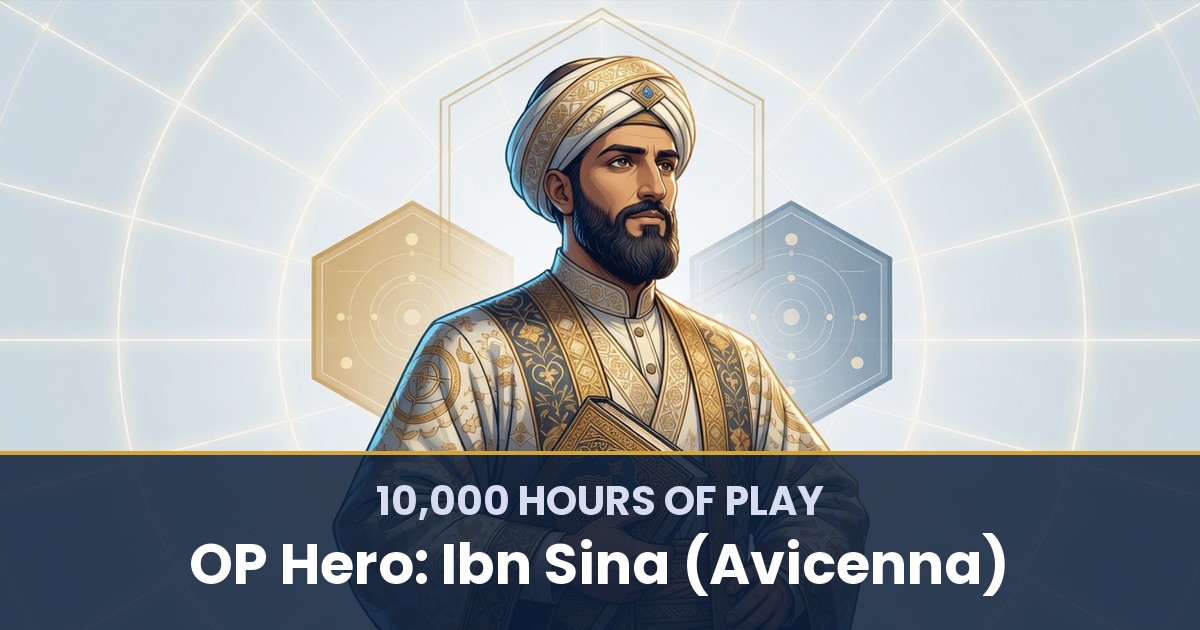
10,000 Hours of Play by OP Hero: Ibn Sina (Avicenna)
How Ibn Sina (Avicenna) turned forty failed reads, a royal library, and years of exile into the Canon of Medicine.


A bookseller in the market of Bukhara held out a volume to a teenager and told him to buy it, because it was cheap.
The teenager was Ibn Sina, the man Europe would later call Avicenna. By his own account he had read Aristotle’s Metaphysics forty times and knew it by heart. He still did not understand it.
The cheap book was a short work by al-Farabi on the purpose of the Metaphysics. He read it, and the problem finally opened up.
A few years later he was treating the Samanid ruler and reading in the royal library.
Over the next four decades, through court jobs, a mutiny, and a prison cell, he wrote the Canon of Medicine. European universities were still teaching from it in the 1600s.
⚡ Speed Run Notes
- Ibn Sina’s game: organize the known sciences into complete, usable systems, and keep writing them whichever court he happened to be serving.
- He read the Metaphysics forty times without understanding it. A cheap commentary by al-Farabi unlocked it.
- Curing the Samanid ruler as a teenager earned him the reward he asked for: permission to read in the royal library.
- Mutiny, prison, and exile interrupted his career. He wrote through all of it, at times fifty sheets a day without his books.
- His Canon of Medicine reached Europe in Latin and was still part of university medical teaching about six centuries after he wrote it.
Table of Contents
About Yu-kai Chou

Yu-kai Chou is the author of 10,000 Hours of Play — the book that treats your life as the most important game you’ll ever build a character in, and gives you the 6-Step framework (Game · Attributes · Role · Skills · Allies · Quests) to play it on purpose. He has spent two decades developing the system through which this post analyzes its OP Hero, and applies it to his own life and to the lives of the people he advises around the world.
Chou’s other framework, the Octalysis Framework, has been applied by LEGO, Microsoft, Porsche, Coca-Cola, Salesforce, and MrBeast, impacting over 1.5 Billion Users. He has taught the methodology at Harvard, Stanford, Yale, Tesla, Google, BCG, and IDEO, and has advised governments in eight nations including Ukraine, the United Kingdom, the Kingdom of Bahrain, Singapore, Taiwan, the Netherlands, Kazakhstan, and South Korea.
His work has been cited by Harvard, Stanford, MIT, Forbes, Wall Street Journal, Wired, US Department of Energy, NIST, NSF, NCBI, US Department of Education, ClinicalTrials.gov, and Google Scholar — with 3,700+ more academic publications. Explore his books here.
What I keep returning to is that cheap book. Ibn Sina had already put forty reads into the Metaphysics, and the forty-first would not have helped. The move that worked was finding someone who had already explained it. When I’m stuck on something hard, that’s the first question I try to ask now: who has already solved this, and where is their explanation sitting?
Step 1: The Game — What Ibn Sina Was Actually Playing
The first of the six steps is choosing your game. Ibn Sina never wrote his down as a mission statement, but his output makes it easy to read.
He wanted the inherited sciences in one ordered, usable system: logic, mathematics, natural science, psychology, metaphysics, and medicine.
Two books show the shape of that game. The Cure (al-Shifa, also translated as The Book of Healing) is a philosophical encyclopedia covering logic, the natural sciences, mathematics, and metaphysics.
The Canon of Medicine does the same for medicine. It is organized into five books, running from general principles through simple drugs, diseases of particular organs, and general diseases, to compound medicines.
The second half of the game was practical. Knowledge work needs a patron, a library, and a quiet room, and in the politics of eleventh-century Iran none of those lasted long.
So medicine became his access key. Treating rulers bought him libraries, salaries, and protection, and those bought him time to write.
He played that loop for about forty years, across at least five cities, and kept producing through every change of patron.
Step 2: Attributes — The Innate Stats
Attributes are what you bring before training. The labels below are interpretive, but each one appears in his own account of his early life.
Memory. “At the age of ten, I had already mastered the whole of the Qur’an and an abundance of literature,” he wrote.
A questioning mind. His first logic teacher, al-Natili, gave him the standard definition of a genus. The boy began testing that definition in ways, he says, his teacher had never heard of, and he soon moved past him.
Learning speed. He took up medicine around sixteen and called it “not one of the difficult sciences.” Before long, he says, experienced physicians were coming to study under him.
That is the kind of stat combination the OP Talent Triangle Method is built to surface: fast absorption plus a habit of testing whatever he absorbed.
Tolerance for difficulty. Forty reads of a book you cannot understand is a stat most people do not have. The text he kept returning to was by Aristotle, and it took al-Farabi’s commentary to finally open it.
Adaptability. He worked as physician, teacher, author, vizier, and fugitive, sometimes within the same decade.
Step 3: Role(s) — The Character Class Across Chapters
Ibn Sina changed class many times, usually because the world forced him to.
Prodigy student (Bukhara, childhood to about 18). Born near Bukhara, in a year traditionally given as 980 that modern scholars treat as uncertain. By eighteen, he wrote, “I was already familiar with all these sciences.”
Court physician (late teens). He treated the Samanid emir Nuh ibn Mansur, and his reward was permission to enter the court library.
Displaced scholar (999 onward). In 999 the Qarakhanids ended Samanid rule, and he wrote that “necessity” led him to leave Bukhara. He moved to Gurganj in Khwarazm, then to Jurjan and Rayy.
In each city he was a working scholar looking for a court that would keep him.
Vizier (Hamadan, about 1015 to 1024). The Buyid emir Shams al-Dawla made him his vizier. The army mutinied against him and demanded his removal, and he went into hiding.
Prisoner (Fardajan). After a political reversal he was held in the fortress of Fardajan for about four months.
Scholar-physician in Isfahan (about 1024 to 1037). His final patron, ‘Ala al-Dawla, gave him roughly thirteen stable years. Much of his late writing comes from this period.
Step 4: Skills — The Real-Life Game Skills Ibn Sina Mastered
Five Skills show up clearly in his record.
Ley Line Infusion (Mage): quickly absorbing a large body of knowledge. Medicine at sixteen is the clearest case. He picked up a field he considered easy, and within a short time practicing physicians were learning from him.
Adaptive Foraging (Ranger): finding the right resource for the challenge. He found his in a bookseller’s stall: al-Farabi’s short work on the purpose of the Metaphysics, bought because it was cheap.
On the Skills Spectrum, Ibn Sina sits near the master end. He wrote a full encyclopedia in medicine and another in philosophy, and he had enough range in logic and mathematics to connect them.
Bind Fate (Warlock): using someone else’s resources to grow your own power. When he cured the Samanid emir, he asked for access to the court library, and a ruler’s book collection became the material for a teenager’s self-education.
Serenity (Druid): meditation and prayer for inner peace. His own recovery routine for being stuck is on record: “Whenever I was baffled by a problem and could not determine the answer, I repaired to the great mosque and humbly prayed to the Creator until the obscure became clear.”
Lich Grind (Warlock): intense, secluded work periods. While hiding in Hamadan after the mutiny, he wrote large parts of The Cure without access to his books.
His student al-Juzjani reports that he first spent two days writing out the chapter headings from memory, and then “every day he filled fifty sheets” until the sections on natural science and metaphysics were done.
Step 5: Allies — The People Who Multiplied Ibn Sina
He is remembered as a solitary genius, but the record names a handful of people who decided how far he got. These are the allies in his story.
Al-Natili. His first logic teacher. A student who outpaces his teacher still needed someone to hand him the Isagoge in the first place.
Al-Farabi. Dead for decades by the time Ibn Sina was born, and still the mentor who got him past the Metaphysics, through a short book on its purpose.
Nuh ibn Mansur. The Samanid emir whose illness brought Ibn Sina to court, and whose library he was then allowed to use.
Abu ‘Ubayd al-Juzjani. He joined Ibn Sina in Jurjan and stayed with him until his death. He escaped with him to Isfahan and completed his biography afterward.
Much of what we know about Ibn Sina’s later life, including how he worked while in hiding, comes from al-Juzjani.
‘Ala al-Dawla. The ruler of Isfahan who gave him about thirteen years of stability after a decade of upheaval.
Al-Biruni. A fellow scholar of the same generation. The two exchanged a well-known series of questions and answers on natural philosophy and science.
Step 6: Quests — The Milestones That Shaped the Saga
Quest 1: Unlock the Metaphysics (teens). A long stall, then a breakthrough with outside help. His later metaphysics, including his distinction between essence and existence, was built on this Aristotelian base.
Quest 2: Cure the emir (late teens). A medical success converted into access to the Samanid royal library. Around eighteen he wrote his first work, a compendium on the soul, dedicated to the ruler.
Quest 3: Lose everything (999). The first setback. The Samanid state fell, and with it his patron, his library, and his place in Bukhara. He spent the next years moving from court to court.
Quest 4: Survive Hamadan (about 1015 to 1024). The second setback. He rose to vizier, the army turned on him, and he went into hiding. Large parts of The Cure were written during that hiding period.
Later came four months in the fortress of Fardajan, which ended when ‘Ala al-Dawla captured Hamadan. Ibn Sina eventually left for Isfahan disguised as a Sufi, with al-Juzjani, his brother, and two servants.
Quest 5: Lose a book (1030). When Sultan Mas’ud of Ghazna entered Isfahan, soldiers plundered Ibn Sina’s baggage. His Kitab al-Insaf was taken and never recovered.
Quest 6: Outlast the author (1037 onward). He died at Hamadan in 1037, of an intestinal illness that had troubled him for years, while accompanying ‘Ala al-Dawla on campaign.
The Canon kept going. Gerard of Cremona’s Latin translation, made in the 12th century, carried it into European medical schools, where it was still taught in the 1600s.
Inside it is a list of seven conditions for testing whether a drug works, including trying it on a single, uncomplicated disease and testing it on humans. In The Cure he left the “Floating Man,” a thought experiment about a person suspended in empty air who is still aware of his own existence.
What You Can Steal From Ibn Sina’s Build
Ask for the library. The reward Ibn Sina chose for curing a king was access. Pick rewards that compound into your main quest.
Make your craft portable. Medicine worked in every court he landed in, so every exile came with a job attached.
Write it down while the world is unstable. The Kitab al-Insaf shows what can vanish. The Cure, written from hiding, shows what survives when you keep producing anyway.
Keep one ally who records the run. Without al-Juzjani, most of the second half of this story would be lost.
Where this framework comes from

Want the full system this profile is built on?
Every OP Hero piece runs through the same 6-Step framework from 10,000 Hours of Play: Unlock Your Real-Life Legendary Success. The book covers the full system, walks through Yu-kai’s own life run as the first applied case study, and gives you the worksheets to audit your own build.
Related Reading
- All OP Hero Profiles: the complete library
- 10,000 Hours of Play by OP Hero: Aristotle
- 10,000 Hours of Play by OP Hero: Ibn Battuta
- 10,000 Hours of Play by OP Hero: Santiago Ramón y Cajal
- 10,000 Hours of Play by OP Hero: Benjamin Franklin
- 10K HP Step 4: Enhance Your Skills Through Crafting