

Malawi has never had a coup, never fought a civil war, and never missed a peaceful transfer of power since multiparty politics returned in 1994. By the standard measures of African political risk, it should be a reform success story.
Instead, in October 2026, the country is rationing dollars. The Reserve Bank’s indicative rate sits near 1,734 kwacha to the US dollar, official reserves cover less than a month of imports, and an International Monetary Fund (IMF) team just left Lilongwe after two weeks of talks about a replacement for the program that died in May 2025 without completing a single review.[1]
President Peter Mutharika marked one year back in office this month to a report card from the Catholic Commission for Justice and Peace that praised his governance tone and flagged the economic pain in the same breath.[2] The pattern is the puzzle. A politically stable country keeps producing economic emergencies on a schedule.
The Nationcraft Framework reads this as a configuration problem instead of a leadership problem. Malawi runs on one export crop, tobacco, which farmers there call green gold. That crop sets the calendar for the state’s dollars, the state rations those dollars through politics, and every stabilization program arrives mid-cycle and dies before the adjustment lands.
I call this configuration the Green Gold Trap. This analysis scores Malawi across all 18 Nation Variables, shows why five of the most admired reform playbooks in history would fail against this specific profile, and identifies the three packets whose starting conditions actually resemble Lilongwe’s position in 2026.
⚡ Speed Run Notes
- Malawi’s October 2026 crisis is structural: one crop earns the dollars, politics rations them, and IMF programs keep dying mid-cycle. The ECF that lapsed in May 2025 completed zero reviews.
- The V-vector explains the repetition: V13 (Governance Transparency) at 1, V16 (Capital Quality) at 1, and V17 (Commercial Friendliness) at 1 sit under a politically stable surface (V7 at 4, no coups ever).
- The Green Gold Trap: tobacco finances the state just well enough that no government has to fix V13, V16, or V17 before the next auction season rescues the budget.
- Five famous playbooks fail Malawi’s configuration: Singapore’s LKY packet, Deng’s opening, Rwanda’s reconstruction, Ethiopia’s developmental state, and Georgia’s big-bang purge all require variables Malawi does not have.
- Three packets fit: Ghana 1983 (nearest starting twin), Mauritius 1970 (monocrop escape), and Botswana 1966 (windfall rules written before the money arrives).
Table of Contents
- Understanding Malawi’s Governance Landscape Through Nationcraft
- What Is the Nationcraft Framework?
- Why This Malawi Variables Analysis Matters
- The 18 Malawi Nation Variables
- The Green Gold Trap
- Detailed Justifications: Malawi Variable by Variable
- Five Reformer Playbooks Malawi Reform Should Reject
- Best-Match Historical Packets: Three Playbooks Worth Studying
- Strategic Implications
- Governance Strategy Recommendations
- Comparative Context: Malawi Among Its Neighbors
- The Nationcraft Framework in Practice
- Explore More Nationcraft Analyses
- Frequently Asked Questions
About Yu-kai Chou

Yu-kai Chou is a Human-Systems Architect & Behavioral Designer and the creator of the Nationcraft Framework — an 18-variable diagnostic for matching a country’s structural profile to the reform packets that have historically worked under similar conditions. He has consulted for governments in eight nations, including Ukraine, the United Kingdom, the Kingdom of Bahrain, Singapore, Taiwan, the Netherlands, Kazakhstan, and South Korea, and has worked directly with President Zelenskyy’s team on post-war reconstruction priorities for Ukraine.
Chou’s prior framework — the Octalysis Framework — has been applied by LEGO, Microsoft, Porsche, Coca-Cola, Salesforce, and MrBeast, impacting over 1.5 Billion Users. He has taught the methodology at Harvard, Stanford, Yale, Tesla, Google, BCG, and IDEO.
His work has been cited by Harvard, Stanford, MIT, Forbes, Wall Street Journal, Wired, US Department of Energy, NIST, NSF, NCBI, US Department of Education, ClinicalTrials.gov, and Google Scholar — with 3,700+ more academic publications. Explore his books here.

This Malawi analysis applies the Nationcraft Framework’s 18-variable diagnostic to one of the longest-running stabilization puzzles in southern Africa: a country that has cycled through International Monetary Fund arrangements since the 1980s while the configuration underneath them went unexamined. The variable-to-packet matching below is the same method Chou uses in his government advisory work.
Understanding Malawi’s Governance Landscape Through Nationcraft
Most coverage of Malawi in October 2026 reads as a weather report. Inflation averaged 28.4 percent in 2025 and still ran at 20.01 percent in August 2026, the kwacha trades near 1,734 to the dollar at the official window, and fuel queues come and go with the arrival of each forex tranche.[3]
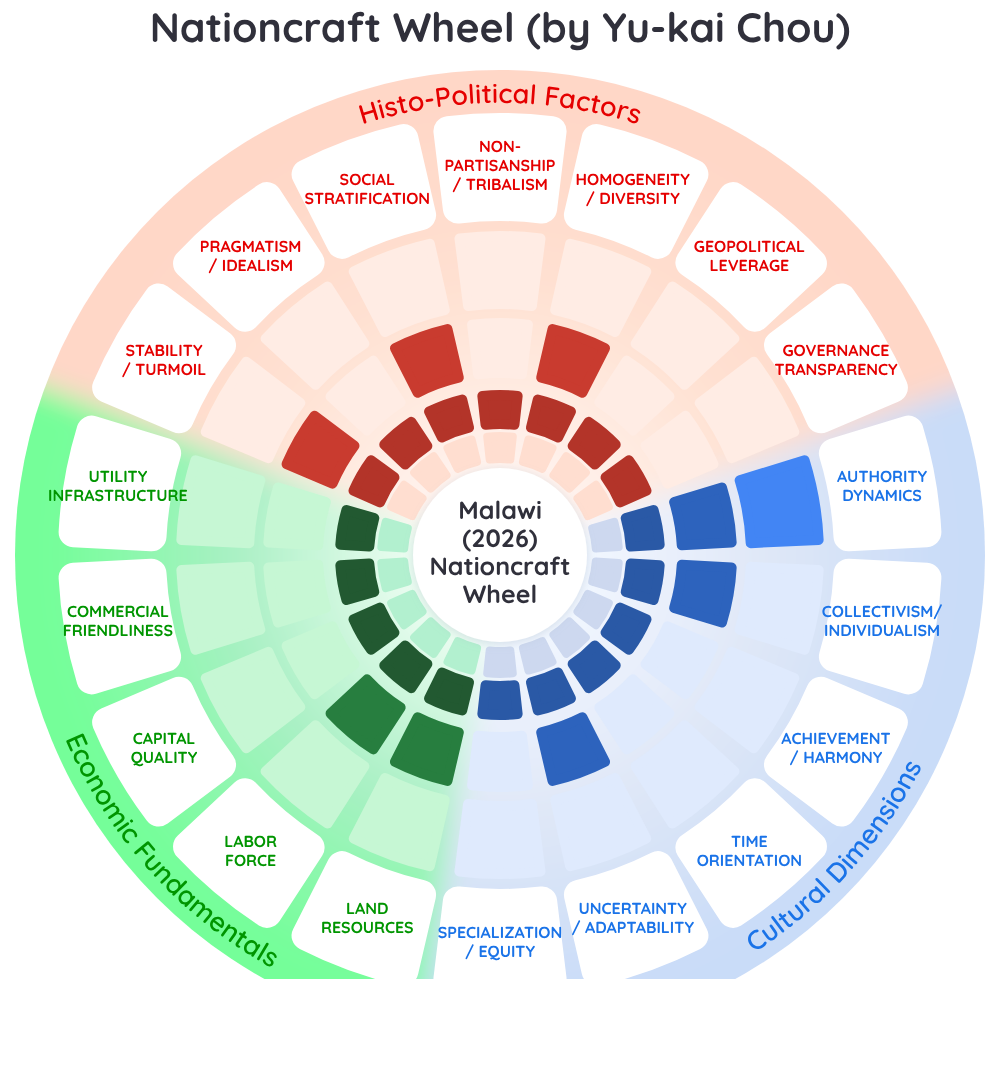
A Nationcraft reading starts somewhere else. Before asking what the government should do, it asks what kind of system is producing these outcomes, and it scores that system across 18 Nation Variables covering culture (V1 to V6), political history (V7 to V13), and economic fundamentals (V14 to V18).
Malawi’s configuration turns out to be unusual in a way the crisis headlines miss. The country combines real cultural assets for governance, including deference to authority (V1 at 7) and communal cohesion (V2 at 6), with some of the weakest institutional and economic scores in the entire 147-country Nationcraft corpus: V13 (Governance Transparency) at 1, V16 (Capital Quality) at 1, and V17 (Commercial Friendliness) at 1.
That spread between cultural capacity and institutional delivery is the signature of the trap this analysis names. The population is ready to be governed well, while the system that governs it keeps leaking the resources that good governance would need.
What Is the Nationcraft Framework?
The Nationcraft Framework treats a nation the way a behavioral designer treats any complex system: diagnose the configuration first, prescribe second. It extends the Octalysis Strategy Dashboard to national scale, and its logic for applying the Octalysis Framework to nation-building is simple to state. Policy effectiveness is decided by context fit, and only secondarily by policy quality.
The framework scores a country on 18 Nation Variables, then matches that profile against a corpus of historical Success Packets. A Success Packet is a documented reform program, such as Ghana’s Economic Recovery Program or Mauritius’s export-zone diversification, recorded with the variable conditions that were present when it started.
The matching discipline is what separates Nationcraft from the standard policy conversation. The question is never whether land reform or devaluation or an anti-corruption drive worked somewhere. What matters is whether the country that made it work started from a configuration that resembles yours.
A packet that produced a miracle under one V-vector routinely produces a crisis under another. This analysis applies that test to Malawi in both directions: which packets the configuration rejects, and which ones it can actually run.
Why This Malawi Variables Analysis Matters
Malawi is about to make the same decision it has made many times since the 1980s. An IMF staff mission was in Lilongwe from September 22 to October 6, 2026, discussing a new Extended Credit Facility (ECF), and reported considerable progress on a package built around exchange-rate reform, fiscal consolidation, and debt sustainability.[1]
The previous ECF, approved in late 2023, terminated automatically on May 14, 2025 because 18 months passed without a completed review.[4] Local reporting now frames the new negotiation around a question with real political weight: whether the government will let the kwacha move, and what that does to prices in a country where most households buy imported fuel and fertilizer.[5]
So the stakes are concrete. If the next program is designed against Malawi’s actual V-vector, it can be the last one. If it is designed against a generic template, the 18-month clock starts again.
There is also a timing reason to run this analysis now. Mutharika’s first anniversary in office fell in October 2026, and anniversary assessments from the Catholic Commission for Justice and Peace and from regional press agree on the same split verdict: credible intentions, deteriorating household economics.[2] First-year political capital is the scarcest reform resource a V10-fragmented democracy has, and Malawi is spending it right now.
The 18 Malawi Nation Variables
Here is Malawi’s full 2026 profile from the Nationcraft corpus, scored 1 to 10. Higher scores mean the variable makes the nation easier to govern and reform, and the scores describe governability rather than virtue.
| Variable | Score | 2026 reading |
|---|---|---|
| V1 Authority Dynamics | 7 | Strong deference to the presidency, chiefs, and churches; executive dominance is accepted |
| V2 Collectivism vs Individualism | 6 | Village-level communal obligation remains strong; extended-family safety nets carry welfare |
| V3 Achievement vs Harmony | 3 | Consensus and harmony outrank open competition; confrontation is socially expensive |
| V4 Time Orientation | 2 | Horizons compress to the harvest and the election; long-term plans rarely survive either |
| V5 Uncertainty & Adaptability | 4 | High coping capacity at household level, low institutional appetite for structural change |
| V6 Specialization vs Equity | 2 | Thin specialist class; subsistence equity dominates the skills distribution |
| V7 Stability vs Turmoil | 4 | No coups or civil wars ever, yet chronic fiscal emergencies and the annulled 2019 election |
| V8 Pragmatism vs Idealism | 2 | Policy debates run on promises and loyalties more than on tested adjustment |
| V9 Social Stratification | 6 | A narrow political-commercial elite sits far above a large rural majority |
| V10 Non-Partisanship vs Tribalism | 2 | Parties function as regional-ethnic vehicles; cabinets balance regions before skills |
| V11 Homogeneity vs Diversity | 4 | Multiple ethnic groups under a shared lingua franca; regional identity shapes politics |
| V12 Geopolitical Leverage | 2 | Landlocked, small, and aid-receiving; little bargaining power with creditors or markets |
| V13 Governance Transparency | 1 | Cashgate-era procurement culture persists; audit findings rarely produce consequences |
| V14 Land Resources | 4 | Fertile land and Lake Malawi, offset by density, deforestation, and climate exposure |
| V15 Labor Force Quality | 6 | Young, hard-working population with improving schooling; skills still concentrated in agriculture |
| V16 Capital Quality | 1 | Reserves below one month of official import cover; shallow credit markets; chronic forex rationing |
| V17 Commercial Friendliness | 1 | Licensing friction, administered prices, and forex allocation make formal business a privilege |
| V18 Utility Infrastructure | 2 | Low electrification and recurrent power and fuel interruptions tax every formal firm |
Two clusters carry the diagnosis. The cultural cluster (V1, V2, V15) says Malawians will follow credible leadership through hard adjustments. The institutional-economic cluster (V13, V16, V17, V18) says the machinery for converting that followership into outcomes barely exists.
Current macro numbers put magnitudes on those institutional scores.
| Indicator | Position (latest available, October 2026) |
|---|---|
| Real GDP growth | 1.8% (2024), about 2.5% (2025), IMF October 2026 projection 2.6% (2026)[3] |
| Inflation | 28.4% average in 2025; 20.01% in August 2026; the IMF’s October 2026 outlook projects about 21.9% for the year[3] |
| Exchange rate | About K1,734 per US dollar at the official window, October 13, 2026[6] |
| Foreign reserves | About US$600.6 million in July 2026, roughly 2.4 months of imports on the broad measure[5] |
| IMF status | ECF auto-terminated May 14, 2025; new ECF mission concluded October 6, 2026 with no program yet approved[1] |
The Green Gold Trap
Every Nationcraft analysis looks for the variable interaction that keeps reproducing the country’s signature failure. For Malawi, the interaction runs through tobacco.
Tobacco has long been Malawi’s dominant export earner, and farmers call it green gold for a reason. The auction season delivers the one reliable hard-currency pulse the economy gets each year.[10]
Now trace what that pulse does inside this V-vector. Because V16 (Capital Quality) sits at 1, the tobacco inflow is the reserve position, so the state’s solvency runs on a crop calendar. Because V13 (Governance Transparency) sits at 1, allocation of those scarce dollars happens through discretion, and discretion in a V10 (Non-Partisanship vs Tribalism) score of 2 environment flows along patronage lines.
And with V4 (Time Orientation) at 2, every government treats the next auction season and the next election as the planning horizon. The crop rescues the budget just well enough that the deep fixes to V13, V16, and V17 can always be deferred one more year.
That is the Green Gold Trap: the export crop that keeps Malawi alive is precisely what lets its institutions stay unreformed. The lifeline funds the postponement.
The trap also explains the IMF record without any appeal to bad faith. A program signed in year one meets the auction-season politics of year two, the program’s exchange-rate conditions collide with the patronage value of rationed dollars, reviews slip, and the arrangement dies. The 2023 ECF’s zero completed reviews before its May 2025 termination is the cleanest exhibit the pattern has ever produced.[4]
Detailed Justifications: Malawi Variable by Variable
Cultural Dimensions (V1 to V6): the underused asset base
V1 (Authority Dynamics) at 7 is Malawi’s most undervalued reform asset. Authority commands genuine deference here, through the presidency, through traditional chiefs, and through churches whose pastoral letters have moved national politics since 1992.
A V1 of 7 means a government that chooses adjustment can carry people through it, which is a condition many reforming states would pay dearly for. The waste is that this followership keeps being spent on patronage maintenance rather than on hard transitions.
V2 (Collectivism vs Individualism) at 6 reflects the village-level mutual obligation that functions as Malawi’s real welfare system. Reform design can build on V2 directly, since programs delivered through existing communal structures, from village savings groups to farm clubs, consistently outperform individually targeted schemes in this profile.
V3 (Achievement vs Harmony) at 3 and V6 (Specialization vs Equity) at 2 travel together. Social harmony outranks open competition, the specialist class is thin, and conspicuous individual success attracts leveling pressure rather than emulation. Any packet that depends on celebrated high performers, the way Singapore’s did, starts against the grain of a V3 of 3.
V4 (Time Orientation) at 2 is the quiet killer in the set. Household horizons compress to the next harvest because survival demands it, and political horizons compress to the next election because V10 politics demands that. Malawi’s repeated long-term plans, Vision 2020 and then Malawi 2063, state 30-year ambitions that annual budgets quietly ignore.
V5 (Uncertainty & Adaptability) at 4 splits by level. Households adapt constantly, switching crops, trades, and borders as conditions shift, while institutions treat structural change as a threat to the discretion that feeds them.
Histo-Political Factors (V7 to V13): stable surface, leaking core
V7 (Stability vs Turmoil) at 4 needs careful reading. Malawi has never had a coup or a civil war, and in 2020 its judiciary annulled a flawed election and the system survived the rerun peacefully, an almost unique event on the continent.
The score still sits at 4 because stability of the state is not stability of conditions. Chronic fiscal emergencies, donor suspensions, and currency crises create turmoil at the household level that the political calm conceals.
V8 (Pragmatism vs Idealism) at 2 measures how policy actually gets chosen. Fertilizer subsidies survive every evaluation because they are politically sacred, exchange-rate corrections wait until reserves are gone, and programs are judged by loyalty before results. Ghana before 1983 scored high on this kind of idealism too, which matters later in this analysis.
V9 (Social Stratification) at 6 and V10 (Non-Partisanship vs Tribalism) at 2 describe the political economy that eats programs. A narrow elite circulates across parties, and the parties themselves are regional vehicles, with the north, center, and south voting as blocs. Cabinets get balanced by region before competence, and forex allocation, fuel distribution, and public jobs follow the same map.
V11 (Homogeneity vs Diversity) at 4 moderates the picture, since Chichewa functions as a lingua franca and intermarriage blurs lines the party map keeps sharp. V12 (Geopolitical Leverage) at 2 removes the external rescue option: Malawi is landlocked, strategically quiet, and holds no commodity any great power is bidding for, so nobody needs it enough to bail it out on soft terms.
V13 (Governance Transparency) at 1 is the floor of the entire profile. The 2013 Cashgate scandal, in which officials siphoned tens of millions of dollars through the government payment system, triggered donor withdrawal from budget support that never fully returned. Audit reports since then have kept finding the same procurement patterns, and convictions remain rare enough to make headlines.[8]
Economic Fundamentals (V14 to V18): the one-crop treasury
V14 (Land Resources) at 4 reflects genuine endowments, including fertile soils, Lake Malawi’s water and fisheries, and emerging mineral deposits, offset by one of Africa’s highest rural population densities and brutal climate exposure. Cyclone Freddy in 2023 erased infrastructure the budget had no capacity to rebuild.
V15 (Labor Force Quality) at 6 is the second underused asset. The population is young, schooling has expanded, and Malawian workers carry a strong reputation across the region’s farms and mines. The score caps at 6 because the domestic economy gives this workforce almost nothing to do outside subsistence agriculture.
V16 (Capital Quality) at 1 is the trap’s load-bearing wall. Reserves of roughly US$600 million cover about 2.4 months of imports on the broad measure, and under one month on the official measure, while private credit stays scarce and expensive.[5] A country that cannot finance its own import bill cannot finance its own transformation.
V17 (Commercial Friendliness) at 1 explains why capital never accumulates. Between export licensing, administered prices, and the forex queue, formal business operates by permission, and permission is a patronage good under V10 at 2 and V13 at 1.
V18 (Utility Infrastructure) at 2 taxes whatever survives the rest. Grid electricity reaches a small fraction of households, outages are routine, and fuel arrives in pulses tied to the dollar queue. Every formal firm in Malawi effectively runs its own power and logistics systems, which prices small competitors out before they start.
Five Reformer Playbooks Malawi Reform Should Reject
When a country reaches Malawi’s position, the same five success stories get prescribed by visiting consultants. Each one is real, and each one fails the variable match. The table shows the decisive gaps, and the sections after it explain them.
| Packet | Required configuration | Malawi 2026 | Decisive gap |
|---|---|---|---|
| SP-002 Lee Kuan Yew Industrialization (Singapore 1965) | V3 9, V5 8, V8 9, rising V13 | V3 3, V5 4, V8 2, V13 1 | Achievement drive and pragmatism |
| SP-003 Deng Xiaoping Open Reform (China 1978) | V1 10, V2 10, V10 9 | V1 7, V2 6, V10 2 | Unified party machine |
| SP-006 Rwanda Post-Genocide Reconstruction (1994) | V10 1 under one command, V2 7 | Competitive regional politics | Command cohesion Malawi neither has nor should want |
| SP-030 EPRDF Developmental State (Ethiopia 1991) | V1 8, V2 8, V4 7, suppressed competition | V4 2, open party competition | Vanguard discipline, and the packet’s own collapse |
| SP-051 Saakashvili Reform (Georgia 2004) | V8 9, V15 6, post-revolutionary mandate | V8 2, patronage state intact | A purge without pragmatism becomes a faction fight |
SP-002: the Lee Kuan Yew packet needs an achievement culture Malawi does not have
The Singapore story gets cited in Lilongwe the way it gets cited everywhere. The corpus scores Singapore 1965 at V3 (Achievement vs Harmony) 9, V5 (Uncertainty & Adaptability) 8, and V8 (Pragmatism vs Idealism) 9, and the packet’s engine was an Economic Development Board with full authority, mandatory savings through the Central Provident Fund, and an anti-corruption bureau with teeth.
Malawi’s V3 of 3, V5 of 4, and V8 of 2 reject the transplant at the root. The LKY packet converts competitive anxiety into export performance, and it presumes a bureaucracy that promotes on measurable output. I ran the same stress test on the origin country in the Singapore LKY packet analysis, and the conclusion cuts both ways: the packet is real, and it is one of the least transferable objects in the entire corpus.
There is also a geographic disqualifier. Singapore monetized the world’s busiest strait, while Malawi is landlocked with V12 (Geopolitical Leverage) at 2. Port-dependent export industrialization priced in Singapore’s position, and Malawi pays Mozambique and Tanzania for access to the sea.
SP-003: Deng’s gradualism requires a party machine Malawi’s democracy lacks
Deng Xiaoping’s packet, with its special economic zones, household responsibility system, and dual-track pricing, ran on China 1978’s scores of V1 (Authority Dynamics) 10, V2 (Collectivism vs Individualism) 10, and V10 (Non-Partisanship vs Tribalism) 9. One party controlled every lever for the entire 20-year sequence.
Malawi’s V10 of 2 makes that continuity impossible, since governments alternate between regional coalitions and each arrival reworks the civil service. A dual-track price system in a V13 (Governance Transparency) 1 environment would also collapse into arbitrage for the connected, which is what the corpus shows happening in every low-transparency copy of Deng’s sequence.
The one transferable element, letting farmers keep their surplus, appears in the Ghana section below, where it arrives through a configuration Malawi actually shares.
SP-006: Rwanda’s reconstruction packet rode a command cohesion no democracy can copy
Rwanda’s post-1994 packet, with performance contracts, zero-tolerance anti-corruption, and digital leapfrogging, is the model donors most often wish onto Malawi. The corpus records its starting conditions honestly: V10 at 1 under a single victorious movement, total state collapse, and a command structure that could impose measurable targets on every official.
Malawi’s politics are competitive, regional, and noisy, and that is a feature worth protecting. I traced what the Kigali model costs and what it requires in the Rwanda star-pupil analysis: the packet’s performance machinery is inseparable from its political monopoly. A country with Malawi’s peaceful-transfer record should not trade that inheritance for imihigo contracts, and the variable match says the trade would fail anyway.
SP-030: Ethiopia’s developmental state is the tempting misfit
On paper, the EPRDF packet looks tailored to Malawi, since Agricultural Development-Led Industrialization aimed state resources at smallholder productivity, exactly Malawi’s base. Ethiopia 1991 scored V1 8, V2 8, and V4 (Time Orientation) 7, and the packet demanded two decades of suppressed political competition to protect its long-horizon investments.
Malawi’s V4 of 2 and open electoral cycle cannot host that bet, and the packet’s own trajectory warns against wanting it to. The Ethiopia analysis follows the developmental state into the civil war that consumed its gains. A model that requires closing the political system to work is a model whose failure mode is war, and Malawi’s V7 of 4 is an asset precisely because the system stayed open.
SP-051: Georgia’s big-bang purge becomes a faction fight under V10 at 2
Saakashvili’s Georgia fired its entire traffic police, rebuilt customs from scratch, and registered companies in 15 minutes. Georgia 2004 scored V8 (Pragmatism vs Idealism) 9 with a post-revolutionary mandate, and the packet’s logic was wholesale replacement of broken institutions.
Run that sequence through Malawi’s V8 of 2 and V10 of 2 and the output changes character. Mass dismissals in a patronage democracy do not read as state-building. Under those scores they read as one region’s coalition clearing another’s clients out of the payroll, and the next alternation reverses them. The Nationcraft corpus flags this failure shape repeatedly: a purge that merely swaps one patronage network for another borrows the vocabulary of reform while deepening the spoils logic underneath it.
Malawi needs V13 repair urgently, but through mechanisms that survive alternation, which is where the recommendations section lands.
Best-Match Historical Packets: Three Playbooks Worth Studying
Rejecting five famous models is only useful if the corpus offers better matches, and for Malawi it offers three. Each one started from a configuration that rhymes with Lilongwe’s 2026 position, and each one carries a caution that belongs in the same breath as the recommendation.
| Packet | Starting configuration vs Malawi 2026 | What transfers | Caution |
|---|---|---|---|
| SP-038 Rawlings Structural Adjustment (Ghana 1983) | V1 7 vs 7, V2 7 vs 6, V16 4 vs 1, V17 3 vs 1 | Exchange-rate unification, producer-price restoration, retrenchment with education reinvestment | Requires the pragmatism pivot (Ghana’s V8 was 8, Malawi’s is 2), and Ghana later relapsed |
| SP-029 Diversification & Services (Mauritius 1970) | Monocrop sugar economy, V15 6 vs 6, V14 2 vs 4 | Using the protected crop’s rents to finance export zones and tourism | Mauritius started with V13 at 6 and V17 at 5; Malawi must build both first |
| SP-004 Botswana Diamond Management (1966) | Third-poorest nation, 12 km of paved roads, V1 7 vs 7, V8 9 vs 2 | Windfall rules written before the revenue arrives | The rules must bind before mining money flows, or they never will |
SP-038: Ghana 1983 is Malawi’s nearest starting twin
No packet in the corpus starts closer to Malawi 2026 than Ghana 1983. Gross domestic product (GDP) had fallen 30 percent in a decade, the cocoa sector had collapsed under administered producer prices, a million Ghanaians had just been expelled from Nigeria, and hyperinflation raged while the official exchange rate pretended otherwise.
The variable mirror is striking: Ghana 1983 scored V1 at 7 against Malawi’s 7, V2 at 7 against Malawi’s 6, and its V16, V17, and V18 all sat in the collapsed range Malawi occupies now. The Economic Recovery Program then did the three things Malawi’s new ECF negotiation circles around today. It unified the exchange rate and legalized forex bureaus, which killed the black-market premium that had been feeding the connected.
It restored producer prices to cocoa farmers, and production doubled. Applied to tobacco and the wider farm-gate, that is the single most direct lever Malawi has, since the farmers who earn the green gold currently surrender most of its value to the state’s pricing and licensing chain.
It cut the civil service by 15 percent while pushing resources into basic education, an exchange of patronage mass for human-capital depth. The packet’s binding precondition is the one Malawi has not yet met. Rawlings pivoted from socialist rhetoric to a V8 pragmatism of 8, judging every policy by results, and Malawi’s V8 of 2 is the gap a reform coalition would have to close with its own behavior.
The caution is equally instructive: Ghana’s stabilization did not immunize it, and the country’s return trips to the Fund are the subject of the Ghana bailout cycle analysis. The ERP fixed prices and the exchange rate, while leaving the political economy of spending intact, and that unfinished half is exactly the V13 work Malawi cannot skip.
SP-029: Mauritius wrote the manual for escaping a one-crop economy
In 1968, Mauritius was a sugar monoculture that a Nobel laureate, James Meade, publicly predicted would fail, with feared unemployment near 60 percent. The island instead became the corpus’s cleanest monocrop escape, and its method is the part that transfers.
Mauritius took the rents from its protected crop, sugar sold into Europe at roughly three times world prices under the Sugar Protocol, and recycled them into export processing zones that employed 90,000 textile workers by 1990, then into tourism and services. The protected crop financed its own replacement.
Malawi’s analog assets are real: tobacco earnings, trade preferences into regional and developed markets, Lake Malawi’s unbuilt tourism economy, and a V15 workforce of 6 that matches what Mauritius started with. I scored the modern island’s configuration in the small-state survival analysis, where Mauritius appears alongside Bahrain and Botswana as a study in converting narrow endowments into diversified resilience.
The honest gap is institutional. Mauritius began with V13 (Governance Transparency) at 6 and V17 (Commercial Friendliness) at 5, which meant investors trusted the zones from day one. Malawi at V13 1 and V17 1 would need the transparency and licensing reforms to land first, or the zones become one more discretionary allocation channel.
SP-004: Botswana’s packet matters because Malawi’s mining moment is arriving
Botswana at independence in 1966 was among the poorest countries on earth, with about 12 kilometers of paved road. Diamonds were discovered a year later, and what distinguishes the packet is the sequence: the governance rules came before the revenue.
Stable negotiation of 50-50 mining stakes, savings rules for windfalls, and a pragmatic V8 of 9 turned a resource discovery into the fastest sustained growth on the continent, where most of its neighbors turned similar discoveries into curses. The relevance to Malawi is immediate and practical. The Kayelekera uranium mine returned to production in 2025, and rare-earth and rutile projects are moving toward output, which means Malawi is about to receive its first meaningful non-tobacco export pulse in decades.[9]
Under the current configuration, with V13 at 1 and V4 at 2, mineral revenue would simply join the forex queue and finance another postponement cycle. The Botswana packet says the window to prevent that is now, while the revenues are still small: published revenue accounting, parliamentary oversight of mineral agreements, and a savings rule that survives elections, all legislated before the money gets large enough to defend itself.
Strategic Implications
Put the diagnosis and the packet matches together and Malawi’s strategic position clarifies into four statements.
First, the binding constraint is institutional, because the cultural and demographic readings come back strong. The Nationcraft reading finds followership (V1 7), cohesion (V2 6), and workforce quality (V15 6) that most reforming states would envy, trapped under V13, V16, and V17 scores of 1.
Second, the next IMF program is the trap’s test case rather than its solution. Exchange-rate unification is Ghana 1983’s proven opening move for this configuration, and it only compounds if the transparency work travels with it, because a devalued kwacha allocated through the same discretionary queue reproduces the old politics at a new price.
Third, sequencing must respect V4 at 2. Thirty-year visions have no constituency in a two-year political horizon, so reforms have to pay visibly within one season to survive, which is why farm-gate price restoration belongs first: it puts money in millions of rural hands within a single auction cycle while the slower V13 repairs take root.
Fourth, the mining window imposes a deadline. Botswana’s packet was available to Botswana because the rules preceded the revenue, and Malawi’s equivalent window is open now and will close as mineral exports scale.
Governance Strategy Recommendations
These recommendations are written for the general and reformist reader, from citizens and analysts to the diaspora, as a statement of what reform of Malawi’s configuration would require. Each one is a system-opening move: every step either returns value to the population directly or subjects state discretion to a mechanism that can rule against it.
| Sequence | Move | Variable target | Who benefits, and through what mechanism |
|---|---|---|---|
| Season 1 | Unify the exchange rate with published auction results | V16, V13 | Importers and households; the Reserve Bank’s published auctions let parliament and press audit every allocation |
| Season 1 | Restore farm-gate prices by cutting licensing and marketing margins | V17, V4 | Tobacco and food farmers see the reform pay within one harvest, building the constituency for the rest |
| Season 2 | Publish government payments and fund the Auditor General with protected tenure | V13 | Citizens get the Cashgate-prevention machinery: audits that courts can act on, with prosecutors who answer to evidence instead of cabinets |
| Season 2 | Replace licensing regimes with registration for small enterprises | V17, V15 | The V15 workforce gains legal entry into formal business without buying permission |
| Season 3 | Legislate mineral-revenue rules with parliamentary oversight before revenues scale | V14, V16, V4 | The population, through a Botswana-style published savings rule that elections cannot quietly raid |
The test applied to every row is openness. Exchange-rate unification removes a discretionary rationing power from the state, published payments give the press and courts something to rule against, and registration-over-licensing removes veto points rather than adding them.
Nothing here asks for a stronger center. Malawi’s V1 at 7 already supplies enough authority to govern, and the configuration fails on accountability rather than command, so the repairs all run in the accountability direction.
Comparative Context: Malawi Among Its Neighbors
Malawi’s configuration becomes clearer against its region, and the Nationcraft corpus has scored most of the neighborhood.
Zambia next door ran the debt-distress sequence Malawi is now flirting with, defaulting in 2020 and then restructuring under an IMF program as the region’s test case, a path examined in the Zambia model-debtor analysis. Zambia’s V14 of 8 in copper gives it an exit asset Malawi’s V14 of 4 lacks, which makes Malawi’s need for the farm-gate and transparency levers more acute rather than less.
Zimbabwe shows the downside configuration, where currency collapse met a liberation-party state, and the Zimbabwe analysis traces what happens when exchange-rate fictions persist for decades. Malawi’s kwacha debate is mild by comparison precisely because its V7 stability has kept politics competitive.
Madagascar offers the cautionary democratic parallel: another aid-dependent island of political churn where repeated refoundations never touched the underlying variables, covered in the Madagascar refoundation analysis. And Vietnam’s trajectory, examined in the Vietnam analysis, shows what the agriculture-first opening achieves under a V1 of 9 party state, a reminder that Malawi must reach the same farm-gate liberalization through democratic coalition instead.
The Nationcraft Framework in Practice
This Malawi reading demonstrates the move that defines every Nationcraft analysis: configuration is strategy. The 18 scores are never averaged into a ranking, because governance leverage lives in the interactions, and Malawi’s interaction of a strong V1 with a broken V13 produces a completely different reform program than the same V13 under a weak V1 would.
The same method runs through every entry in this series, from the Venezuela reform playbooks analysis that set this series’ template to the full Nation Variables Library. Each analysis runs the identical sequence: score the variables, name the trap, reject the famous packets that misfit, and match the ones whose starting conditions rhyme.
For Malawi, the output is a short list with a clock on it. Ghana 1983 for the opening moves, Mauritius 1970 for the diversification arc, Botswana 1966 for the mining window, and a V13 repair program that has to start before the minerals and the next tobacco season let politics postpone it again.
Explore More Nationcraft Analyses
The Nationcraft country analyses library holds every published study in this series, each built on the same 18-variable method. For profiles adjacent to Malawi’s situation, start with the Kenya concession trap analysis for another donor-navigating democracy, or the Angola prosecution dividend analysis for a resource state attempting the V13 repair Malawi needs.
Closing
Malawi’s tragedy has never been chaos. It is the opposite: a stable, communal, hard-working country whose green gold keeps buying its institutions one more year of staying exactly as they are.
The October 2026 moment, with a new president’s mandate still fresh, an ECF on the table, and mineral revenues approaching, is the rare alignment where the trap’s own clock can be turned against it. If the farm-gate pays farmers this season, the auctions get published this year, and the mining rules pass before the revenue arrives, the next IMF program can be remembered as the last one Malawi needed.
Frequently Asked Questions
What is the Green Gold Trap in Malawi?
The Green Gold Trap is this analysis’s name for the interaction between Malawi’s tobacco dependence and its weakest Nation Variables. Tobacco, locally called green gold, delivers the state’s main hard-currency pulse each auction season, and that pulse rescues the budget just well enough that governments can keep postponing repairs to transparency (V13 at 1), capital (V16 at 1), and commercial friction (V17 at 1). The lifeline finances the postponement, so the crisis repeats on a crop calendar.
Why has Malawi needed so many IMF programs?
The Nationcraft reading finds the cause in configuration, with no appeal to bad faith needed. Programs are signed in crisis, then collide with the patronage value of rationed foreign exchange (V10 at 2, V13 at 1) and the short political horizon (V4 at 2), so reviews slip and arrangements lapse. The 2023 Extended Credit Facility terminated automatically in May 2025 without completing a single review, and talks on a successor concluded a staff visit on October 6, 2026 without yet producing a program.
Which historical reform packets actually fit Malawi’s profile?
Three packets start from conditions resembling Malawi 2026. Ghana’s 1983 Economic Recovery Program (SP-038) matches closest on starting scores and supplies the opening moves of exchange-rate unification and farm-gate price restoration. Mauritius’s diversification packet (SP-029) shows how a monocrop economy recycles its crop rents into new export sectors. Botswana’s diamond-management packet (SP-004) provides the windfall-governance rules Malawi should legislate before its new mineral revenues scale.
Does devaluing the kwacha solve Malawi’s crisis?
Devaluation alone does not resolve the configuration. Exchange-rate unification is the proven first move for this configuration, because it ends the black-market premium and the rationing politics attached to it, and Ghana 1983 demonstrates the mechanism. The move only compounds when paired with the V13 transparency repairs, since a devalued kwacha allocated through the same discretionary queue would reproduce the old patronage at a new price while households absorb the inflation.
How does the Nationcraft Framework score Malawi in 2026?
Malawi scores strongest on Authority Dynamics (V1 at 7), Collectivism (V2 at 6), Social Stratification (V9 at 6), and Labor Force Quality (V15 at 6), and weakest on Governance Transparency (V13 at 1), Capital Quality (V16 at 1), and Commercial Friendliness (V17 at 1), with Time Orientation (V4) and Pragmatism (V8) at 2. The profile describes a governable population under leaking institutions, which is why this analysis prescribes accountability mechanisms, never stronger central command.
Related Reading
- The Nationcraft Framework — the 18-variable method behind this analysis
- Nation Variables Library — every published country analysis in one place
- Nationcraft Analysis: Liberia Concession Republic Trap 2026 — another aid-shaped state renting out its endowments
- Nationcraft Analysis: Bolivia Second Dose Trap 2026 — a resource democracy facing its own IMF reckoning
- Nationcraft Analysis: Guatemala Escape Valve Trap 2026 — how an escape valve defers the reform a configuration needs
- Nationcraft Analysis: Sri Lanka Compliance Paradox 2026 — what program compliance can and cannot fix
Footnotes
- International Monetary Fund, “IMF Staff Concludes Visit to Malawi,” Press Release No. 26/323, October 6, 2026. imf.org
- Channel Africa, “Malawi President marks one year in office amid mixed economic results,” October 2026. channelafrica.co.za
- International Monetary Fund, Malawi country page, accessed October 17, 2026. imf.org/en/countries/mwi
- International Monetary Fund, “Malawi: Questions and Answers,” on the automatic termination of the 2023 Extended Credit Facility, May 2025. imf.org
- Malawi Nation, “IMF return to test fiscal turn-around,” October 2026. mwnation.com
- Reserve Bank of Malawi, official exchange rates, October 2026. rbm.mw
- Malawi24, “IMF deal: Malawi to devalue kwacha,” October 7, 2026. malawi24.com
- Transparency International, Corruption Perceptions Index, Malawi country data. transparency.org
- World Nuclear Association, “Uranium in Africa” (Kayelekera restart), updated 2025. world-nuclear.org
- World Bank, “Malawi Overview,” accessed October 2026. worldbank.org