

In 1978, China and the Soviet Union were both command economies staring at the same problem: how do you dismantle central planning without dismantling the country?
China answered with twenty years of patient, zone-tested, deliberately incomplete reform. Russia answered in 1992 with the fastest liberalization program ever attempted on a large economy.
Four decades later the scoreboard looks absurd. China multiplied its GDP per capita 64 times and moved 800 million people out of poverty, while Russia’s economy contracted roughly 45 percent in five years, handed its industrial crown jewels to a dozen insiders, and watched male life expectancy collapse.
Most commentary stops there and declares gradualism the winner. The Nationcraft reading goes one layer deeper, and it finds something more uncomfortable: the same configuration that let China sequence reform brilliantly for two decades is now the thing preventing it from reaching the next item in its own sequence.
That is the Sequencing Paradox, and in November 2026, with consumer prices nearly flat, consumer-goods retail crawling at 1.1 percent for the year so far, and a 15th Five-Year Plan that doubles down on supply while demand waits its turn again, China is living inside it.
⚡ Speed Run Notes
- Reform order beats reform speed. China sequenced agriculture before industry and zones before the nation (SP-003); Russia liberalized everything at once with V13=2 institutions and got oligarchy (FP-016).
- Poland ran shock therapy with V13≥5 transparency and an EU anchor and multiplied GDP per capita nine times (SP-005), so the method was never the villain. The 18-variable profile is what decides the outcome.
- China’s gradualism required V1=10 authority, V4=9 patience, and V2=10 collectivism. Those same scores now protect every incumbent interest that loses from the next reform phase.
- The deferred phase is the household: consumption sits near 40% of GDP against a world norm above 60%, October CPI printed 0.7%, and the 15th Five-Year Plan still leads with technology self-reliance.
- A Nationcraft reform guide for China runs through opening moves: courts that can rule against the state, hukou equalization, household income share, and numbers outsiders can audit (V13=4).
Table of Contents
- Understanding China’s Governance Landscape Through Nationcraft
- What Is the Nationcraft Framework?
- Why This China Variables Analysis Matters Right Now
- The 18 China Nation Variables
- The Sequencing Paradox
- Detailed Justifications: Reading the Scores
- Best-Match Historical Packets
- Governance Strategy Recommendations
- Strategic Implications
- Comparative Context
- Frequently Asked Questions
About Yu-kai Chou

Yu-kai Chou is a Human-Systems Architect & Behavioral Designer and the creator of the Nationcraft Framework — an 18-variable diagnostic for matching a country’s structural profile to the reform packets that have historically worked under similar conditions. He has consulted for governments in eight nations, including Ukraine, the United Kingdom, the Kingdom of Bahrain, Singapore, Taiwan, the Netherlands, Kazakhstan, and South Korea, and has worked directly with President Zelenskyy’s team on post-war reconstruction priorities for Ukraine.
Chou’s prior framework — the Octalysis Framework — has been applied by LEGO, Microsoft, Porsche, Coca-Cola, Salesforce, and MrBeast, impacting over 1.5 Billion Users. He has taught the methodology at Harvard, Stanford, Yale, Tesla, Google, BCG, and IDEO.
His work has been cited by Harvard, Stanford, MIT, Forbes, Wall Street Journal, Wired, US Department of Energy, NIST, NSF, NCBI, US Department of Education, ClinicalTrials.gov, and Google Scholar — with 3,700+ more academic publications. Explore his books here.

This China analysis is written from outside the country it diagnoses. Chou has advised eight governments on reform sequencing, grew up across the Taiwan Strait from the economy Deng Xiaoping rebuilt, and treats the Deng packet (SP-003) as the most instructive success case in the entire Nationcraft corpus — which is exactly why its 2026 stall deserves an honest 18-variable reading rather than another victory lap.
Understanding China’s Governance Landscape Through Nationcraft
China is the single most-cited country in the Nationcraft corpus, and for a specific reason. Its 1978–2000 reform run, canonized as the Deng Xiaoping Open Reform Packet (SP-003), is the cleanest large-scale demonstration ever recorded that the order of reforms matters more than the speed of reforms.
Start from the configuration, because in Nationcraft the configuration is the strategy. China scores V1=10 on Authority Dynamics, V2=10 on Collectivism, V4=9 on Time Orientation, and V10=10 on Non-Partisanship, which together describe a state that can pick a twenty-year sequence and hold it through unpopular stretches without an election interrupting phase two.
That is the engine that ran the most successful poverty-reduction program in recorded history. The same engine explains the 2026 predicament this analysis diagnoses.
A V1=10 system has no independent referee (V13=4 on Transparency) and no mechanism that forces the sequencer to schedule the reforms it finds threatening. For two decades that did not matter, because the next phase in the sequence always made the state stronger and the population richer at the same time.
In 2026 those two lines have diverged. The phases that remain on China’s reform list, which this analysis walks through below, mostly transfer income, legal standing, and information from the apparatus to households, and a sequencer that answers to nobody keeps finding reasons to schedule something else first.
What Is the Nationcraft Framework?
The Nationcraft Framework is Yu-kai Chou’s 18-variable system for diagnosing why the same policy produces opposite results in different countries. It extends the behavioral-design logic of the Octalysis Framework from products to nation-states, treating a country as a motivational system with measurable preconditions.
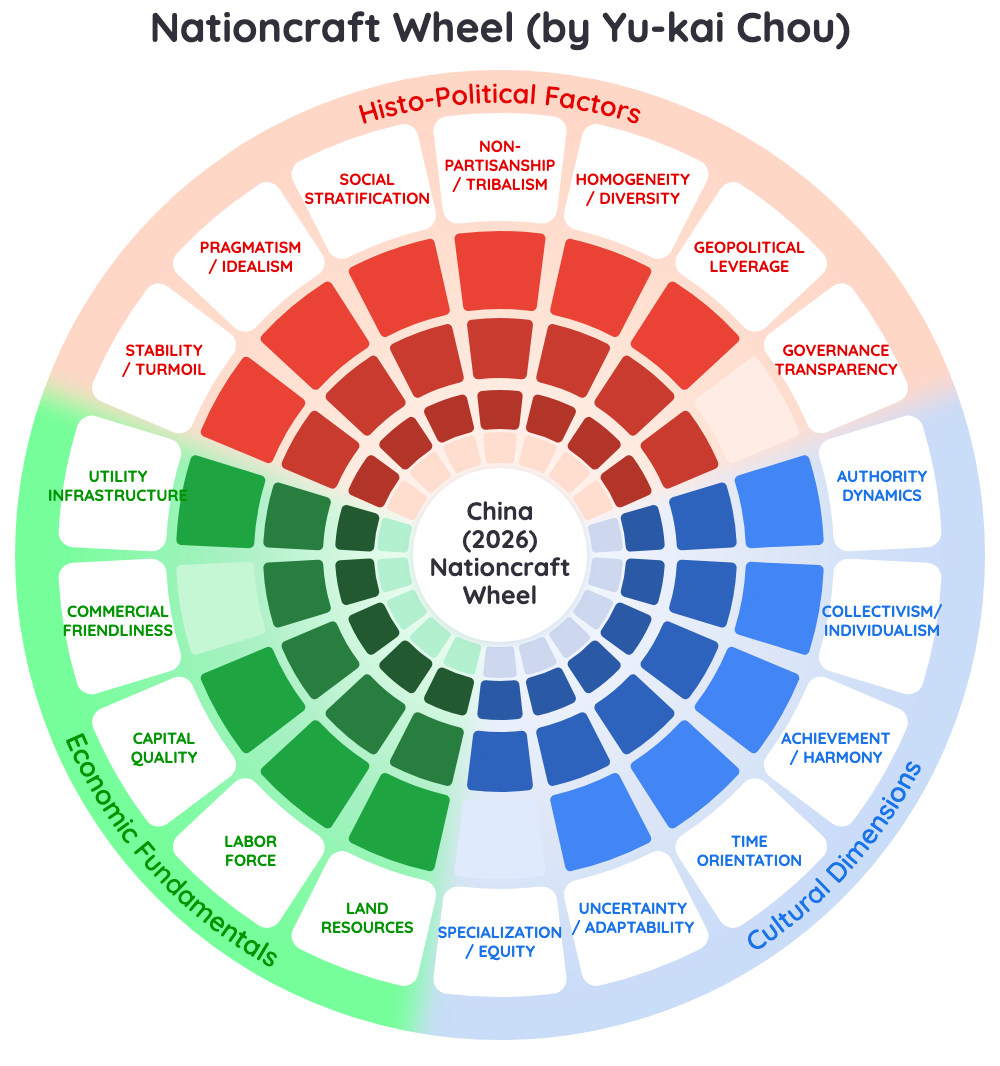
The 18 Nation Variables split into three clusters. Cultural variables (V1–V6) cover authority, collectivism, achievement drive, time horizon, uncertainty tolerance, and the specialization-equity balance.
Histo-political variables (V7–V13) cover stability, pragmatism, stratification, tribalism, homogeneity, geopolitical leverage, and transparency. Economic variables (V14–V18) cover land, labor, capital, commercial friendliness, and infrastructure.
Against those profiles, Nationcraft maintains a library of roughly 140 historical reform packets, each one a documented policy bundle with its preconditions, sequencing, and measured outcomes. The method asks one question: which packets worked under conditions that resemble yours, and which packets failed under conditions that resemble yours?
Scores measure ease of governance rather than moral standing. A V1=10 says nothing admirable or damning by itself; it says certain packets become available and certain failure modes become likely.
Why This China Variables Analysis Matters Right Now
This is the second Nationcraft reading of China in 2026. The August analysis, the China Supply Reflex Trap, diagnosed the demand side: a state that can command factories into existence cannot command households to spend.
This reading takes the reform-sequencing layer, and November 2026 is the right moment for it. The Fifth Plenum of the 20th Central Committee met in Beijing in late October and devoted itself to one agenda: full and rigorous Party self-governance, the discipline architecture for the road to the 2027 congress.[4]
A plenum spent on internal discipline, in the first year of the 15th Five-Year Plan (China’s fifteenth consecutive long-range plan since 1953), is itself a sequencing datum: the center’s scarcest meeting time went to the apparatus.[3]
The macro backdrop makes the sequencing question concrete. Third-quarter GDP grew 4.5 percent year on year, inside the plan’s 4.5–5 percent target band, with the first three quarters at 4.6 percent.[1]
October consumer prices rose 0.7 percent year on year and were flat month on month, with the first ten months up 0.9 percent.[2] Retail sales of consumer goods grew just 1.1 percent over the first three quarters, against 4.6 percent output growth.[1]
An economy printing near-zero inflation with weak retail growth while hitting its output target is an economy whose supply side keeps winning the schedule. The 15th Five-Year Plan’s headline priorities, led by technology self-reliance and a 7 percent annual increase in R&D spending, confirm the pattern.[3]
What the 15th Five-Year Plan schedules, and what it defers
The plan’s published 2026 framework sets a 4.5–5 percent growth target, more than 12 million new urban jobs, a surveyed unemployment ceiling of 5.5 percent, R&D spending growth above 7 percent a year, 11.7 average years of schooling for the working-age population, and a life-expectancy target of 80.[3]
Read that list as a sequencer’s queue. Output, employment, technology, and human-capital inputs all receive numbered commitments, while the household-centered structural items this analysis scores (income share, hukou standing, enforceable contracts, auditable books) appear, where they appear at all, as direction rather than target.
A five-year plan is the most honest document a V4=9 state produces, because it shows what actually got scheduled. The 15th shows the Sequencing Paradox in official print.
Forty-eight years after Deng started the sequence, the question the Nationcraft Framework puts to China is simple. Why does the country that taught the world reform sequencing keep deferring the same phase?
The 18 China Nation Variables
The table below is China’s 2026 Nationcraft scorecard, sanity-checked in November 2026 against National Bureau of Statistics releases, Freedom House, V-Dem, Transparency International, and IMF reporting. Scores run 1–10, and they are never averaged, because the configuration carries the information.
| Variable | Score | 2026 reading |
|---|---|---|
| V1 Authority Dynamics | 10 | Centralized single-party authority; the October 2026 Fifth Plenum centered on Party self-governance, with no institutional dilution |
| V2 Collectivism | 10 | Campaign-style mass mobilization still delivers policy nationwide |
| V3 Achievement | 8 | Gaokao and “involution” intensity; the state now regulates its own excesses |
| V4 Time Orientation | 9 | Fifteenth consecutive five-year plan; codified 2035 and 2049 horizons |
| V5 Uncertainty Adaptability | 9 | Historic pivot capacity; the post-2021 property response has been slower than Deng-era corrections |
| V6 Specialization vs Equity | 5 | Hukou two-track access to schooling and healthcare persists |
| V7 Stability | 7 | Regime-secure; protest stays localized and contained |
| V8 Pragmatism | 7 | Deng-era pragmatism re-weighted by doctrine; “new productive forces” narrows the menu |
| V9 Social Stratification | 8 | Gini near 46–47; property wealth concentration |
| V10 Non-Partisanship | 10 | Single-party monopoly; no partisan fragmentation channel |
| V11 Homogeneity | 8 | Han population near 91 percent; managed periphery |
| V12 Geopolitical Leverage | 10 | Manufacturing gravity, rare-earth processing dominance, UN Security Council seat |
| V13 Transparency | 4 | CPI score near 43; managed statistical series; partial local-debt disclosure |
| V14 Land | 8 | Continental resource base; per-capita water and arable stress |
| V15 Labor | 8 | Top-tier STEM pipeline against a workforce shrinking since 2012 |
| V16 Capital Quality | 7 | Deep pools under capital controls; property-sector drag continues |
| V17 Commercial Friendliness | 6 | World-class logistics against regulatory unpredictability |
| V18 Utility Infrastructure | 7 | 45,000+ km of high-speed rail; household-service conversion gaps remain |
Read as a configuration, this is the strongest gradualism profile in the current corpus: V1=10, V2=10, V4=9, V10=10 is precisely the signature the Gradualist Reform pattern (ET-005) requires. The friction sits in V13=4, V6=5, and V9=8, the three scores that describe who gets left out of the sequence.
The Sequencing Paradox
Every Nationcraft analysis names the specific trap its V-vector produces. For 2026 China, the name is the Sequencing Paradox.
The configuration that makes a state the world’s best reform sequencer is the configuration that eventually prevents it from sequencing the reforms it needs most.
The mechanism is visible in the variables. Gradualism of the Deng type requires V1≥9 and V2≥8, because somebody has to hold the sequence steady for twenty years, contain the losers of each phase, and shut down the political entrepreneurs who would auction the schedule off.
China had exactly that, and phases one through three worked in textbook order: agriculture first (1978–84), urban industry and special economic zones second (1984–92), state-enterprise restructuring and WTO accession third (1992–2001).
Each of those phases shared one property. The state got stronger and the population got richer at the same time, so the sequencer never had to choose between them.
The reform phases still on China’s list break that property. Lifting household consumption from roughly 40 percent of GDP toward the 60-percent world norm means transferring income share away from the state-adjacent investment complex.[5]
Courts that enforce contracts against state entities, hukou equalization that would let China’s internal migrants claim services where they work, and statistics an outsider can audit each move standing and information away from the apparatus. A sequencer with V1=10 and V13=4 faces no institution that can force those items up the queue, so the queue keeps reordering itself toward supply-side projects the apparatus is comfortable with.
Late 2026 is what that reordering looks like in data: October CPI at 0.7 percent, consumer-goods retail at 1.1 percent for the year through September, output on target.[1][2] The sequence continues, and the deferred phase stays deferred.
Detailed Justifications: Reading the Scores
V1=10, V2=10, V10=10: the sequencer’s engine
Authority Dynamics at 10 reflects a system where decision authority concentrates in one party center with no veto player, confirmed again in October, when the Fifth Plenum adopted a resolution on Party self-governance and confirmed discipline rulings with no institutional counterweight in the room.[4] Collectivism at 10 shows up in delivery: when the center picks a campaign, provinces, state firms, and neighborhood committees move together.
Non-Partisanship at 10 records the absence of any partisan fragmentation channel. In Nationcraft terms these three scores explain why the Deng sequence never fractured the way the India Umpire Trap analysis shows democratic reform sequences fracturing: there was no opposition to sell phase two short.
V4=9 and V5=9: patience with a new stiffness
Time Orientation at 9 is the fifteen-plans-in-a-row score, with 2035 and 2049 targets written into party documents. Uncertainty Adaptability keeps a 9 on the strength of history: de-collectivizing agriculture in six years and reversing an entire development doctrine after 1978 remain the benchmark pivots.
The November sanity check carries a one-notch caution on V5, because the property-sector workout has now run five years without a resolution-shaped resolution, slower than any Deng-era course correction. A V5=9 culture governed by a V8=7 doctrine moves like a V5=7 state.
V8=7: pragmatism, re-weighted
Deng’s “crossing the river by feeling the stones” was operational pragmatism at V8=9. The 2026 version subordinates experiment to doctrine: “new productive forces” names in advance which growth paths are acceptable, and the 15th Five-Year Plan’s technology-first priority list narrows the menu further.[3]
That re-weighting matters for sequencing because experimentation was the original packet’s safety mechanism. Shenzhen existed so a failure would be a zone-sized failure, and a doctrine that pre-answers questions runs fewer experiments.
V13=4: the missing referee
Transparency at 4 aggregates a CPI integrity score near 43, statistical series that pause when they embarrass (the youth-unemployment series suspension of 2023 remains the canonical case), and local-government financing vehicles whose debts are only partially disclosed. For this analysis, V13 is the load-bearing score.
Sequencing theory says the next phase should be whatever unlocks the most downstream value. China’s V13=4 means no auditor, court, or press can force that calculation into the open, so the schedule is set by what the apparatus prefers to build.
V6=5 and V9=8: the two-track society
Specialization vs Equity at 5 records the hukou system’s two-track access to schooling, healthcare, and property. Stratification at 8 reflects a Gini near 46–47 with wealth concentrated in urban property.
These scores identify who the deferred phase is for. Migrant workers and rural households are the population whose income share, services access, and legal standing the remaining reforms would raise.
V14–V18: an economy built to supply
The economic cluster reads 8, 8, 7, 6, 7, and the pattern inside it repeats the thesis. Physical capacity scores run high (45,000 kilometers of high-speed rail, top-tier grid), while the scores touching households and firms without state cover run lower: V17=6 for regulatory unpredictability, V16=7 with the property drag, V18=7 on household-service conversion.
Labor at V15=8 carries the long shadow: a top-of-PISA talent pipeline inside a workforce that has been shrinking since 2012. Demographics is the one clock the sequencer cannot reschedule.
Best-Match Historical Packets
Nationcraft treats history as a packet library with preconditions. Three packets anchor this analysis: the one China wrote, the one Russia suffered, and the one that proves the difference was never about speed.
| Packet | Country, years | Approach | Key preconditions | Measured outcome |
|---|---|---|---|---|
| SP-003 Deng Xiaoping Open Reform | China, 1978–2000 | Sequenced gradualism: rural → zones → SOEs/WTO | V1≥9, V2≥8, patient capital, experimental zones | GDP per capita $156 → $10,000+ (64x); poverty 88% → under 1% |
| FP-016 Yeltsin Shock Therapy | Russia, 1991–1999 | Simultaneous price liberalization, voucher privatization, austerity | Ran with rule-of-law and corruption-control scores near 1–2 | Real GDP down ~45% by 1996; oligarch capture; ~40% in poverty by 1999 |
| SP-005 Poland Shock Therapy | Poland, 1990–2004 | Balcerowicz Plan: shock with an EU anchor | V8≥7, V15≥6, V13≥5, external anchor | GDP per capita $1,700 → $15,700 by 2020 (9x); unemployment peaked near 20% |
SP-003: what the Deng packet actually sequenced
The packet’s order was the message. Phase one (1978–84) de-collectivized agriculture through the household responsibility system, which fed the population and created rural purchasing power before any urban reform asked anyone to bear risk.
Phase two (1984–92) expanded special economic zones and ran dual-track pricing, letting market prices grow up alongside plan prices instead of replacing them overnight. Phase three (1992–2001) restructured state enterprises under Zhu Rongji and locked the system into world trade through WTO accession.
The corpus notes what the packet could not copy forward: its own preconditions. It requires V1≥9 and V2≥8, patient capital with no electoral clock, and it explicitly fails in multi-party systems, which is why the packet transfers to so few of the countries that cite it.
FP-016: what Russia’s shock actually hit
The Yeltsin packet is the corpus’s cautionary mirror, and the Russia Fortress Economy analysis traces its long shadow into the present. In January 1992 Russia freed most prices at once, then pushed voucher privatization through an economy whose rule-of-law and corruption-control readings sat near the floor.
The sequencing theory behind it said gradualism would let vested interests organize, so speed itself became the strategy. What speed actually did was transfer pricing power and then asset ownership into an institutional vacuum, where the best-connected insiders converted both into permanent position.
The human ledger from the packet record: real GDP down roughly 45 percent from 1991 to 1996, hyperinflation that erased savings, poverty near 40 percent of the population by 1999, and a demographic crisis measured in collapsed male life expectancy. Ordinary Russians paid for the sequence error, and the oligarchic structure it created outlived every reform that followed.
SP-005: the control case that kills the simple story
If gradualism were simply superior, Poland should have failed. Poland ran the Balcerowicz Plan in January 1990, a shock program as abrupt as Russia’s, and produced the strongest post-communist growth record in Europe, a story whose current institutional chapter the Poland Captured Referee analysis continues.
The packet’s precondition line explains the divergence: shock therapy requires V8≥7, V15≥6, V13≥5, and an external anchor, and it fails when V13 drops below 5 because privatization becomes looting. Poland had Solidarity’s legitimacy, a transparency floor, and the EU accession path as a binding external referee; Russia had none of the three.
That is the Nationcraft point in one comparison. The same packet, run on two different V-vectors, produced a nine-fold income gain in one country and an oligarchy in the other. The variable profile decided the outcome before the policy document was even drafted.
ET-005 and ET-004: the two patterns behind the packets
Zoom out and the three packets instantiate two corpus patterns. Gradualist Reform (ET-005) requires V1≥8, V4≥8, V8≥7 with a dominant-party system that can contain reform losers, which is why its example list reads China, Vietnam, and (in federal form) India.
Shock Therapy (ET-004) requires V5≥7, V8≥8, V13≥5, V15≥6, a post-crisis window, and an external anchor, which is why its example list reads Poland and Estonia. Neither pattern dominates the other; each has a precondition signature, and a reformer’s first job is knowing which signature their country matches.
The outcome ledger, side by side
Packets are judged by trajectories rather than intentions, so here is the ledger the corpus keeps on the three cases, from each packet’s own baseline year.
| Milestone | China (SP-003, base 1978) | Russia (FP-016, base 1991) | Poland (SP-005, base 1990) |
|---|---|---|---|
| Baseline GDP per capita | $156 | ~$3,440 | ~$1,700 |
| Year 5 | $225; poverty 88% → 70% | ~$1,840 (1996); bottom of a ~45% real contraction | $3,600 (1995); transition recession over, unemployment ~15% |
| Year 10 | $400; coastal boom beginning | ~$1,330 (1999 post-crisis low); ~40% in poverty | $4,500 (2000); growth resumed |
| Long run | $10,000+ by 2018 (64x); poverty under 1% | Recovery arrives only with the 2000s oil cycle, on an oligarchic ownership structure | $15,700 by 2020 (9x); EU accession 2004 |
Two of these columns compound and one collapses, and the collapsing column is the one that ran its packet without the packet’s preconditions. That asymmetry, rather than any verdict on speed, is what the Sequencing Paradox generalizes.
Where the Deng packet transfers in 2026
Two live corpus countries still fit the gradualist signature. Vietnam, whose Đổi Mới packet (SP-018) the corpus labels a China-model variant, holds the party-control and pragmatism preconditions, and the Vietnam Double-Digit Decree analysis shows it now attempting the growth-target version of the same supply-first wager.
India fits the democratic variant: the 1991 Liberalization Packet (SP-011) proved phased reform works with V1≤6, at federal speed, with services instead of manufacturing as the lead sector. The transfer lesson cuts both ways, because both countries also inherit the paradox: the stronger the sequencer, the harder the household phase is to schedule.
Governance Strategy Recommendations
This section is written for the general reader, the analyst, and the future reformer, in the sense the Nationcraft Framework always intends: here is what reform of this configuration would require, judged by who benefits. Reform in the Nationcraft sense means opening the system, so every move below is scored by what physically changes for households, and none of it is advice on making the apparatus run better.
| Reform move | What physically changes | Who gains | Variables moved |
|---|---|---|---|
| Hukou equalization | Migrant families enroll children in urban schools and claim urban healthcare where they actually live and work | The migrant-worker population and their dependents | V6 5→7, V9 8→6 |
| Household income share | Wages, social insurance, and public services grow faster than state-adjacent investment; consumption’s GDP share climbs toward world norms | Households broadly, rural households most | V6, V9; demand-side V17 |
| Courts that bind the state | Commercial judgments against state entities are published and enforced; firms stop pricing in expropriation risk | Private firms, workers, and anyone holding a contract | V13 4→6, V17 6→7 |
| Auditable numbers | Statistical series keep publishing when they embarrass; local-government debt is disclosed in full | Savers, researchers, and every decision-maker outside the apparatus | V13 4→6 |
| Competitive neutrality | Private firms borrow, enter markets, and win contracts on the same terms as state firms | Entrepreneurs and the workers their firms would hire | V17 6→8 |
Every row on that list shares one shape: it is a transfer of income, standing, or information toward the population. That is exactly why the Sequencing Paradox predicts these rows stay queued behind another round of semiconductor fabs.
The honest reading of the preconditions also belongs here. Each row names a mechanism that would have to be able to rule against the bodies it checks, and a V1=10 configuration has historically absorbed such mechanisms rather than submitted to them, which is why this analysis forecasts the sequence rather than cheering for it.
For reformers in other countries, the transferable lesson is the packet discipline itself. Match your V-vector to the pattern whose preconditions you meet (ET-005 if you hold a long horizon and can contain losers, ET-004 only with a V13≥5 floor and an external anchor), sequence the phase that feeds people before the phase that asks them to bear risk, and treat the Polish-Russian divergence as the permanent warning about running any packet without its transparency precondition.
Strategic Implications
For readers of this series, three implications follow from the diagnosis. First, expect supply-side bias to persist through the 15th Five-Year Plan window, because nothing in the configuration forces the reorder; October’s 0.7 percent CPI print is the equilibrium, under current sequencing, rather than an anomaly.[2]
Second, the growth model exports the imbalance. A 40-percent consumption share with world-leading manufacturing capacity means surpluses the rest of the world absorbs, and the USA Pendulum Trap analysis shows the electoral backlash machinery that greets those surpluses on the other side.
Third, demographics sets a deadline doctrine cannot move. With the workforce shrinking since 2012 and the population since 2022, every deferred year of household-centered reform raises the age at which the median Chinese citizen would first experience a consumption-led economy.
There is one falsifier worth watching for. If the plan window produces a hukou reform with enforcement teeth or a sustained rise in the household income share, the paradox breaks and this scorecard gets revised upward on V6 and V13 with it; the series treats that as the single best bullish indicator on China that exists.
The Sequencing Paradox also reframes how the series reads Deng himself. His genius was sequencing as a discipline: choose the next phase by what it unlocks for the people feeding the system.
By that standard, the most Dengist move available in 2026 is the one the current sequence keeps postponing.
Comparative Context
China’s configuration sits inside a family of East Asian sequencers the corpus tracks closely. The Park Chung-hee Industrialization Packet deep-dive shows South Korea running V1-heavy sequencing for eighteen years and then, under pressure from the configuration’s own graduates, handing the sequence to voters.
The Singapore LKY stress test examines the one state that kept high-V1 sequencing clean for six decades, with V13 and rule-of-law scores China has never approached. The Taiwan Silicon Shield reading completes the triangle: a KMT-era sequencer that democratized mid-sequence and kept compounding.
The contrast set matters because it breaks the fatalist reading of this analysis. High-authority sequencing has exited into open systems before, in Seoul and Taipei, under exactly this civilizational umbrella; the variable that separated those exits from stagnation was each system’s willingness to let a referee emerge.
The Nationcraft Framework in Practice
The Nationcraft method shown here is the same one applied across the series: score the 18 variables from current evidence, name the trap the configuration produces, then search the packet library for precondition matches instead of importing whatever worked somewhere impressive. It is behavioral design at nation scale, and it inherits Octalysis’s core finding that systems run on motivation structure rather than on stated intentions.
China illustrates the motivational layer unusually well. The state’s own designs, from the China Social Credit System to campaign-style mobilization, lean on extrinsic and fear-adjacent drives, the pattern the White Hat vs Black Hat Gamification framework predicts will deliver compliance while suppressing the intrinsic confidence a consumption economy needs.
Households that cannot predict their legal standing save defensively, and no stimulus voucher redesigns that motivation. That is the deepest link between this site’s two frameworks: the deferred reforms are, in Octalysis terms, the White Hat phase of Chinese statecraft.
Explore More Nationcraft Analyses
The full country series lives in the Nationcraft country analyses library, with new 18-variable readings published continuously. For adjacent sequencing stories, start with the August India Mandate Trap companion to this piece’s democratic-gradualism thread.
Closing
China solved the hardest sequencing problem in economic history and then met the one its solution created. The configuration that held the sequence steady for two decades now decides what gets sequenced, and it keeps choosing itself.
Whether the household phase ships inside the 15th Five-Year Plan window is the single most consequential open question in the world economy, and the 18 variables above are the instrument this series will keep reading it with.
Frequently Asked Questions
What is the Sequencing Paradox in China’s Nationcraft analysis?
The Sequencing Paradox is the finding that the configuration making China the world’s best reform sequencer (V1=10 authority, V4=9 time orientation, V2=10 collectivism) is the same configuration that now prevents it from scheduling its most needed reforms. The remaining phases transfer income, legal standing, and information from the apparatus to households, and no institution inside a V1=10, V13=4 system can force those phases up the queue.
Why did China’s gradualism succeed where Russia’s shock therapy failed?
The Nationcraft corpus answers with preconditions rather than ideology. China’s Deng packet (SP-003) required V1≥9 and V2≥8 plus patient capital, and sequenced agriculture before industry so every phase fed the population first. Russia ran shock therapy (FP-016) on rule-of-law and corruption-control scores near the floor, so freed prices and voucher privatization transferred assets into an institutional vacuum that insiders captured.
Does the Poland case prove shock therapy can work?
It can work when its own preconditions hold. Poland’s Balcerowicz Plan (SP-005) succeeded with V13≥5 transparency, a V15≥6 workforce, and the EU accession path as an external anchor, multiplying GDP per capita nine times by 2020. The corpus rule is that shock therapy fails when V13 drops below 5, which is the exact line separating Warsaw’s outcome from Moscow’s.
What would reform in the opening sense look like for China?
The five moves this analysis scores are hukou equalization, raising the household income share, courts whose judgments bind state entities, fully published statistics and local-government debt, and competitive neutrality between private and state firms. Each one physically transfers income, standing, or information toward households, which is the Nationcraft definition of reform as opposed to state-capacity optimization.
How current is this China V-vector?
The 18 scores were sanity-checked on November 11, 2026 against National Bureau of Statistics releases through the October CPI print, the Fifth Plenum readout, Freedom House, V-Dem, and Transparency International data. The check found zero major drifts from the corpus record and carried three one-notch minor notes on V5, V16, and V18.
Related Reading
- The Nationcraft Framework — the 18-variable system behind this analysis
- Nationcraft Country Analyses Library — every published V-vector reading
- Nationcraft Analysis: South Korea Post-Martial 2026 — the sequencer that handed its sequence to voters
- Nationcraft Analysis: North Korea Summit Mirage 2026 — the opposite corner of the V1=10 family
- Nationcraft Analysis: Sri Lanka Graduation Cliff 2026 — sequencing under an external program
- How Taiwan Gamified Tax Collection — a receipt lottery as early compliance-by-motivation design
Footnotes
- National Bureau of Statistics of China, “National Economy Sustained Steady Progress in the First Three Quarters,” via gov.cn, October 19, 2026. english.www.gov.cn
- Xinhua / National Bureau of Statistics, “China’s consumer prices rise 0.7 pct in October,” via gov.cn, November 9, 2026. english.www.gov.cn
- PRC Embassy summary of the 15th Five-Year Plan framework and 2026 targets, March 20, 2026 (updated October 28, 2026). china-embassy.gov.cn
- China Daily, “Fifth plenary session of the 20th CPC Central Committee concludes, adopting resolution on Party self-governance,” October 30, 2026. chinadailyhk.com; session announcement: Xinhua via NPC, July 30, 2026. subsites.chinadaily.com.cn
- World Bank, Households and NPISHs final consumption expenditure (% of GDP), World Development Indicators. data.worldbank.org
- World Bank, GDP per capita (current US$) — China, World Development Indicators. data.worldbank.org