
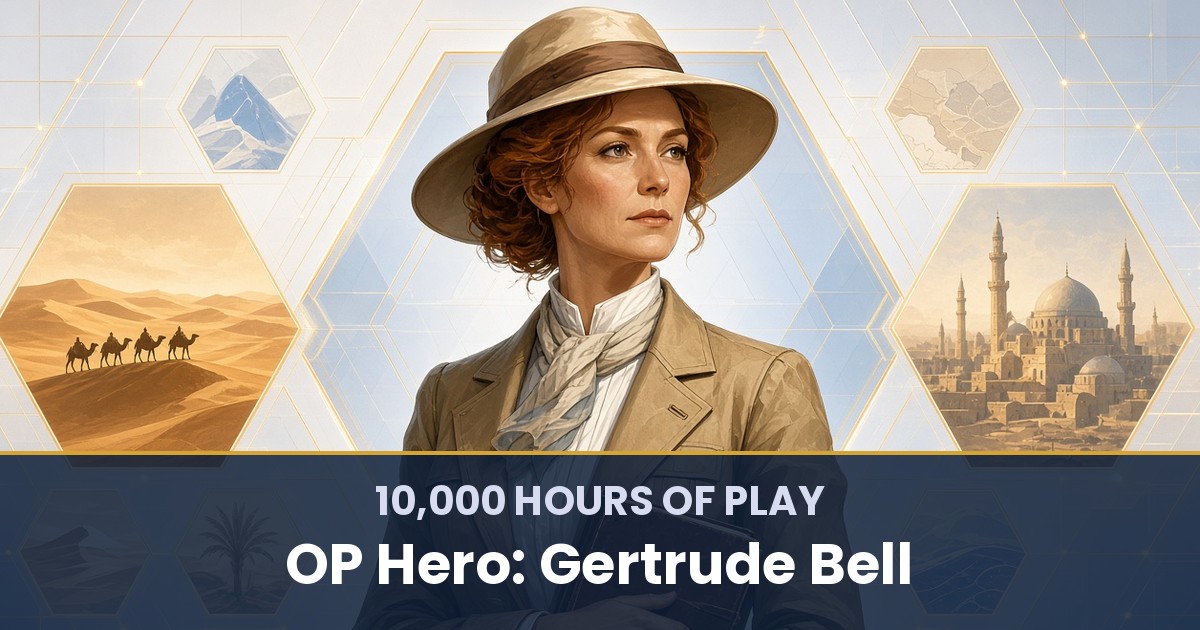


On December 16, 1913, a forty-five-year-old Englishwoman rode out of Damascus at the head of a camel caravan, pointed at Ha’il, the desert stronghold of the Ibn Rashid dynasty.
The round trip would cover roughly 1,800 miles of sand, and the authorities at Ha’il who held her up had no idea what to do with her.
Seven years later, that same woman sat in a Cairo conference room as the only woman among the delegates, helping decide who would rule a new country called Iraq. The knowledge that earned her the seat came from the camel journeys she had been making for years.
Gertrude Bell ran a thirty-year build in which almost nothing paid off until the last decade, and when you lay her life across the 6-Step framework, you can see exactly how a scholar with a notebook ended up shaping a nation. Let’s run her life through it, one Step at a time.
⚡ Speed Run Notes
- Gertrude Bell played one Game for three decades: turn first-hand knowledge of the Middle East into real influence over how it was governed and preserved.
- Her Attributes showed up early: a first in Modern History at Oxford at nineteen, then an appetite for physical risk that took her up unclimbed Alpine peaks.
- She switched Roles roughly every decade: scholar, mountaineer, explorer, intelligence analyst, administrator, museum founder, while the Game underneath never moved.
- Five canon Skills power her build: Ley Line Infusion, True Sight, Courageous Heart, Loremaster, and Concord of Elements.
- Allies converted her knowledge into position: Percy Cox gave her a desk inside the empire, T. E. Lawrence backed the same king, and Faisal gave her a state to help build.
- The lesson to steal: deep, unglamorous knowledge compounds quietly for years, then becomes leverage the moment the world suddenly needs it.
Table of Contents
- Step 1: The Game Gertrude Bell Was Actually Playing
- Step 2: Attributes, the Innate Stats
- Step 3: Roles, the Character Class Across Chapters
- Step 4: The Real-Life Game Skills Gertrude Bell Mastered
- Step 5: The Allies Who Multiplied Gertrude Bell
- Step 6: The Quests That Shaped the Saga
- What You Can Steal From Gertrude Bell’s Build
- Where this framework comes from
About Yu-kai Chou

Yu-kai Chou is the author of 10,000 Hours of Play — the book that treats your life as the most important game you’ll ever build a character in, and gives you the 6-Step framework (Game · Attributes · Role · Skills · Allies · Quests) to play it on purpose. He has spent two decades developing the system through which this post analyzes its OP Hero, and applies it to his own life and to the lives of the people he advises around the world.
Chou’s other framework, the Octalysis Framework, has been applied by LEGO, Microsoft, Porsche, Coca-Cola, Salesforce, and MrBeast, impacting over 1.5 Billion Users. He has taught the methodology at Harvard, Stanford, Yale, Tesla, Google, BCG, and IDEO, and has advised governments in eight nations including Ukraine, the United Kingdom, the Kingdom of Bahrain, Singapore, Taiwan, the Netherlands, Kazakhstan, and South Korea.
His work has been cited by Harvard, Stanford, MIT, Forbes, Wall Street Journal, Wired, US Department of Energy, NIST, NSF, NCBI, US Department of Education, ClinicalTrials.gov, and Google Scholar — with 3,700+ more academic publications. Explore his books here.

Bell got the order of Step 2 right, and that is the part of her build I would copy: she learned how much risk she could carry on an Alpine rope in 1902, years before she bet the same tolerance on a camel ride to Ha’il. Test an Attribute somewhere failure is cheap, the way she did on the mountains, before you build a Game on it.
Step 1: The Game — What Gertrude Bell Was Actually Playing
Strip away the titles and the legend, and Bell’s Game reads cleanly: acquire first-hand knowledge of the Middle East, then convert that knowledge into influence over how the region was governed and how its heritage was preserved.
Every chapter of her life feeds that single mission. Her journeys from the 1890s onward through Persia, Palestine, Syria, Turkey, and Mesopotamia were data collection.
Her 1907 book The Desert and the Sown looks like travel writing, and it is, but it also carries landscape, archaeology, tribal politics, and interviews with local power brokers braided into one record. She was mapping a political world, one conversation at a time.
When the First World War broke out, the British realized that this private obsession was now a strategic asset. Bell moved from Cairo to Basra to Baghdad, and her decades of notes became operational intelligence.
After the 1921 Cairo Conference installed Faisal as king of Iraq, she turned the same mission toward cultural preservation: an antiquities law, a national museum, a framework for keeping Iraq’s history in Iraq.
Step 2: Attributes — The Innate Stats
Bell’s raw stats were visible long before the desert. In 1888, at nineteen, she took first-class honours in Modern History at Oxford, the first woman to do so.
The physical side of her stat sheet came next. Between 1899 and 1904 she compiled a serious Alpine mountaineering record, and in the summer of 1902 a blizzard on the Finsteraarhorn’s northeast ridge left her and her guides hanging on a rope for roughly two days and nights before they got down alive. An Alpine peak, the Gertrudspitze, still carries her name.
So the attribute sheet starts with risk tolerance and physical endurance, measured in hours on a frozen rope.
Add pattern recognition: her notebooks connected geography, settlement history, tribal affiliation, and imperial interest into one mental map, which is precisely what made her valuable to wartime intelligence later.
Social perception belongs on the sheet too. The reason Cairo wanted her in 1915 was that she could tell which tribal leaders mattered and what they wanted, a reading no map could supply.
Using the Talent Triangle Method, the play is to find where your strongest innate stats overlap and build there. Bell’s overlap of endurance, pattern recognition, and social perception pointed at exactly one career, the explorer-diplomat, and she held it for the rest of her life.
Step 3: Role(s) — The Character Class Across Chapters
Bell respec’d her Role repeatedly, which is what a long Game usually demands.
In the 1880s and 1890s she was the scholar and linguist, building the historical and language foundation at Oxford and after. From the 1890s to 1914 she played the explorer-writer-photographer, with a mountaineering side class that sharpened her nerve.
The war years rolled her into a new class entirely: intelligence analyst, recruited to Cairo in 1915, supplying the regional knowledge British officials could not get through normal channels.
From 1917 she served as Oriental Secretary under Sir Percy Cox, which made her a political adviser inside the administration that would shape postwar Iraq. After 1921 she took her final form: state-builder and cultural administrator, writing the rules that governed archaeology in the new country.
The Role changes whenever the environment changes, but each new class inherits the full experience bar of the previous one.
The explorer’s notebooks fed the analyst, whose wartime standing fed the administrator, whose political capital funded the museum founder.
Step 4: Skills — The Real-Life Game Skills Gertrude Bell Mastered
Five canon Skills show up in Bell’s build with specific, dateable evidence.
Ley Line Infusion (Mage): rapidly absorbing a large body of knowledge in one subject. Bell did this with languages her whole life. Beyond French, German, and Italian, she worked in Persian, Arabic, and Turkish, and her translation Poems from the Divan of Hafiz appeared in 1897.
True Sight (Ranger): observing keen details others miss. Her field method was relentless: routes, wells, ruins, personalities, and tribal relationships, all recorded in diaries, letters, and photograph albums. British planners later leaned on details she had written down years earlier.
Courageous Heart (Paladin): charging into uncharted, hostile territory. The 1913–14 ride to Ha’il is the textbook case: a roughly 1,800-mile loop through contested desert to a city ruled by a rival dynasty and back, where she was held up by suspicious authorities before being allowed to leave with her notes.
Loremaster (Druid): weaving compelling stories that move people. The Desert and the Sown and Amurath to Amurath (1911) made the desert legible to readers in London, and that storytelling is what turned private expertise into public authority.
Concord of Elements (Druid): bringing parties with different interests to one table. At Cairo in 1921 she helped align British officials, Arab nationalists, and the Hashemite family behind a single candidate for the Iraqi throne.
On the Skills Spectrum, Bell reads as a master of one domain served by several specialist Skills, the configuration that fits a Game built on depth other people cannot fake.
Step 5: Allies — The People Who Multiplied Gertrude Bell
Bell’s knowledge only became power because specific people converted it.
Sir Percy Cox is the clearest case. As the senior British political officer in Mesopotamia, he brought Bell to Basra in 1916 and made her his Oriental Secretary in 1917, the desk from which her private archive became imperial policy. When Cox needed Ibn Saud’s cooperation, Bell was there in Basra in 1916 when the desert ruler came to meet the British.
T. E. Lawrence was the ally who shared her cause at the decisive moment. The two had overlapping expertise and, at the 1921 Cairo Conference, they pushed the same outcome: Faisal, son of Sharif Hussein of Mecca, as king of Iraq.
Faisal himself became her third great alliance. After his coronation in August 1921, Bell held real standing in the new court, and she spent it on an antiquities law and a museum rather than on herself.
Beneath the famous names sat the quieter network that made everything else possible: the tribal leaders and local elites who received her year after year. Iraqis called her “Khatun,” an honorific for a lady of standing, and that standing was itself an asset the British could not replicate.
Step 6: Quests — The Milestones That Shaped the Saga
Quest 1, become the field authority (1890s–1907): years of journeys through Persia, Palestine, Syria, and Asia Minor, culminating in The Desert and the Sown in 1907. Quest reward: a reputation as a writer whose travel books doubled as political geography.
Quest 2, the Ha’il expedition (1913–14): departing Damascus on December 16, 1913, she covered roughly 1,800 miles on the loop to the Ibn Rashid stronghold and back, returning in April 1914 with first-hand notes on central Arabia, four months before the war began.
Quest 3, the war conversion (1915–17): recruited to Cairo in 1915, then posted to Basra and Baghdad, she converted twenty years of private knowledge into the empire’s working map of Mesopotamia.
Quest 4, the setback (1920): the postwar settlement she worked inside did not go smoothly. The 1920 Iraqi revolt made the cost of the occupation brutally clear, and Bell’s own memoranda wrestled with borders, public opinion, and the terms of the settlement. The system she helped administer was contested from the start, and she knew it.
Quest 5, the Cairo Conference and the crown (1921): out of that failure came the settlement push at Cairo in March 1921, where Bell backed Faisal’s candidacy, and Faisal was crowned king of Iraq in August 1921.
Quest 6, the endgame institution (1922–26): appointed Honorary Director of Antiquities in 1922, she drafted the antiquities law Iraq passed in 1924 and built the Baghdad museum that became the Iraq Museum, insisting that Iraq keep a share of what was excavated on its own soil. She died in Baghdad in July 1926, with the museum as her monument.
What You Can Steal From Gertrude Bell’s Build
First, compound unfashionable knowledge while nobody is watching. Bell spent two decades learning languages and tribal genealogies that had no market value, until suddenly they were exactly what an empire at war needed most.
Second, write everything down as you go. The diaries, letters, and photograph albums Bell kept were the raw material the Arab Bureau put to work in 1915.
Third, respec the class and keep the mission. Bell changed character class six times in forty years and never once restarted at level one.
Fourth, let allies convert your knowledge into position. Bell never held elected office of any kind. Every ounce of her influence flowed through alliances she built deliberately, over years, with people who controlled the doors she needed opened.
Where this framework comes from

Want the full system this profile is built on?
Every OP Hero piece runs through the same 6-Step framework from 10,000 Hours of Play: Unlock Your Real-Life Legendary Success. The book covers the full system, walks through Yu-kai’s own life run as the first applied case study, and gives you the worksheets to audit your own build.
Related Reading
- All OP Hero Profiles: the full 10,000 Hours of Play hero catalog
- 10,000 Hours of Play by OP Hero: Roald Amundsen
- 10,000 Hours of Play by OP Hero: Nellie Bly
- 10,000 Hours of Play by OP Hero: Mary Seacole
- 10,000 Hours of Play by OP Hero: Raoul Wallenberg
- Real-Life Game Skill: The Lich Pact