
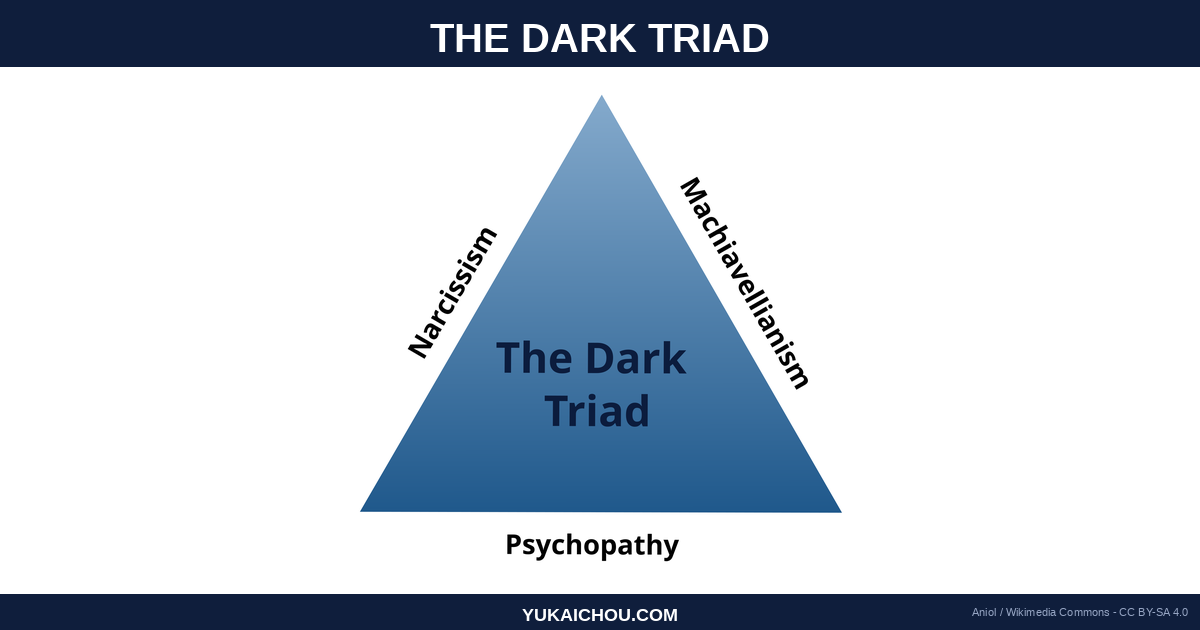

Every designer who has ever chosen a dark pattern, buried a cancel link, or engineered a scarcity countdown that wasn’t really scarce has met the Dark Triad somewhere on the way to that decision — either in themselves, in the executive signing off on the roadmap, or in the “growth hacker” whose tactics they inherited. The three traits — Machiavellianism, narcissism, and psychopathy — are not a Halloween costume for “bad people.” They are a measurable cluster of everyday personality that shows up inside the same teams that ship games, fintech onboarding, SaaS trials, and government nudge programs.
What most designers get wrong is treating the Dark Triad as character judgment instead of as an engineering variable. Paulhus and Williams published the canonical paper in 2002 for exactly this reason: they wanted to test whether three constructs that each psychology sub-field had been studying in isolation were really one family, and what the shared core actually predicted. The answer — “sort of, but the overlap is smaller and messier than the headlines said” — is the reason the construct is still contested twenty-plus years later, and the reason every serious behavioral design shop should understand both the signal and the noise.
Below is the working map I use when I audit a behavioral design for Black-Hat risk: what the three traits actually are, what Paulhus & Williams got right, the three places their framework falls apart under modern measurement, how each trait maps to the Octalysis Core Drives, and how a designer can recognize Dark-Triad-flavored design choices in their own specs before those choices ship and damage real users. By the end, you will have a working toolkit for spotting, measuring, and counter-designing against the Dark Triad in any system you are asked to build.
Speed Run Notes
- The Dark Triad is three distinct but overlapping personality traits — Machiavellianism (cold strategy), narcissism (grandiose self), psychopathy (callous impulsivity) — not a single “evil” dimension.
- Paulhus & Williams (2002) proved the three overlap meaningfully but are not redundant. The shared core — callous disregard for others — is what later researchers relabelled the “D-Factor.”
- All three predict short-term strategic gain and long-term relational collapse. In designed systems, that trade-off is the operational definition of Black-Hat Octalysis.
- Measurement is contested: Dirty Dozen (12 items) is fast but noisy; SD3 (27 items) is the current gold standard; both show psychopathy soaking up too much variance.
- Dark-Triad-flavored designs map to CD6 / CD7 / CD8 (Scarcity, Unpredictability, Loss). The White-Hat counter is Ownership (CD4) and Creativity (CD3) with transparent exit paths.
- The designer’s job is not to avoid every Black-Hat lever; it is to know when a lever crosses from motivating into manipulative — and to build that crossover into the spec, not the hindsight.
In This Article
- What Is the Dark Triad?
- The Core Findings
- What Paulhus & Williams Got Right
- Where the Dark Triad Falls Apart
- The Brain on the Dark Triad
- Dark Triad vs Other Personality Theories
- The Dark Triad in the Real World
- The Elephant in the Room
- How to Apply the Dark Triad with the Octalysis Framework
- Practical Steps to Apply the Dark Triad
- FAQ
About the Author

Yu-kai Chou is an S-Tier Behavioral Designer and the creator of the Octalysis Framework, the gamification design system now applied to products and experiences reaching over 1.5 billion users. His book Actionable Gamification is one of the most-cited works in the field, and he has been ranked the #1 Gamification Guru in the World.
He has advised MrBeast, LEGO, Microsoft, Porsche, Tesla, Stanford, Harvard, and governments including Ukraine on turning behavioral psychology into product mechanics that actually change user behavior.
Verify: Wikipedia · Google Scholar · Wikidata · LinkedIn
What Is the Dark Triad?
The Dark Triad is a three-trait model of socially aversive personality proposed by Delroy Paulhus and Kevin Williams at the University of British Columbia in their 2002 paper The Dark Triad of personality: Narcissism, Machiavellianism, and psychopathy, published in the Journal of Research in Personality. The paper pulled together three sub-literatures that had each been developing in isolation — clinical psychopathy research (Hare), political-psychology Machiavellianism research (Christie & Geis), and personality-disorder narcissism research (Raskin & Hall) — and asked a deceptively simple question: when you measure all three traits in the same non-clinical sample, how much do they overlap, and what does their overlap predict?
The trio itself is best read as a short vocabulary exercise, because the three labels look similar but mean different things in the technical literature than in everyday speech.
Machiavellianism — The Strategist
Machiavellianism, in the Christie & Geis (1970) tradition, is a cold-blooded instrumental outlook on social life: the belief that people are tools for one’s goals, that manipulation is a legitimate tactic, and that ethical constraints are naive. High-Mach individuals plan. They read the room, play long games, and are willing to lie when lying pays. They do not crave admiration (that is narcissism), and they are not impulsive (that is psychopathy). They are strategic. In a product team, Machiavellianism looks like the growth-marketing lead who can coolly describe exactly which cancellation friction will depress churn by 0.4 percent and can do it in a conference room without blinking.
Narcissism — The Grandiose Self
Subclinical narcissism is not the DSM personality disorder. It is a dispositional trait of inflated self-views, entitlement, a need for admiration, and a willingness to take credit for others’ work. It splits into at least two factors — grandiose and vulnerable — but the Dark Triad literature has historically focused on the grandiose form (Raskin & Hall’s NPI). Narcissists are the ones who mistake “received the project brief” for “authored the project brief.” They respond well to public recognition and poorly to peer correction. In a design team, narcissism looks like the founder-CEO who insists every roadmap slide include their face and who calls any counter-argument “not being a team player.”
Psychopathy — The Callous Impulsive
Subclinical psychopathy is the trait most often confused with its clinical extreme. Hare’s psychopathy construct, when detuned down to the normal range, describes callousness, low empathy, low anxiety, and high impulsivity — the combination that produces thrill-seeking risk-taking decoupled from concern for other people’s welfare. Paulhus & Williams used the Self-Report Psychopathy Scale (SRP-III) in their original paper. This is the trait most likely to be missing, in normal samples, from the co-worker who also scores high on Machiavellianism. In a design team, high psychopathy looks like the senior engineer who will ship the A/B test that extracts the conversion lift even when the test’s losing arm knowingly harms a minority of users, because “that’s what the test is for.”
The Shared Core vs The Unique Variance
The reason all three traits are bundled as a “triad” rather than studied as separate variables is that empirical work since 1998 has consistently shown they share a common core — callous, self-interested disregard for others — while retaining distinct edges. Machiavellianism is callousness with strategy. Narcissism is callousness with self-inflation. Psychopathy is callousness with impulsivity and low anxiety. The callousness is the shared face; the tactics are the unique variance. Moshagen, Hilbig, and Zettler (2018) formalized this shared core as the D-Factor (the general Dark Factor of Personality), which we will return to below.
The Core Findings
Six findings from the Dark Triad literature do the bulk of the predictive work. They are worth holding clearly in mind because almost every applied claim (“dark personalities are better leaders,” “dark personalities do worse in teams,” “dark personalities fit UX roles poorly”) is a simplification of one or more of these.
Finding 1 — Moderate Overlap, Not Redundancy
Paulhus & Williams’s 2002 original found intercorrelations of approximately r = 0.25 to r = 0.50 among Machiavellianism, narcissism, and psychopathy in a student sample. That is “related but not redundant.” If the three had been one construct in three costumes, intercorrelations would push past r = 0.80. They do not. Every subsequent meta-analysis (Muris, Merckelbach, Otgaar, & Meesters 2017, combining 91 studies) lands in the same r = 0.30 – 0.50 band. The three traits are a family, not a uniform.
Finding 2 — Strategic Short-Term Gain, Long-Term Cost
Across organizational, romantic, and friendship contexts, Dark-Triad-high individuals secure short-term benefits (promotions, sexual partners, first-impression status) and pay long-term costs (team-level dysfunction, counterproductive work behavior, relationship collapse). Jonason & Webster’s (2012) work, and O’Boyle, Forsyth, Banks, & McDaniel’s (2012) meta-analysis, both show this U-shape clearly: the short-term lift is real; the long-term drag is larger.
Finding 3 — Moderate Heritability, Not Destiny
Twin studies (Vernon, Villani, Vickers, & Harris 2008) estimate heritability coefficients of roughly 0.31 for Machiavellianism, 0.59 for narcissism, and 0.64 for psychopathy. That is substantial but not deterministic — environment, context, and incentive structures are all moving parts. Designers who assume “you can’t change a narcissist so don’t even try” are misreading the heritability data; the trait has ceiling effects and situational elasticity both.
Finding 4 — Sex Differences, but Smaller Than Stereotype
Across samples, men score higher than women on all three traits, with the largest gap on psychopathy (d ~ 0.67) and smaller gaps on Machiavellianism (d ~ 0.39) and narcissism (d ~ 0.26) (Muris et al. 2017). These effect sizes are real, but they are not the “men are X, women are Y” caricature — the within-gender variance swamps the between-gender means for every trait.
Finding 5 — The Industries That Attract Them
Babiak, Neumann, & Hare’s (2010) corporate-psychopathy study found psychopathy scores in a sample of executives roughly three to four times higher than community-sample base rates. Similar “industry fit” patterns appear for Machiavellianism in sales, finance, and politics, and for narcissism in entertainment, advertising, and tech entrepreneurship. The causal story is bidirectional — these industries select for some Dark-Triad signals and reward others — but the descriptive statistic is robust.
Finding 6 — The “Successful Psychopath” Is Real, Barely
A sub-literature on successful psychopathy (Lilienfeld, Watts, & Smith 2015) argues that certain psychopathy facets (fearless dominance, social potency) can be adaptive in high-pressure leadership when de-coupled from impulsive antisociality. The effect is real but narrow: it is specific facets of one of the three Dark-Triad traits under specific conditions. Headlines that summarize this as “psychopaths make the best CEOs” are doing considerable narrative violence to the actual findings.
What Paulhus & Williams Got Right
Before we audit what the framework got wrong, it is worth naming what Paulhus & Williams’s 2002 paper genuinely unlocked. Three contributions stand out and still hold twenty-plus years later.
Bundling Pre-empted a Literature-Wide Replication Crisis
Prior to 2002, the three traits sat in separate silos. Machiavellianism research rarely measured psychopathy. Psychopathy research rarely measured narcissism. Narcissism research rarely cited either. The siloing meant every sub-literature was over-claiming — attributing to “their” trait variance that actually belonged to one of the other two. Paulhus & Williams forced the three to share a regression table. The immediate consequence was that a lot of claims in each sub-literature turned out to be trait-non-specific: “Machiavellianism predicts counter-productive work behavior” was really “the shared dark core predicts counter-productive work behavior, and Machiavellianism happened to be the measure used.” That is a disciplinary gift — a large step down the reproducibility path, years before “replication crisis” became a common phrase in psychology.
Normal-Range Measurement Without Clinical Diagnosis
The other move Paulhus & Williams made — which is easy to miss because it is baked in — was to pull all three traits into the normal range. The original psychopathy construct came from Hare’s PCL-R, a clinical instrument used for forensic settings. The original Machiavellianism construct (Christie & Geis’s Mach-IV) sat closer to political psychology. The Dark Triad paper’s contribution was to show that self-report, normal-range instruments for each trait hung together meaningfully, which opened the entire construct to industrial, organizational, and design research. Without that move, we could not study Dark-Triad dynamics in design teams at all — we would have needed clinicians to interview every subject.
A Honest Take on Adaptive Costs and Benefits
The 2002 paper did not moralize. It treated the three traits as variables with consequences, some adaptive and some maladaptive, depending on context. That restraint opened space for the “successful psychopath” literature, for studies of dark-trait leadership advantages, and for the current evolutionary-psychology conversation about whether Dark-Triad strategies are a Life History fast-pathway. A more moralistic original framing would have locked the construct into “bad people” rhetoric and prevented the conditional-advantage literature from developing. The original paper was careful to describe and not prescribe, and the field is richer for it.
Where the Dark Triad Falls Apart
Twenty-plus years of cumulative research have also exposed three substantial fault lines in the Dark Triad framework. These are not minor footnotes — they are the reason serious personality psychologists now hedge every applied claim, and the reason behavioral designers should too.
Critique 1 — The Factor Structure Problem
The most damaging critique is the one that has reshaped the field: the Dark Triad’s three-factor structure does not replicate cleanly. Muris, Merckelbach, Otgaar, & Meesters’s (2017) large meta-analysis reported intercorrelations in the r = 0.30 – 0.50 band — enough to confirm overlap, but also enough to raise a deeper question: is this one factor in three costumes, or three factors with a shared corner?
Moshagen, Hilbig, & Zettler’s (2018) pre-registered item-level analysis in Psychological Review delivered the answer that blew up the tidy story. They extracted what they called the D-Factor — a general Dark Factor of Personality — from a 70-item pool spanning Machiavellianism, narcissism, psychopathy, sadism, spitefulness, egoism, and moral disengagement. D alone accounted for roughly half the variance across all seven constructs. In other words, the Dark Triad’s three-trait structure is largely a measurement artifact of which questionnaires were historically grouped together; the deeper factor is a single general tendency, and the three Dark-Triad labels are shallow facets of it.
This is the single most important scientific update the field has made since 2002, and behavioral designers must internalise it: when you say “this ad is narcissism-bait,” you are almost certainly describing something that D-Factor measurement would have caught as general dark-core activation, not a narrowly “narcissism” phenomenon. Designing against the triad is, in practice, designing against D.
Critique 2 — The Measurement Instruments Are Structurally Biased
The two most-used Dark Triad scales — the Dirty Dozen (Jonason & Webster 2010, 12 items) and the Short Dark Triad or SD3 (Jones & Paulhus 2014, 27 items) — both carry known structural problems that inflate certain claims and deflate others.
The Dirty Dozen is fast (completion under two minutes) and widely used, but it is so short that the psychopathy subscale has only four items. That is not enough items to cover psychopathy’s full conceptual space — particularly the fearless-dominance facet that the “successful psychopath” literature cares about. Miller et al. (2012) and Lee & Ashton’s subsequent work have documented substantial “conceptual shrinkage”: the Dirty Dozen measures a narrower, more antisocial, more impulsivity-weighted version of each trait than the full instruments do.
SD3 fixes some of that, but introduces a different problem: its psychopathy subscale absorbs a large share of variance in multi-trait regression. If you predict any outcome from all three SD3 subscales simultaneously, the psychopathy subscale almost always “wins” the beta-coefficient contest, suppressing the unique Machiavellianism and narcissism contributions. That is an instrument artifact, not a population truth — it happens because SD3’s psychopathy items include highly loaded content (e.g., “I like to get revenge on authorities”) that correlates strongly with both other traits. Designers reading Dark-Triad applied research should always check which instrument the paper used before accepting any “psychopathy uniquely predicts X” claim.
Critique 3 — The Dark Tetrad and the Question of What’s Missing
Buckels, Jones, and Paulhus (2013) argued that everyday sadism — the enjoyment of others’ suffering — adds predictive power that the Dark Triad alone misses, particularly for trolling, cyberbullying, and workplace bullying. Their expanded model, the Dark Tetrad, added sadism as a fourth factor. The extension has been productive: online-trolling and cyber-aggression research using the Dark Tetrad reliably finds sadism outperforming the other three traits in predicting those specific behaviors.
This is a scientific embarrassment for the original Dark Triad: either (a) sadism is really just the psychopathy callousness facet under a different name (in which case the Dark Triad’s psychopathy measurement is too broad), or (b) sadism is genuinely separate (in which case the Dark Triad was always missing a fourth trait). The current consensus is “a bit of both, and we should measure all four in serious work.” The Dark Triad, as a strict three-trait model, is an accident of 2002 literature boundaries, not a principled final count. For designers studying online-community moderation, harassment patterns, or in-game griefing, the Dark Tetrad is the right frame — the Dark Triad alone will under-measure the phenomenon you care about.
The Brain on the Dark Triad
Neural correlates of Dark-Triad traits have been studied for roughly fifteen years, and three findings have emerged with enough replication weight to quote in an applied piece. None of them implies “brain scan can diagnose a narcissist”; all of them matter for thinking about how Dark-Triad dynamics interact with the rest of the Octalysis behavioral-neuroscience story.
Reduced Empathic Response in the Anterior Insula
Functional MRI work by Decety, Chen, Harenski, and Kiehl (2013) and subsequent replications have shown that high-psychopathy individuals display blunted anterior insula and anterior cingulate activation when viewing others in pain. The same circuits that light up in low-psychopathy observers — the affective empathy network — light up less in high-psychopathy individuals. The cognitive perspective-taking network (medial prefrontal cortex, temporoparietal junction) appears less affected, which is consistent with the behavioral observation that high-psychopathy individuals can read other people’s emotions quite well while caring less about them.
Striatal Response to Social Reward in Narcissism
Studies of grandiose narcissism show heightened ventral striatum response to social-approval stimuli (Brunell & Buelow 2018, and earlier work by Campbell & Foster). The same dopaminergic circuit that drives response to food, sex, and money appears to fire more strongly for admiration in high-narcissism individuals. This is the neural corollary of the trait-level observation that narcissists will chase public-facing reputation currency harder than private-facing mastery currency, and it explains why leaderboard-heavy designs (Black-Hat-adjacent CD2) can disproportionately attract narcissistic participants.
Cognitive-Control Correlates of Machiavellianism
Machiavellianism shows the most complex neural profile, with multiple studies (Bereczkei 2018 and related) suggesting that high-Mach individuals engage cognitive control (dorsolateral prefrontal cortex) more heavily during social decision-making. The trait seems to rely on effortful regulation rather than automatic empathy — high-Mach individuals “think through” social moves in a way that low-Mach people “feel through.” For designers, this is useful: Machiavellian users are susceptible to time pressure (which taxes cognitive control) in a way that narcissistic and psychopathic users are less so. Dark-pattern tactics that rely on rushing a user will disproportionately bite the Machiavellian segment’s defenses, not the psychopathic segment’s.
Dark Triad vs Other Personality Theories
Placing the Dark Triad next to its neighbours helps clarify what it uniquely measures. I want to name four adjacent frameworks and what each handles that the Dark Triad does not.
Big Five (OCEAN)
The Big Five (OCEAN) — Openness, Conscientiousness, Extraversion, Agreeableness, Neuroticism — remains the dominant general personality framework. The Dark Triad sits largely on the low end of Agreeableness, with additional variance from low Conscientiousness (psychopathy) and high Extraversion (narcissism). Statistically, about 40–60 percent of Dark Triad variance can be recovered from Big Five measures, depending on the instrument. That leaves 40–60 percent that is not simply low Agreeableness — enough to justify the Dark Triad as a distinct construct, but not enough to ignore the Big Five when you already have it. A design team that already measures Agreeableness does not need to add a separate Dark Triad assessment in most cases; a team studying harmful user behavior specifically should measure both.
HEXACO Honesty-Humility
The HEXACO model (Ashton & Lee 2007) adds a sixth factor — Honesty-Humility — that captures sincerity, fairness, greed-avoidance, and modesty. Low Honesty-Humility is, empirically, the single variable that correlates most strongly with Dark Triad composite scores (r around −0.60). Some researchers argue that HEXACO H-H is already a better measure of the shared Dark-Triad core than the Dark Triad itself, and that the three-trait structure is historical baggage. Designers using HEXACO H-H measures will cover most of what Dark Triad coverage provides at lower questionnaire cost.
Reiss’s 16 Basic Desires
Reiss’s 16 Desires model, which I have written about before, is motivational rather than personality-structural. It cannot substitute for the Dark Triad because it measures what people want, not how they behave when pursuing what they want. But its Power and Vengeance desires in particular correlate with Dark-Triad composite scores, and Reiss-based user segmentation is often more actionable for designers than Dark-Triad screening because it points to levers a designer can actually move.
Attachment Theory
Attachment theory (Bowlby & Ainsworth) captures the relational history underneath dark-trait development. Dismissive-avoidant and fearful-avoidant attachment patterns correlate modestly with Dark-Triad scores, and the developmental story of cold parenting → emotional flattening → adult callousness has been theorized for decades. Attachment is a layer underneath; Dark Triad is a layer above. A complete behavioral picture would carry both, not replace one with the other.
The Dark Triad in the Real World
I want to ground the construct in four applied domains, because every serious designer should have a working intuition for how Dark-Triad dynamics show up in the places they already work.
Workplace and Leadership
The largest applied literature is in industrial-organizational psychology. O’Boyle, Forsyth, Banks, & McDaniel’s (2012) meta-analysis pooled 245 independent samples and found that high Dark-Triad scores predict modestly lower job performance (r = −0.07 for narcissism, r = −0.03 for Machiavellianism, r = −0.12 for psychopathy) and substantially higher counterproductive work behavior (r = 0.35 averaged across the three). The gap — small on performance, large on CWB — is the diagnostic pattern: Dark-Triad-high employees extract nearly as much measurable output as their peers while simultaneously costing the organization substantially more in hidden damage. That is the definition of a Black-Hat contributor.
In leadership specifically, narcissism shows a bell-curve relationship with effectiveness. Moderate narcissism helps with visibility, vision articulation, and charisma. High narcissism collapses back into overconfidence, team alienation, and strategic tunnel vision. The managerial implication is real but careful: you do not want zero narcissism on a senior leadership team (you will under-invest in bold moves), and you do not want a lot of it (you will over-invest and damage morale). The middle is where it works, and the middle is harder to hire for than either extreme.
Design and UX
The design-studio version of the Dark Triad shows up as “growth team friction.” A growth-marketing function led by a high-Mach individual will produce designs that are strategically sophisticated, emotionally bloodless, and effective on short-term metrics. A growth team led by a high-narcissism individual will produce designs optimized for the leader’s public narrative (press-friendly, award-friendly, keynote-friendly) more than for user outcomes.
A growth team with high-psychopathy leadership produces the cleanest Black-Hat designs — the dark patterns, the manipulative onboarding, the “you won’t believe what happens if you try to cancel” flows — because low empathy combined with low anxiety about consequences is a potent recipe for shipping things that other teams would self-censor away from. Every one of these patterns is identifiable in a design-review post-mortem if you know what to look for.
Online Communities and Social Platforms
The Dark Triad, extended to the Dark Tetrad, is the dominant personality-psychology lens on online trolling, cyberbullying, and platform toxicity. Buckels, Trapnell, & Paulhus’s (2014) “Trolls just want to have fun” study famously found sadism outperforming the original three traits in predicting trolling behavior — a finding that has informed Twitch, Riot Games, Roblox, and X (formerly Twitter) moderation teams. For platform designers, the practical implication is that your trolling base rate is not evenly distributed across your user base: a small Dark-Tetrad-high subset will produce a disproportionate share of moderation burden, and designs that reduce the reward pay-out of trolling (less attention for inflammatory posts, slower virality for outrage content) will disproportionately disincentivize that subset.
Dating and Romantic Design
Online-dating research has extensively profiled Dark-Triad users. The pattern is consistent: Dark-Triad-high individuals are over-represented among dating-app heavy users, show a short-term mating-strategy bias, and are more likely to use manipulative tactics (false photos, identity misrepresentation, deceptive self-descriptions). Design teams building matching systems have known this for a decade and have responded with verification tools, report mechanisms, and selective de-emphasis of signals Dark-Triad-high users tend to inflate. The platform-side economics are interesting: Dark-Triad-high users are unusually engaged (they chase many matches) but produce unusually negative externalities on the platform’s other users, so the net value is frequently negative even though the gross engagement looks strong.
The Elephant in the Room
The part of the Dark Triad conversation that most behavioral-design writing dodges is the producer side. Every framework I have just described applies as much to the team building the product as it does to the users the team is measuring. If you lead a design function long enough, you will have a colleague, a manager, or a client whose Dark-Triad composite is high enough that it shapes the roadmap. You will have to decide whether to confront that, work around it, or leave.
I am not going to give you a clean algorithm for that decision. The literature does not support one, and my honest experience over twenty years of advising is that the answer depends on specifics I cannot know from a pillar post. But I will give you the three heuristics I have found most useful.
First, never mistake competence for character. Dark-Triad-high colleagues are often impressively competent — that is half of why they rise. Competence is not a defense against harm; it is, if anything, an amplifier. The question is not “are they good at the work” but “what does the work they are good at produce for users.”
Second, design the spec and the process, not the person. You cannot therapize your CEO. You can insist the launch-approval checklist include a Black-Hat audit step, and you can write that step in enough detail that cutting it requires explicit executive sign-off. The spec is a more durable guardrail than the conversation.
Third, watch for the moment when the cost of staying exceeds the cost of leaving. In every long career, at least one of those moments arrives. Most designers notice it six months after it should have mattered.
How to Apply the Dark Triad with the Octalysis Framework

The Dark Triad maps onto the Octalysis Framework in a very specific way, and mapping it correctly is the difference between using the Dark Triad as a vague warning and using it as an engineering input. The short version is: Dark-Triad-flavored designs gravitate to the bottom-half Core Drives (CD6 Scarcity & Impatience, CD7 Unpredictability & Curiosity, CD8 Loss & Avoidance) and the Left-Brain extrinsic side, while their healthiest counter-designs live on the top half (CD1 Epic Meaning, CD2 Accomplishment, CD3 Creativity) and the Right-Brain intrinsic side.
Each of the three Dark-Triad traits has a signature Octalysis footprint, and understanding the footprint tells you which levers a designer carrying that trait will reach for first.
Machiavellianism → Black-Hat CD6 (Scarcity) and CD8 (Loss)
Strategic, cold, long-horizon manipulation maps cleanly onto Scarcity and Loss & Avoidance because those two Core Drives respond to deliberate, planned constraint engineering. The high-Mach designer’s default move is “how do I construct a constraint that makes the user feel they will lose something if they do not act?” Countdown timers that are not real, fake low-stock indicators, cancellation flows with deliberate multi-step friction, “your streak will reset” guilt loops, and free-trial auto-renewals with obscured billing pages are all Machiavellian implementations of CD6 and CD8.
Counter-design principle: make the constraint verifiable. If the scarcity is real (there actually are only three tickets left), show the system state that proves it. If the loss is real (the user will actually lose 72 hours of work), the friction to cancel should be proportionate to the value preserved. If either cannot be verified honestly, the design is Machiavellian and should be reworked.
Narcissism → Grey-Hat CD2 (Accomplishment) and Black-Hat CD5 (Social Influence)
Grandiose self-presentation maps onto the public-visibility facets of Accomplishment and Social Influence. The high-narcissism designer’s default move is “how do I give this user a trophy other people will see?” Leaderboards that rank the top ten users by public metric, “earn a badge on your profile” loops with no skill floor, paid-promotion status symbols, and “stream-able” achievement animations are narcissistic implementations of CD2 and CD5.
Counter-design principle: decouple accomplishment from audience. A White-Hat Accomplishment system rewards skill acquisition in a way the user can feel privately (a learning plateau crossed, a new capability unlocked) before it rewards them publicly. The public-facing version should be opt-in and capped so that it does not dominate the motivational structure. Leaderboards specifically should be sliced to small peer groups (top ten in your cohort, not top ten globally) so the marginal user still has a shot at the top, and the marginal narcissist’s public-status payoff is structurally bounded.
Psychopathy → Full-Spectrum Black-Hat with No CD1 (Epic Meaning) Ballast
The signature of psychopathy in design is the willingness to reach for any Black-Hat lever without the top-half Core Drives as ballast. A high-psychopathy product lead will ship dark-pattern onboarding, variable-ratio rewards engineered for addiction (CD7 at toxic dose), and exploit-minors-if-the-metrics-work optimisations — and will do so without the internal conflict that comes from a team culture anchored in CD1 Epic Meaning & Calling. The absence of meaning is the operational signature.
Counter-design principle: build CD1 infrastructure early and enforce it. A Dark-Triad-resistant design culture includes a written mission, a documented Black-Hat audit step on every launch checklist, a publicly visible “what we would not ship” exclusion list, and executive-level sign-off for any design that crosses the list. CD1 ballast does not prevent a high-psychopathy colleague from joining the team; it makes the team’s collective threshold for Black-Hat compromise much harder to move alone.
The Octalysis Audit Question
When I audit a behavioral design for Dark-Triad contamination, I ask one operational question: if I stripped out the bottom-half Core Drives and the Left-Brain side entirely, would the design still have any motivational surface left? A healthy design says yes — there is Epic Meaning, Accomplishment, Creativity, and Social Relatedness underneath the Scarcity and the Variable Rewards. A Dark-Triad design says no — take out the Black-Hat levers and the design collapses into “please, user, give us your money for no reason.” That question, asked honestly, is the single most useful Dark-Triad gut-check a design team can do.
If the Octalysis side of this mapping is unfamiliar, the full Octalysis Framework is the canonical reference — Dark-Triad-flavored design is one specific lens on its Black-Hat half.
Practical Steps to Apply the Dark Triad
If you want to use the Dark Triad as a working tool in your next behavioral design project, here is the seven-step protocol I recommend.
Step 1 — Know your reference measurement. If you are going to talk about Dark-Triad effects in your team, use the SD3 (Jones & Paulhus 2014) as the default instrument and only drop to the Dirty Dozen for rapid screening with known limitations. Do not quote “dark triad” research without knowing which instrument produced the number.
Step 2 — Run the design-spec audit before the work, not after. Write a Dark-Triad audit step into your design-review checklist. Three questions: (a) are we engineering scarcity or constraint that is not actually real? (b) are we rewarding visibility over skill? (c) are we using variable rewards at a frequency our user base cannot metabolise? Score each one red, yellow, or green. Red requires a rework; yellow requires a documented justification; green ships.
Step 3 — Map every Black-Hat lever to its White-Hat counterweight. For every CD6, CD7, or CD8 mechanic in your spec, the design should carry a matching CD1, CD2, or CD3 mechanic that the user can access without engaging the Black-Hat path. A design that cannot describe its White-Hat counterweight is Dark-Triad-flavored by omission.
Step 4 — Make the user’s exit path first-class. Dark-Triad designs hide exits. White-Hat designs make them prominent. Cancellation, refund, data-export, and subscription-pause flows should be as easy to find and as fast to complete as the sign-up flow. Parity between sign-up and sign-out is a structural defense against Machiavellian interface decisions.
Step 5 — Monitor the long-tail metric, not just the launch metric. Dark-Triad designs lift the first-week metric and harm the twelve-month cohort metric. If your dashboard only shows the first week, you are instrumenting exactly the metric Dark-Triad designs optimise and not the metric they damage. Every flagship design should have a twelve-month cohort retention and satisfaction series visible to the team that shipped it.
Step 6 — Include a harm-externality review step. A design that nets positive for the paying user while netting negative for non-paying surrounding users (partners, children, co-workers, the platform’s other participants) is doing harm the normal metric stack will not capture. Add a review step that asks “who else is paying for this design, and do they consent?” — and document the answer.
Step 7 — Write the mission down and refer back to it. Dark-Triad-resistance scales with how much Epic Meaning infrastructure the team has built around its own work. A documented mission, a “what we would not ship” exclusion list, and a ritualised “would the user we respect most thank us for this?” review are not soft-skill corporate theatre. They are CD1 infrastructure, and they do real engineering work to keep Dark-Triad designs from making it to production.
Closing Thoughts
The Dark Triad is a useful framework, but it is useful specifically because of its flaws, not despite them. A design leader who has only heard the popular version (“dark triad = bad people”) will miss everything that actually matters. A design leader who understands that the three traits share a common callous core but retain distinct edges, that the three-factor structure is largely a measurement artifact, that sadism is a legitimate fourth missing trait, and that the whole framework is a lens on both users and producers — that leader has a genuinely useful instrument for thinking about Black-Hat risk in their own work.
The deepest thing Paulhus & Williams’s framework teaches, if you stay with it long enough, is that Black-Hat design is not a technical mistake that a better A/B test will fix. It is a disposition that shows up in the team and gets encoded into the spec. The defense is not more tooling; it is more ownership of what the spec says, more willingness to strike a lever that is producing lift but also producing harm, and more infrastructure around Epic Meaning that outlasts any individual team member. The frameworks inside Octalysis give you the vocabulary to do this work. The Dark Triad, used carefully, gives you the self-honesty to know when the work is needed. That is the serious use of the framework, and it is the one I hope this piece has argued for.
If you want to go deeper into the Black-Hat vs White-Hat conversation this post has touched, the full Octalysis Framework page is the canonical reference, and Actionable Gamification contains the extended treatment. The rest of the Behavioral Framework Library places the Dark Triad in its neighbourhood of related constructs.
Frequently Asked Questions
What is the Dark Triad in simple terms?
The Dark Triad is a personality model proposed by Paulhus and Williams in 2002 that groups together three socially aversive traits — Machiavellianism (cold strategic manipulation), narcissism (grandiose self-views), and psychopathy (callous impulsivity). The three overlap meaningfully but are not identical; their shared core is a callous, self-interested disregard for others.
Is the Dark Triad the same as being a “bad person”?
No. The Dark Triad is a set of measurable personality traits that exist on continua in the general population, not a clinical or moral diagnosis. Most people score somewhere in the middle on all three. Being high on a trait increases the probability of certain behavior patterns; it does not determine them, and it does not reduce to a moral judgement. The framework is a research tool, not a character verdict.
Who created the Dark Triad model?
Delroy Paulhus and Kevin Williams, psychology researchers at the University of British Columbia, formalized the Dark Triad in a 2002 paper in the Journal of Research in Personality. They did not invent the three constituent constructs — those came from earlier separate literatures — but they were the first to combine them into a single empirical framework and show the intercorrelations that justified treating them as a family.
What is the D-Factor and how does it relate?
The D-Factor (Dark Factor of Personality), introduced by Moshagen, Hilbig, and Zettler in 2018, is a general single-factor model that accounts for the shared callous-disregard variance across a wide family of dark traits including the Dark Triad, sadism, spitefulness, egoism, and moral disengagement. It is the current serious candidate to replace the Dark Triad’s three-factor structure, and it changes applied predictions meaningfully in some domains.
Should I measure employees or users with Dark Triad scales?
Generally no, unless you have institutional-review-board oversight and a clear research purpose. The scales were designed for research, not personnel selection, and they are vulnerable to faking-good in consequential settings. More useful in applied design work is to use the framework as a lens on your specs and processes, not as a screening tool for individuals.
What is the Dark Tetrad?
The Dark Tetrad adds everyday sadism — the enjoyment of others’ suffering — as a fourth trait alongside Machiavellianism, narcissism, and psychopathy. Proposed by Buckels, Jones, and Paulhus in 2013, it outperforms the original Dark Triad in predicting specific behaviors like online trolling, cyberbullying, and workplace bullying. For research in those domains, the Dark Tetrad is now the standard frame.
What’s the difference between the Dirty Dozen and the SD3?
The Dirty Dozen (Jonason & Webster 2010) is a 12-item scale — four items per trait — optimised for brevity. The SD3 (Short Dark Triad, Jones & Paulhus 2014) is 27 items — nine per trait — optimised for coverage. The Dirty Dozen is fast but loses conceptual fidelity, particularly on the fearless-dominance facet of psychopathy. The SD3 is the current gold-standard for applied research and is what you should quote unless you have a specific reason to use a shorter scale.
Does high narcissism make someone a better leader?
The relationship between narcissism and leadership effectiveness follows an inverted-U curve. Moderate narcissism is associated with better visibility, vision articulation, and charisma. High narcissism collapses back into overconfidence, team alienation, and strategic tunnel vision. The “psychopaths make the best CEOs” headline version of this literature is substantially overstated; the careful version is “some facets of some dark traits, at moderate levels, are adaptive for some leadership contexts.”
How do the Dark Triad and Big Five personality traits relate?
Dark Triad composites sit largely on the low end of Agreeableness, with additional variance from low Conscientiousness (psychopathy) and high Extraversion (narcissism). About 40–60 percent of Dark Triad variance is recoverable from the Big Five, depending on instrument and sample. The HEXACO model’s Honesty-Humility factor captures even more of the shared Dark-Triad core. The Dark Triad is a distinct construct but is not independent of the broader personality map.
What’s a practical way to use the Dark Triad in behavioral design?
The most useful application is as a lens on your own design specs, not as a screening tool for users. Ask three operational questions of every design: (1) am I engineering scarcity or constraint that is not actually real, (2) am I rewarding public visibility over private skill acquisition, and (3) am I using variable reward schedules that exceed what my user base can metabolise? If any answer is yes without a solid White-Hat counterweight, the design carries Dark-Triad fingerprints and should be reworked before it ships.
References
- Paulhus, D. L., & Williams, K. M. (2002). The Dark Triad of personality: Narcissism, Machiavellianism, and psychopathy. Journal of Research in Personality, 36(6), 556–563.
- Christie, R., & Geis, F. L. (1970). Studies in Machiavellianism. Academic Press.
- Raskin, R., & Hall, C. S. (1979). A Narcissistic Personality Inventory. Psychological Reports, 45(2), 590.
- Hare, R. D. (2003). Hare Psychopathy Checklist–Revised (PCL-R) (2nd ed.). Multi-Health Systems.
- Jonason, P. K., & Webster, G. D. (2010). The Dirty Dozen: A concise measure of the Dark Triad. Psychological Assessment, 22(2), 420–432.
- Jones, D. N., & Paulhus, D. L. (2014). Introducing the Short Dark Triad (SD3): A brief measure of dark personality traits. Assessment, 21(1), 28–41.
- Buckels, E. E., Jones, D. N., & Paulhus, D. L. (2013). Behavioral confirmation of everyday sadism. Psychological Science, 24(11), 2201–2209.
- Buckels, E. E., Trapnell, P. D., & Paulhus, D. L. (2014). Trolls just want to have fun. Personality and Individual Differences, 67, 97–102.
- Moshagen, M., Hilbig, B. E., & Zettler, I. (2018). The dark core of personality. Psychological Review, 125(5), 656–688.
- Muris, P., Merckelbach, H., Otgaar, H., & Meesters, E. (2017). The malevolent side of human nature: A meta-analysis and critical review of the literature on the Dark Triad. Perspectives on Psychological Science, 12(2), 183–204.
- O’Boyle, E. H., Forsyth, D. R., Banks, G. C., & McDaniel, M. A. (2012). A meta-analysis of the Dark Triad and work behavior. Journal of Applied Psychology, 97(3), 557–579.
- Babiak, P., Neumann, C. S., & Hare, R. D. (2010). Corporate psychopathy: Talking the walk. Behavioral Sciences & the Law, 28(2), 174–193.
- Vernon, P. A., Villani, V. C., Vickers, L. C., & Harris, J. A. (2008). A behavioral genetic investigation of the Dark Triad and the Big 5. Personality and Individual Differences, 44(2), 445–452.
- Lilienfeld, S. O., Watts, A. L., & Smith, S. F. (2015). Successful psychopathy: A scientific status report. Current Directions in Psychological Science, 24(4), 298–303.
- Decety, J., Chen, C., Harenski, C., & Kiehl, K. A. (2013). An fMRI study of affective perspective taking in individuals with psychopathy. Frontiers in Human Neuroscience, 7, 489.
Related Reading
- The Octalysis Framework (canonical reference)
- Myers-Briggs Type Indicator: An S-Tier Behavioral Designer’s Guide
- Cognitive Dissonance: Festinger’s Attitude-Behavior Conflict
- The Dunning-Kruger Effect
- Milgram’s Obedience Experiment
- The Behavioral Framework Library