


You want to understand what makes a product addictive. What keeps people coming back. What drives them away. But analyzing every interaction in a user’s journey would take weeks, if you even knew where to begin.
That’s where the Octalysis Scoring Method comes in.
Instead of drowning in data, you can evaluate any experience in 5 to 10 minutes by rating how strongly each of the 8 Core Drives appears in a product. The result isn’t just a number: it’s an octagon-shaped visualization that reveals what’s actually driving engagement, what you’re missing, and where real improvements live.
⚡ Speed Run Notes
- The Octalysis Scoring Method rates each of the 8 Core Drives on a 0 to 10 scale, then squares each score. The resulting octagon shows which motivations are actually carrying the experience.
- Many products score high on Core Drive 2: Development & Accomplishment and Core Drive 8: Loss & Avoidance, but stay weak on Core Drive 1: Epic Meaning & Calling and Core Drive 3: Empowerment of Creativity & Feedback. That is why users may comply without feeling attached.
- A balanced octagon is not automatically better. Strong products usually lean into 3 to 4 Core Drives that fit the audience and the stage of the journey.
- If the White Hat side of the octagon stays weak, the experience may still drive action, but it usually struggles to create long-term loyalty or positive memory.
- The method is diagnostic, not magical. Its job is to show you where the motivational gaps are, so you can stop guessing what to improve next.
Table of Contents
- How the Scoring Works
- Three Rules That Actually Matter
- What Each Octagon Shape Actually Tells You
- Four Levels of Scoring Depth
- Case Study: Why SuperBetter Struggled
- Case Study: Why ArtWarz Works
- How to Run a 30-Minute Scoring Session
- Scoring Yourself: The Self-Gamification Edition
- The Bottom Line
- FAQ
- Related Reading
About Yu-kai Chou

I’m Yu-kai Chou, creator of the Octalysis Framework. I started building it in 2003, before gamification became mainstream, and I’ve since used it with teams at LEGO, Microsoft, Porsche, Coca-Cola, Salesforce, and MrBeast.
I’ve taught this work at Harvard, Stanford, Yale, Google, Tesla, BCG, and IDEO.
If you want the broader body of work behind this scoring lens, start with Books by Yu-kai Chou.
How the Scoring Works
The framework is deceptively simple: score each Core Drive on a scale of 1 to 10.
That’s it. No algorithms. No complex weightings. No overthinking.
Here’s what that looks like in practice:
- Core Drive 1 (Epic Meaning & Calling): Does the product give users a sense of grand purpose?
- Core Drive 2 (Development & Accomplishment): Can users see themselves getting better, progressing, leveling up?
- Core Drive 3 (Empowerment of Creativity & Feedback): Does the product let them create something and see immediate results?
- Core Drive 4 (Ownership & Possession): Do they feel a sense of ownership over their progress, inventory, or accomplishments?
- Core Drive 5 (Social Influence & Relatedness): Does it tap into community, mentorship, social acceptance, or FOMO?
- Core Drive 6 (Scarcity & Impatience): Does urgency or limited availability drive action?
- Core Drive 7 (Unpredictability & Curiosity): Are there surprises? Daily rewards? Randomness that keeps you guessing?
- Core Drive 8 (Loss & Avoidance): Are users motivated by avoiding loss or breaking a streak?
But here’s the critical part: the three unspoken rules that separate useful analysis from noise.
Three Rules That Actually Matter
Rule 1: Score the Average User, Not the Power User
When I scored Octalysis Prime’s Core Drive 5 (Social Influence), I gave it a 3, despite the fact that we have a vibrant, engaged Slack community. Why? Because the majority of users never get to experience that community. They sign up, they take a course, they might never step foot in Slack.
The score has to reflect what the average user actually experiences, not what’s theoretically possible for someone who falls down the rabbit hole. If most users don’t actually experience that Core Drive, you can’t score it as if they do.
Rule 2: Don’t Confuse Creator Motivation with User Motivation
I scored Octalysis Prime’s Core Drive 1 at only 2, even though I personally wake up every morning driven by a sense of epic meaning and grand purpose. The product has that energy. It’s infused with my values.
But does the average user feel like they’re on an epic mission to transform gamification globally? No. Some do. Most see it as a useful skill to learn.
Your passion for your product is invisible to users unless the product itself makes that mission salient to them. Don’t score what you feel; score what they feel.
Rule 3: Feel Out the Experience, Don’t Obsess Over Precision
A score of 7 vs. an 8? It doesn’t matter. The goal isn’t scientific accuracy down to the decimal point. It’s to feel out the contours of the experience and reveal patterns you might miss otherwise.
If you’re torn between two scores, pick one and move on. Your intuition about the product is probably more accurate than you think.
A fourth, harder rule: Score Behavior, Not Aspiration.
This is the rule designers break most often, and it took me years to name it.
I once worked with a smart-home insurance partner whose product owner was certain Core Drive 1 (Epic Meaning & Calling) was the dominant lever, “because the home is what the customer has worked their whole life to protect.” It sounded right. It was wrong. When we watched real users move through the experience, the home was not symbolizing destiny. It was symbolizing accomplishment and control. Core Drive 2 (Development & Accomplishment) and Core Drive 3 (Empowerment of Creativity & Feedback) were doing the heavy lifting, and the team had been weighting their design around a Core Drive that nobody was actually feeling.
The pattern repeats everywhere. A founder scores their meditation app a 9 on Core Drive 1 because the founder personally feels the calling. The user feels a quieter Core Drive 2 every time they hold a streak. The same gap that made me score Octalysis Prime’s Core Drive 1 at a 2, even though I personally live in Core Drive 1, is what most product teams refuse to do for their own work.
Score what users repeatedly do, not what you wish they felt. If your scoring session keeps returning answers you like, you are scoring the brochure, not the product.
The Formula: Why Square?
Once you’ve scored all 8 Core Drives, you square each score and add them up. The maximum possible score is 800.
This formula encodes one core truth: it’s better to be extremely strong in one or two Core Drives than to be mediocre across all eight.
Here’s what this looks like mathematically:
- One Core Drive at 10 = 100 points
- Eight Core Drives at 2 each = 32 points total
The square formula punishes mediocrity and rewards mastery. It’s why Tinder, which dominates in Core Drive 7 (Unpredictability) and Core Drive 5 (Social Influence), is more addictive than an app that tries to activate all 8 Core Drives at a mediocre level.
Focus beats breadth. Intensity beats balance. Always.
Run the math against two real product profiles and the asymmetry stops being abstract.
Imagine a balanced product that scores a 4 on every Core Drive. Squared and summed, that totals 128 points. Now imagine a focused product that runs hot on Core Drive 7 (Unpredictability & Curiosity) at 10, decent on Core Drive 5 (Social Influence & Relatedness) at 9, with the rest dribbling along between 1 and 3. That product totals more than 200 points. The two products tie on simple average. The focused product wins by roughly 65 percent on the Octalysis Score, and it almost always feels dramatically more engaging in the wild.
Depth beats breadth when it comes to motivation. The squared formula is not a math trick. It is the framework’s way of telling you that one Core Drive turned all the way up will out-pull six Core Drives sitting at lukewarm. Picking which Core Drives to lean into is the actual job.
The Real Actionable Insight: The Shape
Here’s the uncomfortable truth: the actual score itself is the least actionable thing about this method.
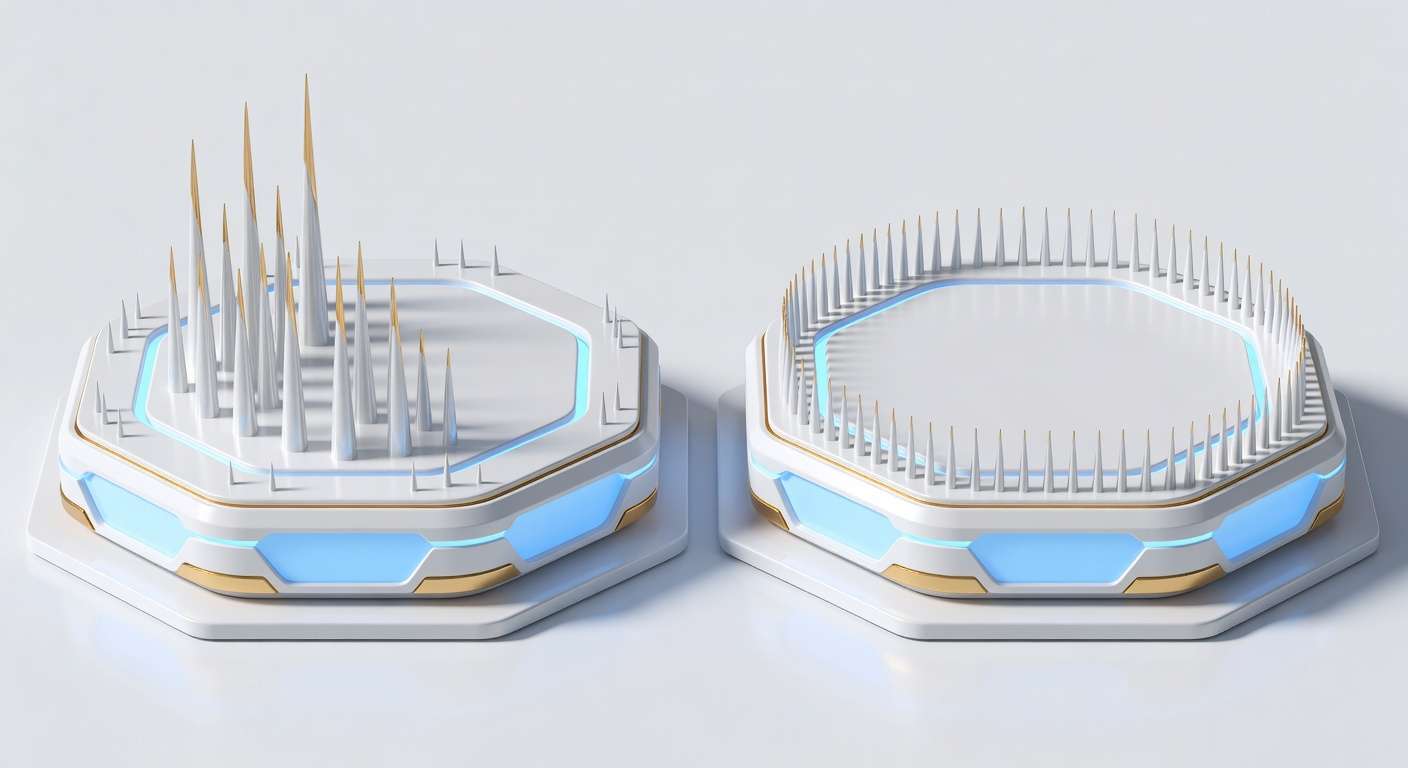
What matters is the shape of the octagon.
An octagon with two tall peaks and six short valleys tells you something completely different than an octagon that’s relatively even across all dimensions. A learning platform should look dramatically different from a social platform.
A learning platform’s octagon should be dominated by Core Drive 2 (Development) and Core Drive 7 (Unpredictability & Curiosity). You learn best when you’re progressing visibly and encountering novel problems.
A social platform’s octagon should be dominated by Core Drive 5 (Social Influence) and Core Drive 3 (Empowerment of Creativity). Connection and self-expression are what drive it.
And here’s what matters more than you might think: weak areas in your octagon aren’t always problems. When we scored Octalysis Prime, Core Drive 8 (Loss & Avoidance) came in at a 2. Low, right? But that’s intentional. We don’t want people afraid of losing their course progress. We want them motivated by growth, not fear.
A weak Core Drive is only a problem if you need it for your strategy. Otherwise, it’s just not part of your story.
What Each Octagon Shape Actually Tells You
Saying the shape matters more than the score is only useful if you have a vocabulary for shapes. Over years of scoring sessions, I keep seeing the same five archetypes show up. Once you can name them, you can read an octagon in seconds.
The Focused Peak. Two or three tall Core Drives, the rest sitting quiet. Tinder, viral mobile games, religious callings. The product is honest about what it is, and it pulls hard on the Core Drives that match its honesty. Risk: when every dominant drive lives on the Black Hat side, the experience burns out users fast.
Waze is the cleanest version of this archetype I score in workshops. Strip away the brand and any navigation app runs on Core Drive 2 (feel smart, on the right track) and Core Drive 8 (do not get lost, do not feel helpless). What Waze stacked on top is a focused peak across Core Drive 1 (the big traffic-monster narrative during onboarding), Core Drive 4 (the cute avatar attachment), Core Drive 5 (group arrivals and the beep-beep social prod), and Core Drive 7 (the Oracle Effect predictions). Same baseline as a stock GPS, very different shape, very different feel.
The Balanced Flat. Everything hovers between 4 and 5. If every player type activates every Core Drive at the same moderate level, you have drawn a circle, not an octagon, and you have learned nothing. Force yourself to pick the two or three Core Drives that should dominate and let the others sit quiet. Contrast is the entire point of the exercise.
The White Hat Tower. Tall on Core Drive 1, Core Drive 2, Core Drive 3, with the right side staying quiet. Long-form learning, healthcare, meaning-driven communities. Engagement compounds over months, retention sticks, and the product can survive a price increase. The tradeoff is the start. Cold-start users may not feel pulled in until they cross the first competence threshold, so pair this shape with stronger onboarding hooks if early dropoff is the problem.
The Black Hat Tower. Inverted: tall on Core Drive 6, Core Drive 7, Core Drive 8, with the top three staying quiet. Viral apps, slot machines, attention loops. The shape produces action immediately and produces shame and churn within months. If you see this shape on a product you care about, the strategic move is to stand up at least one White Hat Core Drive next to it before scaling.
The Left-Right Split. Extrinsic dominant or intrinsic dominant, with a clear gap between the two halves of the octagon. Status games tilt right (Core Drive 4, Core Drive 6, Core Drive 8). Creative communities tilt left (Core Drive 1, Core Drive 2, Core Drive 3). Poker is the case study I lean on most here: it activates 7 of 8 Core Drives, but Core Drive 1 (Epic Meaning & Calling) stays quiet, which is exactly why “Poker for Charity” events keep drawing players who would never sit at a normal table.
Read the shape first. The score is downstream of it. The same logic applies to the White Hat versus Black Hat split: a tall Black Hat Tower with no White Hat support is a different problem than a balanced flat, and the fixes are different too.
The Low-Hanging Fruit Principle
Here’s where this method becomes actionable.
Pushing a Core Drive from 9 to 10? That’s grueling work. You’re optimizing something that’s already nearly perfect.
Adding a Core Drive that’s currently at 0 to a 1? That’s relatively easy, and the impact is often more significant. You’re introducing an entirely new motivation lever that users aren’t experiencing at all.
This is why the Octalysis Scoring Method isn’t just about diagnosis. It’s about identifying where your effort compounds fastest.
Four Levels of Scoring Depth
You can stop at the simple version: overall scores for the entire product. Most practitioners I work with start there, and that’s fine. You can get meaningful insight very quickly.
But if you want to go deeper, there are three more levels:
| Depth | What You Score | Best Use |
|---|---|---|
| Level 1 | The whole experience | Fast first diagnosis |
| Level 2 | Discovery, Onboarding, Scaffolding, Endgame | Spot phase-to-phase dropoffs |
| Level 3 | Phases by player type | Compare novice versus expert motivation |
| Level 4 | Micro-interactions | Tune a specific screen or moment |
Level 1: Overall. One octagon for the whole product. Fastest. Easiest. Best starting point.
Level 2: Phase-Based. Score separately for Discovery, Onboarding, Scaffolding (core experience), and Endgame (long-term engagement). This reveals how the Core Drives shift as users mature. Most products fail at the transition between phases.
Level 3: Phase × Player Type. Score by phase AND by user archetype (hardcore vs. casual, experienced vs. novice). You’ll find that the same product activates completely different Core Drives depending on who’s using it.
Level 4: Micro-Interactions. Score individual buttons, notifications, or interactions. This is the granular level. I do this maybe once every five years, when I’m really trying to optimize a single moment in the experience.
Start at Level 1. Move to Level 2 when you find patterns that confuse you. Rarely need to go deeper than that.
Case Study: Why SuperBetter Struggled
Let me walk you through a real example that taught me something important about this method.
SuperBetter is Jane McGonigal’s resilience app designed to help people battle chronic illness and depression. It’s a beautiful concept. Users face “bad guys” (challenges), collect “power-ups” (coping mechanisms), and recruit “allies” (supporters).
When I scored it, I found three critical problems:
First: Silent Level-Ups (Missing CD7). Users would progress through the app and hit achievements, but there was no celebration. No confetti. No notification. No dopamine spike. The game mechanics were there, but the unpredictability and surprise (Core Drive 7) was completely absent. Players didn’t feel surprised or delighted.
Second: Customization at the Wrong Moment (Mistimed CD3). The app threw customization at users during onboarding, asking them to name their “bad guys” and create their own quests. Sounds great, right? But users didn’t know enough about the app yet to customize effectively. Core Drive 3 (Empowerment of Creativity & Feedback) requires that users understand the system before they can creatively shape it. Timing matters.
Third: Cognitive Overload (CD6 Working Against You). On Day 1, the app showed users 8 different tabs and sections. That’s not generous feature-setting. That’s overwhelming. Core Drive 6 (scarcity) works best when it creates urgency. Instead, SuperBetter created choice paralysis. Too many things felt scarce and important, so nothing felt urgent.
Fourth: The Power Pack Believability Gap (Promised CD2, Delivered Doubt). Onboarding asks users to pick a “Power Pack” matched to their challenge. A user with chronic spinal pain is shown two options: “Mental Resilience in 5 Minutes a Day” and “Simply Connect.” Neither one names spine pain, neither one describes a path to relief. The page promises Core Drive 2 (Development & Accomplishment) and the user reads a believability gap. A high CD2 score on paper collapses to zero the moment a user cannot draw the line from the offered feature to the outcome they came for. This is the fourth scoring rule on the page right here: aspiration is what the product owner sees, behavior is what the user can act on.
The insight wasn’t complex. The fix was simpler: celebrate progress visibly, introduce customization after users understand the core loop, and simplify the Day 1 experience.

Case Study: Why ArtWarz Works
Now let me show you a product that nailed the Octalysis Scoring Method when I scored it.
ArtWarz was a competitive drawing game. Two artists faced off. You drew. You voted on which drawing was better. Simple.
When I scored it, here’s what I found:
The first thing first-time users see when they click “Start Quest” is an empty book. The message reads: “The book appears to be empty.” Two options sit beneath it: “Give up” or “Investigate.” Most products with that screen lose the user. ArtWarz used it as a Core Drive 3 filter: investigate, and clicking different parts of the book revealed hidden content, and the first quest, “The Alchemist’s Spell,” unlocked. That single choice is one of the cleanest Core Drive 3 (Empowerment of Creativity & Feedback) moments I have seen designed: a small empowering decision, an immediate reveal, a sense of earned discovery before the drawing tools even open.
Core Drive 3 (Empowerment of Creativity): The empty canvas is waiting. You create something from nothing. Immediate feedback from votes. This is CD3 in its purest form.
Core Drive 4 (Ownership & IKEA Effect): The quest map uses drag-and-drop interactions. You physically move your battles around. You own your tournament bracket. This ownership activates the IKEA Effect: you value things more when you’ve invested effort in creating them.
Core Drive 2 (Development & Accomplishment): The app tracks your artistic mastery by body part: you can see which drawing styles (portrait, anatomy, perspective) you’re improving in. It’s not just “you won more battles.” It’s granular skill development you can visualize.
But here’s what ArtWarz was missing: the promotional video on its landing page had almost zero Core Drive 1 (Epic Meaning). It didn’t tell the story of why drawing matters, why the community exists, or what you’re part of. It was just “here’s a drawing game.”
One small fix, repositioning that narrative, would have made an already engaging product even more powerful.
How to Run a 30-Minute Scoring Session
Readers want to try the method on their own product the same day they read about it. Here is the workflow I run with coaching clients. Thirty minutes, one octagon you can argue about with your team.
- Define the player and the desired action first. Whose experience are you scoring, and what does success look like for that person? Skip this step and you cannot score anything honestly, because you do not know who you are scoring for. Decide between novice and expert, between buyer and daily user, between the person you have today and the player type you are designing toward.
- Pick the phase you are scoring. The same product activates different Core Drives across Discovery, Onboarding, Scaffolding, and Endgame. Score one phase per session until you are fluent.
- Score quickly from gut. Eight numbers, 1 through 10, no looking back. The first instinct sits closer to the truth than the deliberated answer in almost every session I run.
- Annotate one behavior per Core Drive. Beside each score, write the single feature or moment that justified it. If you cannot name a behavior, the score is aspirational and the number drops by at least one.
- Sketch the octagon and read its shape. Focused Peak, Balanced Flat, White Hat Tower, Black Hat Tower, Left-Right Split. Naming the shape before discussing the numbers changes the conversation.
- Pick the cheapest one-point lift. Find the lowest score that is strategically necessary, not the lowest score on the page. Brainstorm one lightweight change that raises that Core Drive by a single point. Rough ideas are useful here. They often surface the right one.
Run the same loop on a competitor afterward. Comparing two octagons of the same player and phase, side by side, is where the method earns its keep.
Want the full diagnostic playbook? The 30-minute session above is the warm-up. Actionable Gamification walks through the entire method: Levels 2 and 3, all 8 Core Drives across the 4 Experience Phases, and 90+ worked examples, so you can score an entire product instead of one phase at a time.
Scoring Yourself: The Self-Gamification Edition
Here’s something I don’t always talk about: you can use this method to score your own life and habits.
When your target is yourself, when you’re trying to understand what motivates you personally, use your past behavior as the evidence. What have you actually done repeatedly? What Core Drives were activated?
I realized years ago that I’m driven by Core Drive 1 (Epic Meaning). That’s why I wake up obsessed with gamification. Everything I do connects to this grand vision of creating a more engaging world.
But I’m also high in Core Drive 2 (Development). I need to see myself progressing, learning new skills, becoming sharper.
Once I understood that, I could design my own life better. I could seek out experiences that activated these drives instead of expecting myself to stay motivated by things that don’t actually move me.
If you want a concrete first move, score your last 30 days. Pull up your calendar and your phone screen-time report. Look at the activities that took the most hours, especially the ones you did not have to do. Score the Core Drives those activities actually fired. The list usually surprises people. Most readers find that two or three Core Drives moved the bulk of their week, and at least one of those Core Drives was nothing like the one they would have named in advance.
Then redesign the next 30 days so the Core Drives that actually move you fire on activities that matter. Not the activities you wish moved you. The ones the data says do. This is the longer teaching of the Actionable Gamification book: the framework is a lens, not a destination. The point is to keep using it on yourself until the way you spend your time matches the way you actually want to feel.
The Bottom Line
Can’t decide on a score? Your gut feeling is probably right. Pick a number and move on. Precision is less important than pattern recognition.
Scoring a competitor? Use their free trial or freemium experience. Don’t score features you’ve never seen. Score only what an average user actually encounters.
Your product has zero in a Core Drive? That might be fine. It’s only a problem if you need that drive for your strategy.
Stuck between two scores? Ask yourself: “What percentage of users experience this Core Drive?” If it’s under 50%, drop the score. If it’s over 70%, raise it.
Want to go deeper? Level 2 (phase-based scoring) is where most practitioners find real patterns. Start there before micro-analyzing individual interactions.
FAQ
How do I score a Core Drive I’m not sure about?
Start with user behavior data, not gut feeling. Look at which features users engage with most, what they complain about, and where they drop off. Each pattern maps to specific Core Drives. If users love customization, CD3 is high. If they share screenshots, CD5 is activated. Let behavior, not opinion, guide scoring.
What’s a ‘good’ Octalysis score?
There’s no universal good score. A meditation app should score high on CD1 and CD3, low on CD6 and CD8. A competitive game should score high on CD2, CD5, and CD7. The right score depends on your product’s purpose and your users’ motivational profiles.
How often should I re-score my product?
After every major feature launch and quarterly for ongoing products. User motivations shift as products mature. An onboarding experience needs different Core Drives than an endgame experience.
Can I use this for non-digital experiences?
Absolutely. The Octalysis Scoring Method works for retail experiences, employee programs, educational curricula, and physical spaces. Core Drives are human universals, not digital constructs.
What if all my Core Drive scores are low?
That means your experience lacks motivational architecture entirely. Start by identifying which 2–3 Core Drives matter most for your users and build targeted mechanics for those. Don’t try to raise all 8 simultaneously: focus creates impact.
Related Reading
- The Octalysis Framework
- Onboarding Design: The First Five Minutes
- Endgame Design and Dead Ends
- White Hat vs. Black Hat Behavioral Design
- Books by Yu-kai Chou