
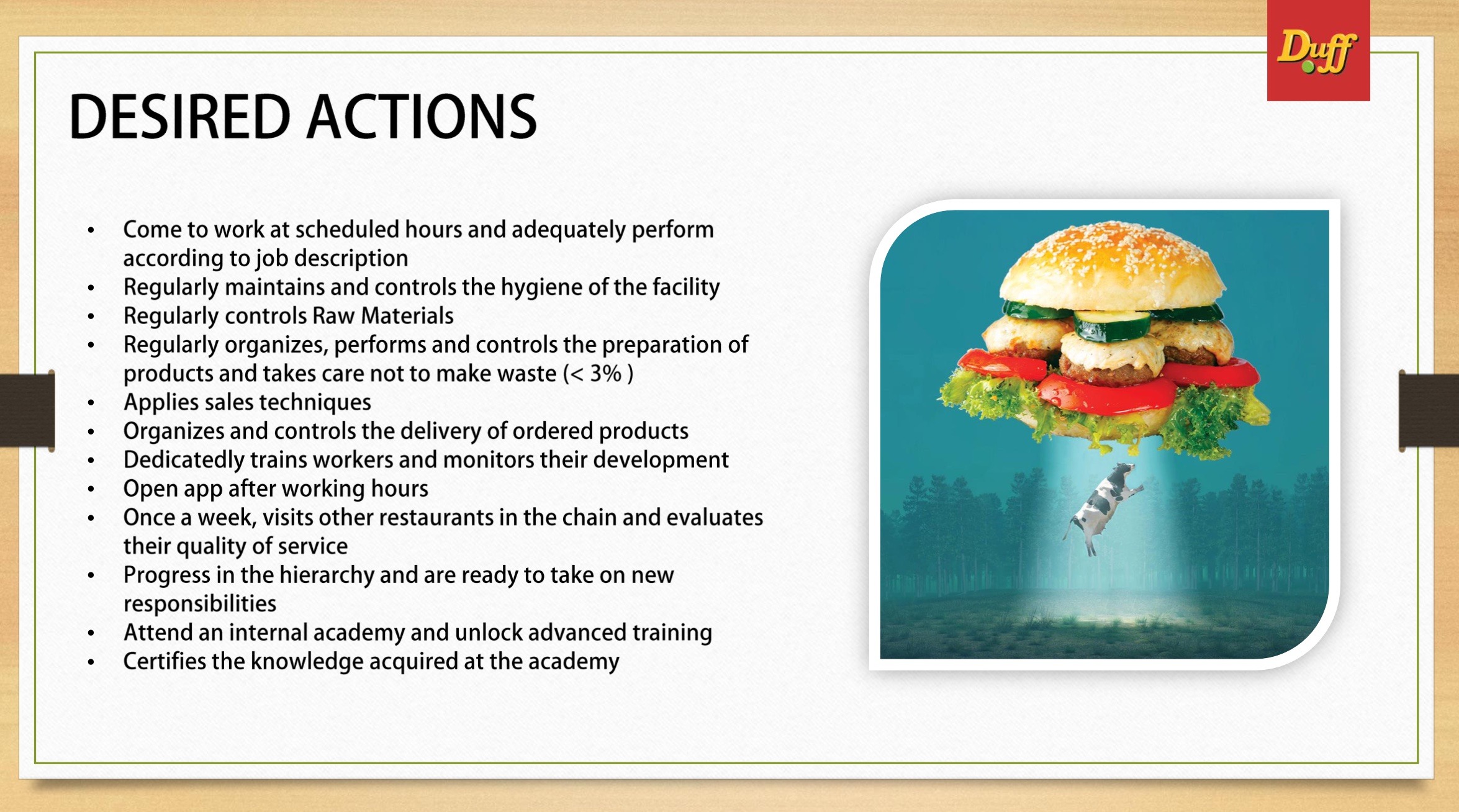

Many people are motivated to grab a bite to eat at a fast-food restaurant. Working in this industry, on the other hand, can in many cases use some more Human-Focused Design — the behavioral science behind the Octalysis Framework.
⚡ Speed Run Notes
- Community features are multiplication machines — one featured practitioner inspires 10 aspiring ones. Aspiring practitioners need role models. Each feature gives them a concrete person to emulate. The feature is as much marketing to future practitioners as recognition of current ones.
- A framework spreads through named advocates, not anonymous content. Named practitioners become trusted sources in their own networks. Anonymous content is downstream of those relationships. The certification infrastructure exists to create more names, not more content.
- CD4 (Ownership) activates when a practitioner sees their name on the official site. The recognition is a form of equity. The practitioner feels co-owned by the framework's success. That co-ownership creates the volunteer-level effort paid marketing cannot buy.
- Every certification community should aim for graduates who train the next cohort. Self-sustaining pipelines are the sign of a mature community. If all training runs through the founder, the framework doesn't scale. If alumni train newcomers, the framework scales to the size of its trust network.
- The deepest insight: featured practitioners become the memory of the community. Five years from now, the public record of the community is the list of featured practitioners. That list is the legacy. Curating it well today is curating the legacy for decades to come.
In this submission for the Octalysis Level 1 Certificate, Predrag takes a close look at working for the restaurant chain Duff. The Octalysis Level 1 Certificate requires demonstrating mastery of the 8 Core Drives of human motivation and applying Core Drive 2: Development & Accomplishment — the very drive that pushes earners to grow, improve, and achieve milestones like this certification.
About the Creator of the Octalysis Framework

Yu-kai Chou created the Octalysis Framework after studying gamification since 2003 — years before the term entered mainstream vocabulary. As a Human-Systems Architect & Behavioral Designer, his framework has been applied by LEGO, Microsoft, Porsche, Coca-Cola, Salesforce, and MrBeast, impacting over 1.5 Billion Users.
Chou has taught the Octalysis methodology at Harvard, Stanford, Yale, Tesla, Google, BCG, and IDEO.
His work has been cited by Harvard, Stanford, MIT, Forbes, Wall Street Journal, Wired, US Department of Energy, NIST, NSF, NCBI, US Department of Education, ClinicalTrials.gov, and 3,700+ more academic publications. Explore his books here.
Predrag’s Submission
Predrag made sure to cover the Human-Focused Design aspect of this submission.
He added many funny images that help to keep the reader’s motivational energy high.
Congratulations, Predrag. Well done!
Thanks a lot, Dirk, Myrte for the great news. I am very grateful and happy for this achievement.
Predrag Stefanovic
Do you want to join a community of learners and bring your knowledge of Human-Focused Design to the next level? Learn what gamification really is and how the Octalysis approach transforms real-world systems.
Don’t hesitate to try out Octalysis Prime for free!
Related Reading
- The Octalysis Framework for Gamification & Behavioral Design
- What is Gamification? Definition, Examples & Framework
- Actionable Gamification: Beyond Points, Badges & Leaderboards
- Top 10 Enterprise Gamification Examples
- 90+ Gamification Examples & Cases with ROI Stats
- The $1.06 Billion Octalysis Gamification Case Study