
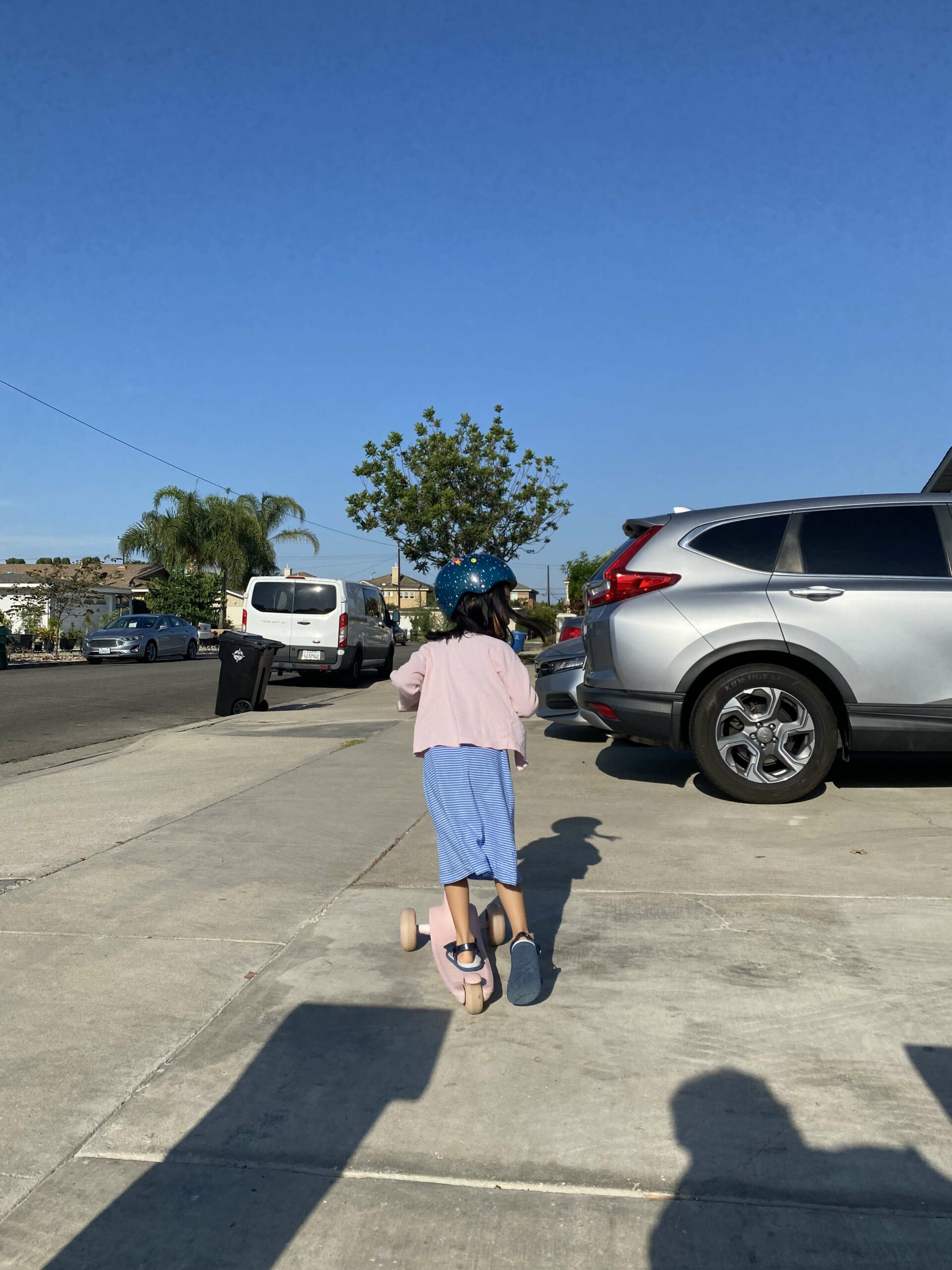

Inspired by Michaeleen Doucleff’s book, Hunt, Gather, Parent, and the show Old Enough on Netflix, I decided to teach my 5-year-old how to scoot to grandma’s house independently.
I care about moments like this because they are rarely about transportation. They are about whether a child starts to believe, deep down, that she can move through the world without an adult performing every meaningful step for her. That belief is a core part of autonomy, and once it forms, it shows up everywhere else: chores, school, friendships, and eventually work.
⚡ Speed Run Notes
- The solo trip to grandma's is a rite of passage compressed into an afternoon. Rites of passage used to be long, elaborate, dangerous. Modern life removed them. What's left is the parent's job to create small ones — a solo scoot, a solo errand, a solo decision. These tiny rites do the work of the larger ones.
- The anxiety the parent feels is the correct price for the autonomy the child gains. If the parent isn't slightly nervous, the trip isn't meaningful. The nervousness is proof that something real is happening. Skipping the nervousness by over-controlling the environment empties the rite of its power.
- Core Drive 3 (CD3): Empowerment of Creativity & Feedback in a child compounds over the years in ways most parents never trace. A 6-year-old who navigated solo becomes a 12-year-old who takes initiative, becomes a 25-year-old who starts businesses. The causal chain runs through small moments the parent might forget happened.
- The hardest part of the scoot is not the child's journey — it's the parent's restraint. The parent's job is to not intervene. That is harder than it sounds. Every impulse pulls toward rescue. The discipline of staying out of the way is the whole parenting practice in miniature.
- The deepest insight: a child's self-concept is built from the things they did that the parent didn't do for them. Every task a parent performs that a child could perform is a self-concept theft. The small solo trip is a correction — the parent returning the task that was always supposed to be the child's.
Table of Contents
About the Author

Jun Loayza is a serial entrepreneur, product leader at YouTube, and the creator of the GRACE Parenting Framework — a behavioral-design approach to raising children grounded in five developmental pillars: Growth, Responsibility, Autonomy, Confidence, and Empathy. He graduated from UCLA in 2007 with degrees in Economics and Philosophy.
Jun has co-founded multiple startups including RewardMe and Untemplater, and has been Yu-kai Chou’s business partner for over 16 years. As a father of three, the GRACE framework grew out of his own daily parenting practice — testing behavioral-design principles on the hardest audience there is: his own kids.
Verify: LinkedIn · Author Archive
I would never do this as a Parent in SF
My wife and I lived in San Francisco for 13 years, 5 of them with kids.
I’ve dreamed about teaching my kids autonomy by letting them walk to school more independently, but it never felt safe because of the homelessness and general crime in SF.
Our school was only a 10-minute walk from our home. If she had to, our 5 year old could have made the walk.
To practice, I would bike the girls to school, park at the street corner, and encourage them to walk to the school gates by themselves. It was slow going.
That slowness is not failure. It is usually what healthy development looks like. A child inches forward, retreats, inches forward again, and only later makes the leap that seemed impossible a week earlier. That is why I like a scaffolding approach here, where the challenge stays just barely ahead of the child instead of miles ahead of them.
Parents often sabotage this process by treating hesitation as evidence the child is not ready. Sometimes hesitation just means the child is calibrating. If I rush in too quickly, I accidentally teach the wrong lesson: not “the world is navigable,” but “you can’t do this unless I do it with you.” That is how unnecessary protection starts drifting toward learned helplessness.
At first they didn’t want to. After a few days they walked a few steps. Then a week later they made it halfway.
All the while, I made sure to let them know, “Practice makes better. You’ll make it further little-by-little each day. Don’t feel rushed. Take your time and you’ll get there.”
Important: Kids mature at different paces. It’s more productive to encourage and let them know that they’ll do it when they’re ready as opposed to forcing kids to do something.
In this example, if I had forced them to walk to the gate, they would have resisted harder and probably developed a fear of walking independently.
For many reasons, my kids never made it by themselves to the gate.
But we soon moved to the suburbs and my chance to teach autonomy through independent walking was reborn.
The environment changed everything. The route was shorter, quieter, and more legible. There were fewer variables, fewer strangers, and fewer reasons for my nervous system to scream “absolutely not.” That matters because strong parenting decisions are rarely abstract. They depend on distance, traffic, visibility, temperament, and repetition. The same child can be unready in one environment and ready in another.
A parent’s worst fear: abduction
In Julie Lythcott-Haims’ book How to Raise an Adult, the opening pages describe a scene that is a parent’s worst nightmare.
A mother left her child alone in the mall in order to do some shopping. The child was abducted and killed.
How can I encourage my 5 year old to venture out on their own?
I know for sure that my dad would think I’m crazy and disagree with my actions. This is the scrutiny that Lenore Skenazy received when she was labeled the world’s worst mom for letting her then 9-year-old ride the train in New York by himself.
Do the benefits of autonomy really outweigh the risks of abduction?
It’s really all in the details. Each child is different; each city or suburb is different.
Personally, I don’t know when is the right time or where is the best place to do it. San Francisco was not the right place, but a neighborhood suburb only 2 small blocks away feels right to me.
Julie Lythcott-Haims wrote about many statistics that show a child is much safer today than in the past and the chances of abduction are low, but it’s absolutely a non-zero chance.
That is the tension every parent has to metabolize. The child is not the only one learning in these moments. The parent is learning too, especially whether they can regulate fear without letting fear become the architect of family life. That kind of restraint is a form of emotional intelligence. If I cannot manage my own panic, I will always over-design the child’s world around my nerves instead of her growth.
I also think safety works best when it is designed, not assumed. A familiar route, a short distance, visibility, and a child who already understands basic street awareness create a situation that is safer than it looks from the outside. In that sense, good parenting is a lot like creating psychological safety: safe enough to try something real, but not so padded that the experience becomes meaningless.
That is why I don’t like one-size-fits-all parenting debates. “Never let a young child go alone” is too blunt, and “kids should all be independent earlier” is too blunt too. The right question is more tactical: what is the smallest real-world challenge this child can carry safely today that will make tomorrow’s challenge easier? Once I ask it that way, the problem becomes design instead of ideology.
How I’m approaching the parenting lesson
On a Monday evening, I showed my 5-year-old a video from Old Enough that shows a 3-year-old Japanese kid crossing the street all by himself and buying groceries.
The next morning I asked my 5-year-old, “Are you ready to scoot to grandma’s house independently like the little boy you saw on the TV?”
“Yes Papi!” she said excitedly.
“Ok. Take it slow and easy. Watch out for cars in the street and backing out of the driveway. If you need anything, just yell for help.”
“Ok Papi.”
And off she went.
Notice that the setup matters almost as much as the route. I didn’t frame it like a command. I framed it like a chance to step into a bigger version of herself. That difference is what separates behavior design built around motivations instead of just actions. You can force the same motion and get the opposite inner outcome.
I was nervous.
All these crazy thoughts ran through my head. After about 1 minute I left the house to make sure she made it to grandma’s safely.
Walking along the street, I couldn’t see her in the distance. Had she been kidnapped? Did she get lost? Did I send her off on her own too soon?
As I rounded the street to the cul de sac, I saw my 5-year-old beaming with pride in front of Max the dog. She ran to me and exclaimed, “Papi, I got here all by myself! And I was careful about the cars.”
That sentence is why these moments matter. A child’s self-concept is built from the things they did that the parent did not do for them. Once a child says, “I got here all by myself,” that memory becomes part of who they believe they are.
Yea, it’s worth it.
I don’t know the exact age, maturity, or location that will work for your child, but it’s worth it. The same principle shows up in our knife lesson too: capability grows when the task is real, the guidance is clear, and the parent has enough discipline to step back.
That is why I keep coming back to autonomy as a parenting north star. Not because independence is trendy, but because it is one of the cleanest ways to help a child experience earned capability instead of borrowed safety.
That is the part many of us miss. Autonomy is not a philosophical value floating in the air. It is built through specific reps: a walk to the gate, a scoot to grandma’s, a simple errand, a tool used correctly, a responsibility carried without supervision. Over time those reps compound into initiative. The child stops waiting for life to happen and starts participating in it.
What I Was Really Training
On the surface I was training a route: leave the house, follow the street, notice the driveways, reach grandma’s place. But underneath that I was training something much more durable. I was training initiative. I was training situational awareness. I was training the felt experience of, “I can do a meaningful thing without an adult holding my hand the whole time.”
Those capacities do not emerge from lectures. They emerge from successful reps. A child does something slightly above her current comfort level, survives it, and then stores the experience. The next time the challenge feels smaller because she is not walking into the unknown anymore. She is walking into a memory of competence.
That is also why I do not obsess over whether the child executed the moment perfectly. Perfection is not the goal. Ownership is the goal. If she pauses, looks both ways twice, hesitates at the corner, or needs a few extra seconds to decide, that is fine. Those micro-pauses are part of learning. What matters is that she is the one reading the environment and making the call.
Overprotective parenting often confuses smoothness with success. But a perfectly smooth experience is usually one where the adult secretly did all the hard parts. I would rather see a child wobble a little inside a real challenge than glide through something that was fully adult-managed behind the scenes.
I also think moments like this train the parent. Every modern parent has to decide whether their job is to eliminate uncertainty or to teach navigation through uncertainty. Those are not the same thing. If I eliminate every uncertain moment, my child may feel safe today but underprepared tomorrow. If I teach navigation, I accept a little discomfort now in exchange for a much more capable human later.
That tradeoff is worth it to me because adulthood does not wait for perfect confidence before demanding action. Life asks people to go first all the time, to make a call, to enter a room, to solve something without a script. Childhood is where those muscles begin. The solo scoot is tiny, but the pattern it reinforces is not tiny at all.
So when I say the trip was worth it, I do not just mean the destination. I mean the identity shift that came with it. My daughter did not merely arrive at grandma’s house. She arrived as a slightly more capable version of herself, and I got to witness the moment she knew it.
This article is part of Jun Loayza’s parenting series, Dad Smarter, Not Harder. The series explores how small, concrete parenting decisions can steadily build autonomy, confidence, and responsibility in kids.
Related Reading
- GRACE Parenting: How to use a knife to teach kids Autonomy and Confidence
- How to get siblings to stop fighting by emphasizing maturity
- Your kids don’t want to watch TV — they want to work!
- The Power of Roleplaying in Children
- The Octalysis Framework for Gamification & Behavioral Design
- The Ultimate Gamification Books: Actionable Gamification & 10,000 Hours of Play