
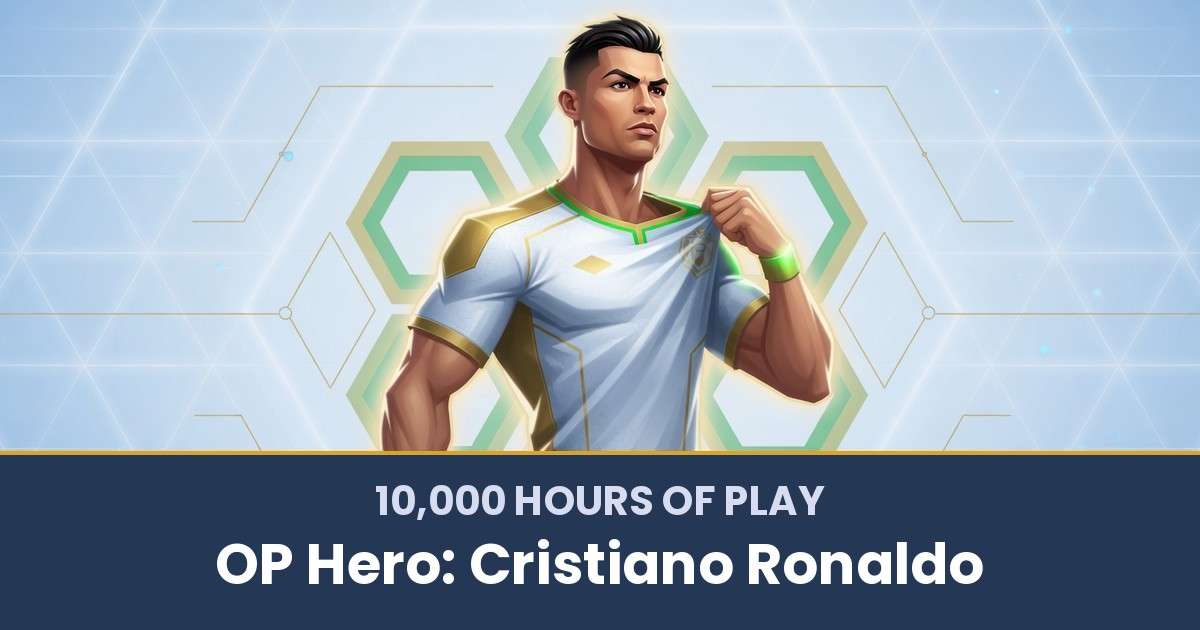


On 4 July 2004, a 19-year-old cried on a football pitch in Lisbon. Portugal had just lost the Euro 2004 final at home, 1-0 to Greece, and Cristiano Ronaldo could not stop the tears.
Twelve years later, almost to the day, he stood on another final pitch and could not play. He had limped off injured in the 25th minute of the Euro 2016 final. Portugal beat France anyway, and Ronaldo lifted the first major trophy his country had ever won.
Most profiles of Ronaldo argue about whether he or Messi was the greater player. That argument skips the more useful question. Ronaldo was not the most naturally gifted footballer of his generation. He became the most decorated one regardless. Run him through the 10,000 Hours of Play framework and you can see exactly how he closed that gap, and which parts of the build you can copy.
⚡ Speed Run Notes
- Ronaldo never changed his Game: be measured, by goals and trophies, as the best footballer alive. Every transfer and every training choice fed that one scoreboard.
- His Attributes showed up before the trophies did — a hatred of losing his coaches noticed when he was a small boy, a high tolerance for dislocation, and self-belief that read as arrogance.
- The skill you cannot copy from Messi but can copy from Ronaldo is Ninja Focus (Rogue): for two decades he out-practiced more gifted players.
- His biggest reinvention was Elemental Transposition (Mage): when his body could no longer dribble past everyone, he rebuilt himself into a penalty-box striker and kept scoring.
- The Euro 2004 final loss looked like a fairy tale ending badly. It was the setup for Phoenix Rebirth (Paladin) and the Euro 2016 trophy that came twelve years later.
- The build is copyable. Pick a scoreboard you actually care about, then out-work the people who were born ahead of you.
Table of Contents
- Step 1: The Game — What Cristiano Ronaldo Was Actually Playing
- Step 2: Attributes — The Innate Stats
- Step 3: Role(s) — The Character Class Across Chapters
- Step 4: Skills — The Real-Life Game Skills Cristiano Ronaldo Mastered
- Step 5: Allies — The People Who Multiplied Cristiano Ronaldo
- Step 6: Quests — The Milestones That Shaped the Saga
- What You Can Steal From Cristiano Ronaldo’s Build
- Where this framework comes from
- Related Reading
About Yu-kai Chou

Yu-kai Chou is the author of 10,000 Hours of Play — the book that treats your life as the most important game you’ll ever build a character in, and gives you the 6-Step framework (Game · Attributes · Role · Skills · Allies · Quests) to play it on purpose. He has spent two decades developing the system through which this post analyzes its OP Hero, and applies it to his own life and to the lives of the people he advises around the world.
Chou’s other framework, the Octalysis Framework, has been applied by LEGO, Microsoft, Porsche, Coca-Cola, Salesforce, and MrBeast, impacting over 1.5 Billion Users. He has taught the methodology at Harvard, Stanford, Yale, Tesla, Google, BCG, and IDEO, and has advised governments in eight nations including Ukraine, the United Kingdom, the Kingdom of Bahrain, Singapore, Taiwan, the Netherlands, Kazakhstan, and South Korea.
His work has been cited by Harvard, Stanford, MIT, Forbes, Wall Street Journal, Wired, US Department of Energy, NIST, NSF, NCBI, US Department of Education, ClinicalTrials.gov, and Google Scholar — with 3,700+ more academic publications. Explore his books here.
What makes Ronaldo worth studying through this framework is that he is the clearest proof that the most-gifted player and the most-decorated player do not have to be the same person. He spent two decades closing a talent gap with effort that was visible, scheduled, and repeated. The lesson I would lift for your own build is the one from Step 4: Ninja Focus is the only skill on his entire sheet that needs no natural gift at all, and it is the one that did the most work.
Step 1: The Game — What Cristiano Ronaldo Was Actually Playing
Strip away the five clubs and two continents and Ronaldo spent his whole career playing one Game: be measured as the best footballer alive, by the only metrics that leave a permanent record. Goals and trophies. Nothing softer.
He said it out loud, repeatedly. “I don’t follow records, records follow me,” he told the press after another scoring milestone. Around the 2014 Ballon d’Or gala he put the ambition in plain legacy terms: “I want to end up as the number one in the history of football.”
The Game was comparative on purpose. He did not want to be good. He wanted to be first, and he wanted the scoreboard to prove it to everyone, including himself.
That is why he kept moving. Sporting CP to Manchester United in 2003. United to Real Madrid in 2009. Madrid to Juventus in 2018, then to Al-Nassr in 2022. Each move chased a bigger stage or a fresh record to set, even when it cost him comfort.
This matters for the rest of the build because a numerical, public Game can be audited. Every season, every transfer, every training block had a clean test: did it add goals, did it add trophies? A vague Game like “be a great player” cannot be graded. Ronaldo’s could, and he graded it constantly.
Step 2: Attributes — The Innate Stats
The Attributes Ronaldo ran on were visible long before the trophies, and most of them are temperament, not technique. Map him on the Talent Triangle Method and three stats sit far above the line.
A hatred of losing that registered in early childhood. At the youth clubs of his native Madeira, coaches and teammates remember a boy who cried if his team lost or if he did not see enough of the ball. That trait never decayed. After Ronaldo’s United debut in August 2003, Sir Alex Ferguson said, “He has an incredible desire to be the best. I’ve never seen a player with so much desire.” The desire was not built at Old Trafford. It walked in the door.
An unusual tolerance for dislocation. At 12 he left Madeira alone for Sporting’s academy in Lisbon, an island boy in a strange city with almost no family around him. By his mother’s account he cried nearly every day from homesickness and still refused to go home, because he would only return as a great player. He repeated the uprooting at 18, moving his whole life to Manchester. Most people treat dislocation as a cost. He treated it as a fee worth paying.
Self-belief that bordered on arrogance. Teammates from his Sporting years recall a 15-year-old telling them, without irony, that he would become the best player in the world. He later compressed the attitude into a line: “Talent without work is nothing, but I always believed I was the best.” That belief arrived early and unearned, which is exactly what makes it an Attribute rather than a Skill.
Step 3: Role(s) — The Character Class Across Chapters
Ronaldo cycled through four Roles across his career, but the Class underneath barely shifted. He was a Warlock the whole way: a competitor wired for supremacy, who measures himself by the gap between his number and everyone else’s. The costumes changed every few years. The orientation toward crushing the comparison did not.
He started as the academy showman in Madeira and Lisbon, a creative winger whose entire job was beating defenders one on one. The end product was thin and senior teammates grumbled about the showboating, but the raw flair was undeniable. He existed in the wider game, which was the only goal of that chapter.
Next came the apprentice winger under Ferguson at Manchester United, from 2003 to roughly 2009. He arrived as a stepover specialist and was rebuilt into a finisher, going from 6 goals in his first season to a 42-goal haul across all competitions in 2007-08. The trickster learned end product.
The Role history remembers most is the central goal-machine at Real Madrid, from 2009 to 2018, where he became the club’s all-time top scorer with 450 goals. The winger Role is one Lionel Messi never had to graduate from, because his body let him keep dribbling. Ronaldo’s body served notice earlier, and the difference shaped both careers.
His current Role is the global elder statesman and record-setter: still scoring into his late 30s at Juventus and Al-Nassr, and captaining Portugal as the all-time leading scorer in men’s international football.
Step 4: Skills — The Real-Life Game Skills Cristiano Ronaldo Mastered
Read his career through the canon skill set and five moves keep surfacing. They are not vague “athlete qualities.” They map onto the same Real-Life Game Skills the Skills Spectrum uses to grade every OP Hero on this site.
Ninja Focus (Rogue). This is sustained discipline and focus, and it is the engine of the whole build. At United, Ferguson’s staff put a skinny teenager in the gym and watched him add muscle and power, but the documented detail is that Ronaldo drove the work himself, staying behind to drill shooting and free kicks long after sessions ended. “If you want to be good you have to practice,” he said. “This is what I do.” It is the same relentless-practice skill that defines Tiger Woods, and it is the one move on Ronaldo’s sheet anyone can copy without talent.
Heroic Strike (Warrior). This is the bold, confident statement that forces a binary choice. When Ferguson handed an 18-year-old the No. 7 shirt at Manchester United, the number carried the weight of George Best, Eric Cantona, and David Beckham. Ronaldo could have asked for something quieter. He took the 7 and the comparison that came with it, turning his own shirt into a public test he had to pass.
Vision Manifestation (Warlock). This is mental rehearsal so vivid it shapes the outcome. Ronaldo’s free-kick routine became famous precisely because it was a visible act of visualization: the wide stance, the long stare, the rehearsed picture of the ball’s path. On 30 January 2008 against Portsmouth, he struck a dipping 30-yard knuckleball over the wall that he called the best goal of his career to that point. The stance was the skill made visible.
Elemental Transposition (Mage). This is the skill of reframing a problem as a puzzle. By his late 20s, Ronaldo could no longer win games by dribbling past four players, so he treated his own aging body as a design problem. Under Carlo Ancelotti at Real Madrid he moved from the touchline into the penalty box, trading dribbles for movement and timing. The result was 61 goals in 54 games in 2014-15. He solved the puzzle instead of mourning the dribbler.
Phoenix Rebirth (Paladin). This is recovery from a devastating failure. The 19-year-old who wept after the Euro 2004 final did not get the storybook ending then. He spent the next twelve years building toward it, and in 2016 he captained Portugal to the European title. The failure is covered in Step 6. What matters here is that he treated the wreckage of 2004 as a starting position, not a verdict.
Step 5: Allies — The People Who Multiplied Cristiano Ronaldo
Ronaldo’s name carries the legend, but the build leaned on a small Alliance whose work is hard to separate from his own.
Sir Alex Ferguson signed him from Sporting in 2003 and then defended and developed him in public, taking him from 6 goals as a raw teenager to a 42-goal season and the 2008 Champions League. Ronaldo has called Ferguson “my father in football.” Ferguson, in turn, described him as the most gifted player he ever managed.
Jorge Mendes, his long-time agent, engineered the moves that kept the Game on the biggest possible stage: Sporting to United, the world-record transfer to Real Madrid, then Juventus and Al-Nassr. An OP Hero needs someone who can open the doors the talent has earned.
Dolores Aveiro, his mother, is the reason there was a career to build at all. She kept him in football through real poverty and a difficult home, and moved her own life to Lisbon, Manchester, and Madrid to keep him supported. Ronaldo has said his success is a consequence of her strength.
Karim Benzema stands in for the teammates who multiplied him at Real Madrid. Benzema spent years doing the unselfish, link-up work that freed Ronaldo to live in the penalty box, and that club-record 450 goals owes a quiet debt to the striker who kept feeding him.
Step 6: Quests — The Milestones That Shaped the Saga
Six Quests bracket the run. Listed in order, the throughline is clear: the worst night set up the best one.
2003 — the leap to Manchester United. On 12 August 2003, United signed the 18-year-old from Sporting for a fee reported around £12.24 million, making him the most expensive teenager in English football at the time. The island boy was now in the world’s loudest league.
2004 — the Euro final loss. On 4 July 2004, host nation Portugal lost the Euro 2004 final 1-0 to Greece. Ronaldo, 19, played the full match and cried at the end. It was the first major failure of his career, and it became the fuel for everything in Step 4. Kobe Bryant ran the same arc, turning an early, public defeat into the engine of a decade of work.
2008 — the peak season. Ronaldo scored 42 goals in 49 games, won the Premier League, scored in the Champions League final win over Chelsea on 21 May 2008, and collected his first Ballon d’Or that December. The apprentice had become the best player in the world.
2009 — the record move. On 26 June 2009, Real Madrid’s bid of £80 million was accepted, the highest fee ever paid for a footballer at the time. He was unveiled at the Santiago Bernabéu on 6 July 2009 in front of a reported 80,000 fans, before kicking a single ball.
2016 — Euro 2016, the trophy that closed the loop. On 10 July 2016, Portugal beat France 1-0 after extra time. Ronaldo went off injured in the 25th minute and spent the rest of the match coaching from the touchline. Twelve years after the tears, the captain finally lifted his country’s first major trophy.
2016 to 2018 — the Champions League three-peat. Ronaldo was the focal point as Real Madrid won three straight European titles, the first club to do so in the Champions League era. He finished as the competition’s top scorer in each of those seasons.
What You Can Steal From Cristiano Ronaldo’s Build
The lazy lesson from a Ronaldo profile is “work hard.” It explains nothing, because everyone agrees with it and almost nobody does it at his volume.
The first real lesson is structural. Pick a scoreboard you can actually read. Ronaldo’s Game was numerical and public, which meant every choice had a grade attached: more goals, more trophies, or not. Most people’s goals are unauditable. “Be successful” and “be a great manager” cannot be scored, so they never get the honest feedback that improvement requires. Define the number first.
The second lesson is about effort, but a specific kind. Ninja Focus is the one skill on Ronaldo’s entire sheet that requires zero natural gift. He could not give himself Messi’s balance, but he could out-practice him, and for twenty years he did. The skill that did the most work is the one available to you right now.
The third lesson is timing. Ronaldo reinvented himself from winger to striker while he was still winning, not after he started losing. He ran Elemental Transposition early, treating the decline he could see coming as a puzzle to solve in advance. Reinvent on your schedule, before the game forces it.
Audit your own build against his. Is your Game a number you could actually check this month? Are you out-working the people who were born ahead of you, or just admiring them? And are you rebuilding while you are ahead? The OP Hero profiles are full of people who were not the most gifted in the room and won anyway. Ronaldo is the loudest proof, and he started as a homesick 12-year-old who refused to go home.
Where this framework comes from

Want the full system this profile is built on?
Every OP Hero piece runs through the same 6-Step framework from 10,000 Hours of Play: Unlock Your Real-Life Legendary Success. The book covers the full system, walks through Yu-kai’s own life run as the first applied case study, and gives you the worksheets to audit your own build.
Related Reading
- All OP Hero Profiles — the full catalog of life-as-RPG breakdowns, organized by Class and Skill.
- 10,000 Hours of Play by OP Hero: Lionel Messi — the rival whose build is the natural counterweight to Ronaldo’s.
- 10,000 Hours of Play by OP Hero: Tiger Woods — another build where Ninja Focus did most of the heavy lifting.
- 10,000 Hours of Play by OP Hero: Kobe Bryant — a competitor who turned an early defeat into a decade of obsession.
- 10,000 Hours of Play by OP Hero: Michael Jordan — the other athlete defined by a hatred of losing.
- The 10,000 Hours of Play framework — the hub for the full system.