
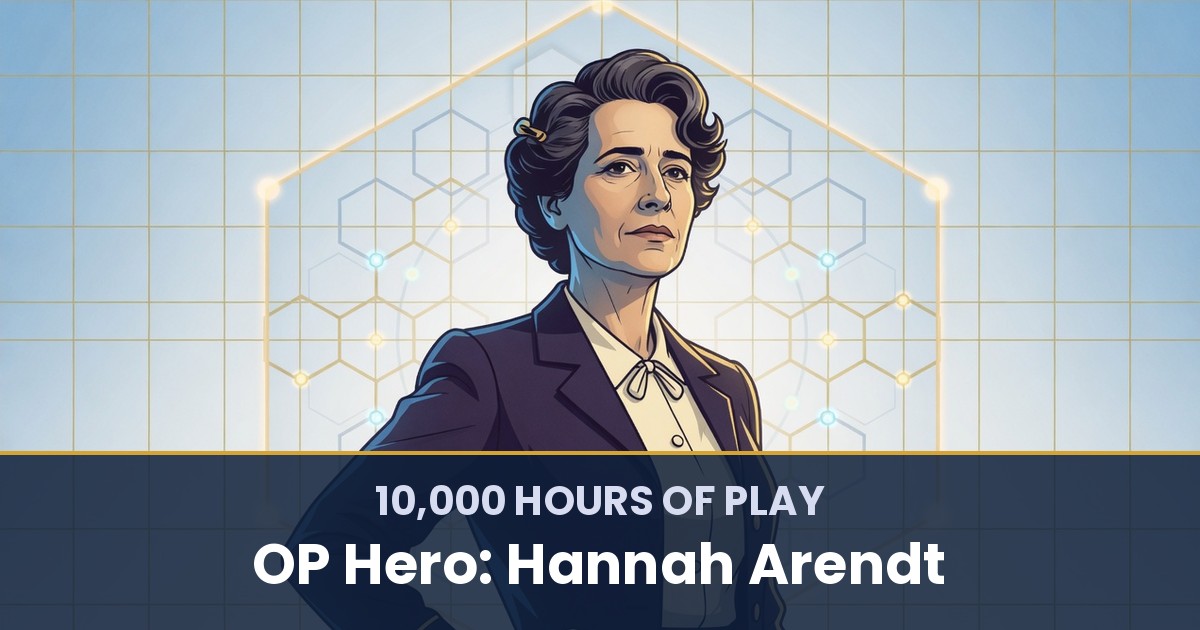


In 1940, French authorities locked Hannah Arendt inside the Gurs internment camp as an “enemy alien.” She had already fled Nazi Germany once, back in 1933.
She escaped the camp, made it out through Lisbon, and reached New York in 1941 as a stateless person. No country would claim her.
Ten years later, in 1951, two things happened in the same year: she became a citizen of the United States, and she published The Origins of Totalitarianism, the book that explained the very machinery that had tried to erase her.
Run her life through the 10K HP framework and you find a character build whose Game held still for five straight decades while everything around it burned: a thinker who lost her homeland, her language community, and her legal existence, and converted all of it into the raw material of her work. The rest of this profile walks the six Steps of that build in order.
⚡ Speed Run Notes
- Arendt’s Game stayed fixed for five decades: understand how political catastrophe became possible, and defend the conditions that let free people act together.
- Her Attributes showed early: independent judgment, pattern recognition across events others treated separately, and the nerve to publish arguments she knew would cost her allies.
- Her Role changed constantly: philosophy student, refugee organizer, escaped internee, New York editor, professor, trial reporter. The mission underneath never moved.
- Her Skill set maps cleanly to canon: Arcane Wisdom (Mage), True Sight (Ranger), Loremaster (Druid), Aegis (Paladin), Phoenix Rebirth (Paladin).
- Her hardest Quest was surviving her own success: the 1963 Eichmann report triggered years of public backlash, and she never withdrew the argument.
Table of Contents
About Yu-kai Chou

Yu-kai Chou is the author of 10,000 Hours of Play — the book that treats your life as the most important game you’ll ever build a character in, and gives you the 6-Step framework (Game · Attributes · Role · Skills · Allies · Quests) to play it on purpose. He has spent two decades developing the system through which this post analyzes its OP Hero, and applies it to his own life and to the lives of the people he advises around the world.
Chou’s other framework, the Octalysis Framework, has been applied by LEGO, Microsoft, Porsche, Coca-Cola, Salesforce, and MrBeast, impacting over 1.5 Billion Users. He has taught the methodology at Harvard, Stanford, Yale, Tesla, Google, BCG, and IDEO, and has advised governments in eight nations including Ukraine, the United Kingdom, the Kingdom of Bahrain, Singapore, Taiwan, the Netherlands, Kazakhstan, and South Korea.
His work has been cited by Harvard, Stanford, MIT, Forbes, Wall Street Journal, Wired, US Department of Energy, NIST, NSF, NCBI, US Department of Education, ClinicalTrials.gov, and Google Scholar — with 3,700+ more academic publications. Explore his books here.
Arendt’s build earns its place in this series because her sharpest weapon was a trained Skill rather than a gift: she taught herself to look at events without inherited categories, and then published what she saw even when it cost her. If I could lift one thing from her character sheet, it would be her Aegis: years of public attack, and the argument she had checked against the record never moved.
Step 1: The Game — What Hannah Arendt Was Actually Playing
Most biographies file Arendt under “philosopher.” She rejected the label herself, telling interviewer Günter Gaus on German television in 1964 that she had never aspired to it, and that her work belonged to political theory.
The distinction points straight at her Game. Philosophy, as she saw it practiced, retreated into abstraction. Her mission was to face events directly and, in her own famous formulation from The Human Condition, “to think what we are doing.”
Every major project she shipped serves that one mission. The Origins of Totalitarianism (1951) traced how antisemitism, imperialism, statelessness, and terror converged into a new form of domination.
The Human Condition (1958) asked which human activities sustain a durable common world, and separated labor, work, and action to answer it. Her unfinished The Life of the Mind turned to thinking, willing, and judging as the faculties that make responsibility possible.
That Game was never a career ladder, a chair at a particular university, or a school of followers.
It was a question she refused to put down: how did freedom break, and what would it take to keep it repairable? A Game defined as a question has a property most career goals lack, which is that no institution has the power to take it away from you.
Step 2: Attributes — The Innate Stats
Attributes are the stats you show before any training. A Library of Congress photograph from 1920 shows Arendt as a schoolgirl of about fourteen, studying in the family library, already reading far beyond what school demanded.
Her first standout Attribute was independent judgment. The same girl who built her own curriculum became the theorist who refused the “philosopher” label on national television, because accepting other people’s categories was never her default setting.
Her second was pattern recognition across separate domains. Conventional histories treated antisemitism, imperialism, and bureaucracy as distinct subjects; Arendt saw structural connections between them and built Origins on those links.
Her third was cognitive risk-taking. She argued that totalitarianism was a genuinely new form of rule, then later challenged the prevailing image of Adolf Eichmann as a demonic mastermind, knowing the second argument would ignite a firestorm among her own community.
The fourth was her alertness to plurality: an instinct that politics happens among distinct people with distinct perspectives, which later became a central concept of her theory.
Here is the practical lesson, and it comes straight from the OP Talent Triangle Method: Arendt did not choose her Game at random. She aimed her innate stats at the one arena where independent judgment and cross-domain pattern recognition compound hardest, which is the analysis of political catastrophe.
Your own Attributes were probably visible early as well; the useful exercise is checking whether you have pointed them at an arena that rewards them, because Arendt’s payoff came from that aim rather than from the raw stats themselves.
Step 3: Role(s) — The Character Class Across Chapters
Arendt’s Role changed six times across five decades, and the changes themselves are the reason to study her chapter of the roster.
In the 1920s she played the philosophy student: she studied with Martin Heidegger at Marburg beginning in 1924, completed her doctorate at Heidelberg in 1928 under Karl Jaspers, and published her dissertation on Augustine’s concept of love in 1929.
Then history deleted that character class. After fleeing Germany in 1933, she respec’d into a Jewish political activist in Paris, working for Youth Aliyah to help Jewish young people reach Palestine.
In 1940 the Role was forced on her: interned refugee, then escapee. From 1941 she rebuilt in New York as an editor and Jewish cultural worker, and from 1944 served as research director of the Commission on European Jewish Cultural Reconstruction, documenting cultural property the Nazis had scattered.
From 1944 onward she settled into the class she would master, the political theorist, and by 1959 she had become the first woman appointed a full professor at Princeton. In 1961 she added one more class: trial reporter, covering Eichmann in Jerusalem for The New Yorker.
Through all six Role changes, the Game from Step 1 never moved.
Most people fuse their identity to their current Role, so when the Role dies they believe the character died with it. Arendt kept her identity attached to the mission rather than to the current Role, which is why losing the scholar’s life in 1933 did not end the project the scholar had started.
Step 4: Skills — The Real-Life Game Skills Hannah Arendt Mastered
Attributes are what you start with. Skills are what you grind, and Arendt’s grind maps onto five canon Skills.
The first is Arcane Wisdom (Mage): absorbing enormous amounts of information and synthesizing it into a clear output. For Origins, she worked through political documents, imperial records, antisemitic pamphlets, and Nazi administrative material, then compressed it all into one structural argument.
The second is True Sight (Ranger): observing details others miss. In the Jerusalem courtroom between April and December 1961, where the world saw a monster, Arendt watched Eichmann’s actual conduct: the recycled bureaucratic formulas, the clichés, the apparent inability to think from another person’s standpoint. She then tested that observation against the trial transcript and the police interrogation record.
The third is Loremaster (Druid): weaving particular stories to carry general meaning. Arendt treated the recounting of specific lives and events as a method, because a concrete story discloses political truth that abstract theory smooths away.
The fourth is Aegis (Paladin): pushing the Quest through public criticism. The Eichmann book cost her friendships and provoked organized hostility for years, and she clarified but never retracted the core argument.
The fifth is Phoenix Rebirth (Paladin): coming back from devastating loss stronger than before. Statelessness took her country, her profession, and her legal identity; within a decade of arriving in New York she had researched, written, and published The Origins of Totalitarianism.
On the Skills Spectrum, Arendt is a clear master-track case: a few Skills, ground for decades, aimed at a single Game.
Step 5: Allies — The People Who Multiplied Hannah Arendt
Arendt’s build looks solitary from a distance. The correspondence archives say otherwise.
Karl Jaspers supervised her 1928 dissertation and remained her intellectual anchor through letters exchanged from 1926 all the way to 1969. He modeled the exact quality her work is famous for, which is judgment that bows to no school.
Martin Heidegger, her teacher at Marburg from 1924, supplied philosophical concepts she later transformed into her own account of action and public life. The relationship was complicated by his Nazi entanglement, and she still extracted from it the training that sharpened her.
Heinrich Blücher, her husband, was her political interlocutor from 1936 until his death in 1970. Their partnership connected her philosophy to street-level political experience across two exiles.
Mary McCarthy, her closest American friend, tested her arguments and polished her prose through a correspondence running from 1949 to 1975, and helped her find her footing in American publishing.
William Shawn of The New Yorker made a single decision that reshaped her legacy: he commissioned her to cover the Eichmann trial in 1961, handing her analysis an international readership.
Earlier still, the Zionist organizer Kurt Blumenfeld pulled her from pure scholarship into Jewish political engagement in the years around her flight from Germany.
Across the six of them, each Ally covered a stat she lacked: judgment had a mentor, tools had a teacher, grounding had a partner, honesty had a peer, reach had an editor, and stakes had an organizer.
Step 6: Quests — The Milestones That Shaped the Saga
Quest one: survive statelessness, 1933 to 1951. Eighteen years without a country produced the concept she is still cited for in refugee law debates, the “right to have rights.”
Quest two: explain total domination, 1945 to 1951. The Origins of Totalitarianism assembled the wreckage of Europe into a structural account of how terror-based rule became possible.
Quest three: rebuild the vocabulary of action, 1958. The Human Condition distinguished labor, work, and action, and made plurality a load-bearing political concept.
Quest four: report the Eichmann trial, 1961 to 1963. She attended the Jerusalem proceedings, filed for The New Yorker, and published Eichmann in Jerusalem with its permanently unsettling phrase, “the banality of evil.”
Quest five was the setback: survive the backlash, 1963 to 1966. The book brought hostile campaigns, broken friendships, and disputes with scholars and Jewish organizations, and she absorbed it all without abandoning the argument.
Quest six stayed open: The Life of the Mind, begun in 1972. She completed Thinking and Willing, both published in 1978 after her death on December 4, 1975, while Judging had to be reconstructed from her lecture notes.
Even the unfinished Quest did its work. A Game chosen well outlasts the player, and the questions she left open are still generating books by other people.
What You Can Steal From Hannah Arendt’s Build
First, write your Game down as a question rather than a job title. Arendt’s question kept its grip through four countries, one internment camp, and eighteen years without citizenship.
Second, expect your Role to be deleted at least once. Arendt lost the scholar’s life and gained the activist’s, then lost that and gained the editor’s, and her mission compounded through every swap.
Third, grind Skills that feed each other. Her Arcane Wisdom gathered the material, her True Sight caught what everyone else missed in it, and her Loremaster made the findings land as story.
Fourth, recruit Allies who are willing to argue with you. The Jaspers and McCarthy correspondences are decades-long records of two people telling Arendt exactly where her drafts failed, and her books are better for every page of it.
Fifth, budget for the backlash Quest, because thinking in public has drawn fire for as long as the record goes: Socrates was tried and executed for it in Athens, and Arendt’s milder version still cost her friendships and three years of organized hostility.
Arendt’s whole run demonstrates the framework’s least comfortable claim: the board you inherit does not decide how you play it. She inherited the worst board her century offered, and the run still became legendary.
Where this framework comes from

Want the full system this profile is built on?
Every OP Hero piece runs through the same 6-Step framework from 10,000 Hours of Play: Unlock Your Real-Life Legendary Success. The book covers the full system, walks through Yu-kai’s own life run as the first applied case study, and gives you the worksheets to audit your own build.
Related Reading
- All OP Hero Profiles — the full hub
- 10,000 Hours of Play by OP Hero: Immanuel Kant
- 10,000 Hours of Play by OP Hero: Viktor Frankl
- 10,000 Hours of Play by OP Hero: Carl Jung
- 10,000 Hours of Play by OP Hero: Baruch Spinoza
- The OP Talent Triangle Method