
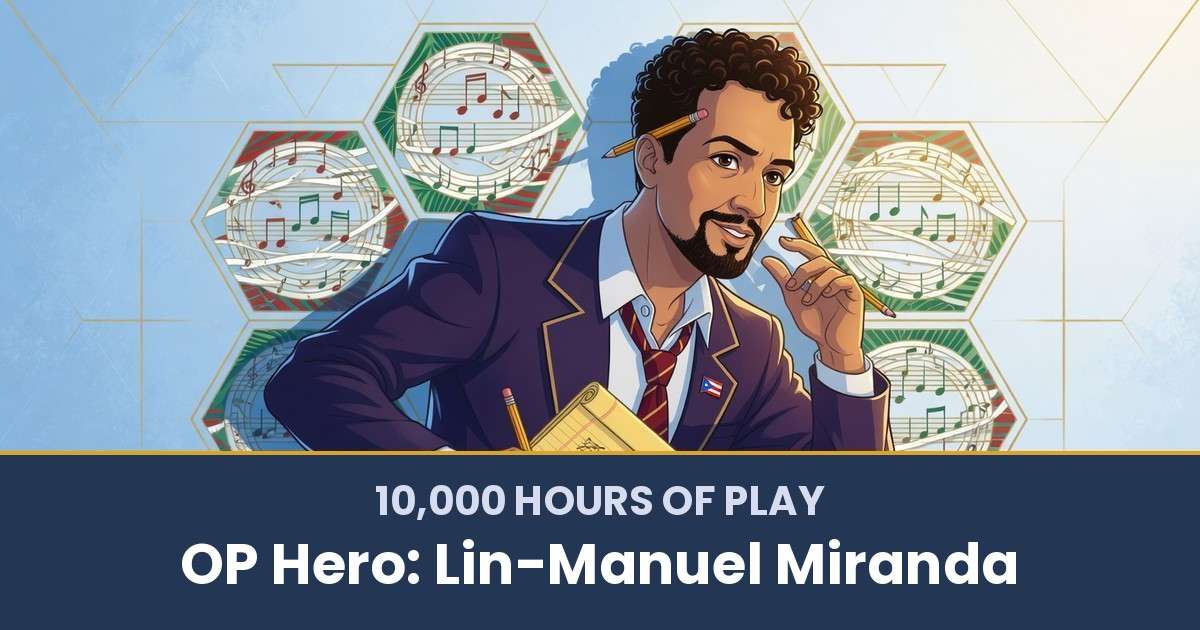


In 2008, a 28-year-old kid from Washington Heights wrote a Broadway musical about his Latino neighborhood — bilingual, hip-hop infused, almost no famous names attached. In the Heights won the Tony for Best Musical that year. Seven years later he did it again, except this time the show was about Alexander Hamilton, performed in rap, and cast almost entirely with actors of color.
The bet should not have worked. A hip-hop musical about a dead Treasury Secretary, written and acted by people who looked nothing like the founding fathers in your sixth-grade textbook, is not what Broadway picks for a sure thing. It should have been a flop. It became the cultural event of the decade — a Pulitzer Prize, 11 Tony Awards, a billion-dollar phenomenon, and a permanent reset on who gets to tell the American story.
Lin-Manuel Miranda is the rare creator whose build can be reverse-engineered cleanly through the 10,000 Hours of Play framework. The Game is obvious. The Attributes show up before he can drive. The Roles stack in plain view. And the Skills he reached for at each level are skills you can train, if you stop treating his career as a magic trick and start treating it as a build order.
⚡ Speed Run Notes
- Lin-Manuel Miranda’s life-game is not “be famous.” It is to put the people he grew up with on the biggest stages, in the most ambitious forms, at the highest craft level — a mission visible from his Hunter College High School shows onward.
- The innate Attributes that powered him — pattern recognition across media, hyperverbal rhythmic mind, empathy for outsiders, comfort with risk on unconventional forms, obsessive work ethic — all show up before he can legally drink.
- He moved Class three times: student playwright → indie writer-performer → mythic-scale showrunner. Each transition was earned, not granted.
- His breakthrough Skills are not innate. Vision Manifestation (Warlock), Loremaster (Druid), Lich Grind (Warlock), Concord of Elements (Druid), Wildfire Spark (Ranger), and Phoenix Rebirth (Paladin) — these are trainable for anyone willing to put in the hours.
- The Hamilton bet took six years of quiet work. The viral moment looked overnight; the build was not. That gap is where most people quit.
Table of Contents
- Step 1: The Game — What Lin-Manuel Miranda Was Actually Playing
- Step 2: Attributes — The Innate Stats
- Step 3: Role(s) — The Character Class Across Chapters
- Step 4: Skills — The Real-Life Game Skills Lin-Manuel Miranda Mastered
- Step 5: Allies — The People Who Multiplied Lin-Manuel Miranda
- Step 6: Quests — The Milestones That Shaped the Saga
- What You Can Steal From Lin-Manuel Miranda’s Build
- Where this framework comes from
- Related Reading
About Yu-kai Chou

Yu-kai Chou is the author of 10,000 Hours of Play — the book that treats your life as the most important game you’ll ever build a character in, and gives you the 6-Step framework (Game · Attributes · Role · Skills · Allies · Quests) to play it on purpose. He has spent two decades developing the system through which this post analyzes its OP Hero, and applies it to his own life and to the lives of the people he advises around the world.
Chou’s other framework, the Octalysis Framework, has been applied by LEGO, Microsoft, Porsche, Coca-Cola, Salesforce, and MrBeast, impacting over 1.5 Billion Users. He has taught the methodology at Harvard, Stanford, Yale, Tesla, Google, BCG, and IDEO, and has advised governments in eight nations including Ukraine, the United Kingdom, the Kingdom of Bahrain, Singapore, Taiwan, the Netherlands, Kazakhstan, and South Korea.
His work has been cited by Harvard, Stanford, MIT, Forbes, Wall Street Journal, Wired, US Department of Energy, NIST, NSF, NCBI, US Department of Education, ClinicalTrials.gov, and Google Scholar — with 3,700+ more academic publications. Explore his books here.
What I find instructive about Lin-Manuel’s build is that he is a Druid-Warlock hybrid who refused to choose. The Druid in him wants the whole community on stage — every kid from his block, every actor of color who’d been told there were no parts for them. The Warlock in him is willing to grind in private for six years, alone with a yellow legal pad, until the vision is precise enough to deliver. Most builders pick one. He let both run, and the combination is the lesson — empathy without the Warlock’s grind stays a feeling, and the grind without the Druid’s empathy stays a manuscript in a drawer.
Step 1: The Game — What Lin-Manuel Miranda Was Actually Playing
The surface game looks like “make musicals.” That is wrong.
The deeper game, the one he has been chasing since high school, is this: put the people he grew up with — Latino kids in Washington Heights, working-class immigrants, the cast that nobody invited to the Broadway party — on the biggest possible stages, in the most ambitious possible forms, at the highest possible craft level. In a 2016 NEA interview he framed his ambition as wanting to write shows that look like the world he lives in — the subway, the neighborhood, the city as it actually is.
This is not a marketing line he developed later. The first musical he wrote, at Hunter College High School, was already an adaptation experiment — he was already trying to take an existing story and warp it into a form that the kids around him could see themselves inside of. The first version of In the Heights was written when he was a sophomore at Wesleyan University. He was nineteen.
The game also has a craft layer. He is not just trying to put underrepresented faces on stage; he is trying to do it without lowering the bar. Hip-hop musical theater could have been gimmick. He treated it as engineering. Each show had to work as story, as music, and as cultural statement, all three at the same time, because that is the bar he set when he was still in college. Most creators chase one of those three. He always wanted the trifecta.
Like most OP heroes, his life-game was visible before he could buy a beer. The 10K HP discipline is just learning to name the game you have already been playing, so you can play it more deliberately.
Step 2: Attributes — The Innate Stats
Innate Attributes are the dials you got at character creation. They are not coaches and they are not classes you can take. They are the raw shape of your nervous system. Five of Lin-Manuel’s were visible long before anyone called him a genius.
Cross-media pattern recognition. From childhood, he was the kid mashing the movies and books he loved into new forms. The high school musical he co-created riffed on The Princess Bride; he could not stop seeing one story and immediately imagining what it would look like as another. This is the same circuit that, in 2008, looked at Ron Chernow’s 800-page Hamilton biography and said: this is a hip-hop concept album. Most people who read that biography saw a biography. He saw a Broadway show. Same eyes, different stats.
Hyperverbal rhythmic mind. He has talked openly about writing songs on the subway, on his honeymoon, in the shower. The internal composer never stops. The freestyle group he co-founded in 2004, Freestyle Love Supreme, is a public demonstration of this Attribute — you cannot fake live freestyle rap, and you cannot train to it from zero if the wiring is not there.
Empathy for outsiders. He has said his “ideal show” is the school show where everyone gets a part. Read that as childhood empathy that never grew out of him. In the Heights, Hamilton, the songs he wrote for Encanto — they all share the same gravitational center, which is the kid who got left out.
Risk-tolerance on unconventional forms. Bilingual hip-hop on Broadway. Rap about Treasury policy. He chose, repeatedly, the form everyone said would not commercialize. This is the same Attribute that shows up in Yu-kai’s Talent Triangle Method — sometimes the rarest Edge Strength is just the willingness to spend years on a bet other people will not touch.
Obsessive baseline. He has told NEA interviewers — and many others — that he is happiest when he is working. Some people work to live. He works because the alternative — not working — does not feel like rest to him. That Attribute is the unfair multiplier on every other one in the list.
Step 3: Role(s) — The Character Class Across Chapters
Roles are the character class you take on for a chapter of your life. Lin-Manuel ran through four of them on the way to becoming the hybrid he is now.
Chapter 1 — Apprentice Storyteller (Hunter College High School, early 1990s). The drama-kid role. Writing class shows, acting in plays, obsessing over what the next school show should be. This is the apprenticeship period that almost every OP storyteller hero has on their resume — the years where the volume is high and the stakes are low.
Chapter 2 — Campus Showrunner (Wesleyan, late 1990s – 2002). The role flips from performer to creator. By sophomore year he is writing the first In the Heights. He is using campus theater as a prototyping environment — the same way an engineer would use a sandbox. Wesleyan was his MVP lab.
Chapter 3 — Indie Writer-Performer (early-to-mid 2000s). Off-Broadway, Freestyle Love Supreme, day-jobbing as a substitute teacher while developing In the Heights through years of workshops. This is the longest, most invisible chapter, and the one most people forget about when they remember him as the Hamilton guy. The 2008 Tony win is the visible event. The role he was running before that win is what made it possible.
Chapter 4 — Mythic-Scale Showrunner (2015 onward). After Hamilton, the class changes again. He stops being one creator with one show and starts being a multi-platform composer-actor-director-philanthropist. Disney songs (Moana, Encanto), film direction (Tick, Tick… Boom!), Puerto Rico hurricane relief, public-policy advocacy. The role expanded to fit the scale.
The lesson is that the class transitions were never sideways. Each one inherited the skills of the previous one and added a new layer. He is still the Hunter College kid; he just runs on different servers now.
Step 4: Skills — The Real-Life Game Skills Lin-Manuel Miranda Mastered
Skills are the trainable layer. Yu-kai’s Skills Spectrum separates Specialists from Dabblers from Masters, and Lin-Manuel sits at the Master end on a very specific stack. Six canon Skills carried the most weight.
Vision Manifestation (Warlock) — the ability to visualize success so vividly that the visualization shapes the work. In 2009 he stood in front of the President of the United States at the White House Poetry Jam and performed the opening number of a musical he was writing about Alexander Hamilton. The room laughed at “hip-hop musical.” He had already seen the show finished. He performed from inside the finished version, six years before it would actually exist. That confidence is what kept the project alive through the years of doubt.
Loremaster (Druid) — weaving compelling, inspiring stories. This is the Skill underneath everything he ships. The same Skill that powers other OP storytellers like Stan Lee, who built the Marvel universe one origin story at a time. Lin-Manuel runs it on history (Hamilton), on community (Heights), and on family (Encanto). The pattern is the same: take a story most people consider closed, find the human inside it, and tell it so the audience cannot look away.
Lich Grind (Warlock) — intense, secluded work periods. Hamilton took six years of writing. Not six years of “thinking about Hamilton” — six years of laying tracks, killing songs, rewriting, killing more songs. He has said the rule was: if a song does not advance story or character, it goes. That is the Skill that turned a freestyle of one rap song at the White House into a Pulitzer Prize. The Warlock energy here is what Yu-kai documents in his own Lich Pact — sustained, isolated, painful focus over years.
Concord of Elements (Druid) — bringing multiple parties of different interests together. Hip-hop heads and Broadway purists do not naturally share an audience. Latin music lovers and history nerds rarely show up to the same venue. Lin-Manuel’s Hamilton brought all of them into one room and made each tribe feel like the show was theirs. That is not luck. That is a Druid-class harmonization Skill that he trained for a decade before the show shipped.
Wildfire Spark (Ranger) — viral marketing. Hamilton’s #Ham4Ham street performances, the cast album drop strategy, the way the show was talked about on social media before most ticket holders saw it. Then Encanto‘s “We Don’t Talk About Bruno” hit number one on the Billboard Hot 100 in 2022 — the first Disney song to do so since 1993 (Aladdin’s “A Whole New World”). He understood, before most theater people did, that the song was the marketing.
Phoenix Rebirth (Paladin) — recover from devastating failure and come back stronger. After Hamilton, the backlash arrived. The 2016 production faced criticism over its founders-as-immigrants framing. The 2020 Disney+ filmed version reopened debate on slavery in the founders’ lives. He absorbed it, learned, addressed it publicly, and kept building. Compare to how J.K. Rowling ran a different version of this Skill after her own post-success controversies — same Paladin energy, different output.
Step 5: Allies — The People Who Multiplied Lin-Manuel Miranda
Solo build is a myth. Every OP Hero has an alliance, and Lin-Manuel’s is unusually tight.
Thomas Kail — his lifelong director. Met him at Wesleyan. Directed In the Heights and Hamilton. The kind of collaborator who can keep saying “cut that song” until the show works. Without Kail, the manuscript stays a manuscript.
Alex Lacamoire — orchestrator and music director. The person who took Lin-Manuel’s hip-hop demos and turned them into the layered orchestrations that made Hamilton playable by a full pit. Same partnership pattern as a director-DP relationship in film.
Andy Blankenbuehler — choreographer. The kinetic vocabulary of Hamilton on stage is his. The story is sung and rapped, but it is also danced, and that physical layer is what makes a song like “Yorktown” feel like an actual battle instead of a recital.
Ron Chernow — historian. Wrote the 800-page Alexander Hamilton biography that sparked the project, then agreed to serve as historical consultant. The first time most people heard about the show, Chernow’s credibility was the thing that made it sound less crazy. Multiplier on legitimacy.
Luis A. Miranda Jr. — his father. Veteran New York political operative, Latino community organizer, and the person who first showed Lin-Manuel that storytelling and political agency are the same engine viewed from different angles. The post-Hamilton activism work in Puerto Rico runs on rails his father laid down.
Notice the alliance pattern. It is not a network of fans. It is a small, specialized team that has been together for two decades. That is the OP-Hero pattern, and it shows up in build after build — including the way Spielberg kept John Williams and Janusz Kaminski close for decades, or the way Stan Lee kept Steve Ditko and Jack Kirby in the building.
Step 6: Quests — The Milestones That Shaped the Saga
Quests are the concrete projects, not the abstract ambitions. Six matter most for Lin-Manuel’s saga.
Quest 1 — First version of In the Heights (Wesleyan, ~1999). A sophomore college musical. Tiny stakes, real prototype. The reps that taught him his own writing engine.
Quest 2 — In the Heights on Broadway (2008). Years of off-Broadway development culminated in a Broadway run that won four Tony Awards including Best Musical. This was the proof of concept that a Latino, hip-hop infused, original musical could win the highest prize on the highest stage.
Quest 3 — Hamilton at the White House (2009). The Obamas hosted an evening of poetry and spoken word. He stood up and announced he was working on “a concept album” about Alexander Hamilton. He performed the opening number, alone at the piano. The room laughed at the premise. Six years later they would not be laughing.
Quest 4 — Hamilton on Broadway (2015). Pulitzer Prize for Drama. Eleven Tony Awards. Cultural rewrite of who gets to perform American history. Commercial juggernaut. The Quest that turned him from “Tony-winning Latino playwright” into “American cultural figure.”
Quest 5 — The setback (2016–2020). Not every Quest is a victory. The criticism of Hamilton’s framing of the founders — and especially the rekindled debate after the Disney+ filmed release in 2020 — was a real failure of foresight. He had not anticipated how the show would land in a post-2020-summer cultural climate. He responded publicly, acknowledged the gap, and kept working. That is Phoenix Rebirth in operating-system form.
Quest 6 — Disney composer and beyond (2016 onward). Songs for Moana, songs for Encanto, directorial debut on Tick, Tick… Boom! (2021). The latter, a love letter to Jonathan Larson, completed a personal Quest he had been carrying since high school — paying back the artist whose work first taught him a musical could be about real life. “We Don’t Talk About Bruno” hit number one. The Disney pivot kept him relevant to a generation that will not encounter Hamilton until they are older.
What You Can Steal From Lin-Manuel Miranda’s Build
If you look at the rest of the OP Hero roster, you start to see the pattern. The big bets that look like overnight wins are almost always the visible third of a six-year iceberg. The freestyle that looks effortless is built on a decade of freestyle nights at Joe’s Pub. The “yes” that lands you on the biggest stage is built on a hundred quiet years of “yes” to small unsexy work.
From Lin-Manuel’s build, take three things. First, name your real Game out loud — not the surface goal, but the underneath one. Second, find the Skill stack that fits your innate Attributes and grind it for years before anyone is watching. Third, build a small, specialized alliance and keep it together. Those three, in that order, are how you turn a Hunter College kid into a Pulitzer winner.
You will not write Hamilton. You will write your version of it. Start.
Where this framework comes from

Want the full system this profile is built on?
Every OP Hero piece runs through the same 6-Step framework from 10,000 Hours of Play: Unlock Your Real-Life Legendary Success. The book covers the full system, walks through Yu-kai’s own life run as the first applied case study, and gives you the worksheets to audit your own build.
Related Reading
- All OP Hero Profiles — the full 10K HP roster — every hero analyzed through the same 6-Step framework.
- 10,000 Hours of Play by OP Hero: Stan Lee — another Loremaster who built a universe.
- 10,000 Hours of Play by OP Hero: Steven Spielberg — the long-arc collaborator pattern.
- 10,000 Hours of Play by OP Hero: Hayao Miyazaki — visionary storyteller, slower cadence, same gravity.
- 10,000 Hours of Play by OP Hero: Maya Angelou — language as a force of cultural lift.
- The Talent Triangle Method — how to find your own Edge Strength before you grind.