
![Squid Game Gamification Analysis: All 8 Core Drives Decoded [Octalysis]](https://yukaichou.com/wp-content/uploads/2026/04/squid-game-octalysis-analysis-featured-v8.png)

What makes a TV show so psychologically gripping that 142 million households binge it in 28 days? Squid Game isn’t just great television — it’s one of the most complete gamification case studies in entertainment history, activating all 8 Core Drives of the Octalysis Framework simultaneously.
⚡ Speed Run Notes
- Squid Game is the purest illustration of Black Hat drives ever produced in mass media. It shows what happens when CD6 (Scarcity), CD7 (Unpredictability), and CD8 (Loss Avoidance) are deployed without White Hat balance. The result is engagement without enjoyment, which is exactly the show's thesis.
- The show works as entertainment precisely because the viewer gets CD1 (Epic Meaning) that the contestants are denied. Contestants play for money. Viewers play to understand humanity. The asymmetry is the show's genius. It indicts gamification while being a masterclass in it.
- The playground games chosen are CD7 (Unpredictability) at its darkest — childhood games recontextualized as life and death. The familiar made horrifying. This is unpredictability through context shift, not content shift. The games themselves are simple; the stakes reframe them entirely. This is how context itself becomes a design tool.
- The show reveals the danger of products that optimize for engagement without optimizing for user wellbeing. Every designer who has shipped a Black Hat mechanic should rewatch the show. It's a mirror. The reflection is uncomfortable on purpose.
- The deepest insight: Squid Game is a public service announcement dressed as entertainment — and the entertainment is so good most viewers miss the PSA. The show is teaching its audience to see manipulation. That's valuable work disguised as nine hours of TV. Gamification designers should take the lesson seriously.
Here I break down exactly how Squid Game’s design kept contestants (and viewers) trapped in what I call “full-octagon engagement” — and what it reveals about the motivation mechanics hiding in your own workplace.
Spoilers Alert: not only will parts of the show be spoiled, you will understand the inner workings of how something like Squid Game is designed, ruining your entire experience if watching for the first time.
Table of Contents
Author Credibility: Yu-kai Chou

Yu-kai Chou created the Octalysis Framework after studying gamification since 2003 — years before the term entered mainstream vocabulary. As a Human-Systems Architect & Behavioral Designer, his framework has been applied by LEGO, Microsoft, Porsche, Coca-Cola, Salesforce, and MrBeast, impacting over 1.5 Billion Users.
Chou has taught the Octalysis methodology at Harvard, Stanford, Yale, Tesla, Google, BCG, and IDEO.
His work has been cited by Harvard, Stanford, MIT, Forbes, Wall Street Journal, Wired, US Department of Energy, NIST, NSF, NCBI, US Department of Education, ClinicalTrials.gov, and Google Scholar — with 3,700+ more academic publications. Explore his books here.

But what makes it a GAME?
It’s called the Squid Game, but is it really a game? Most of the time we think of games as fun activities that drive good memories.
Squid Game seems to just be this perverted meat trap where people are dying for the entertainment of sick rich people.
You see similar scenarios in horror Escape Room movies where many people die if they don’t solve puzzles to escape the room quickly. But they don’t call it a game — just another torture zone.
However, if you look at similar films here, you will see that something like the Hunger Games also call themselves a game, except the goal is to just kill off one another. In Roman gladiator arenas, there is also the common saying, “Let the games begin!”
So what makes people slaughtering each other a form of game?
Technically, games exist for us to rehearse and train for real life situations that are important. That’s why boys love playing fighting games — in primitive times you don’t want your first ever fight to be of life-or-death.
Their brain creates pleasure when tackling these situations so they would have enough practice to survive in the future world.
That’s also why there are also many popular games that are related to socializing, solving puzzles/problems, and building industrial empires — all useful skills to gain for thriving in our harsh world.
So when people are put in an artificially created environment where they need to outcompete each other and even potentially cause each other to be eliminated, they call this a Game — and this is exactly what makes gamification such a powerful lens for understanding entertainment. The fact that many sports are just a game that professionals play to entertain a paying audience also fits well in the setup of Squid Game.
But of course, it goes beyond that. Squid Game actually offers little games that Koreans play as kids when they were growing up, further pushing for that aspect of “I want desperate people to survive and murder each other, but through a gamified environment.”
So what makes the gamified Squid Game so compelling?
There are 2 aspects to consider here: the Squid Game itself for the contestants, and the Squid Game show for the audience.

For both of them, we could use the Octalysis Strategy Dashboard to evaluate the different sets of Business Metrics, Player Types, Desired Actions, Feedback Mechanics, and Rewards/Incentives. For practicality sake, we use a super shrunk down version of this process.
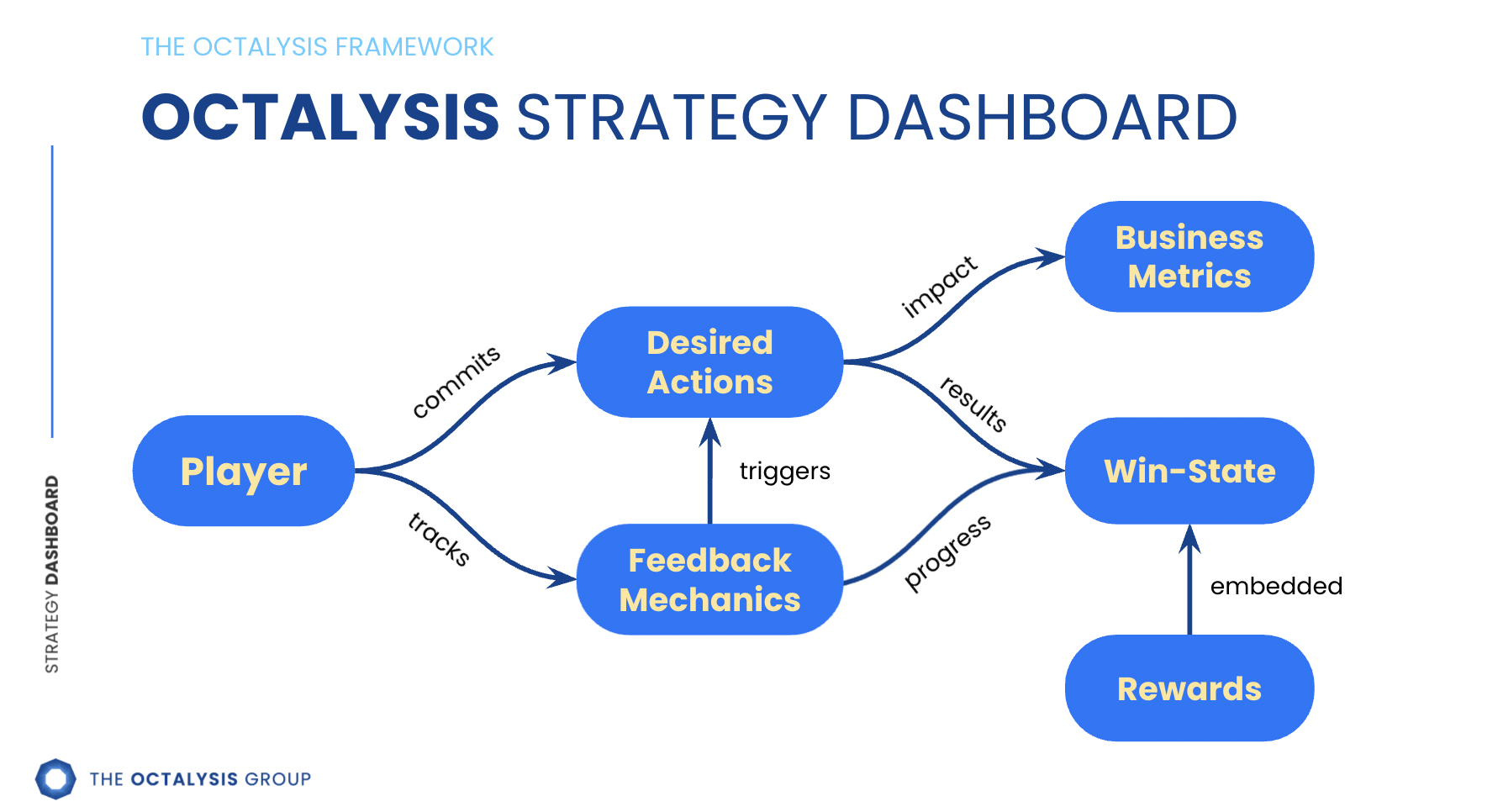
If we look at the Squid Game for the Contestants:
Business Metrics: how thrilling and entertaining the VIPs will feel while watching people struggling and getting eliminated
Player: financially and socially desperate people who have dropped to the bottom of society that have little to live for or too much to lose if they didn’t have money.
Desired Actions: go through a list of 6 games, surviving each of them, while making sure other contestants are being eliminated
Feedback Mechanics: floating ball with a ton of cash, number of current players, gameful environment with death triggers, soldiers with guns etc.
Rewards/Incentives: a huge deal of money that could likely solve all the problems they are facing in their normal reality.
Now if we look at Squid Game for the Netflix Viewers:
Business Metrics: keep people watching content for a long extended period of time so every month they feel like the fee was worth it — also increase word of mouth.
Player: media-oriented people who prefer watching shows as their main form of entertainment. Also people who like thrillers and aren’t afraid of blood, like the Game of Thrones audience.
Desired Actions: binge watch Squid Game for long periods of time. If they stop watching it, think about it all night long and talk to others about it.
Feedback Mechanics: TV screen — which characters are still alive, what is the new challenge, attachment to characters, drama/tension built between characters, curiosity of the entire organization.
Rewards/Incentives: satisfying ones’ curiosity, feedback of one’s creative guessing, social relatedness towards characters in the show and how they develop
For this article, we will focus on the Game Contestants (and potentially explore Netflix Viewer in another article)
Squid Game Contestant Game Analysis
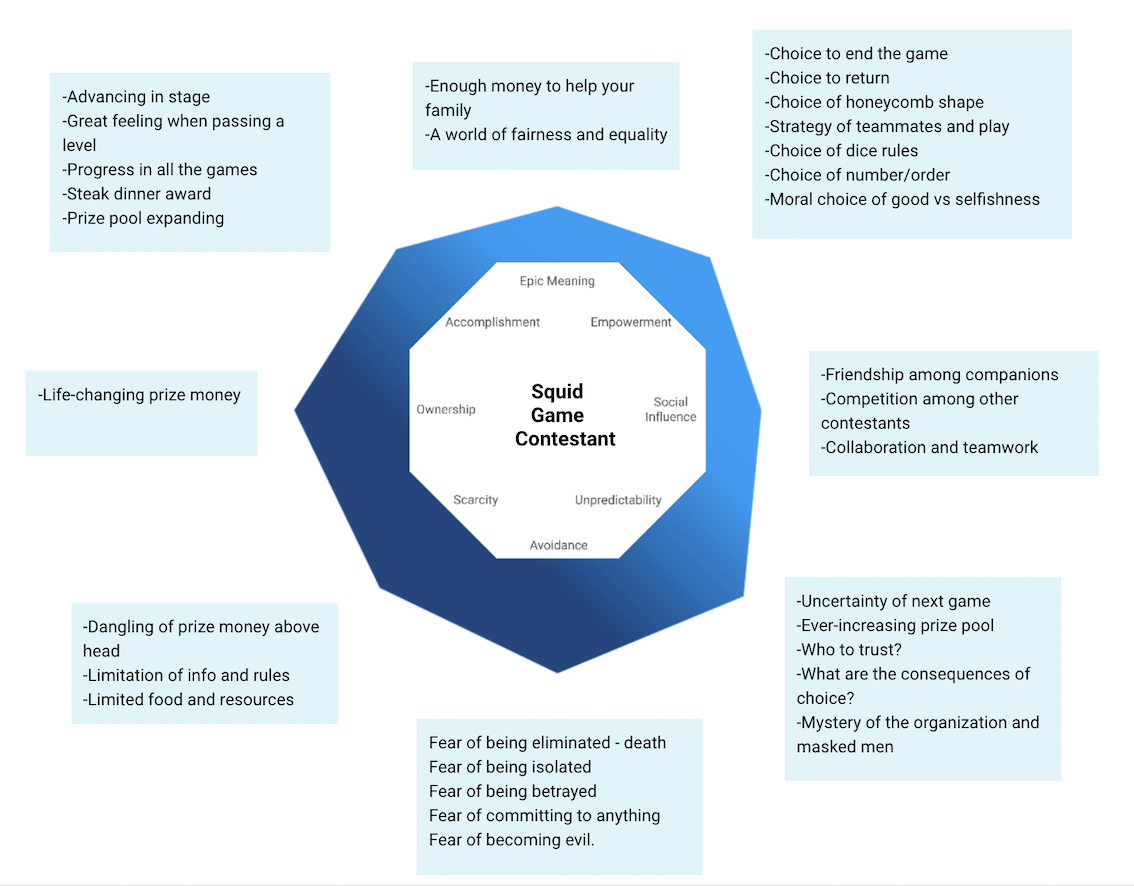
So if we apply the 8 Core Drives of the Octalysis Framework, we could make this analysis to the game from the position of the contestants. Let’s first get the obvious ones out of the way:

Core Drive 4: Ownership & Possession in Squid Game
Of course, the biggest appeal for people to play the Squid Game is the money prize if they are the final winners.
There is nothing special about this, but companies who want to motivate people need to think heavily about incentive designs and how that incentive is presented.
Keep in mind that Core Drive 4: Ownership & Possession is on the left side of the octagon so it is a “Left Brain Core Drive,” which means it is purely an extrinsic motivation design.
This means that the players are doing the activities because of a goal, milestone, or reward, but they don’t necessarily enjoy the activity itself. So once they obtain the reward, hit their goals, or the reward becomes stale and uninteresting, people will stop doing the behavior.
For Squid Game, it is not hard to imagine that if the reward suddenly disappears or is not as attractive as they thought, no one would want to continue.
Core Drive 8: Loss & Avoidance in Squid Game
Core Drive 8: Loss & Avoidance is also apparent and obvious within the Squid Game. If you don’t do the Desired Actions and reach the Win-State, you will be “eliminated,” also known as being murdered immediately. This motivates people to keep trying and doing their best, obviously because they do not want to get killed.
However, it goes beyond that. You can see that within the game, people are driven by Avoidance for many other things, including trying to avoid being isolated and shunned by others, being betrayed, or even committing to decisions.
Also, for some characters, they really try to avoid doing things against their conscience and becoming what they consider an evil person. The CD8 of not losing their lives fights head and head with the CD8 of not becoming a selfish evil person.
Finally, after surviving for a few rounds, even though people have the right to end the games, almost no one wants to at that point because they have built up so much sunk costs.
They have risked, survived, and even killed to get to where they are.
If they quit, all of that would be for nothing and the whole endeavor would feel silly. The Sunk Cost Prison is strong, trapping them to keep playing the game.
Core Drive 8 Loss & Avoidance is at the bottom of the octagon, which means it is purely a Black Hat motivation Core Drive, which means that it has an immense power to motivate people to do Desired Actions immediately, but people feel completely out of control and therefore completely demoralized throughout the experience.
Core Drive 7: Unpredictability & Curiosity within Squid Game
It is not hard to detect that one of the most soul-snatching elements of Squid Game is the uncertainty within the experience. What game is next? How many people will die and how does that affect the prize pool? What are the consequences of the choices within the games (partner, number, shapes)?
All these feel unpredictable and therefore always on peoples’ minds.
How important this component is fully shown by how much people are willing to do just to find out the next game and convert the CD7: Unpredictability to CD2: Development & Accomplishment. One character, after realizing his hard work wouldn’t allow him to know what happens next as he expected, started to take irrational and risky actions that put his life in jeopardy, defeating the purpose of knowing what the next game is in the first place.
On an interpersonal level, there is a lot of unpredictability on who they can trust within the group, who might kill them, and who might protect them.
In addition, every contestant (alongside the audience) has been curious about the crazy organization of the masked people, where it is hosted, and everything else as it seems bizarre.
Core Drive 7: Unpredictability & Curiosity is on the right bottom of the octagon, which means it is a Black Hat Intrinsic Motivation Core Drive. This means that it fully engages our brain and we would always be thinking about it, however, we feel out of control and therefore could still be demoralized if we are in that uncertainty for too long.
Core Drive 2: Development & Accomplishment within Squid Game
CD2: Development & Accomplishment is clear in Squid Game, much like most gamified designs. The game is broken into six stages (aligning with the 4 Experience Phases of gamification), with clear winners and losers on each stage. Every time the Win-State moment happens, people rejoice and feel amazing.
Of course, in each of these children’s games there is a sense of progress in all of them: how far you have traveled (in three instances), how much of an item you have drilled out, how far you have pulled, how many marbles you have etc.
That sense of progress feels great which leads to the feeling of accomplishment after.
Finally, one of the greatest feelings of Development is the prize pool’s continuous growth as each round advances. The floating ball on top is a great progress bar that is filled with cash, and the number in billions on a display is also motivating.
Core Drive 2: Development & Accomplishment is on the left top of the octagon, which means it is a White Hat Extrinsic Motivation Core Drive. With CD2, usually people feel good as long as they keep feeling progress and accomplishment, but the moment they feel like they are no longer having meaningful progress and accomplishments, they lose interest quickly.
In fact, some people in Squid Game feel like even though they have won the game, it is no longer meaningful progress and achievement and therefore they lose the will to play.
Now that we have examined the more obvious Core Drives within Squid Game, let’s evaluate some more subtle Core Drives that make the death game so engaging.
Core Drive 1: Epic Meaning & Calling within Squid Game
For Squid Game, there is a modest sense of Epic Meaning & Calling in the design. Of course, there is a built-in nature where many of the contestants want to get the prize money in order to save their family members, which is a higher meaning than just protecting themselves.
This is demonstrated further when one character (without going into full spoilers) told another character that the latter has something to live for unlike the former hence the latter should win the game.
But also, you can see that the game tries to emphasize on the idealism of fairness and equality. It tries to maintain that the outside world is unfair, that the contestants are victims, whereas the Squid Game is fair and everyone has an equal chance of winning.
This is emphasized by the title of Episode 2 being titled “Hell” referring to the real world and Episode 5 being titled “A Fair World” referring to the Squid Game.
In my literature in Octalysis Design, I often talk about how the most important thing within Core Drive 1: Epic Meaning & Calling is Believability.
And believability is best established if the designer takes sacrificial actions in order to fulfill that.
In the show, the Front Man kills his own men, not because of their corruption, but because he says they broke the principles of giving everyone a fair chance.
Core Drive 1: Epic Meaning & Calling is on the top of the octagon, which means it is a pure White Hat motivation Core Drive, often giving people the best sense of feeling and sometimes motivating people to take self-sacrificial actions in order to maintain the higher meaning.
Core Drive 3: Empowerment of Creativity & Feedback in Squid Game
Core Drive 3: Empowerment of Creativity & Feedback is all about MEANINGFUL Choices and strategy. Surprisingly, Squid Game offers an unusual high level of meaningful choices compared to other survival games within the genre.
The strategy component for Squid Game is obvious. Contestants have some level of control (or the perception of it) in terms of how they will play the game. They can choose their partners, shapes, numbers, and a variety of other things on each game.
This is unlike a normal survival game where you just get thrown in and hope you don’t die. Strategy is involved during this process, and it’s a process of guessing probabilities of what could be the most advantageous.
However, the most unique thing about Squid Game overall is that contestants can actually choose to end the game if over half of them vote to do it.
And in fact, unique to this entire genre, they actually do vote to end the game, and actually get to go home.
This makes people feel that they have MEANINGFUL choices that matter and feel empowered that this is a place that empowers their choices.
So when the contestants return to the Squid Game, they CHOSE to go back. They DECIDED that it’s a game they want to play. And as a result, their psychological condition is much more resilient in taking in the craziness of all the tension the game offers.
They no longer feel like a victim that was thrown into these death games, but a voluntary participant even after they already found out that this could be deadly.
Core Drive 3: Empowerment of Creativity & Feedback is on the top right of the octagon, which means it is a White Hat Intrinsic Motivation Core Drive. It is often the longest lasting and most sustainable type of motivation that makes people feel good, and adds a much-needed feel of agency during the Squid Game so people can cope with the craziness better.
Core Drive 6: Scarcity & Impatience in Squid Game
Core Drive 6: Scarcity & Impatience is common in Squid Game. Not only do contestants have scarcity and limitations in resources, food, free time, and information — which in itself creates obsessive yet uncomfortable engagement — but one of the “killer” features of the Squid Game is the countdown timer.
There is a scarcity of time to complete a mission, which means that if you hesitate too much, you and sometimes many others will be eliminated.
This type of motivation creates an insane amount of stress and obsession. People who started off wanting to be good moral characters, when faced with the countdown timer of death, start behaving ferociously and even terminating others just so they can make progress before the timer runs out.
Core Drive 6: Scarcity & Impatience is on the left bottom of the octagon, which means it is a Black Hat Extrinsic Motivation Core Drive, and while it creates a high intensity of obsessive behavior, no one feels great about this kind of motivation and could lead to burn out quickly.
Core Drive 5: Social Influence & Relatedness
The last Core Drive on our list is CD5: Social Influence & Relatedness. Core Drive 5 plays an important yet interesting role in Squid Game, as towards the beginning, it was a bit more White Hat in design (collaboration, appreciation), where people worked together to help each other.
They wanted others in close proximity to stay alive. Especially the main protagonist, he had a heart of gold and was focused on caring about others and encouraging those around him.
This made the “game” experience much more intrinsically tolerable as if you imagine people going through the Squid Game experience by themselves while facing strangers at each stage like a gladiator, it will feel tremendously more Black Hat and difficult to cope with.
However, as the game goes on, CD5 eventually shifted to become more and more Black Hat (Competition, Peer Pressure, Envy), whereas contestants needed to start sabotaging each other, tricking each other, and eliminating each other to play the game.
This transition forced even the strongest of hearts to breakdown, becoming violent and villainous characters.
In fact, this led to the main protagonist feeling like he was the loser even though he won. If he could have won alongside some friends and maintaining his own moral principles, he would likely feel much better about the experience and continued his life more positively.
However, due to the Black Hat nature of the games, he became demoralized and didn’t care about being the winner at all.
Core Drive 5: Social Influence & Relatedness is on the right side of the Octagon, which means while it is Right Brain/Intrinsic (it engages our brain), it could become White Hat (collaboration) or Black Hat (competition) depending on how you design for it.
Squid Game’s transition from White Hat to Black Hat likely led some early contestants to stay in the game for longer, but later on created soul-crushing scenarios for these same contestants.
Key Statistics: Why Squid Game Dominated Global Entertainment
Squid Game is the most-watched Netflix series of all time, with 1.65 billion viewing hours in its first 28 days of release, according to Netflix’s official Top 10 data. The show was watched by 142 million subscriber households and reached the #1 position in 94 countries simultaneously.
“When we look at Squid Game through the Octalysis Framework, we see every single Core Drive is activated — from Epic Meaning in the contestants’ sacrificial motivations to Loss & Avoidance in the death mechanics. Very few entertainment experiences achieve full-octagon engagement like this.” — Yu-kai Chou, creator of the Octalysis Framework
According to Bloomberg’s reporting via Business Insider, Squid Game Season 1 had a production budget of approximately $21.4 million — about $2.4 million per episode — yet generated an estimated impact value of roughly $891 million for Netflix, making it one of the highest ROI entertainment products in history.
“The genius of Squid Game’s design is that contestants can vote to end the game at any time. This single mechanic transforms the experience from a victim narrative to one of voluntary participation — a textbook application of Core Drive 3: Empowerment of Creativity & Feedback.” — Yu-kai Chou
The cultural impact extended well beyond the screen. Squid Game Season 2 premiered in December 2024, and the franchise expanded into a Netflix reality competition show, Squid Game: The Challenge, where 456 contestants compete for $4.56 million — mirroring the show’s own scarcity mechanics (Core Drive 6).
Frequently Asked Questions About Squid Game Gamification
What makes Squid Game a gamification example?
Squid Game is a gamification example because it applies game design elements — progression stages, clear win/loss conditions, reward systems, countdown timers, and meaningful choices — to a high-stakes survival scenario. Using the Octalysis Framework, all 8 Core Drives are present in Squid Game’s design, making it one of the most complete gamification case studies in entertainment.
How does the Octalysis Framework explain Squid Game’s addictiveness?
The Octalysis Framework reveals that Squid Game activates both White Hat motivations (Epic Meaning, Accomplishment, Empowerment) and Black Hat motivations (Scarcity, Unpredictability, Loss & Avoidance). This full-octagon engagement creates intense psychological immersion — contestants (and viewers) feel simultaneously empowered and trapped, which is the hallmark of intensely engaging but potentially distressing experiences.
What is the sunk cost effect in Squid Game?
The sunk cost effect in Squid Game is a Core Drive 8 (Loss & Avoidance) mechanic where contestants refuse to quit after surviving multiple rounds because they feel their suffering and sacrifice would be “wasted.” Even though they can vote to leave, the psychological weight of what they’ve already endured traps them in continuing — a phenomenon Yu-kai Chou calls the “Sunk Cost Prison.”
Why do Squid Game contestants choose to return?
Contestants return because of Core Drive 3 (Empowerment of Creativity & Feedback) — the game gives them a genuine choice, making them feel empowered rather than victimized. Combined with Core Drive 4 (Ownership & Possession) motivating them toward the prize and Core Drive 8 (Loss & Avoidance) making their desperate real-world situations unbearable, returning feels like the rational choice despite the mortal danger.
Can Squid Game’s design principles be applied ethically?
Yes — the Core Drives present in Squid Game are neutral motivational forces. When applied ethically through White Hat gamification (emphasizing Epic Meaning, Accomplishment, and Empowerment over Scarcity and Loss), these same principles improve education, healthcare, and workplace engagement. Yu-kai Chou’s Octalysis Framework specifically distinguishes between ethical White Hat and manipulative Black Hat applications of these design patterns.
Is your life or workplace a Squid Game?
When we watch shows, we don’t just think about its relevancy in that fictional world, but we see if there are things in our real lives that connect with them, and if there are things we can do about them.
How about your own life? Are you going through a ton of misery simply because of a big payout or paycheck (CD4)? Or you do things simply to avoid losing your job (CD8)? Are you driven by climbing the ladder and feeling the victory of advancing to the next stage (CD2)?
Do you live by some higher standard or principle (CD1), or simply hear random words managers say when they utter the glorious company mission statement? Or do you do things because they empower you with choices and you feel completely in control and creative in those activities?
Maybe some people start off in life with White Hat CD5: Social Influence, caring about others and building companionship with friends. However, as life goes on and they advance through the ranks, they become distant to childhood friends and start comparing their successes to each other.
Maybe they believe that the way they climbed this high was because they outmaneuvered their peers in the workplace.
So they need to continue to “eliminate” their colleagues at high levels within their organization. That, or get eliminated by these other killers who did the same thing climbing to that position.
When we examine a show like Squid Game, we can reflect on our own lives, examine the choices we make, who we have become, and make proactive decisions on what game should we play, and how we should play that game in order to bring the most meaning into our lives.
Related Reading
- The Octalysis Framework for Gamification & Behavioral Design
- Actionable Gamification: Beyond Points, Badges & Leaderboards
- White Hat vs Black Hat Gamification
- Applying Evil Egg Design
- Anti Core Drives
- The $1.06 Billion Octalysis Gamification Case Study
- The Strategy Dashboard for Gamification Design
- How the 8 Core Drives Interact