


Most Web3 tokens launched in 2026 do not have real token utility. They have a launch price and a hope that the next buyer pays more. That is not utility. That is a chair-shuffling contest dressed up as tokenomics.
Founders rarely admit this out loud. They will tell you about “tokenomics,” “deflationary mechanics,” “value accrual,” and a hundred other phrases that sound like real economics. Strip the vocabulary away and most of these designs reduce to one prayer: please let demand outpace supply long enough for early holders to exit. A surprising number of teams I advise are shocked when I run their token through a single question and the speculation premium evaporates.
So here is the question, and here is the test. If your users could never sell the token to anyone else at any price, would they still want it tomorrow? If the honest answer is no, you do not have token utility. You have a momentum trade pretending to be a product.
⚡ Speed Run Notes
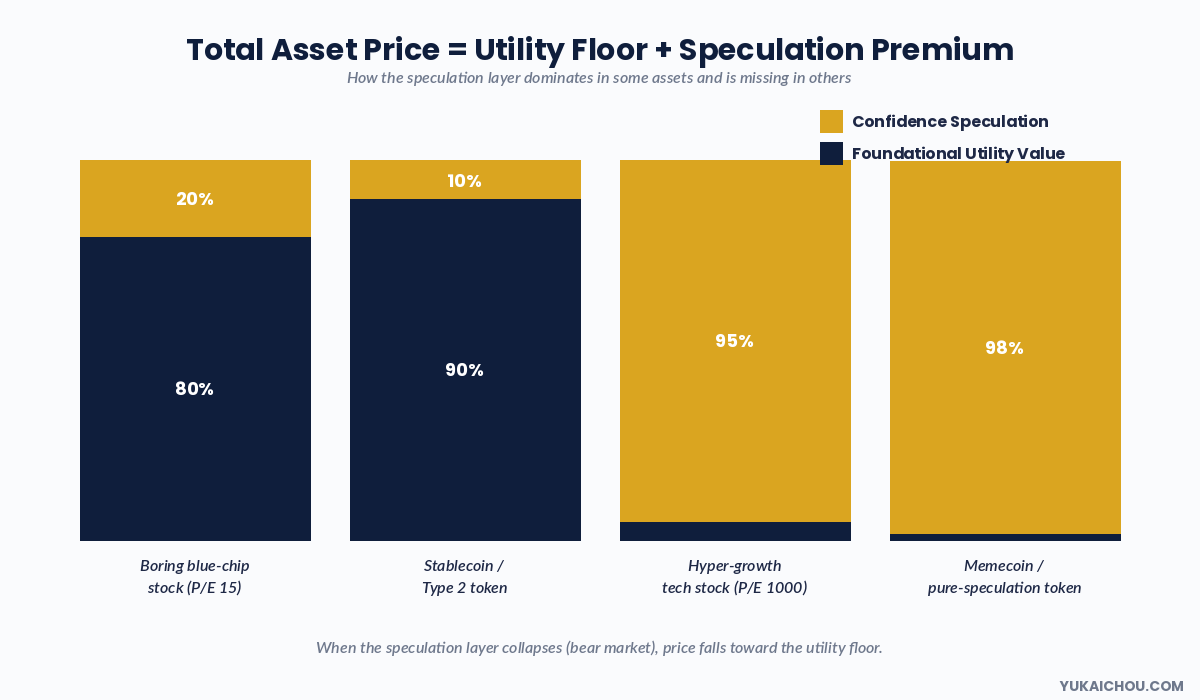
- Every token’s price equals Foundational Utility Value plus Confidence Speculation. In bear markets the speculation evaporates first; the utility is what’s left standing.
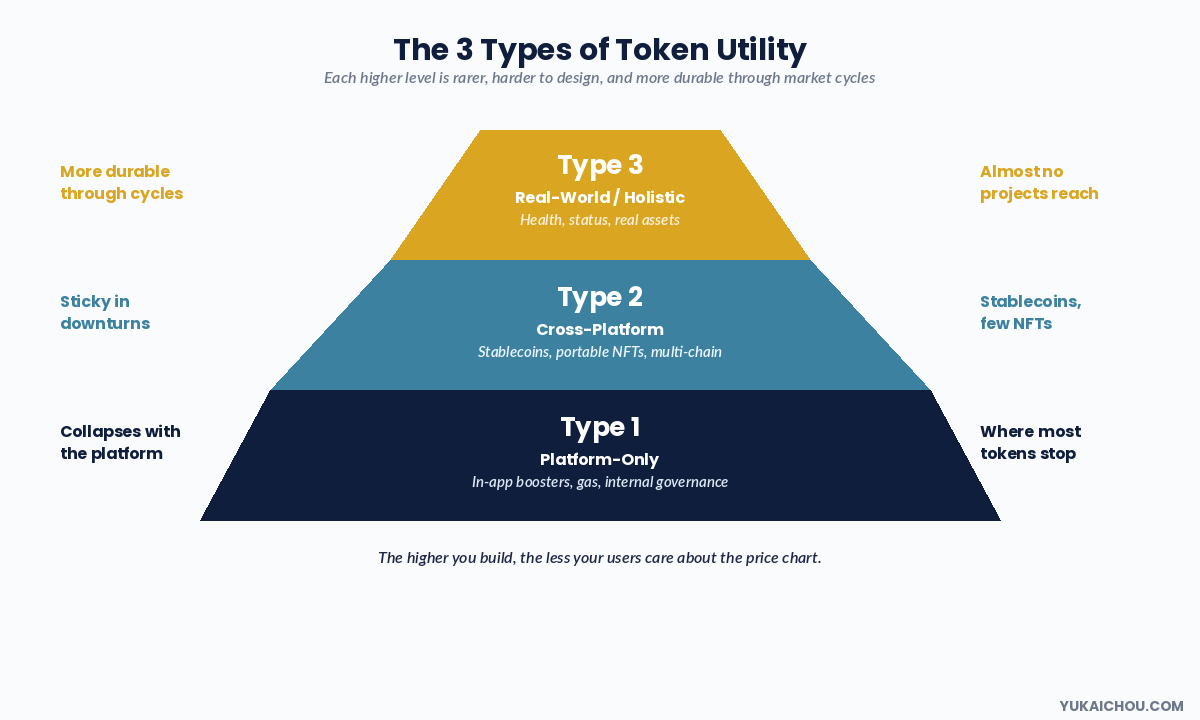
- Token utility comes in three types. Type 1 is platform-only (“I can spend this in the app”). Type 2 works across ecosystems. Type 3 creates real-world or holistic value the token holder enjoys regardless of price.
- The True Utility Price Test: what would users pay if they knew they could never resell? That number is your floor. Everything above it is hope.
- “Deflationary” is the most abused word in Web3. Almost no token actually shrinks in supply. Most teams mean “we expect demand to grow faster than issuance,” and that is a marketing claim, not a design property.
- Liquidity and purchasability are not the same thing. Plenty of healthy economies block resale on purpose. The collapse risk shows up when you offer liquidity without enough Type 3 utility to anchor it.
Table of Contents
Author Credibility: Yu-kai Chou

Yu-kai Chou is an S-Tier Behavioral Designer and the creator of the Octalysis Framework, the gamification design system now applied to products and experiences reaching over 1.5 billion users. His book Actionable Gamification is one of the most-cited works in the field, and he has been ranked the #1 Gamification Guru in the World.
He has advised MrBeast, LEGO, Microsoft, Porsche, Tesla, Stanford, Harvard, and governments including Ukraine on turning behavioral psychology into product mechanics that actually change user behavior.
Verify: Wikipedia · Google Scholar · Wikidata · LinkedIn
Why this post specifically. I have been doing economy and tokenomics design for over a decade. First inside game studios, then as an advisor to Web3 projects including Metablox, BLOOM, and several token launches I’m not allowed to name. The same mistake shows up again and again: founders confusing a token that can be sold with a token that has value. The framework below is the lens I run every project through before I let them ship a single contract.
Note on terminology: In the Octalysis Framework, human motivation is broken down into 8 Core Drives (CDs). We use shorthand like CD2 for Core Drive 2 to refer to these specific motivational levers.
Every Asset’s Price Is Two Numbers Stacked
Before we get into tokens specifically, you need a mental model that applies to every asset on earth, from a Manhattan condo to an ETH wallet to a baseball card.
The price of any asset is the sum of two distinct quantities:
Foundational Utility Value: what the thing is actually worth to someone who plans to use it and never resell it.
Confidence Speculation: what the next buyer will pay you above that, because they believe the next buyer after them will pay even more.
That is it. Every dollar of price is one of those two things. When I say it like that it sounds obvious, but the implications are uncomfortable, because in good markets the speculation layer can be ten or twenty times bigger than the utility layer, and most owners never notice.
Look at stocks. A normal mature company trades at a P/E ratio somewhere around fifteen, meaning if you bought the entire company, it would take roughly fifteen years of earnings to get your money back. Then you have a company trading at a P/E of one thousand. There is no honest way to read that as “I’m being paid back from earnings.” That price is almost entirely a bet that this company will dominate its category in ten years and current earnings are irrelevant. The earnings are the utility floor. The other 95% of the price is confidence speculation.
This is not me criticizing speculation. Speculation is how new things get funded. Without it, no early-stage company would have capital to grow. The danger is not that the speculation layer exists. The danger is forgetting that it exists, and assuming a price is “real” when most of it is a vote on the future.
The dot-com bubble is the cleanest example. In 2000, internet companies were priced at billions. By 2002 most of them had collapsed 90%+. The story we tell is “the internet was overvalued.” But the internet itself wasn’t overvalued. The internet was, if anything, undervalued. Amazon, Google, and the entire e-commerce ecosystem ate the world over the next twenty years. What collapsed in 2002 was the speculation premium, not the foundational utility. Pets.com died because it had no foundational utility. Amazon dropped from around $113 at its 1999 peak to under $6 in late 2001, then went on to become a multi-trillion-dollar company because the foundational utility was real, even when the speculation evaporated.
Crypto is running the exact same playbook on a faster clock. Every token that “moons” is mostly speculation. Every token that survives the next bear market is one with a real foundational utility floor.
The Three Types of Token Utility
Once you accept that price has a utility layer and a speculation layer, the obvious next question is: what counts as utility?
I break token and NFT utility into three types. They form a hierarchy. Each higher level is harder to design and rarer in practice. Each higher level is what protects users from caring whether the price chart is green or red on any given Tuesday.
Type 1 — Platform Utility
The token does something inside the issuer’s own platform. You can spend it on boosters, level up your character, unlock premium content, vote on a governance proposal that affects only this app, pay gas on this specific chain.
Most tokens stop here. Type 1 utility is fine, but it has a hidden weakness. It only matters as long as users want to keep using the platform. The moment the platform loses its grip, the utility evaporates and the price collapses to whatever the speculation layer will tolerate. Which, in a bear market, is approximately zero.
Most “utility tokens” launched in 2025-2026 are this. Memecoins technically don’t even have this. They have nothing to spend on. Pure speculation, no floor.
Type 2 — Cross-Platform Utility
The token works in more than one ecosystem. Maybe it’s accepted as payment across a network of partner apps. Maybe an NFT is portable into multiple games. Maybe a stablecoin is recognized as collateral by several DeFi protocols.
This is harder to design and much rarer than Type 1. The reason is structural. Getting any second platform to honor your token requires either economic alignment, a federation agreement, or open standards that you don’t fully control. But the moment you achieve it, your token’s utility floor goes up because it stops being held hostage to a single platform’s survival.
Stablecoins are the cleanest example. USDC’s utility doesn’t depend on Circle being your favorite company. It depends on dozens of exchanges, wallets, and DeFi protocols accepting it. That’s why stablecoin market caps are sticky in a downturn, because the cross-platform utility floor is real.
Type 3 — Real-World / Holistic Utility
This is the level almost no project reaches. The token creates value the holder enjoys regardless of any platform’s existence. Health benefits. Real-world status. Access to physical communities. Ownership of an income-producing real-world asset. A skill or relationship that wouldn’t exist without the token’s existence.
The cleanest case study is the original Move-to-Earn boom. StepN exploded in 2022. Users bought sneaker NFTs, walked daily, and earned tokens. Then the token economy collapsed, with GST falling roughly 98% within two months of peak and GMT falling more than 90% by year-end, and the speculative layer disintegrated. Yet a meaningful slice of users kept walking. Why? Because along the way they had built a daily exercise habit. They were healthier. The token had served as a launchpad for a Type 3 outcome (physical fitness), and that outcome didn’t require the token economy to keep functioning.
Helium Network is another case worth studying. Its token rewards people for running physical hotspots that provide LoRaWAN coverage to actual devices. The token price has been on a rollercoaster for years, but the underlying network of hotspots provides real-world wireless coverage that has utility independent of HNT’s market cap.
The pattern is the same: Type 3 utility insulates user motivation from speculation cycles. If your design depends entirely on Type 1 plus liquidity, you are fully exposed. The first time the market dips, your users disappear. If you have Type 3 in the mix, a slice of your users will stay even when the chart looks like a cliff edge.
This connects directly to Octalysis. Type 1 utility tends to lean on Core Drive 4 (Ownership & Possession) and Core Drive 7 (Unpredictability & Curiosity), built around the ownership of a token and the gamble of price action. Type 3 utility activates Core Drive 1 (Epic Meaning & Calling), Core Drive 2 (Development & Accomplishment), and Core Drive 5 (Social Influence & Relatedness). The first set is volatile and Black Hat-leaning. The second set is durable and White Hat-leaning. Tokens designed for short-term capture rely on the first. Tokens designed to outlast a cycle build the second.
The True Utility Price Test
Here is the diagnostic I run on every project I advise. It takes one sentence:
The true utility price of something is the price you would pay if you knew you could never sell it at a higher price to anyone else.
Apply this to a $1M Manhattan condo. Strip out the resale assumption. How much would you pay just for the right to live there for the rest of your life, knowing you can never recoup a dollar of it through sale? Maybe $200K. Maybe $400K. Whatever your honest number is, that is the foundational utility price. The other $600K-$800K is the bet that someone in the future will pay you more.
This isn’t an argument that the condo is overpriced. The owner might have very good reasons to think the resale premium is justified. The point is that the resale premium is a separate number from the utility number, and confusing the two is how people get destroyed in downturns.
Now apply the same test to a token. If your users knew they could never sell their tokens to anyone at any price, ever? How much would they pay to acquire one today? That is your token’s true utility price. Anything above it is speculation premium.
I have seen this question kill more dishonest tokenomics designs in five seconds than any technical audit. Founders who stammer when asked are giving you the answer. If the honest answer for your token is close to zero, your project is a momentum trade dressed up as a product. There’s nothing inherently wrong with running a momentum trade, but you should know that’s what you are doing, and you should not be surprised when the music stops.
The flip side is the upside. If your honest answer is meaningfully above zero, you have a foundation. The speculation layer can crash and your users will still want what you built. That is the only durable position a Web3 project can occupy.
The “Deflationary” Token Myth
Almost every Web3 pitch deck I get sent has the word “deflationary” in it. In 95% of cases, the word is being used wrong, and I think the misuse is doing real damage to the field’s credibility.
Here is what deflationary actually means. Day 1 has the most tokens that will ever exist. Every day after that has fewer. The supply curve only goes down. That’s it. That’s the definition. Almost nothing in crypto works this way.
What teams usually mean when they say “deflationary” is one of these:
“We have a burn mechanism.” Some percentage of transaction fees, or some percentage of platform revenue, gets used to buy back and burn tokens. Great. But if your protocol still mints new tokens through staking rewards, liquidity mining, or treasury vesting at a rate higher than the burn, you are net inflationary. The burn is performance art.
“Supply is capped.” Bitcoin’s 21-million cap is the canonical example. But Bitcoin’s actual supply in 2026 is still increasing, slowly, via the halvings, but still increasing. Permanently fixed supply doesn’t arrive until mining completes around 2140. Yu-kai’s framing on this is blunt: a cap that arrives 100 years out is “kicking the problem to the next generation.” It’s not wrong to have a cap. It’s wrong to call the asset deflationary today.
“Demand will outpace supply growth.” This is the most common one and it is the most slippery. It’s not a property of the token. It’s a forecast about market behavior. “Demand will outpace supply” is identical to “the price will go up because we expect more buyers than sellers.” Every project that has ever launched has predicted that. Most have been wrong.
If you are a designer, my ask is simple: stop letting the word “deflationary” do work in your pitch that it cannot honestly do. If your supply only ever shrinks, say so and prove it. If your burn rate exceeds your mint rate, show the math with assumptions stated. Otherwise, drop the word and describe what your token actually does. The audience that matters can tell the difference, and the audience that can’t is going to be the first to leave when they figure it out.
Purchasability Is Not Liquidity
Here is a distinction that solves a surprising number of design arguments.
Purchasability is the ability for users to buy something with money. Liquidity is the ability for users to sell something for money. They are completely separate mechanisms, and most designers conflate them.
Plenty of healthy economies allow purchasability without liquidity. Almost every mobile game on earth lets you buy gems with real money. Almost none of them let you sell gems back. League of Legends skins, Genshin Impact characters, Clash Royale gem chests are all purchasable, none are officially liquid. And these are some of the most profitable digital economies ever built.
What happens when you block official liquidity? A black market forms. eBay used to have an entire economy of people selling World of Warcraft gold and Diablo II items for real money. Riot Games and Blizzard didn’t sanction it, but the demand was real, so the market existed anyway. Smart economy designers acknowledge this and design around it. They make official accounts non-transferable, they ban accounts caught buying, they make the friction of black-market trading high enough that most users don’t bother.
Web3 inverted this default. Most token economies launch with full liquidity baked in from day one. Anyone can buy, anyone can sell, the price is public, and the market is global. This isn’t inherently bad, but it amplifies the speculation layer enormously, because every holder is constantly aware of price, and every price move is a referendum on whether to stay or exit.
If you are designing a token, the liquidity question deserves a real answer rather than a default. Some questions worth sitting with:
Does my token need to be tradeable on the open market on day one? What would I lose if I gated liquidity behind a vesting schedule, a reputation tier, or a real-world identity check? Could I keep purchasability open while restricting resale, and would that change the kind of holder I attract?
The teams that ask these questions before launch end up with healthier holder bases. The teams that just turn on liquidity by default end up with mercenaries.
A Design Checklist for Real Tokenomics
If you want to put this framework to work, here is the test I run with every team I advise. Do this before you mint a single contract.
1. What type of utility does my token have? Be precise. Not “Type 1 with a path to Type 2.” Type 1 today, period. If you have aspirations to Type 2 or 3, write down what specifically has to happen for that to be real. Then ask whether you actually control any of those things.
2. What is my token’s true utility price? If users could never resell at a higher price, what would they honestly pay? Don’t answer this in your own head. Ask five users you don’t know. The number they give you is the floor. Anything above that is hope.
3. Where is the gap between price and utility floor coming from? Is it from foundational growth in the platform’s value? From hype? From influencer marketing? From the mechanical structure of supply? Each source of the gap has a different lifespan. Hype lasts months. Mechanical scarcity can last years. Foundational growth can last decades.
4. Am I using “deflationary” honestly? If your supply isn’t actually shrinking, drop the word. Replace it with a description of what your token actually does. The trust you save is worth more than the marketing pop.
5. Is liquidity a feature or a default? If you turned on liquidity because every other token has it, you didn’t design a feature. You inherited a default. Decide what you would lose by gating it, and only then keep it open if the answer is “too much.”
6. What happens to my user motivation when the token drops 80%? Run the thought experiment. Do users still log in? Do they still complete the daily action? Do they still feel the platform is worth their time? If the only thing keeping them active is the token going up, you are not building a product. You are running a casino with a roadmap.
This is the bar I hold every project to before I’ll attach my name to it. Most fail. The ones that pass tend to be the ones I’m still proud of three years later.
If you want to go deeper on the structural side (sources of currency inflow, sinks for outflow, and the confidence layer that surrounds them), that mechanical design lives in my full Economy Design framework. The piece you just read is the upstream filter. It tells you whether the token deserves to exist at all. The economy framework tells you how to keep it healthy once it does.
If you want help applying this lens to your own project, the lens itself is part of the deeper Web3 and behavioral design curriculum inside Octalysis Prime, where I work through token, NFT, and economy designs in live sessions with the community.
Frequently Asked Questions
What is the difference between Type 1, Type 2, and Type 3 token utility?
Type 1 utility means the token does something inside one platform: buying boosters, paying gas, or voting on internal governance. Type 2 means the token works across multiple platforms, like a stablecoin accepted by many DeFi protocols. Type 3 means the token creates real-world or holistic value the holder enjoys regardless of price, like physical fitness, real-world community access, ownership of an income-producing asset. Type 3 is the rarest and the only one that meaningfully insulates users from price crashes.
What is the True Utility Price Test?
The True Utility Price Test asks: what would your users pay for the token if they knew they could never resell it to anyone at any price? That number is your token’s foundational utility floor. Everything above it is speculation premium. If the honest answer is close to zero, your project is a momentum trade rather than a product.
Is “deflationary” tokenomics real?
Almost never in the strict sense. True deflation means total token supply shrinks every day forever, meaning Day 1 has the most tokens that will ever exist. Most projects use “deflationary” to mean “we have a burn mechanism” or “we expect demand to grow faster than supply,” which is a marketing claim rather than a structural property. Bitcoin has a fixed cap but is still net-issuing in 2026.
Why do healthy game economies block liquidity?
Most successful mobile and console games allow purchasability (buy gems with cash) but not liquidity (sell gems back). Blocking official liquidity reduces speculation, keeps the economy stable, and protects whales and casual players from each other. Black markets emerge anyway, but designers can make them inconvenient enough that most users stay in the official system.
How does this connect to Octalysis?
Type 1 utility tends to activate Core Drive 4 (Ownership & Possession) and Core Drive 7 (Unpredictability & Curiosity), both leaning Black Hat and short-term. Type 3 utility activates Core Drive 1 (Epic Meaning & Calling), Core Drive 2 (Development & Accomplishment), and Core Drive 5 (Social Influence & Relatedness), all leaning White Hat and durable. Tokens that survive cycles tend to be designed around the second set.
Related Reading
- Economy Design: Sources, Sinks & the Confidence Framework: the full mechanical model for currency inflows, outflows, and confidence layers.
- The Economy Framework That Explains Axie Infinity‘s Collapse: case study of what happens when Type 3 utility is missing.
- Why Do Smart People Buy High and Sell Low?: the psychology that drives speculation cycles.
- The Convergence of Ecommerce & Web3 Gaming: BLOOM: applied case study of cross-platform utility design.
- The Octalysis Framework: the full behavioral design system underneath all of this.