
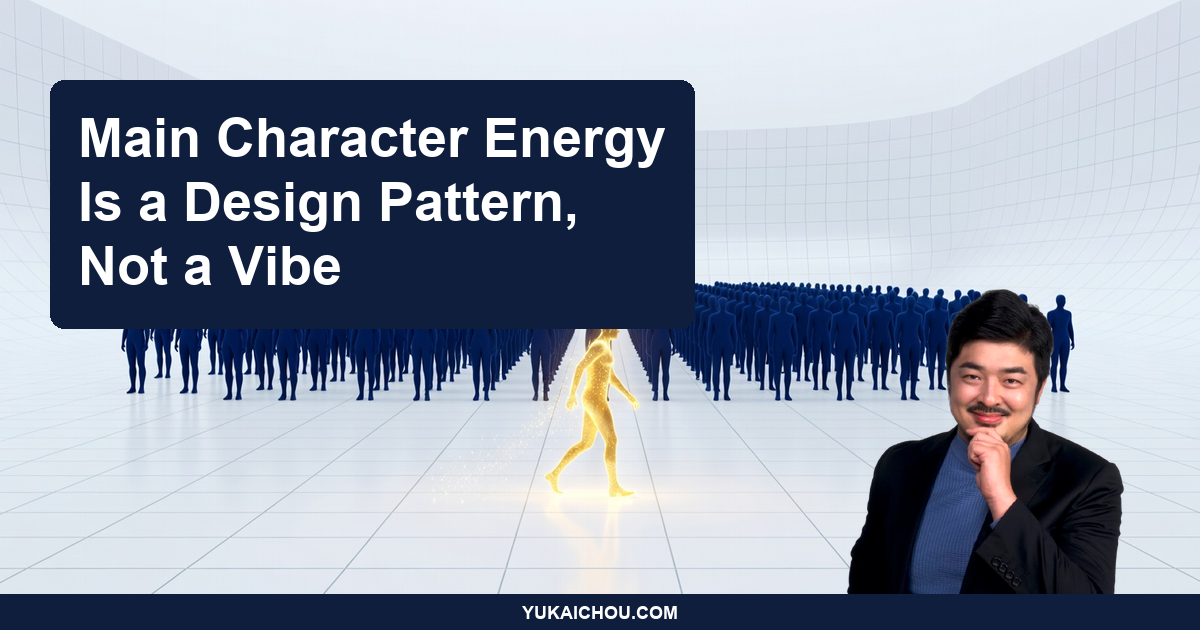

The internet decided “main character energy” was a vibe. A swagger. A way of dressing. A confidence aesthetic you either had or you didn’t.
That’s not what it is.
Main character energy is a design pattern. It’s a specific, repeatable architecture for how you orient your daily decisions, and the absence of it is the reason most people will give the same answer to “what’s new?” five years from now as they gave you last Tuesday.
I’ve spent two decades building the Octalysis Framework for clients like Microsoft, LEGO, Coca-Cola, and most recently the team running MrBeast’s behind-the-scenes operation. The thing that keeps showing up across product design, education, and even how we structure our own lives is that engagement isn’t a personality trait. It’s a system. And the same system that makes a good video game compulsive can be wired into how you live a Tuesday.
So I want to take “main character energy” out of the aesthetic bucket and put it back where it belongs: as the output of a specific identity design that you can run on yourself starting today.
⚡ Speed Run Notes
- The fastest diagnostic for NPC mode: ask someone “what’s new?” and listen for the phrase “same old, same old.”
- NPCs follow a script and react. Main characters run a quest and choose. The split isn’t talent. It’s orientation.
- Three behavioral tells of the victim variant: chronic complaining, prepackaged excuses, externalized blame. All three feel like analysis. None of them is a strategy.
- The control hack is responsibility at three ascending levels: what you do, what you avoid doing, and how you respond to what you didn’t choose.
- You can already plan a 50-level RPG character. The trick is realizing your real life uses the same toolkit.
Table of Contents
- The “Same Old, Same Old” Test
- Why Your Crocodile Brain Picks NPC Mode
- The Three Tells of a Victim NPC
- The Three Levels of Responsibility
- From Goal to Quest: The Translation Layer
- The Six-Step Real Life RPG System
- Elon as the Structural Example
- Why You Can Plan a Game Character But Not Your Life
- The Permission Clause
- FAQ
Author Credibility: Yu-kai Chou

I’m Yu-kai Chou. I created the Octalysis Framework in 2003 and have spent the years since applying it to products at Google, LEGO, Microsoft, Porsche, Coca-Cola, the World Bank, and (most relevant here) to the literal mechanics of how human motivation is engineered inside games people can’t stop playing.
That second piece is why I keep coming back to the NPC question. I wrote a whole book about it called 10,000 Hours of Play, a life-design playbook structured the way an RPG is structured, because the cognitive grammar of “stats, quests, allies, levels” is something almost everyone already speaks fluently. Most people just never thought to point it at themselves.
This post is the upstream version of the question. It’s the identity decision that has to happen before you ever pick a class, build a skill tree, or recruit your party.
The “Same Old, Same Old” Test
Here’s the diagnostic I run on people in conversation, usually without telling them I’m running it.
You bump into someone you haven’t seen for six months. You ask “what’s new with you?” Their answer falls into one of two buckets.
Bucket A: “Oh, you know. Same old, same old. Work’s work. Kids are kids. Nothing crazy.”
Bucket B: “Actually, I just shipped my first prototype. I started learning Cantonese because my partner’s family. I quit the job and I’m two months into figuring out the next thing.”
Bucket A people are in NPC mode. Not because their lives are bad. Often they’re materially better off than the Bucket B people. House paid down. Kids healthy. Job stable. Externally, the report card looks fine.
What’s missing is internal motion. The story isn’t progressing. The character sheet didn’t change. If you ran into them again in a year, you’d get the same answer, and if you ran into them in five years you’d still get the same answer.
Bucket B people might be poorer, more stressed, sleeping less. But the story is alive. Something happened. Something is becoming. They’re playing a game.
And here is the part I want you to actually sit with: this isn’t about which bucket is better. Some people honestly belong in Bucket A and are happy there. The diagnostic isn’t a verdict. It’s just a mirror, so you know which game you’re currently playing and so you can decide whether you chose it.
Most people in Bucket A didn’t choose it. They drifted into it.
Why Your Crocodile Brain Picks NPC Mode
System 1, the fast, automatic, evolutionarily ancient part of your brain that I call the crocodile brain, strongly prefers NPC mode. It’s safe. It’s predictable. The energy cost is minimal.
An NPC, in the original game-design sense, is the blacksmith who stands in the same square of the same village forever, says the same line of dialogue every time you talk to him, and never wonders why he’s there. That structure is enormously efficient. It uses almost no compute. The blacksmith never has to deal with rejection, ambiguity, or failure.
Apply that to a human and the cost is invisible at first. The 22-year-old version of an NPC life looks identical to a Main Character life. Both involve waking up, working, paying rent, dating, watching shows.
The difference compounds slowly, and then all at once. By 35, the Main Character has shipped three things, started a company, joined a community that didn’t exist when they got there, and developed a couple of skills nobody asked them to develop. The NPC has gotten a few raises and renewed the lease.
What the crocodile brain saved on energy, the prefrontal cortex eventually pays for in regret. Core Drive 1 — Epic Meaning & Calling goes hungry. There’s no story to point at. No cause being served. No quest log with anything in progress.
That hunger is what most people interpret as a midlife crisis, when in fact it’s a Core Drive deficiency that’s been accumulating quietly since their early twenties.
The Three Tells of a Victim NPC
Not every NPC is the same. There’s a content-and-quiet variant who’s just running a small life on autopilot, and there’s a louder, harder-to-be-around variant I call the Victim NPC.
The Victim NPC isn’t quietly stuck. They’re actively constructing a story about why they have no choice. And there are three behavioral tells.
Tell #1: Chronic complaining. Skyrim has this villager you meet who tells you “the dragons have destroyed everything!” and then she keeps standing in the same broken doorway, telling every passing player the same line. She is not, at any point, picking up a hammer. The complaint is the entire identity. In real life this looks like the colleague who has explained the failures of management to you fourteen times this quarter without ever updating their resume or proposing a fix.
Tell #2: Prepackaged excuses. “I don’t have time.” “I don’t have money.” “I don’t have the right background.” Every one of these is technically true for somebody. None of them survive contact with someone who wants the thing more than they want the excuse. There are people busier than you who are in better shape than you. There are people who started with less than you who have built more than you. The math of what’s possible is less about absolute resources and more about efficiency with whatever resources are present.
Tell #3: Externalized blame. “If my parents had supported me.” “If the economy weren’t broken.” “If my boss weren’t toxic.” These statements might all be factually accurate. The problem isn’t accuracy. The problem is that none of them is an actionable input for you. Blame relocates the steering wheel out of your car. You can describe the road perfectly and still arrive nowhere.
I want to be careful here, because complaints, constraints, and unfair circumstances are real. Naming a Victim NPC pattern isn’t the same as denying that the world is sometimes legitimately unfair to specific people. The diagnostic isn’t “your problems aren’t real.” It’s “your problems aren’t a strategy.”
The Three Levels of Responsibility

If complaining, excusing, and blaming are the symptoms, what’s the cure?
It’s a three-level practice of responsibility. A control hack I’ve watched move people from passenger to driver more reliably than anything else in my coaching work.
Level 1: Be responsible for what you DO. You control your actions like a player controls their character on the screen. The Victim NPC says “traffic made me late to the interview.” The Main Character says “I underestimated travel time. Next interview I leave an hour earlier.” Same external event. Two completely different control loops.
Level 2: Be responsible for what you DON’T do. This is where most people stop, because Level 2 is where the ego starts to flinch. The 41-year-old with a back problem can either say “everyone my age has back problems” or “I didn’t prioritize movement for fifteen years and now I’m paying the bill.” The failed business partnership can be “they were unreasonable” or “I avoided the hard conversation for nine months and the silence finally exploded.” Skipped quests in an RPG don’t just disappear. Your character stays underleveled. Real life works the same way, except the consequences are slower and harder to trace.
Level 3: Be responsible for HOW YOU RESPOND. You can’t control unexpected events. You can control your move. The seasoned player doesn’t panic when the boss does something unexpected. They read it, recalibrate, and turn the unexpected into setup.
During COVID, two restaurant owners I know got hit with the same dining-room shutdown. One said “the government ruined my business.” The other restructured around delivery, opened two new locations in delivery-dense neighborhoods, and came out of 2022 with more revenue than he’d had in 2019. Different decision tree. Different outcome. Same external event.
You don’t get to skip Level 1 to perform Level 3. The levels stack. But the practice is available to start at any point in your life. This is the actual game, and the controller has been in your hands the whole time.
From Goal to Quest: The Translation Layer
Here’s the trap that catches almost everyone who tries to switch from NPC to Main Character: they upgrade their desire without upgrading their structure.
“I want a better career.” “I want to get in shape.” “I want to start a business.” These are goals. Goals are NPC fuel. They don’t move anything by themselves because they have no edges, no stakes, no calendar.
What converts a goal into motion is a quest. And a quest has four properties that a goal doesn’t:
It’s specific: you can describe the finish line in one sentence. It’s bounded: there’s a start and there’s an end. It has real stakes: failing it costs you something. And it’s nested inside a larger story: completing it actually moves you toward something you care about.
Watch the difference:
Goal: “I want a better career.”
Quest: “Over the next 90 days, I will spend eight hours a week learning Python, ship three portfolio projects, and do interviews with five companies. If I haven’t gotten a written offer by Day 91, I’ll do a structured retro and pick the next quest.”
The first sentence is a wish. The second sentence is a piece of software you can run. The Main Character is just someone who has learned to translate every wish into something runnable.
I’ve gone deeper on this in the Two-Quest Rule, which is the operational discipline that keeps quests from blurring back into goals. It answers the next question this section raises naturally: what happens when you stack so many quests at once that you stop being able to ship any of them, which is the second-most-common failure mode I see in coaching after never starting at all.
The Six-Step Real Life RPG System

If you accept the translation layer, the next question is structural: how do you actually build a Main Character version of yourself? Not metaphorically. Operationally.
I’ve broken this into a six-step system that I teach as the spine of 10,000 Hours of Play. Each step is its own decision point, and each one has a corresponding RPG mechanic that already lives in your head.
Step 1: Choose your game. You don’t get to be good at every industry, every cause, every problem space. You pick the arena. Step 1 of the framework walks through the mission-finding process; the short version is that the right game is one where the work feels like play even when the rewards are slow.
Step 2: Pick your role. Inside that arena, are you the builder, the connector, the teacher, the strategist, the operator? Roles aren’t fixed forever, but at any given chapter of your life one role should be load-bearing. The mistake is being a generalist when the situation needs a specialist, or vice versa.
Step 3: Understand your stats. Your stats are your DNA-level talents. They’re the things that show up effortlessly when you’re engaged. They are not the things you wish you had. They are the things people thank you for that you don’t even notice doing. Map them honestly. Don’t try to level a stat that isn’t yours.
Step 4: Build synergistic skills. Random skills scatter. Synergistic skills compound. If you’re a writer, learn enough design that you can lay out your own essays. If you’re an engineer, learn enough psychology that your products move people. The combinations are where unfair advantages live.
Step 5: Find your allies. No one solos the endgame. Step 5 is about recruiting your party: mentors who’ve walked the path, peers at your level, and people who believe in the mission before there’s evidence. The wrong party makes great stats useless. The right party makes mediocre stats deadly.
Step 6: Complete quests. Step 6 is execution. Vision is decorative until you start clearing milestones. “Build a company that serves a million customers in five years” is decorative. “Get the first ten paying customers in 90 days” is playable. The gap between those two sentences is the gap between aspiration and Main Character energy.
The system is sequential because each step de-risks the next. People who skip ahead, picking a role before choosing a game or recruiting allies before knowing their stats, end up grinding the wrong content for years.
Elon as the Structural Example
I want to use Elon Musk here, but not as the aspirational figure he gets used as in business books. I want him as a structural example, because regardless of what you think of him politically, the architecture of how he became Elon is unusually visible and unusually instructive.
The kid version of Elon, in Pretoria, was a bullied bookworm in a culture that valued physical strength. By any external measure he was a prototypical Bucket A NPC. Small, awkward, picked on, no agency in his environment.
The shift happened in three structural moves, and they map onto the framework cleanly.
First, he found a game. Reading The Hitchhiker’s Guide to the Galaxy as a teenager gave him the question “what’s a worthy problem at the species level?” That question became his arena.
Second, he defined a quest. “Preserve human consciousness in the universe” is huge and ridiculous, but importantly it’s bounded enough to derive concrete sub-quests from: get to Mars, decarbonize ground transport, build a payments rail.
Third, he started playing. He left South Africa, learned to code, founded Zip2, and then, in the part most success stories quietly skip, he kept playing after he won. Selling Zip2 for $300M would have ended the game for almost anyone. He used the money as a power-up, not a retirement.
That third move is the one I want you to notice. The reason he’s still building rockets in his fifties isn’t ambition in the conventional sense. It’s that the original game was never a money game. The win condition was structural, not financial, and the structural win condition still hasn’t been hit. So he’s still on the quest.
You don’t have to like the man to study the architecture. The architecture is what’s transferable.
Why You Can Plan a Game Character But Not Your Life
Here’s a paradox I’ve watched in workshop after workshop, with engineers and CEOs and college students alike.
The same person who tells me “I have no idea what I want from life” can spend four hours optimizing a level-12 multiclass character build in Baldur’s Gate 3. They will min-max the stats. They will pick synergistic feats. They will sketch a multiclass path that won’t pay off for thirty hours of gameplay. And they will do this with delight.
If I take that same person and ask them to spend the same four hours mapping their actual stats and a five-year skill tree for themselves, the room temperature drops. Suddenly the exercise is “too abstract” or “too pressured” or “I don’t know enough yet.”
The toolkit is identical. Stats, roles, skill trees, quests, allies, levels. The categories transfer one-to-one. So what’s actually changing?
The seriousness is changing. Planning a fictional character is play. Planning yourself feels like commitment, because the stakes are real and the consequences are public.
The fix isn’t “take it less seriously.” The fix is to recognize that you already have the cognitive fluency for this exercise. You’re not learning a new skill. You’re aiming an existing skill at a different target, and once that becomes a felt truth instead of a clever sentence, the emotional weight that made the exercise feel paralyzing starts releasing on its own.
The Permission Clause
One last thing, and it’s the part of this framework I get the most pushback for skipping when people repeat it secondhand.
This is not a moral judgment.
If you read all of the above and your honest reaction is “I actually want a quiet, predictable, small life and I’m at peace with that” — that’s fantastic. NPC mode chosen consciously is a perfectly good way to live. Some of the most contented people I know have made exactly that choice. The framework is not telling you to want more.
The framework is just a mirror. It’s saying: if you’ve been feeling stuck, and if the stuckness comes with a low-grade hum of “is this it?”, then the architecture above is what’s missing. You’re not broken. You’re just running an operating system that was optimized for safety, on a body that was actually built for quests.
Most people in Bucket A never realize Bucket B is an option. The point of writing this is to make sure you at least see the menu. The choice itself is yours.
Ready to design your Main Character life?
The full operational version of this framework (worksheets, case studies, and the deeper Octalysis mapping for each of the six steps) lives in my book. If you want to start lighter, the upstream Octalysis Framework is the engine underneath every Core Drive call I made above, and the sibling drilldown on Content NPC vs. Victim NPC sharpens the diagnostic.
FAQ
Is “main character energy” the same as narcissism?
No, and the conflation does real damage. Narcissism is a self-importance pattern that depends on others as supporting cast. Main character energy is a self-authorship pattern that’s compatible with treating others as also being the protagonists of their own stories. The difference shows up in how you behave when no one is watching: the narcissist deflates, the Main Character keeps building.
What if I have no idea what game I want to play?
That’s the most common starting state, not a disqualifier. Step 1 of the system isn’t “instantly know your mission.” It’s a structured exploration phase. Try things, run small experiments, notice what energizes you versus what drains you. The mission usually emerges from data, not from introspection alone.
How long does the shift from NPC to Main Character actually take?
The identity shift can happen in a single conversation. The moment you see the framework, you can’t unsee it. The behavioral shift is slower, usually 90 to 180 days of running concrete quests before the new identity feels stable. The compound payoff takes years. The reason most people quit is they expected the timeline to look like the identity shift instead of like the compound curve.
Does this framework work for people in tightly constrained circumstances?
Yes, but the quests look different. Someone managing chronic illness, raising kids alone, or in financial survival mode isn’t choosing between Mars colonization and a quiet life. They’re choosing between being a Victim NPC inside their constraints and being a Main Character inside their constraints. The 6-step system scales down. The choice point is the same.
How does this connect to the Octalysis Framework?
NPC mode is what happens when Core Drive 1 (Epic Meaning), Core Drive 2 (Development & Accomplishment), and Core Drive 3 (Empowerment of Creativity & Feedback) are all running on empty. Main Character energy is what those three drives feel like from the inside when they’re activated together. The framework is the diagnostic. Octalysis is the engineering layer underneath it.
Where to Go From Here
If this framework landed and you want the operational version, I wrote 10,000 Hours of Play as the full playbook for designing a Main Character life. The book walks through each of the six steps with worksheets, case studies, and the deeper Octalysis mapping.
If you want to start lighter, the related drilldown on the two NPC sub-types is Content NPC or Victim NPC: Which Kind of Stuck Are You?. Useful for diagnosing which version of stuck you’re currently sitting in.
And the canonical reference for the engine underneath it all (the eight Core Drives that decide whether your daily life feels like a game or a queue) is the Octalysis Framework.
The question I’ll leave you with is the one I opened with, just with sharper edges:
Six months from now, when somebody asks “what’s new with you?”, what will the honest answer be?
If the answer is “same old, same old,” that’s data. Use it.