
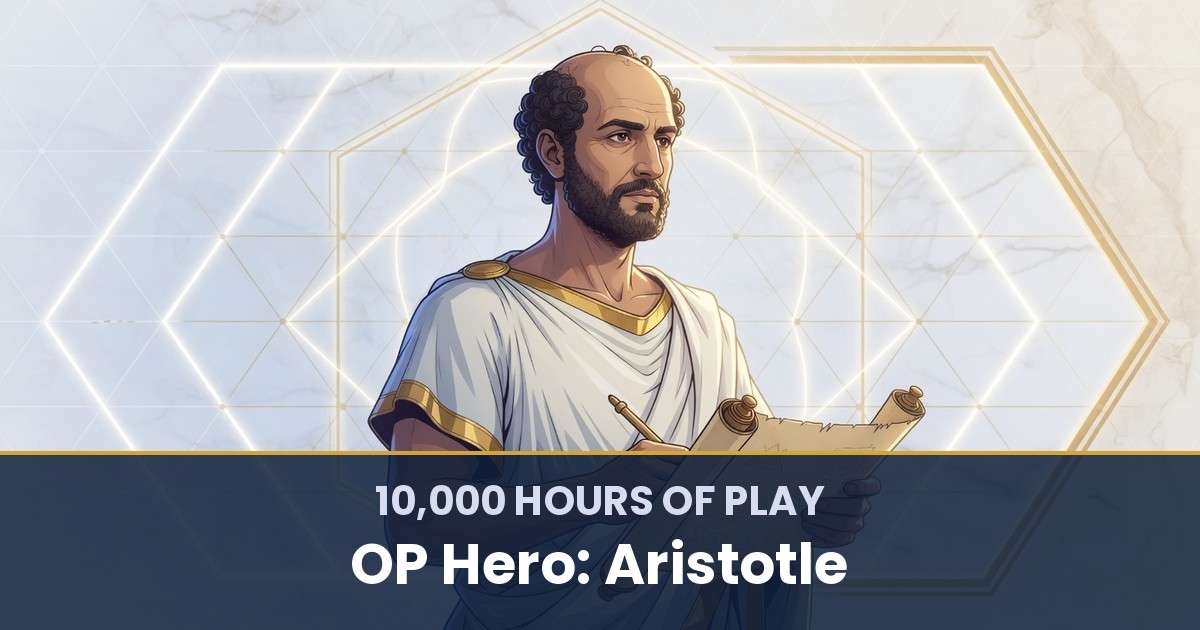
10,000 Hours of Play by OP Hero: Aristotle
A 17-year-old from Stagira walked into Plato's Academy and stayed 20 years. The next 25 he spent inventing how we think. Aristotle's 10,000 Hours of Play OP Hero profile.


In 367 BCE, a seventeen-year-old from a small Greek town called Stagira walked into Plato’s Academy in Athens and stayed for the next twenty years. Twenty years. The bright kid in the room became the senior researcher, then the most obvious successor when the founder died, and then the Academy passed him over.
That moment, age 37, with the highest seat in Greek philosophy handed to someone else, would have ended most careers. Aristotle treated it as a level transition.
What he did next reshaped the next two thousand years of how humans think. Logic, biology, ethics, politics, physics, poetics: he did not just write about them. He invented the categories we still use to write about them. The framework you read every business book through, the syllogism you reason with, the idea that a thing has a purpose and you can ask what it is for: that is all his.
If you treat your life as the most important game you’ll ever play, Aristotle’s run is a master class in what a five-decade build looks like when one person decides to map an entire territory of reality and keeps building after the obvious career door slams shut.
⚡ Speed Run Notes
- Aristotle’s life-game was one quest with a sixty-year time horizon: map all of reality (nature, the soul, the human good) into a single coherent system of knowledge.
- He spent 20 years at Plato’s Academy as a student-then-peer (367 to 347 BCE), got passed over for succession, and used the rejection as a fork in the road rather than a wall.
- From 347 to 343 BCE he ran a field-research arc in Assos and Lesbos, producing the first serious comparative zoology in Western history.
- From 343 BCE he tutored a thirteen-year-old named Alexander, which gave him both a network and (per ancient tradition) a steady supply of specimens once Alexander started conquering things.
- In 335 BCE he founded the Lyceum as a coordinated research institute, not just a school. Closer to a startup than to a salon.
- The skill he kept reaching for was reframing controversy as a puzzle: dialectic over polemic, classification over argument, “what is this for” over “what is this like.”
Table of Contents
- Step 1: The Game — What Aristotle Was Actually Playing
- Step 2: Attributes — The Innate Stats
- Step 3: Role(s) — The Character Class Across Chapters
- Step 4: Skills — The Real-Life Game Skills Aristotle Mastered
- Step 5: Allies — The People Who Multiplied Aristotle
- Step 6: Quests — The Milestones That Shaped the Saga
- What You Can Steal From Aristotle’s Build
- Where this framework comes from
- Related Reading
About Yu-kai Chou

Yu-kai Chou is the author of 10,000 Hours of Play, the book that treats your life as the most important game you’ll ever build a character in, and gives you the 6-Step framework (Game · Attributes · Role · Skills · Allies · Quests) to play it on purpose. He has spent two decades developing the system through which this post analyzes its OP Hero, and applies it to his own life and to the lives of the people he advises around the world.
Chou’s other framework, the Octalysis Framework, has been applied by LEGO, Microsoft, Porsche, Coca-Cola, Salesforce, and MrBeast, impacting over 1.5 Billion Users. He has taught the methodology at Harvard, Stanford, Yale, Tesla, Google, BCG, and IDEO, and has advised governments in eight nations including Ukraine, the United Kingdom, the Kingdom of Bahrain, Singapore, Taiwan, the Netherlands, Kazakhstan, and South Korea.
His work has been cited by Harvard, Stanford, MIT, Forbes, Wall Street Journal, Wired, US Department of Energy, NIST, NSF, NCBI, US Department of Education, ClinicalTrials.gov, and Google Scholar — with 3,700+ more academic publications. Explore his books here.
Aristotle is the OP Hero I quietly study whenever a project I’m running starts to feel too big. Most ambitious builds collapse because the operator confuses “I’m working hard” with “I’m building a system.” Aristotle’s life is the cleanest evidence I know that the move is the opposite. When a research arc gets sprawling, classify it harder, name its parts, and turn the chaos into a tree. That single trait, the instinct to taxonomize an unstructured field, is the lesson I lift from his build every single time.
Step 1: The Game — What Aristotle Was Actually Playing
Most lives play many small games in parallel. Aristotle played one large game for sixty years.
The game was this: build a single coherent system of knowledge that explains how the natural world works, how humans should live, and how anyone can reason correctly about either. He chased it from his late teens through his death at sixty-two, across moves, regime changes, and the loss of every major patron he ever had.
You can see the shape of the game in what he left behind. The surviving Aristotelian corpus runs to roughly twenty-three volumes in a standard Greek-English edition, and the table of contents reads like one person trying to claim every domain at once: logic, physics, biology, psychology, ethics, politics, rhetoric, metaphysics. He was not picking favorites. He was treating reality as a territory and trying to walk every square of it.
The pivot from “knowing many things” to “building a system that explains everything you know” is exactly the move the 6-Step framework is built to expose. Aristotle did not have hobbies. He had branches of the same tree. Ethics was the part of the tree that asked what humans were for. Biology was the part that asked what other living things were for. Logic was the soil the whole thing grew out of. One game, many surfaces.
His clearest statement of the game is in the Nicomachean Ethics: the human good is “activity of soul in accordance with reason,” and happiness is not a feeling but a flourishing across a whole life. Notice what is hidden in that sentence. To even ask what humans are for, you need a theory of what souls do, what reason is, and what counts as a “whole life.” His life-game was to build the theory.
Step 2: Attributes — The Innate Stats
Attributes are the stats your character ships with before any training kicks in. For Aristotle, five show up early and never fade.
Hyper-systemizing intellect. From his earliest surviving works, he is already classifying. Syllogisms by figure and mood. Animals by whether they have blood. Constitutions by who rules. Virtues by what they are the mean between. This is not a habit he learned in his thirties; it is the shape of the mind that walked into the Academy at seventeen. Treat it as a Talent Triangle Attribute, not a Skill. The same way Tiger Woods’s spatial sense was already there at four, Aristotle’s drive to taxonomize was already there at fifteen.
Empirical curiosity. Almost every other major philosopher of his generation worked in pure abstraction. Aristotle wanted to look. The biological treatises describe organs, reproduction, and behavior with the level of detail that only comes from someone who has actually opened the animal up. He did not just want to think correctly. He wanted to see for himself.
Conceptual courage. He spent twenty years inside the most prestigious intellectual institution in Greece and then publicly broke with its central doctrine. Plato’s separate Forms (the idea that “horseness” exists as an abstract entity independent of any actual horse) were the Academy’s load-bearing wall. Aristotle calmly rebuilt metaphysics around immanent forms instead. That is not contrarian aesthetics. That is the temperament of someone who weighs evidence over allegiance.
Pragmatic realism. His ethics refuse both fantasy and cynicism. Happiness needs virtue, but it also needs friends, health, and enough resources to live a decent life. His politics treats real Greek constitutions as data rather than ideal forms to be defended. Low tolerance for utopia, high tolerance for complexity. You can feel this in his prose: it does not soar, it works.
Didactic clarity. Even his technical books reach for the everyday example. Flute-players, builders, athletes, doctors. He cannot help teaching while he thinks. Every abstract idea gets pulled back down to a craft a reader can picture. The instinct to explain is in the bones.
Step 3: Role(s) — The Character Class Across Chapters
Aristotle is one of the rare OP Heroes whose Role changes cleanly four or five times over his life, with each transition serving the same underlying Game. If you scan the catalog of other OP Hero profiles, you’ll see most heroes hold their Role for decades. Aristotle reset his every seven to twenty years and kept the saga coherent anyway.
The Disciple-Scholar (c. 367 to 347 BCE). Twenty years at Plato’s Academy, from age seventeen to thirty-seven. Long enough to absorb every method the place had, and to outgrow them in public. He moved from student to peer to one of the obvious senior figures, and the years here are what gave him the conceptual vocabulary he would spend the next thirty re-engineering.
The Independent Field Researcher (c. 347 to 343 BCE). When Plato died and the Academy chose Speusippus over him, Aristotle did the unobvious thing. He left. He spent the next four years in Assos and Lesbos under the protection of Hermias of Atarneus, doing the kind of detailed marine biology nobody in the Greek tradition had attempted. This is the chapter where he stopped being “Plato’s student” and started being himself.
The Court Scholar (c. 343 to 340 BCE). Philip II of Macedon hired him to tutor a thirteen-year-old prince named Alexander. The Role here is interesting because it is not what most readers imagine. He was not a kingmaker. He was a teacher who happened to be near power, building the relationships and the resource base that would later fund the Lyceum.
The School Founder and Research Director (c. 335 to 323 BCE). The most original Role in the run. After returning to Athens, he set up the Lyceum, not as a salon, but as something closer to a coordinated research institute. His group jointly collected the constitutions of many Greek city-states. They jointly gathered biological data. The Peripatetics were not so much a school of thought as a research team with twelve years of accumulating data. Spend a beat on that: he invented the multi-author, multi-domain research lab.
The Exile (323 to 322 BCE). When Alexander died, anti-Macedonian feeling in Athens turned hot fast, and Aristotle was charged with impiety. He left for Chalcis in Euboea, by ancient tradition with the line about not letting Athens “sin twice against philosophy,” a deliberate echo of Socrates. He died there the next year, at about sixty-two. The Role at the end was the same as at the start: a man trying to keep working, in whatever environment would still let him.
Step 4: Skills — The Real-Life Game Skills Aristotle Mastered
Six canon Skills carry most of the weight in Aristotle’s build. Each one is the kind of trainable technique the Skills Spectrum would classify as a deep, transferable competency rather than a niche craft.
Cognitive Lens (Mage). The ability to zoom in on a detail and zoom out to the strategic picture without losing either. His doctrine of the four causes (material, formal, efficient, final) is a Cognitive Lens move at the scale of a civilization. He is asking the reader to inspect any object, statue or organ or city, at four different levels of resolution at once. That habit of holding micro and macro in the same hand is the precondition for everything else he does.
Astral Projection (Mage). The discipline of seeing the range of possible outcomes before committing to one. Aristotle’s signature version of this is teleological. In Physics II and Parts of Animals, he insists that you cannot understand a thing until you know what it is for, what end it is heading toward. That is Astral Projection on the time axis: the future state is the lens that explains the present structure. Alan Turing used the same Skill in a very different domain.
Elemental Transposition (Mage). The reframe move, where every problem gets translated into a puzzle whose structure makes it solvable. His dialectical method is this Skill made institutional. In the Topics and the early books of the Metaphysics, he starts with widely held views, collects the puzzles they generate, and then resolves them with finer distinctions. Potentiality and actuality. Genus and differentia. Substance and accident. He turns controversies into structured games, then wins the games.
Lich Grind (Warlock). The long, secluded, repetitive work session. Aristotle’s twenty years at the Academy and twelve years at the Lyceum are Lich Grind on a thirty-year timescale. He was not a flash-of-insight writer; he was a take-a-research-problem-apart-for-a-decade writer. The biological corpus alone, collected and dissected and classified and written up over years of work in Lesbos and Athens, would have been a career for most people. For him it was a side project.
Loremaster (Druid). The Skill of organizing what is known into a story that future people can use. The Posterior Analytics definition of scientific knowledge as “demonstrated from first principles by syllogism” is a Loremaster move at the meta-level. He is not just doing the work; he is teaching every later thinker how to encode their work so others can build on it. The reason Aristotle still reads is that he wrote in a way that lets a careful reader join his research program twenty-three centuries later. Compare it to Confucius’s equally engineered transmission system, built in a different culture for the same reason.
Aegis (Paladin). The Skill of moving forward through institutional pushback. Breaking publicly with Plato on the Forms is the obvious instance; the less obvious one is in the post-Academy years, when he was a non-Athenian without citizenship rights, working in a city that distrusted his Macedonian ties. He kept publishing anyway. Marcus Aurelius would later show the same Skill from inside an empire rather than outside one.
Step 5: Allies — The People Who Multiplied Aristotle
For a thinker who is often pictured as a lone systematizer, Aristotle’s run is unusually relationship-heavy. The right ally appears at every fork in the road. The pattern lines up with the 6-Step framework’s claim that Allies multiply, not just support: a strong patron is not a luxury, it is the resource architecture under everything else.
Plato is the most obvious. Twenty years inside his Academy gave Aristotle the conceptual vocabulary, the mathematical training, and the cultural standing he would later use to disagree with him in public. The disagreement is not a betrayal; it is what the relationship was for. A mentor whose student does not eventually break with him on something has failed.
Hermias of Atarneus caught Aristotle on the rebound from the Academy succession. As ruler of Assos and Atarneus in Asia Minor, he gave Aristotle a base, security, and the freedom to pursue the biological work that had no real home in Athens. After Hermias was tortured and killed by the Persians, Aristotle composed a hymn in his honor: a small line in the historical record that tells you how much the protection had meant.
Philip II of Macedon invited Aristotle in 343 BCE to tutor the thirteen-year-old Alexander. The patronage matters less for the prestige than for the network. Twelve years later, when Aristotle wanted to set up the Lyceum, he was returning to Athens with the Macedonian establishment behind him.
Alexander the Great graduated from pupil to indirect collaborator. By ancient tradition, as the empire expanded, Alexander facilitated the collection of zoological specimens and ethnographic data from across the conquered territories. Whether the scale matches the legend or not, the empire-as-research-infrastructure pattern is the multiplier that lets Aristotle’s biology cover ground no individual could have walked.
Theophrastus of Eresus was the star pupil who became Aristotle’s successor. A man from Lesbos, picked up during the field-research years, he ran the Lyceum after Aristotle’s death and carried the Aristotelian research program forward through botany and logic. Without him, the corpus we read today might not have survived.
The Lyceum collaborators are the team you can almost forget existed. From 335 BCE on, the Lyceum operated as a collective. The constitutions of city-states, the biological observations, the histories: these were jointly gathered. The model of philosophy as solo art was something later eras imposed on Aristotle. He himself ran an institute.
Step 6: Quests — The Milestones That Shaped the Saga
Five quests carry the saga. One of them is a clean failure.
Quest 1: Join Plato’s Academy (c. 367 BCE). At about seventeen, Aristotle leaves Stagira for Athens and enters the leading philosophical school in the Greek world. The decision to travel that far, that young, for an apprenticeship of unknown length is the kind of bet you can only make once. He stayed twenty years.
Quest 2: Get passed over for the Academy succession (347 BCE), the setback. Plato dies. Leadership of the Academy passes to Speusippus, Plato’s nephew, not to Aristotle. The conventional reading is partly political. Anti-Macedonian sentiment in Athens was rising, and Aristotle’s northern ties did not help. The reading is partly intellectual as well. Either way, the move he had been positioning for, for twenty years, evaporated. He left Athens within months. Failure is the wrong word; redirect is the right one. Without that loss, there is no Lyceum, no Lesbos zoology, no tutoring of Alexander. The whole second half of the run is downstream of the door closing.
Quest 3: Build the comparative-zoology arc at Lesbos (c. 345 to 343 BCE). Under Hermias’s protection, Aristotle spends time around Mytilene cataloguing marine animals: fish, cephalopods, sea-urchins. History of Animals and Parts of Animals are the resulting texts. The distinction between blooded and bloodless creatures, the comparative anatomy of reproduction, the patterns of generation: none of it had been done in Greek thought at this depth before. This is the chapter that makes him a scientist as well as a philosopher.
Quest 4: Tutor Alexander (c. 343 to 340 BCE). Three years of court tutoring. The Macedonian palace at Pella, then Mieza. The intellectual content of those lessons is largely lost; what survived was the relationship and the standing. The Quest looks small from outside and turns out to be one of the most consequential moves of the whole arc.
Quest 5: Found and run the Lyceum (c. 335 to 323 BCE). Twelve years of Athens-based research and teaching. This is the chapter you would have wanted to be inside if you had been alive in 330 BCE and you cared about getting reality right. The Lyceum’s library, its specimen collection, its constitutions archive, its joint-authored texts: Aristotle was running a research institute centuries before the word existed.
Quest 6: Refuse to be killed for philosophy (323 BCE). Alexander dies. The Athenian backlash against everything Macedonian arrives within months. Aristotle is charged with impiety, the same charge that killed Socrates a lifetime earlier. He chooses Chalcis over Athens, by ancient tradition with the famous line about not letting the city sin twice against philosophy. He died there in 322 BCE. The choice to leave instead of fight is part of the Skill set: the work mattered more than the gesture.
What You Can Steal From Aristotle’s Build
If your version of the Game of Life involves building something large over a long time, three moves from Aristotle’s run are worth keeping at the top of your character sheet.
First: pick a Game whose horizon is at least decades. Aristotle did not have a “career”; he had a sixty-year quest with multiple Role changes inside it. The Roles changed; the Game did not. That is the difference between a person with jobs and a person with a build.
Second: when the obvious path closes, do not negotiate. Move. The 347 BCE Academy succession is the cleanest failure in the whole run, and Aristotle treats it as data, not as identity damage. He spent four years in Asia Minor turning the loss into the most empirical work of his life. The fast pivot to a new Role is what kept the Game alive.
Third: build the team. The lone-systematizer image is mostly a later invention. The actual operating mode is mentor relationship with Plato, patronage relationship with Hermias and Philip, pupil-to-collaborator relationship with Alexander and Theophrastus, and a research institute full of co-investigators. If your build feels lonely, that is a Skill problem, not a fate.
You can find more sibling runs on the OP Hero Profiles hub. Every entry there is a person who decided their life was a game they were going to take seriously, then spent decades earning the right to say they had.
Where this framework comes from

Want the full system this profile is built on?
Every OP Hero piece runs through the same 6-Step framework from 10,000 Hours of Play: Unlock Your Real-Life Legendary Success. The book covers the full system, walks through Yu-kai’s own life run as the first applied case study, and gives you the worksheets to audit your own build.
Related Reading
- All OP Hero Profiles. The running index of life-as-a-game character studies, updated every few days.
- 10,000 Hours of Play by OP Hero: Socrates. The philosopher whose execution Aristotle was deliberately echoing when he left for Chalcis.
- 10,000 Hours of Play by OP Hero: Marcus Aurelius. A different model of the philosopher-near-power Role, from the other side of the empire question.
- 10,000 Hours of Play by OP Hero: Confucius. A parallel non-Western build of the Loremaster Skill at civilizational scale.
- 10,000 Hours of Play by OP Hero: Viktor Frankl. A modern run on the same eudaimonia question Aristotle opened in the Ethics.
- 10,000 Hours of Play by OP Hero: Galileo Galilei. What the empirical attribute Aristotle pioneered turns into two thousand years later.