
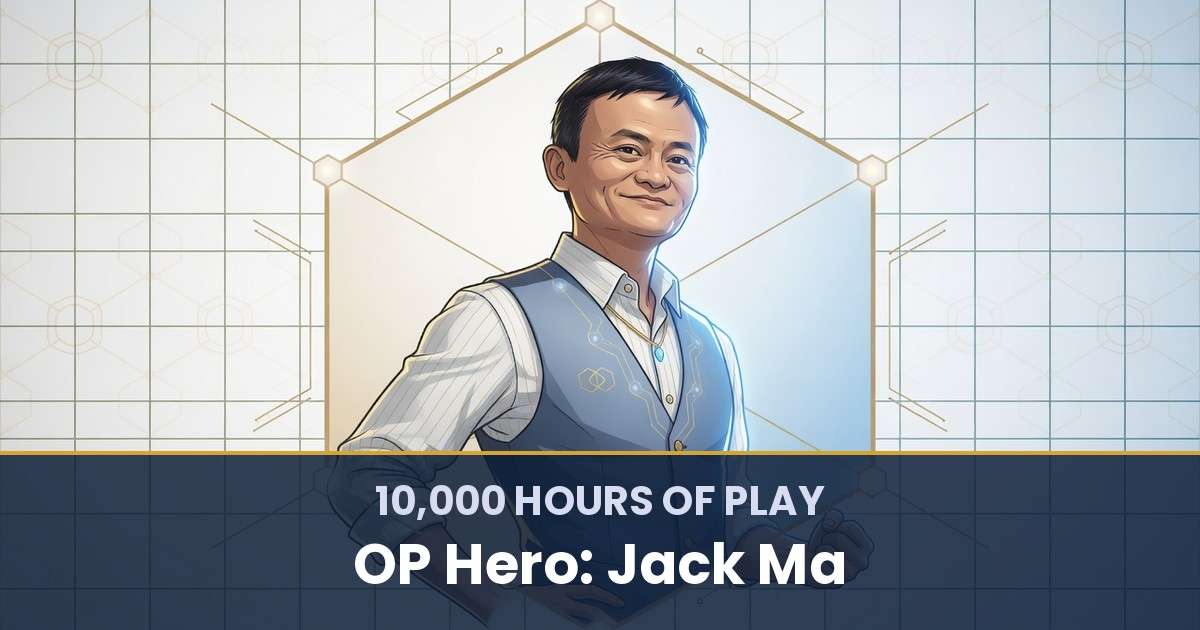
10,000 Hours of Play by OP Hero: Jack Ma
Rejected from ~30 jobs and twice failed by the college exam, Jack Ma built Alibaba anyway. His 10,000 Hours of Play build, read through the 6-Step framework.


In February 1999, a skinny former English teacher crowded seventeen friends into his apartment in Hangzhou and told them, on camera, that they were going to build a company that would compete with the giants of Silicon Valley. He had no computer science degree, no wealthy backers, and no product yet. He had already been rejected from around thirty jobs, including a police force and a newly opened KFC.
His name was Ma Yun, and the world would come to know him as Jack Ma.
Most people who look at Alibaba see the ending: a company worth hundreds of billions, one of the largest public offerings ever staged, a founder who became the richest man in China. What they miss is that almost none of Ma’s starting stats predicted it. He was, by every conventional measure, an underqualified man who kept losing. The interesting question is which stat he had that the qualified people didn’t, and how he aimed it. Read his life through the 10,000 Hours of Play framework and the answer stops looking like luck.
⚡ Speed Run Notes
- Ma’s headline stat was never intelligence or capital. It was an almost inhuman tolerance for rejection. He failed China’s college entrance exam twice and was turned down by roughly thirty employers before he started winning.
- He played one game for decades: hand the “small guys,” China’s tiny businesses and ordinary people, the tools that used to require connections and capital.
- His rarest early move was seeing the internet as transformational in 1995, when almost no one around him in China had ever touched it.
- He beat eBay in China with local reinvention, not money: free listings plus an escrow tool, Alipay, that solved the trust problem eBay never bothered to.
- The build is not a fairy tale. In November 2020 the Ant Group IPO, set to be the largest in history, was frozen days before it was due to list.
- The lesson to steal: an ordinary character sheet plus a rare tolerance for “no” can still out-level people who started with far better numbers.
Table of Contents
About Yu-kai Chou

Yu-kai Chou is the author of 10,000 Hours of Play — the book that treats your life as the most important game you’ll ever build a character in, and gives you the 6-Step framework (Game · Attributes · Role · Skills · Allies · Quests) to play it on purpose. He has spent two decades developing the system through which this post analyzes its OP Hero, and applies it to his own life and to the lives of the people he advises around the world.
Chou’s other framework, the Octalysis Framework, has been applied by LEGO, Microsoft, Porsche, Coca-Cola, Salesforce, and MrBeast, impacting over 1.5 Billion Users. He has taught the methodology at Harvard, Stanford, Yale, Tesla, Google, BCG, and IDEO, and has advised governments in eight nations including Ukraine, the United Kingdom, the Kingdom of Bahrain, Singapore, Taiwan, the Netherlands, Kazakhstan, and South Korea.
His work has been cited by Harvard, Stanford, MIT, Forbes, Wall Street Journal, Wired, US Department of Energy, NIST, NSF, NCBI, US Department of Education, ClinicalTrials.gov, and Google Scholar — with 3,700+ more academic publications. Explore his books here.
What I keep coming back to with Ma is that he won a game he was objectively unqualified to enter. He couldn’t code, he’d failed exams that lesser dreams die on, and he’d been told no by everyone from the police to a fried-chicken franchise. His build is proof that the stat the world can’t test for, the refusal to let rejection register as a verdict, can matter more than every credential it hands out. That’s the attribute I’d lift from his sheet and install in my own.
Step 1: The Game — What Jack Ma Was Actually Playing
Every OP Hero is playing one long game underneath all the smaller ones. Ma’s game was this: give the “small guys” (the tiny merchants, the unconnected, the ordinary people locked out of the old economy) the tools that used to belong only to those with capital and political access.
He said it plainly for years. Alibaba’s purpose, in his framing, was to help young people and small businesses succeed, because “small guys will be big.” That wasn’t marketing bolted on afterward. When he founded Alibaba in 1999, he built it deliberately as a business-to-business marketplace so that small and medium enterprises (SMEs) in China could reach global buyers without needing connections or a fortune to start.
The through-line held for thirty years. First it was helping small factories find overseas customers. Then it was letting anyone open a storefront on Taobao for free. Then it was Alipay, giving people who had never owned a credit card a way to transact and, eventually, to save and borrow. The mission was never “build an e-commerce company.” It was closer to what drove Henry Ford’s insistence on a car ordinary workers could actually afford: take a capability the powerful hoard and hand it to everyone else.
The engine underneath was Spirit of Nature (Druid): meaning-making under stress, where you take your own history of being shut out and convert it into a value-driven purpose. Ma had been the outsider his whole life. He turned that wound into the exact population he spent his career serving.
Step 2: Attributes — The Innate Stats
Attributes are the stats you’re born with, the ones you can aim but can’t install later. Ma’s sheet is strange, because his most important number is one most people would read as a weakness.
His headline stat is a near-total immunity to rejection. He failed China’s national college entrance exam not once but twice, passing only on his third attempt. After graduating he applied for roughly thirty jobs and was turned down by all of them, including a police recruiter and, in the story he loved to tell, a KFC that hired every applicant who showed up except him. Most people take that many no’s as data about themselves. Ma took them as friction to push through.
His second stat is social and verbal magnetism. As a boy in Hangzhou he taught himself English by riding his bike to a hotel and giving free tours to foreign tourists in exchange for conversation, a habit that earned him the nickname “Jack” from one of them. That drive to bridge across cultures became the engine of every pitch he’d ever make.
His third stat is contrarian optimism about the future. In 1995 he traveled to the United States, used the internet for the first time, and came home certain it would remake commerce, in a country where almost no one had seen it. If you want to map your own raw stats honestly before you spend a career fighting them, the Talent Triangle Method is the fastest audit I know. Ma’s gift was refusing to sand down the one stat everyone told him to.
Step 3: Role(s) — The Character Class Across Chapters
Heroes multi-class. The role that wins Chapter One is rarely the role that wins Chapter Four, and Ma cycled through several distinct classes without ever changing his mission.
He started as a teacher. After graduating from Hangzhou Normal University he became an English instructor at Hangzhou Dianzi University in 1988, earning a modest salary and a reputation as a spellbinding lecturer. It’s easy to skip past this chapter, but the classroom was where he drilled the one skill that would later raise every round of funding: making people believe.
Next came the role of internet pathfinder. Around 1995 he launched China Pages, one of the country’s earliest internet ventures, a directory to put Chinese businesses online. It was ahead of its market and it struggled.
Then, in 1999, he became a founder and guild master: the man in the apartment rallying the eighteen original Alibaba co-founders. From there he leveled into platform architect, presiding over Taobao, Tmall, Alipay, and Alibaba Cloud, and orchestrating a record-breaking public listing. His final class is the one he chose on the way out: elder and philanthropist. That arc from operator to teacher-at-large echoes John D. Rockefeller’s late-life pivot from empire-builder to full-time giver.
Step 4: Skills — The Real-Life Game Skills Jack Ma Mastered
Attributes are potential; Skills are what you drill until they fire on command. Ma’s breakthroughs each trace to a specific, nameable technique.
The first is Loremaster (Druid): weaving compelling, inspiring stories that move people to act. Ma couldn’t offer engineers a salary or investors a spreadsheet in 1999, so he offered a narrative. He cast himself and his team as underdogs, invoked Forrest Gump as his model of dumb persistence winning out, and told the “small guys will be big” story so many times it became a creed. People joined a story, then built the company that made it true.
The second is Foresight (Ranger): projecting and committing to a future trend before it’s visible. His 1995 conviction that the internet would reshape Chinese commerce was a bet placed years before the evidence arrived, and every early Alibaba decision was downstream of it. Knowing when to go deep on a rare bet versus staying a generalist is exactly the judgment the Skills Spectrum is built to help you make.
The third is Hydra Riposte (Ranger): countering a crushing attack with relentless innovation rather than matching force with force. When eBay’s EachNet dominated Chinese online auctions, Ma launched Taobao in May 2003 and refused to fight on eBay’s terms. Taobao was free to list where eBay charged fees, added an instant-messaging tool so buyers and sellers could haggle like they did in real markets, and, most decisively, introduced Alipay, an escrow service that held a buyer’s money until goods arrived. eBay had ignored the trust problem; Ma solved it. By 2006 eBay had effectively retreated from China. The same refuse-to-quit engineering runs through Soichiro Honda’s climb from rejected parts-supplier to global manufacturer.
Step 5: Allies — The People Who Multiplied Jack Ma
No hero solos the final boss. Ma’s build was multiplied by a small circle who supplied exactly what his own sheet lacked.
The most important was Joe Tsai, a Yale-trained lawyer with a lucrative investment-firm job who walked away from it to join Ma as co-founder and chief financial officer. Tsai handled the legal and financial machinery Ma had no training for, structuring the deals that kept the company alive. His fingerprints are on both of Alibaba’s survival-defining rounds.
Those rounds came from two more allies. By October 1999, Alibaba had raised US$25 million: US$5 million from Goldman Sachs and US$20 million from SoftBank, the latter driven by Masayoshi Son’s personal conviction after meeting Ma. In 2005, Yahoo invested US$1 billion for roughly a 40% stake, a war chest that arrived at the exact moment Alibaba was battling eBay. This is Bind Fate (Warlock) in its purest form: leveraging someone else’s brand and capital to become powerful yourself.
The last ally was the crowd Ma persuaded first: the eighteen co-founders in that Hangzhou apartment, former students and friends who took equity instead of security. That echoes how Sam Walton multiplied himself through the people he recruited — none of them gave Ma a new personality; each handed him a capability he didn’t have alone.
Step 6: Quests — The Milestones That Shaped the Saga
Quests are the concrete milestones where the build gets tested. Ma’s saga has a clear questline, and it includes the failures most highlight reels edit out.
The first quest was a defeat. China Pages, his mid-1990s attempt to put Chinese businesses online, never found commercial footing: the market was too young, the infrastructure too thin, the capital too scarce. His earliest ventures simply failed. What matters is the reload: instead of concluding he wasn’t built for this, he treated the loss as a level he’d re-enter with better gear. That is Phoenix Rebirth (Paladin), recovering from a devastating failure and coming back stronger.
The second quest was the founding itself: Alibaba, February 1999, seventeen people and a speech in an apartment. The third was the empire itself (Taobao, Alipay, Tmall, Alibaba Cloud) and its coronation in September 2014, when Alibaba’s New York listing raised about US$25 billion, then the largest initial public offering in history.
The fourth quest is the setback the fairy-tale versions skip. In late October 2020, Ma gave a blunt speech at Shanghai’s Bund Summit criticizing China’s financial regulators. Days later, on 3 November 2020, regulators suspended the initial public offering of Ant Group, his fintech affiliate. That listing was set to raise roughly US$34.5 billion and become the largest in history. Ma largely withdrew from public life afterward. The build has a real ceiling, and pretending otherwise would dishonor how hard the game actually is. You can see how his questline sits among other legendary builds on the OP Hero Profiles hub.
What You Can Steal From Jack Ma’s Build
The temptation, looking at your own character sheet, is to conclude that people who win at Ma’s scale must have started with numbers you don’t have. Ma’s run is the argument against that story.
He started with worse-than-average stats on almost every axis that gets tested. No technical skill, no money, no pedigree, a stack of rejections tall enough to end most ambitions. What he had was one rare, untestable attribute, the refusal to let “no” register as a verdict, and the discipline to aim it at a mission bigger than himself.
So audit the “no” you’re currently treating as final. Ask whether it’s actually a verdict on you or just friction on the way to a game you haven’t started yet, the way it was for builders who treat their whole life as one long game to keep playing. Ma’s story doesn’t promise you’ll win, and his last chapter proves the game can turn on you. But it does prove that a modest character sheet, carried by one relentless stat toward a mission you actually believe in, can out-level starting numbers far better than your own.
Where this framework comes from

Want the full system this profile is built on?
Every OP Hero piece runs through the same 6-Step framework from 10,000 Hours of Play: Unlock Your Real-Life Legendary Success. The book covers the full system, walks through Yu-kai’s own life run as the first applied case study, and gives you the worksheets to audit your own build.
Related Reading
- OP Hero Profiles: the full roster of legendary real-life builds
- The 10K HP Framework: 6 Steps to Gamify Your Life
- Soichiro Honda, OP Hero: the rejected mechanic who built an empire
- Sam Walton, OP Hero: the relentless retailer who out-worked everyone
- Henry Ford, OP Hero: the man who put the world on wheels
- John D. Rockefeller, OP Hero: the empire-builder who became a giver