
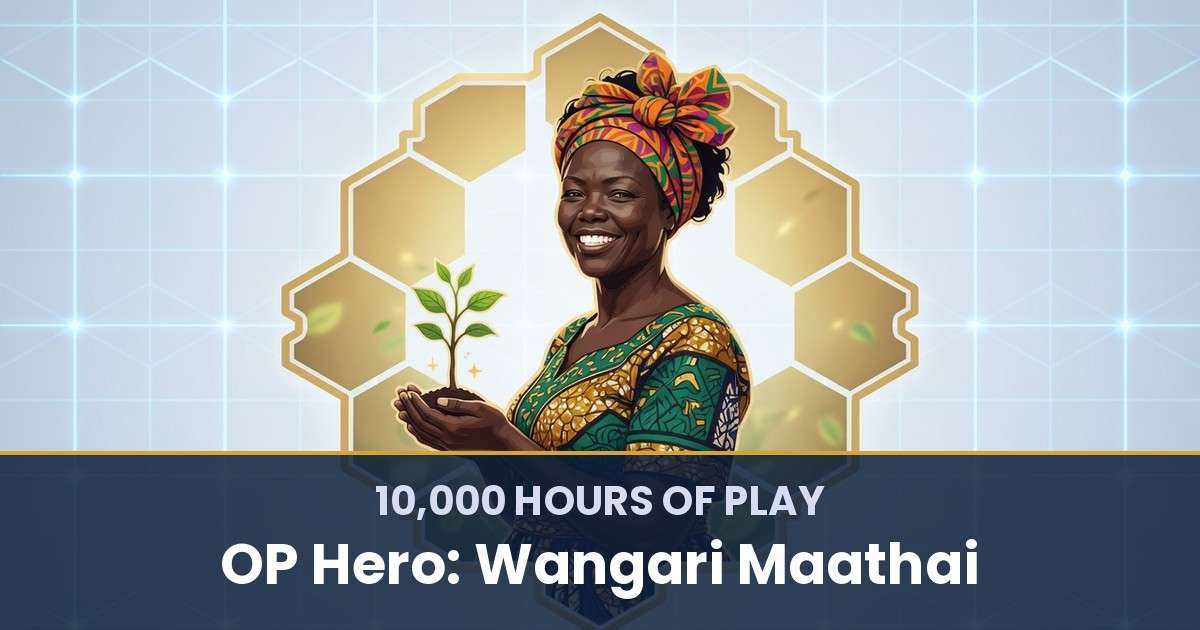
10,000 Hours of Play by OP Hero: Wangari Maathai
Wangari Maathai planted a movement: 30 million trees, a democracy fight, and a Nobel. Her full 10K HP character build, step by step.


On January 8, 1999, Wangari Maathai walked into Nairobi’s Karura Forest carrying a tree seedling. With her walked six opposition members of parliament, a pack of journalists, and a line of international observers.
The forest was public land. President Daniel arap Moi’s government was quietly carving it up for private developers, and she intended to plant a tree in it anyway.
Seven months later, Moi banned further excision of Karura Forest. The same regime whose police had beaten her unconscious in 1992 backed down in front of a 58-year-old biologist holding a seedling.
Run her life through the 10,000 Hours of Play framework and the mystery of how she pulled that off dissolves into a character sheet: one Game held for 34 years, Attributes visible from her first degree, a brutal triple setback that forced a class change, five trainable Skills, and an Alliance that scaled from village nurseries to the United Nations.
Here is the build.
⚡ Speed Run Notes
- Wangari Maathai played one integrated Game for 34 years: restore degraded land and put economic and political power in the hands of the rural women restoring it. The trees and the freedom were the same project.
- Her core mechanic was incentive design: a small payment for every seedling a woman grew and kept alive. That loop scaled to roughly 900,000 women and over 30 million trees by her 2004 Nobel Peace Prize.
- Between 1979 and 1982 she lost her marriage, spent three days in prison, then lost her professorship and her home. The stripped-down character rebuilt everything around the Green Belt Movement.
- Her boss fights were literal land battles. Uhuru Park 1989 and Karura Forest 1999 both ended with a president’s project stopped and public land still public.
- Five canon Skills carry the build: Enchant, Beacon Flare, Concord of Elements, Courageous Heart, and Terraform, the one Skill in the entire canon she practiced literally.
Table of Contents
- About Yu-kai Chou
- Step 1: The Game Maathai Was Actually Playing
- Step 2: Attributes, the Innate Stats
- Step 3: Role(s) Across Chapters
- Step 4: The Real-Life Game Skills She Mastered
- Step 5: The Allies Who Multiplied Her
- Step 6: The Quests That Shaped the Saga
- What You Can Steal From Maathai’s Build
- Where this framework comes from
- Related Reading
About Yu-kai Chou

Yu-kai Chou is the author of 10,000 Hours of Play — the book that treats your life as the most important game you’ll ever build a character in, and gives you the 6-Step framework (Game · Attributes · Role · Skills · Allies · Quests) to play it on purpose. He has spent two decades developing the system through which this post analyzes its OP Hero, and applies it to his own life and to the lives of the people he advises around the world.
Chou’s other framework, the Octalysis Framework, has been applied by LEGO, Microsoft, Porsche, Coca-Cola, Salesforce, and MrBeast, impacting over 1.5 Billion Users. He has taught the methodology at Harvard, Stanford, Yale, Tesla, Google, BCG, and IDEO, and has advised governments in eight nations including Ukraine, the United Kingdom, the Kingdom of Bahrain, Singapore, Taiwan, the Netherlands, Kazakhstan, and South Korea.
His work has been cited by Harvard, Stanford, MIT, Forbes, Wall Street Journal, Wired, US Department of Energy, NIST, NSF, NCBI, US Department of Education, ClinicalTrials.gov, and Google Scholar — with 3,700+ more academic publications. Explore his books here.
What pulls me to Maathai’s build is that her most consequential Skill was a game mechanic. She never asked rural women to care about deforestation in the abstract; she paid a small reward for each seedling that survived, then let ownership and visible progress do the motivational work. That is Enchant executed at national scale, decades before anyone used the word gamification. The lesson I’d lift first: when your Quest stalls, stop preaching and redesign the incentive loop, so the smallest unit of your mission pays off for the person doing it.
Step 1: The Game — What Wangari Maathai Was Actually Playing
From the outside her career looks like three separate lives: a veterinary anatomy professor, a street activist bleeding at protests, and a cabinet-level stateswoman with a Nobel medal.
The Nobel Committee saw the single Game underneath. Its 2004 citation honored her “contribution to sustainable development, democracy and peace,” one phrase holding all three lives together.
Her Game, in 10K HP terms: renew damaged land as the base layer of human dignity, and make sure the people doing the renewing gain economic and political power along the way.
The quest line opened in 1977, when rural women described their actual daily problems through the National Council of Women of Kenya: no firewood, no clean drinking water, thinning diets, no income. Maathai’s answer became the Green Belt Movement.
Trees were the elegant move. A tree answers firewood, water, soil, and food at once, and a woman who plants one holds a visible, growing stake in her own future.
In her Nobel lecture she made the deeper rule of the Game explicit: responsible care of the environment cannot survive without democratic space. Chase the first long enough and you are forced to fight for the second.
That is what separates a Game from a job. A job ends at retirement, while her Game ran 34 years, from the first nurseries in 1977 to her death in 2011, generating new quests to the end.
Step 2: Attributes — The Innate Stats
Attributes are the stats you spawn with. Maathai, born in 1940 in Kenya’s central highlands, showed four before any movement existed.
Systems sight. Trained as a biologist in the United States and Kenya, she looked at eroded hillsides in the 1970s and read the whole chain at once: deforestation feeding fuel scarcity, feeding hunger, feeding poverty. Where officials saw separate problems, she saw one broken loop.
Physical and political courage. She kept walking into places where the state was willing to hurt her, and the record shows the state repeatedly did. A disposition like that rarely gets trained into a mid-career academic; it was standing equipment.
Empathic attunement. The Green Belt Movement’s design came out of listening. The needs it answered were dictated by the rural women themselves, and she built the program around constraints those women named.
An unbowed core. The title of her 2006 memoir names the trait. She became the first woman in East and Central Africa to earn a doctorate, finishing her University of Nairobi dissertation in 1971 inside an institution with no template for her. Persistence that shows up that early tends to hold.
If you want to run this audit on yourself, the Talent Triangle Method separates the stats you were born holding from the Skills you still have time to train.
Step 3: Role(s) — The Character Class Across Chapters
Maathai’s class changes were sharp, and one of them was forced on her.
The Scholar (1960s to 1971). Biology studies in the United States, then the University of Nairobi doctorate awarded in 1971.
The Professor (1975 to 1982). Lecturer by 1975, chair of the Department of Veterinary Anatomy in 1976, associate professor in 1977. A stable, prestigious class she would later burn down on principle.
The Founder (1977 onward). The same year she made associate professor, she planted the Green Belt Movement inside the National Council of Women of Kenya. For five years she ran both classes in parallel.
The forced re-spec (1982). She resigned her university post to run for parliament in Nyeri. Officials disqualified her on a voter-registration technicality, the university refused to take her back, and she was evicted from staff housing. Career, salary, and home gone in a single season.
The Opposition Frontliner (1980s to 1999) and the Stateswoman (2002 to 2011). Stripped of institutional cover, she went where Cesar Chavez had gone before her: full-time grassroots organizing against a power structure that wanted her silent. Twenty years later the arc completed with a parliamentary seat, a ministry post, and the Nobel.
The transferable move is 1982. When the institution ejected her, the mission survived because it had never lived inside the institution in the first place.
Step 4: Skills — The Real-Life Game Skills Wangari Maathai Mastered
Attributes are dealt; Skills are trained. Five canon Skills from the 10,000 Hours of Play system carry Maathai’s file.
Enchant (Druid) — gamification skills that make an activity more enjoyable and preferable. The Green Belt Movement’s engine was a micro-incentive: a woman earned a small payment for each seedling she grew and kept alive. Survival was the score, and the score paid out. That single mechanic recruited roughly 900,000 women and produced over 30 million trees by the mid-2000s.
Beacon Flare (Ranger) — PR skills that cut through noise and drive buzz. When Moi’s regime moved to build a skyscraper in Nairobi’s Uhuru Park in 1989, she fought it with targeted letters, public statements, and staged protests framing the tower as the regime paving over freedom itself. The project was shelved, and the park stayed open ground. Greta Thunberg runs the same Skill in a different era: one person, message discipline, and a media wave no government can ignore.
Concord of Elements (Druid) — bring multiple parties of different interests together. At Freedom Corner in 1992 she joined mothers of political prisoners with GBM’s women’s networks and pro-democracy activists, and the combined vigil ran eleven months at All Saints Cathedral. At Karura in 1999 the party composition was six opposition MPs, journalists, and international observers, with Kofi Annan’s UN weighing in from outside.
Courageous Heart (Paladin) — charge into uncomfortable zones and hostile environments. At the 1992 Freedom Corner protest, police beat her unconscious; she took hospital treatment for head injuries and returned to the same fight. The Skill is walking in while knowing the price.
Terraform (Warlock) — influence rule-makers and regulators to change landscapes. The canon defines it through markets and policy. Maathai gave it the literal reading: sustained pressure until President Moi banned further excision of Karura Forest in August 1999, followed by a seat inside the wall itself as assistant minister for environment and natural resources from January 2003.
Where should each of your own Skills sit between dabbling and mastery? The Skills Spectrum is the sorting tool.
Step 5: Allies — The People Who Multiplied Wangari Maathai
Maathai’s Alliance chart is a study in scaling. Every chapter of the Game added a ring.
The National Council of Women of Kenya. The 1977 launch platform. NCWK gave the Green Belt Movement institutional cover, a ready network of women’s groups, and its first funding channels.
The nursery women. Roughly 900,000 women ran the decentralized nurseries that did the actual planting, learned the silviculture, and tracked seedling survival. She designed the system; they were the system.
The Freedom Corner mothers. The 1992 vigil worked because mothers of political prisoners carried a moral standing the regime could never dismiss, while GBM brought organizational muscle. Prisoners walked free, and Kenya held multi-party elections that December.
The parliamentary allies. On January 8, 1999, six opposition MPs walked into Karura beside her. Numbers of that kind convert a trespass into a national event.
The international ring. Kofi Annan’s UN and foreign governments raised the diplomatic price of the Karura land grab until Moi paid it. Five years on, the Nobel Committee joined the Alliance, and its 2004 award converted her from national dissident into global institution.
Jane Goodall built the same shape of Alliance around primate research: one woman, then an institute, then a planet-wide network. The pattern transfers.
Step 6: Quests — The Milestones That Shaped the Saga
Quest 1: Plant the first nurseries (1977). The Green Belt Movement launches under NCWK, built on the needs rural women themselves listed: firewood, clean water, food, income.
Quest 2: Survive the dark level (1979 to 1982). Her divorce was finalized in 1979; her husband’s stated grounds included that she was too strong-minded for a woman and that he could not control her. When she called the presiding judge incompetent or corrupt, a contempt conviction sent her to Lang’ata Women’s Prison on a six-month sentence; appeal and public outcry freed her after three days. In 1982 she resigned her professorship to run for parliament, was disqualified on a technicality, and lost both job and housing in the refusal that followed. A failed quest line by every scoreboard, and the moment the build committed fully to the Game.
Quest 3: Save Uhuru Park (1989). Media pressure and public mobilization force the regime to shelve its skyscraper. Nairobi keeps its central green space.
Quest 4: Freedom Corner (1992). Beaten unconscious, hospitalized, back anyway. The eleven-month vigil ends with political prisoners released and multi-party elections held that December.
Quest 5: Hold Karura Forest (1999). The January 8 planting party triggers international pressure. By August, Moi bans further excision of the forest.
Quest 6: Enter the castle (2002 to 2004). Voters in Tetu send her to parliament with about 98 percent of the vote in December 2002, and January 2003 brings the assistant minister post for environment and natural resources. On October 8, 2004, she becomes the first African woman to win the Nobel Peace Prize.
The saga kept its failures on the books. Her 1997 presidential run drew a fraction of one percent of the national vote, and she lost a parliamentary race the same year.
When she died on September 25, 2011, of complications from ovarian cancer, the scoreboard she cared about kept counting without her. The Green Belt Movement now puts its total above 51 million trees in Kenya.
What You Can Steal From Wangari Maathai’s Build
Strip the medal and the template is startlingly practical.
Design your Game so the mission pays the people doing it. Maathai turned land restoration into income the day one seedling earned one payment, and any Quest you lead gets stronger the moment contribution stops running on guilt.
Read your worst season as a class-change prompt. The 1982 wipeout removed career, salary, and housing, and the full-time Founder who walked out of the wreckage reshaped a country.
Recruit Allies who hold what you lack: mothers with moral standing, MPs with public platforms, journalists with cameras, a Secretary-General with diplomatic weight. Her Alliance worked because every ring held a different kind of power.
And when the whole quest looks too big, she kept a parable for that. She liked telling the story of the hummingbird that carries one drop of water at a time toward a forest fire while the bigger animals stand watching: do the best you can from where you stand. Thirty million trees started as one seedling with a small payment attached.
The other OP Hero profiles show the same physics across wildly different lives: the Game outlasts the setback when the build is honest. This week, find your seedling payment. Define the smallest unit of your mission, and make completing it pay the person who does it.
Where this framework comes from

Want the full system this profile is built on?
Every OP Hero piece runs through the same 6-Step framework from 10,000 Hours of Play: Unlock Your Real-Life Legendary Success. The book covers the full system, walks through Yu-kai’s own life run as the first applied case study, and gives you the worksheets to audit your own build.
Related Reading
- All OP Hero Profiles: the 10,000 Hours of Play character library
- 10,000 Hours of Play by OP Hero: Norman Borlaug
- 10,000 Hours of Play by OP Hero: Desmond Tutu
- 10,000 Hours of Play by OP Hero: Malala Yousafzai
- 10,000 Hours of Play by OP Hero: Harriet Tubman