

Rwanda is the best student in the development classroom. It posts 7% growth while its neighbors stagnate, ranks near the top of Africa for ease of doing business, and turns donor report cards into marketing material.
In March 2026, the United States sanctioned the Rwanda Defence Force and four of its senior officials for violating a peace deal Rwanda had signed three months earlier. The star pupil got caught copying homework from the room next door.
I call this the Star Pupil Trap: a nation that executes the discipline half of the Singapore playbook with near-perfect form, while lacking every endowment that made Singapore’s version compound. The gap between what the model requires and what the geography provides has to be financed by someone.
For thirty years, two funders covered that gap. Donors paid because Rwanda was the redemption story they needed, and the chaos next door paid because minerals flow toward order.
The Washington Accords now put both funding sources in tension, and the Nationcraft corpus is built for exactly this kind of stress test. Read the 18 variables and you can see exactly where the model holds, where it bends, and which reform playbooks Rwanda’s advisors keep prescribing that its own numbers reject.
⚡ Speed Run Notes
- Rwanda scores V8=9 on Pragmatism, tied with the highest in the Nationcraft corpus. Its trap is that pragmatic execution keeps compensating for endowments (V12=3, V16=3) that no amount of discipline can conjure.
- The Star Pupil Trap: run the Singapore packet’s control half without its geography half, and the deficit gets financed by donor guilt and by extraction from a disordered neighbor.
- The Washington Accords are a direct attack on the second financing source. Formalized mineral trade pays less than informal flows, and it pays transparently.
- Five prescribed playbooks fail Rwanda’s V-vector: Singapore’s LKY packet, Meiji Japan, Park’s Korea, Ethiopia’s EPRDF model, and the Mozambique donor-darling path.
- The fits are unglamorous: Botswana’s institutions-before-resources sequencing, Ukraine’s external-anchor transparency reforms, and an education-first human capital build.
- Succession is the unpriced risk: V1=8 with no transfer mechanism. Kagame can rule to 2034, and the packet that rebuilt Rwanda names succession as its own critical failure point.
Table of Contents
- Understanding Rwanda’s Governance Landscape Through Nationcraft
- What Is the Nationcraft Framework?
- Why This Rwanda Variables Analysis Matters Now
- What Rwanda Actually Looks Like in Numbers
- The Star Pupil Trap
- Detailed Justifications: Reading Each Variable
- Five Reformer Playbooks Rwanda Should Reject
- Three Playbooks Rwanda Should Actually Study
- Strategic Implications
- Governance Strategy Recommendations
- Comparative Context
Author Credibility: Yu-kai Chou

Yu-kai Chou created the Nationcraft Framework, applying behavioral design to the hardest motivational problem there is — getting an entire population to move through structural reform without losing momentum. As of 2026, the framework has informed advisory work with eight governments: Taiwan, the Netherlands, the United Kingdom, Bahrain, South Korea, Singapore, Ukraine, and Kazakhstan. The same 8 Core Drives that have driven design at Microsoft, Porsche, and MrBeast now anchor nation-scale reform sequencing — diagnosing where motivation is broken, which Core Drives to lean into for each phase of reform, and how to sequence the political asks so the public stays bought in.
Published Nationcraft analyses include diagnostic playbooks for Venezuela’s post-Maduro reform window and Thailand’s reset-vs-cycle election dynamics, alongside cabinet-level advisory work on post-conflict recovery, reform-sequencing, and public-policy gamification. Chou also teaches the Octalysis methodology at Harvard, Stanford, Yale, Google, BCG, and IDEO — institutions where the human-systems lens applies whether the system is a product, a company, or a country.
His work has been cited by Harvard, Stanford, MIT, Forbes, Wall Street Journal, Wired, US Department of Energy, NIST, NSF, NCBI, US Department of Education, ClinicalTrials.gov, and Google Scholar — with 3,700+ more academic publications. Explore his books here.

One observation from advisory work with governments including Ukraine and Kazakhstan anchors this analysis: the moment a reform model meets conditions it was not built for arrives on a calendar, never as a surprise, and administrations that pre-position for that date keep their gains. Rwanda’s date is written into the accords, which is why the sequencing below is timed to it.
Understanding Rwanda’s Governance Landscape Through Nationcraft
Most coverage of Rwanda argues about one question: is it a development miracle or an authoritarian cautionary tale? That framing wastes the case.
Rwanda is the clearest live demonstration of what the Nationcraft Framework calls configuration logic. The same variable settings that produce the miracle produce the warning, at the same time, through the same mechanisms.
V1 (Authority Dynamics) at 8 delivers policy execution most democracies dream about, and it also delivers a 99.18% election. V8 (Pragmatism) at 9 lets Kigali swap languages, alliances, and economic strategies inside a single decade, and it also lets Kigali sign a peace agreement while its army supports the militia the agreement targets.
Configuration reading, the method behind how the Octalysis Framework applies to nation-building, sidesteps that argument entirely. Motivation systems do what their configuration says, whether the players are users in an app or ministries in a capital.
The Octalysis Framework proves the same rule at product scale: analyze the drives actually operating, and behavior stops being surprising. Nationcraft applies that discipline to nations.
What Is the Nationcraft Framework?
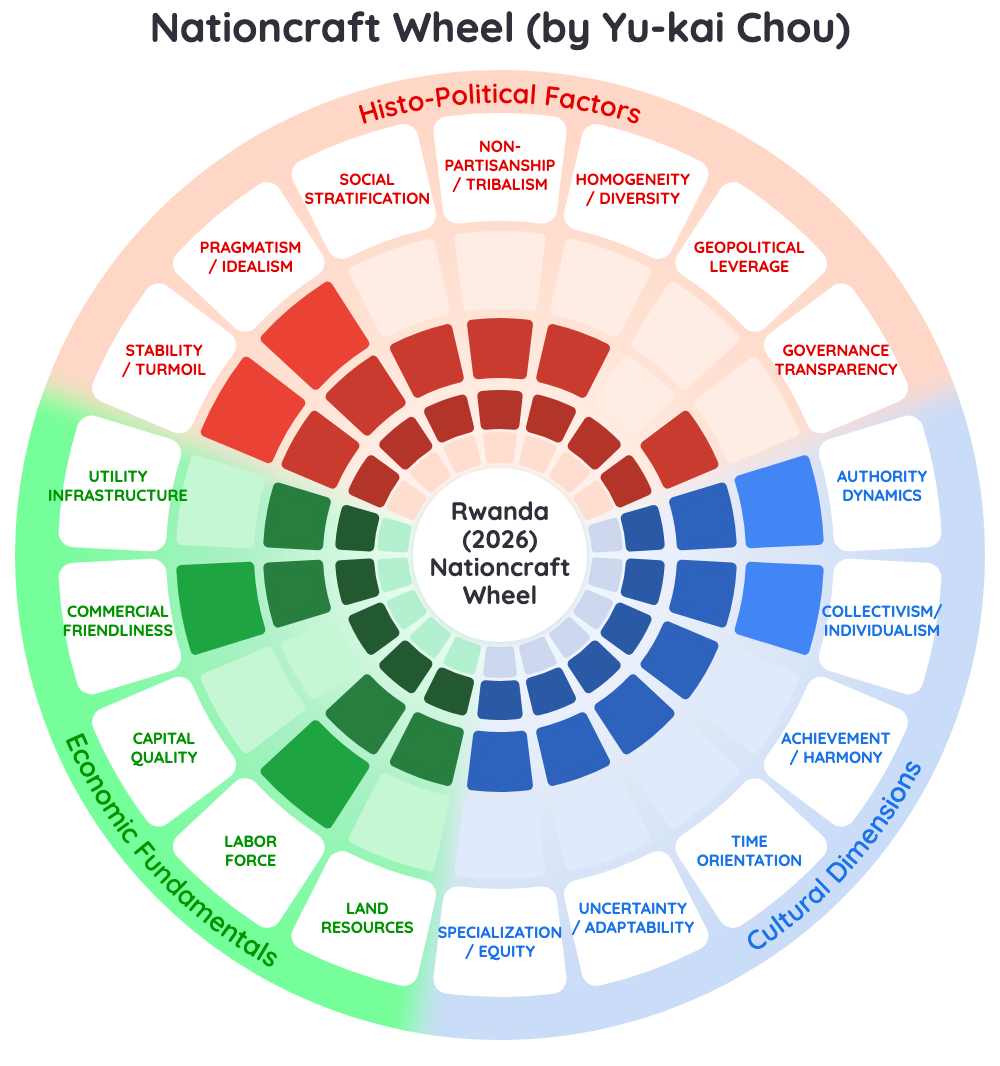
The Nationcraft Framework profiles a nation across 18 variables: six cultural (V1–V6), seven historical-political (V7–V13), and five economic (V14–V18). Each is scored 1–9.
The scores are never averaged. A nation is its configuration, and the Nationcraft corpus exists to match configurations against more than a hundred historical Success Packets, each one a documented reform program with known preconditions, sequencing, and outcomes.
The working rule: policy quality decides less than context fit. A brilliant reform transplanted into the wrong variable profile fails on schedule, which is why every Nationcraft analysis spends more time on preconditions than on prescriptions.
Rwanda makes an unusually good subject because it has already run one full packet to completion. The question in 2026 is what happens when the packet’s financing assumptions expire before the packet’s goals are reached.
Why This Rwanda Variables Analysis Matters Now
The timeline since mid-2025 reads like a stress test designed for this framework.
On June 27, 2025, Rwanda and the Democratic Republic of the Congo signed a US-brokered peace agreement in Washington, with Qatar running a parallel track with the M23 militia in Doha. On December 4, 2025, Presidents Kagame and Tshisekedi signed the full package with President Trump presiding: the Washington Accords for Peace and Prosperity, five instruments covering peace terms, a regional economic integration framework, and minerals partnerships with the United States.
Days later, M23 fighters captured the Congolese city of Uvira. Washington called it a clear violation.
On March 2, 2026, the US Treasury sanctioned the Rwanda Defence Force itself, along with four senior Rwandan officers, for supporting M23 with troops, drones, GPS jamming, and air-defense systems inside eastern Congo. In June 2026, Treasury added a Rwandan gold refinery, and Global Witness reported that at least five of the seven companies handling 85% of Rwanda’s coltan exports were buying conflict material from the DRC.
And yet the process grinds forward. The sixth Joint Security Coordination Mechanism met in Geneva on August 12–13, 2026, where Kinshasa presented its plan for disarming the FDLR, the anti-Kigali militia whose existence anchors Rwanda’s stated security rationale.
The Congolese side of this system has its own analysis in DR Congo’s cobalt trap. This analysis reads the same peace process from the other bank of the Ruzizi, where the pressure lands on the financing model of a state whose entire brand is discipline.
What Rwanda Actually Looks Like in Numbers
Start with the headline economics. Rwanda entered 2026 with the IMF forecasting 7.2% growth; the Fund’s June program review moderated that to 6.8% as the Middle East war pressured the outlook, and Kigali signed a 38-month, $250 million IMF credit facility the same month. Inflation is cooling toward 5.6% inside the central bank’s band, on a $17.3 billion economy.
Under NST2, the national strategy running 2024–2029, Kigali is spending toward middle-income status, and public debt has climbed from 57% of GDP in 2019 to roughly 80% now. Growth is real, and so is the balance sheet strain financing it.
Here is the full Nationcraft variable profile behind those numbers.
| Variable | Score | Reading |
|---|---|---|
| V1 Authority Dynamics | 8/10 | Deep hierarchical norms; RPF dominance; courts barred the main 2024 challengers |
| V2 Collectivism vs Individualism | 7/10 | Umuganda service culture; collective mobilization is a governing tool |
| V3 Achievement vs Harmony | 5/10 | Vision 2050 ambition balanced against reconciliation-first social policy |
| V4 Time Orientation | 5/10 | Long state planning horizon laid over a trauma-shortened cultural clock |
| V5 Uncertainty Adaptability | 6/10 | Repeated economic pivots absorbed without institutional panic |
| V6 Specialization vs Equity | 5/10 | Thin specialist class above a large subsistence-agriculture base |
| V7 Stability vs Turmoil | 7/10 | No coups since 1994; low crime; turmoil exported to the DRC border |
| V8 Pragmatism vs Idealism | 9/10 | The signature score: language switch, alliance switches, policy experimentation |
| V9 Social Stratification | 5/10 | RPF elite layer over deliberately egalitarian service delivery |
| V10 Non-Partisanship vs Tribalism | 5/10 | Ethnic identity de-listed from documents; the cleavage is suppressed rather than resolved |
| V11 Homogeneity vs Diversity | 6/10 | One language, one dominant faith, shared culture across the old divide |
| V12 Geopolitical Leverage | 3/10 | Small, landlocked, sanctionable; leverage is rented via peacekeeping and minerals, never owned |
| V13 Governance Transparency | 4/10 | Clean-but-opaque: strong corruption control, weak political transparency |
| V14 Land Resources | 5/10 | Dense population on fertile hills; modest tin-tantalum-tungsten; Lake Kivu methane |
| V15 Labor Force Quality | 7/10 | Disciplined, trainable workforce; absolute schooling depth still thin |
| V16 Capital Quality | 3/10 | Shallow domestic markets; aid and FDI dependence; debt near 80% of GDP |
| V17 Commercial Friendliness | 8/10 | Among Africa’s easiest places to register and operate a business |
| V18 Utility Infrastructure | 4/10 | Access rising fast, yet landlocked logistics still tax every export |
Read the table as two clusters. The control cluster (V1=8, V2=7, V7=7, V8=9, V17=8) would flatter any East Asian tiger.
The endowment cluster (V12=3, V16=3, V18=4, plus V14=5) belongs to a fragile state. Rwanda is both at once, and that combination is the whole story.
The Star Pupil Trap
Every teacher knows a student who compensates for a weak starting position with ferocious discipline. The Nationcraft corpus knows one nation like that, and the compensation mechanism is the trap.
Formally: the Star Pupil Trap is a configuration where elite execution variables (V1≥8, V8≥8, V17≥7) mask endowment variables (V12≤3, V16≤3) so well that external funders keep financing the gap, until the performance itself becomes the collateral.
The corpus pattern ED-001, the Aid Dependency Trap, triggers on V12≤2 and V16≤3 with aid above 10% of the economy for a decade. Rwanda sits one notch off the V12 threshold and directly on the V16 one, which is exactly where a star pupil would sit: close enough to draw the aid, impressive enough to avoid the stigma.
Two revenue streams have financed the endowment gap since 2000. Donor money flowed because Rwanda delivered measurable results and moral absolution in the same report, and regional mineral flows came through Kigali because ordered territory prices minerals better than chaotic territory does.
The UN estimates M23 has earned at least $800,000 a month since May 2024 taxing roughly 120 tonnes of coltan moving through its zone. Rwanda’s export ledger has captured value from that corridor for years, whatever the paperwork says.
Now watch what the Washington Accords do. The minerals framework formalizes flows, which means traceability, which means the informal premium dies; the sanctions attack the security apparatus that managed the corridor; and donor patience, the other revenue stream, thins as the RDF itself lands on OFAC lists.
A nation with Singapore’s execution and Singapore’s endowments compounds. A nation with Singapore’s execution and Rwanda’s endowments must either fix the endowment variables or keep renting them.
The rent just went up, and the sections below price both options against packets that have actually run.
Detailed Justifications: Reading Each Variable
Scores earn trust through evidence. Here is the reasoning across all three Nationcraft clusters.
Cultural cluster (V1–V6): the obedience inheritance
V1 (Authority Dynamics) = 8 rests on something older than the RPF. Rwanda’s precolonial court culture and dense administrative hierarchy made it one of Africa’s most governable territories, which cut both ways: scholars of the genocide note that orders flowed downhill with terrifying efficiency in 1994, and reconstruction orders flowed downhill with astonishing efficiency after.
The 2024 election quantified the ceiling: 99.18% for Kagame, with the courts having disqualified his most prominent critics, and his two permitted challengers splitting under 1%. The result quantifies V1=8 with unusual precision.
V2 (Collectivism) = 7 shows up in institutions most states cannot run. Umuganda, the mandatory monthly community-work morning, still turns out much of the adult population; it operationalizes Core Drive 5 (CD5): Social Influence & Relatedness, and the design mechanics are laid out in the Core Drive 5: Social Influence & Relatedness guide.
V3 (Achievement vs Harmony) = 5 and V4 (Time Orientation) = 5 record a genuine tension. Vision 2050 is an achievement engine on a 30-year clock, yet the society running it carries a survivor generation whose planning horizon was compressed by catastrophe; the state’s clock runs longer than the culture’s.
V5 (Uncertainty Adaptability) = 6 is earned: this is a country that switched its entire school system from French to English in a single policy stroke. V6 (Specialization vs Equity) = 5 reflects a capital city of conference centers and coders sitting atop hillsides of smallholder farms.
Historical-political cluster (V7–V13): order at home, disorder as policy
V7 (Stability vs Turmoil) = 7 is the score visitors feel: Kigali’s swept streets, functioning ministries, low street crime, zero coups since 1994. The asterisk is that the turmoil did not vanish; it moved across the border, where the RDF’s deployments have now drawn US sanctions.
Rwanda runs V8 (Pragmatism) at 9, and the evidence is everywhere. Gacaca courts processed roughly two million genocide cases through community tribunals when formal courts would have needed a century; the Commonwealth accession, the anglophone switch, and the pivot from coffee exporter to conference-and-services hub are all the same reflex applied elsewhere.
V9 (Stratification) = 5 nets an RPF elite whose inner circle holds disproportionate power against genuinely broad service delivery. V10 (Non-Partisanship vs Tribalism) = 5 is the framework’s honest agnosticism about the deepest question in Rwanda: identity cards no longer say Hutu or Tutsi, public life is scrubbed of the distinction, and nobody can measure whether the cleavage healed or merely holds its breath under V1=8 pressure.
V11 (Homogeneity) = 6 records the underlying advantage: one language, shared faith, shared culture. The 1994 divide was political engineering on a culturally continuous population, which is precisely why identity abolition was even possible.
Outsiders regularly misread V13 (Governance Transparency) = 4. On corruption control, Rwanda outperforms nearly all of Africa; on political transparency, journalists and opposition figures operate in one of the continent’s most constricted spaces. Net the two against each other and the score lands at 4, and the June 2026 coltan revelations show the opacity is load-bearing.
Economic cluster (V14–V18): the missing endowments
V14 (Land) = 5: fertile volcanic hills feeding one of Africa’s densest populations, modest 3T minerals, methane under Lake Kivu. Nothing here funds a state by itself.
V15 (Labor) = 7 is a bet on trajectory: the workforce is disciplined and trainable to a degree employers consistently praise, while average schooling depth remains thin. The score prices the discipline; the schooling gap is why the education plays in the fit section matter.
V16 (Capital) = 3 and V18 (Infrastructure) = 4 are the trap’s foundation. Domestic capital markets are shallow, debt is approaching 80% of GDP, and every container pays the landlocked tax; V17 (Commercial Friendliness) = 8 sits on top as brilliant compensation, because registering a business in six hours costs nothing in endowments and buys real FDI.
V12 (Geopolitical Leverage) = 3 completes it. Rwanda rents leverage through peacekeeping deployments and minerals corridors; rented leverage is exactly what a sanctions list can repossess, and in March 2026 one did.
Five Reformer Playbooks Rwanda Should Reject
Rwanda attracts prescriptions the way strong students attract advanced coursework. Most of them fail the test the Venezuela reform playbooks analysis established: check the packet’s variable preconditions against the actual vector before admiring the packet’s outcomes.
Here is the summary scorecard, with the depth below.
| Packet | Country / Era | Precondition That Fails in Rwanda | Verdict |
|---|---|---|---|
| SP-002 Lee Kuan Yew Industrialization | Singapore, 1965–1990 | Chokepoint geography (V12) and a forced-savings capital engine (V16) | Reject as template; salvage one sub-move |
| SP-001 Meiji Open Reform | Japan, 1868–1912 | Requires V2≥8, V4≥8, V11≥8; Rwanda reads 7, 5, 6 | Reject |
| SP-008 Park Export Discipline | South Korea, 1961–1979 | Cold War patron subsidies and open US market access | Reject |
| SP-030 EPRDF Developmental State | Ethiopia, 1991–2018 | Same model, no political release valves; imploded in 2018 | Reject; treat as warning |
| SP-085 Post-Civil War Recovery | Mozambique, 1992–2016 | Donor-darling status metabolized into hidden-debt collapse | Reject; treat as mirror |
SP-002: The Singapore fantasy runs on geography Rwanda does not have
“Singapore of Africa” is the most repeated compliment Kigali receives, and it is rarely checked against the packet’s own precondition sheet. The original packet already went through Singapore’s compressed-trust stress test, and its own precondition sheet settles the question.
SP-002 requires V8≥8, which Rwanda passes at 9, and there the resemblance ends. Singapore sat on the world’s busiest shipping chokepoint; its V12 was structural, written in water, impossible to sanction away. Rwanda’s V12=3 means its connectivity exists at its neighbors’ pleasure and its patrons’ patience.
Singapore also solved capital internally: the Central Provident Fund conscripted domestic savings at scale, turning V16 from constraint into instrument, and 27x GDP-per-capita growth followed. Rwanda’s V16=3 is patched with concessional debt and donor envelopes instead, which is why its debt ratio is approaching 80% of GDP while Singapore’s model self-financed.
The salvageable piece is that CPF logic: a forced domestic-savings engine matched to Rwanda’s V1=8 enforcement capacity and V2=7 collectivism. The rest of the packet, ports and entrepôt rents included, is geography cosplay.
SP-001: Meiji Japan demanded cultural settings Rwanda reads differently
Advisors who reach past Singapore usually land on Meiji Japan: a humiliated latecomer that industrialized through selective Western adoption. The corpus precondition sheet for SP-001 is unusually strict: V1≥8, V2≥8, V4≥8, V11≥8, and failure is predicted without cultural acceptance of prolonged sacrifice.
Rwanda passes V1. It reads 7 on V2, 5 on V4, and 6 on V11, and the V4 miss is the killer: Meiji reform ran forty years on deferred gratification, and Rwanda’s V4=5 records a society whose trust in long horizons was shattered within living memory.
Japan’s own modern configuration shows the packet’s afterlife, traced in Japan’s long-horizon trap. The lesson for Kigali is narrower: you can borrow Meiji’s selective-adoption reflex, and Rwanda already has through V8=9, yet you cannot borrow the four-variable cultural platform the packet actually ran on.
SP-008: Park’s Korea was subsidized by a superpower with a standing offer
SP-008, Park Chung-hee’s export-discipline packet, gets cited at Kigali conferences because it looks endowment-free: no oil, no ports worth envying in 1961, just disciplined state-directed exporters. The citation misses the balance sheet.
Park’s Korea drew massive US aid, security guarantees, and privileged access to the American consumer market, all priced in Cold War currency. That patron subsidy was the V12 and V16 Korea did not have domestically; Washington supplied both because Korea sat on freedom’s frontier.
Rwanda’s 2026 relationship with Washington runs the other direction: OFAC sanctioned the RDF in March, and the minerals partnership on offer formalizes flows rather than subsidizing champions. Korea’s path after Park, mapped in South Korea’s post-martial reckoning, needed decades to metabolize the authoritarian residue even with the subsidies.
Without the patron, export discipline still matters; as a full packet, SP-008 is unavailable at Rwanda’s V12=3.
SP-030: Ethiopia already ran Rwanda’s model at scale, and it detonated
The nearest analog is the most uncomfortable one. Ethiopia’s EPRDF packet was developmental authoritarianism with African characteristics: double-digit growth years, transformative infrastructure, a party-state that suppressed opposition in the name of delivery.
It detonated in 2018. The corpus records the mechanism plainly: growth without political release valves let grievances accumulate until the federation’s seams tore, and the aftermath ran through Tigray into a war that consumed the model’s gains.
The wreckage gets a full reading in Ethiopia’s Nobel-laureate trap. Rwanda’s version is tighter-run, smaller, and more homogeneous (V11=6 against Ethiopia’s fractured federation), and those differences buy time rather than immunity.
The transferable warning sits in V1–V10 mechanics: a system that suppresses feedback at V13=4 cannot see its own pressure gauge. Ethiopia proves the gauge exists whether or not anyone reads it.
SP-085: Mozambique shows how donor darlings die
Mozambique spent two decades as the donors’ favorite recovery: 7% average growth after its civil war, peace that held, conference invitations, the whole syllabus. Then the hidden-debt scandal surfaced in 2016, secret loans arranged behind the donors’ backs, and the darling status evaporated along with budget support.
The corpus lesson cuts at Rwanda directly: the success story was partly built on opacity the donors chose to tolerate, and when the opacity broke, the financing model broke with it. Substitute coltan certification for hidden loans and the geometry maps onto Kigali one-to-one.
Rwanda’s version of the exposure event may already be running. The Global Witness finding that most of its major coltan exporters bought conflict material, published in June 2026, is precisely the genre of revelation that converted Mozambique from model to cautionary tale.
A financing model rented from donor goodwill carries V12=3 fragility no growth rate cures; Cambodia’s post-genocide path, examined in Cambodia’s patronage ceiling, makes the same point from the patronage side. Rwanda has avoided Cambodia’s corruption trap and Mozambique’s debt trap so far. The shared dependence structure remains in place, and it is the part of the configuration the accords now test.
Three Playbooks Rwanda Should Actually Study
Rejecting the glamorous packets is half the work. The configurations that fit Rwanda’s actual vector are quieter, and all three attack endowment variables instead of flattering execution ones.
SP-004: Botswana’s institutions-before-resources sequencing is the accords play
Botswana at independence was the third-poorest country on Earth at roughly $70 GDP per capita, landlocked and small like Rwanda, and written off just as thoroughly. Its packet, SP-004, made one sequencing decision that generated everything after: transparency institutions were built before diamond revenues arrived, so when the wealth came, the capture machinery did not exist.
The corpus flags the precondition: V13≥6 at the moment of resource formalization, with V8≥8 pragmatism steering. Rwanda has the V8 and runs at V13=4, which reads clean on corruption and opaque on flows, and the Washington Accords minerals framework is, functionally, Rwanda’s diamond moment: the point where informal flows become formal, auditable revenue.
Run Botswana’s sequence and the accords become the mechanism that lifts V13 from 4 toward 6: publish the coltan chain of custody, let traceability kill the smuggling premium, and price the transparency as an FDI differentiator, which is the same clean-government sell Kigali already makes. Refuse the sequence and the accords become pure revenue loss.
Botswana proves a landlocked V12=3 state can compound anyway when V13 moves first. It is the only packet in the corpus that solved Rwanda’s exact endowment equation without a patron.
SP-117: Ukraine shows how external anchors lift V13 under pressure
The second fit comes from a country reforming mid-war. Ukraine’s 2014–2022 packet, SP-117, documents V13 rising from roughly 2 to 5 while artillery fell, because reformers lashed themselves to external anchors: EU and IMF conditionality set the bar, civil society enforced it, and digital infrastructure bypassed the corruptible middle layer entirely.
Diia, the state-services app, has grown past 21 million users and made bribery physically impossible for the services it absorbed. The full configuration is documented in Ukraine’s wartime variable profile.
Rwanda holds a better hand than 2014 Ukraine on every execution variable: V1=8 against Ukraine’s contested authority, V7=7 against a hot war, and Irembo, Rwanda’s services portal, already digitizes much of the citizen-state interface. What Rwanda lacks is what Ukraine had: an external anchor it answers to on transparency, because donors graded Rwanda on delivery instead.
The accords’ verification machinery, the JSCM audits and joint monitoring, is the first externally enforced transparency instrument Rwanda has accepted in decades. SP-117 says treat that machinery as scaffolding for institutions you keep, and the anchor lifts V13 while the sanctions pressure lasts.
The Education-First Builder: closing the V15 depth gap with the diaspora pipeline
The third fit comes from the corpus Human Capital playbook, whose quick-match table lists Rwanda by name under the Education-First Builder archetype: large young population, weak institutional depth, growth ambitions outrunning the school system.
Rwanda’s V15=7 prices workforce discipline, and the underlying schooling depth remains thin; the state’s coding academies and university partnerships are real yet subscale against Vision 2050’s services-economy math. The archetype prescribes teacher-pipeline investment and vocational depth ahead of prestige projects, because V15 depth is the one endowment variable a landlocked state can manufacture domestically.
The companion move is the diaspora pipeline. Rwanda’s global diaspora already functions as an informal V16 supplement through remittances and an informal V15 supplement through returnee expertise; formalizing both, with the diaspora-bond and returnee-placement mechanics the playbook documents, converts sentiment into measurable capital.
Neither move photographs well. Both raise the two variables (V15 depth, V16) whose absence forces the renting behavior the trap runs on, and unlike the minerals corridor, nobody can sanction a teacher pipeline.
Strategic Implications
Configuration analysis earns its keep by pricing futures, so here are the three that matter, each expressed in variable movements rather than vibes.
| Scenario | What Happens | Variable Movement | Probability Driver |
|---|---|---|---|
| Formalization dividend | Accords hold; Rwanda runs the Botswana sequence on mineral flows; sanctions sunset | V13: 4→6, V12: 3→4, V16 slowly rises on cleaner FDI | Whether Kigali treats traceability as asset or threat |
| Sanctions spiral | M23 support continues; donors retrench; the star-pupil brand inverts | V12: 3→2, V16: 3→2; ED-001 signature completes | Security politics outrank economics in Kigali |
| Muddle-through | JSCM meetings continue; partial compliance; slow decay of both rents | V13 flat; debt ratio grinds past 80% of GDP | Neither Washington nor Kigali forces the issue |
Notice what all three scenarios share: none of them is decided by growth performance. Rwanda can post 7% forever and still land in the spiral, because the trap’s resolution runs through V12, V13, and V16, and those move on political choices.
Past the scenarios, the 2034 horizon carries its own weight. The constitution as amended permits Kagame to govern until then, and the corpus entry for Rwanda’s own reconstruction packet names succession as the critical unresolved risk in the entire configuration.
V1=8 systems personalize legitimacy, and personalized legitimacy does not transfer by memo. A state this dependent on one man’s disciplinary reputation holds a single point of failure no infrastructure budget addresses.
Governance Strategy Recommendations
If I were sequencing Rwanda’s next decade through the Nationcraft lens, the program would run through five moves, each matched to the motivational engine that makes it stick.
| Move | Target Variable | Mechanism | Octalysis Engine |
|---|---|---|---|
| 1. Run Botswana’s sequence on the minerals framework | V13: 4→6 | Publish chain-of-custody for 3T exports; let the accords’ auditors in; sell certified-clean sourcing at a premium | Core Drive 1 (CD1): Epic Meaning & Calling — recast compliance as the next chapter of the clean-nation story |
| 2. Build a domestic savings engine | V16: 3→5 | CPF-style contributory scheme sized to Rwandan wages; V1=8 enforcement makes participation credible | Core Drive 4 (CD4): Ownership & Possession — citizens watching balances grow defend the system that grows them |
| 3. Go education-first on human capital | V15 depth | Teacher pipeline and vocational depth ahead of prestige projects; diaspora returnee placement | Core Drive 2 (CD2): Development & Accomplishment — the drive already running the imihigo system |
| 4. Institutionalize succession before it is urgent | V1 continuity | Term-clock transparency, deputy empowerment, party-institution strengthening over person-loyalty | CD5 group identity binding loyalty to the state rather than the founder |
| 5. Keep the JSCM scaffolding after the sanctions leave | V13, V12 | Convert imposed verification into voluntary institutions per Ukraine’s anchor pattern | Core Drive 8 (CD8): Loss & Avoidance retired in favor of White Hat legitimacy motors |
Move 3 deserves the elaboration, because Rwanda already owns the motivational machinery. Imihigo, the performance-contract system binding every mayor to published annual targets, is a nationwide state deployment of Core Drive 2: Development & Accomplishment mechanics.
Pointing that machine at teacher quality and vocational completion, with the same public scoreboards it applies to road-building, is a zero-new-institutions reform. The trap analysis says V15 depth and V16 are the variables that end the renting; imihigo is how a V1=8, V2=7 state moves numbers it decides to care about.
The caution flag on all five moves is Black Hat accumulation. A system running on obligation, surveillance, and loss-avoidance gets compliance while it is watched and quiet exit the moment it stops watching, so each move above deliberately shifts weight toward White Hat motors: meaning, mastery, ownership.
Comparative Context
Rwanda’s configuration reads sharpest against its own neighborhood.
Kenya’s concession trap shows the regional anchor economy running the opposite configuration: V1 contested, V13 noisier, streets that protest, and an IMF relationship that extracts concessions Rwanda never faces because Rwanda’s discipline is its collateral. Kenya pays for pluralism in volatility; Rwanda pays for order in fragility.
Zambia’s model-debtor trap previews the debt half of Rwanda’s future: a state that became the restructuring era’s best-behaved patient and discovered that model-debtor status is itself a trap when the reward for compliance is more compliance. Rwanda’s debt path, from 57% of GDP in 2019 toward 80% now, is walking into the same classroom, and the 38-month IMF arrangement Kigali signed in June 2026 formalizes the enrollment.
And across the border, DR Congo holds the inverse vector: endowments without execution, $24 trillion in minerals governed at V13=1 during its worst years. The two countries form a single economic system with the execution and the endowments on opposite banks. The accords are an attempt to re-plumb that system, and both capitals know it.
The Nationcraft Framework in Practice
This analysis ran the standard Nationcraft sequence: score the 18 variables against current evidence, name the configuration’s operating paradox, test the fashionable packets against their own precondition sheets, and match the vector to packets that actually fit.
Nobody doubts Kigali’s policy quality. The binding constraints live in the configuration, in V12=3 and V16=3 and V13=4, and no amount of execution excellence moves them without being pointed at them directly.
That is the job Nationcraft does: it separates what a nation does well from what its configuration will permit, so the two stop being confused for each other.
Explore More Nationcraft Analyses
The full Nationcraft country analyses library now covers more than sixty nations, each read through the same 18 variables so the configurations compare cleanly.
For the themes running through this one, start with the neighbors and analogs cited above, or with the Venezuela analysis that established the reject-then-fit method this piece applies.
Closing
The star pupil’s report card was never fake. The growth is real, and so is the order it grew in.
What the Washington Accords expose is the funding note stapled to the back of the report card, and the 2034 clock ticking behind V1=8 makes this the decade Rwanda either fixes its endowment variables or discovers what happens to rented ones. The packets that fit are on the table; the star pupil’s final exam is choosing homework nobody applauds.
Frequently Asked Questions
What is the Star Pupil Trap in Rwanda’s Nationcraft analysis?
The Star Pupil Trap is a configuration where elite execution variables (Rwanda’s V1=8 Authority, V8=9 Pragmatism, V17=8 Commercial Friendliness) mask weak endowment variables (V12=3 Geopolitical Leverage, V16=3 Capital Quality) so effectively that external funders keep financing the gap. The performance attracts donor money and regional mineral rents, and the state grows dependent on both while appearing self-made.
Why does the Nationcraft Framework reject the “Singapore of Africa” template for Rwanda?
The LKY packet (SP-002) ran on two preconditions Rwanda lacks: chokepoint geography that made Singapore’s V12 structural, and the CPF forced-savings engine that solved V16 domestically. Rwanda matches Singapore’s V8=9 pragmatism and V17=8 business friendliness, so the discipline half transfers; the endowment half was never portable.
How do the Washington Accords threaten Rwanda’s economic model?
The accords formalize regional mineral flows, and traceability kills the informal premium Rwanda’s corridor position earned. Combined with the March 2026 US sanctions on the Rwanda Defence Force and thinning donor patience, both of the trap’s financing streams tighten at once, which forces the endowment problem the growth numbers deferred.
What is the biggest long-term risk in Rwanda’s variable profile?
Succession. The constitution permits President Kagame to govern until 2034, and Rwanda’s own reconstruction packet (SP-006) names succession as the configuration’s critical unresolved risk. V1=8 systems personalize legitimacy, and no mechanism currently exists to transfer it.
Which reform playbooks actually fit Rwanda’s V-vector?
Three fits emerge from the corpus: Botswana’s SP-004 institutions-before-resources sequencing applied to the accords’ minerals framework, Ukraine’s SP-117 external-anchor transparency reforms applied to the JSCM verification machinery, and the Education-First Builder human capital archetype aimed at V15 depth and the diaspora pipeline.
Related Reading
- The Nationcraft Framework: 18 Variables, 8 Goals, 100+ Success Packets
- Nationcraft Country Analyses Library
- Nationcraft Analysis: Cameroon Succession Trap 2026
- Nationcraft Analysis: Haiti Ballot-First Trap 2026
- Nationcraft Analysis: Bosnia Dayton Deadlock 2026
- Nationcraft Analysis: Ghana Bailout Cycle 2026
Footnotes
- US Department of State, “Joint Statement on the Sixth Meeting of the Joint Security Coordination Mechanism,” August 2026. state.gov
- US Department of State, “Sanctioning Rwandan Violators of the Washington Accords for Peace and Prosperity,” March 2026. state.gov
- Human Rights Watch, “US Sanctions Rwandan Army, Commanders,” March 3, 2026. hrw.org
- Al Jazeera, “US sanctions Rwandan army and top officials for supporting M23 in DRC,” March 3, 2026. aljazeera.com
- US Department of the Treasury, “Treasury Sanctions Rwandan Gold Refinery and Network Enabling Illicit Conflict Minerals Trade,” June 2026. treasury.gov
- PRIF Blog, “Minerals at the Negotiating Table: Resource Politics and Peace in Eastern DRC,” July 15, 2026 (UN coltan-taxation estimates; Global Witness June 2026 findings). blog.prif.org
- AllAfrica, “Rwanda’s Economy to Grow 7.2 Percent in 2026 — IMF Forecast,” January 2026. allafrica.com
- UNDP, “Rwanda’s 2026 Economic Outlook” (inflation path and debt trajectory), March 2026. undp.org
- Worldometers, “Rwanda GDP” (IMF-based nominal GDP, 2026). worldometers.info
- Ecofin Agency, “Rwanda secures 38-month IMF program to navigate global uncertainty” (ECF approval; 6.8% 2026 growth outlook), June 2026. ecofinagency.com
- Ukrinform, “Over 21M Ukrainians now using Diia app.” ukrinform.net
- Al Jazeera, “Rwanda’s Kagame wins fourth presidential term: Provisional results” (99.18%), July 16, 2024. aljazeera.com
- Al Jazeera, “Rwanda’s Kagame sworn in for fourth term after 99 percent election win,” August 11, 2024. aljazeera.com
- Egmont Institute, “The Washington Agreements: Peace for Business is not Enough” (accords structure and instruments). egmontinstitute.be